Grahas in Vedic Astrology: How Jyotish's 9 Classical Planets Differ from the West
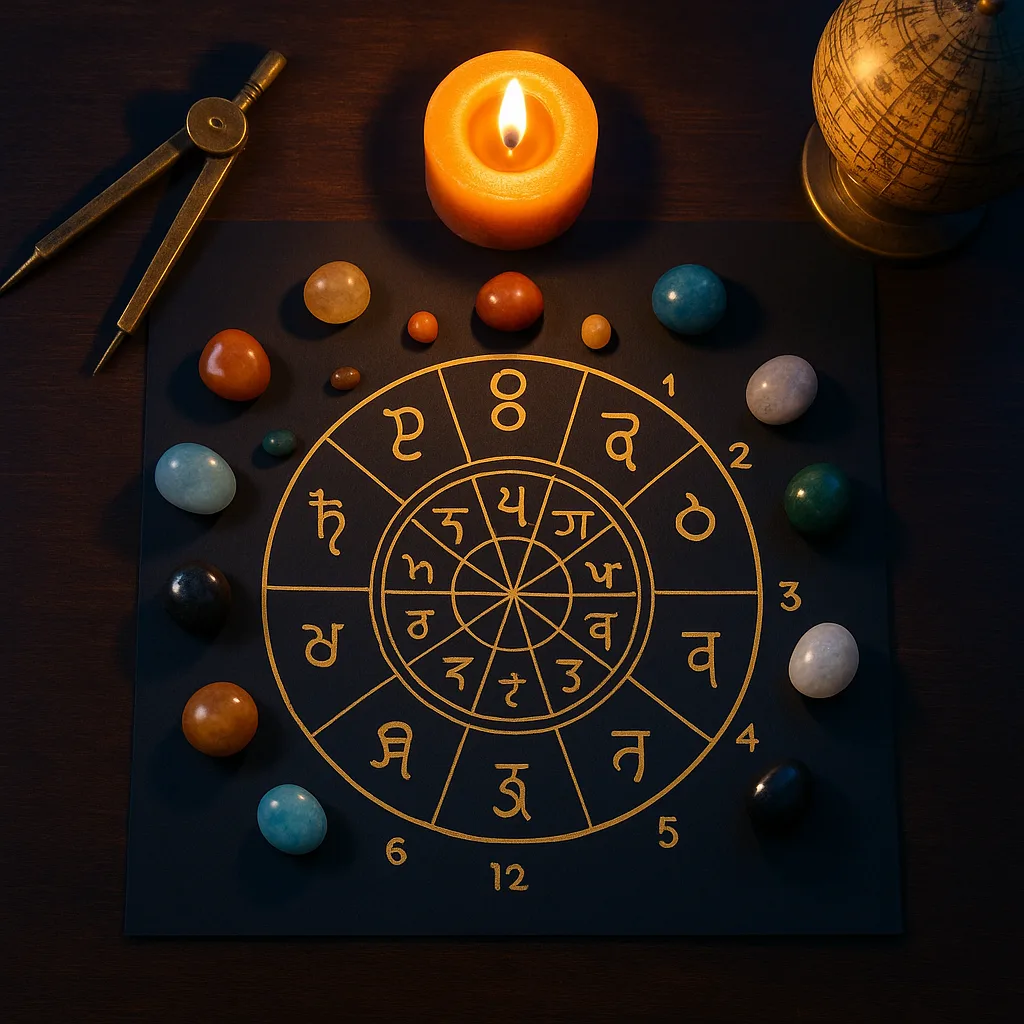
A Vedic astrologer and a Western astrologer can look at the same birth, at the same instant, in the same place, and describe two astrologically different people. Not because one of them got the math wrong, but because the two systems use different reference points to measure where each planet actually sits. In Jyotish, this set of celestial bodies has its own name: Navagraha, the nine grahas, the planetary foundation of every Vedic chart.
What the Navagraha are, and why there are only nine
Graha means something like "that which grasps" or "that which holds," referring to the idea that these bodies capture and distribute influences over whoever is born under their action. The set includes Surya (Sun), Chandra (Moon), Mangala (Mars), Budha (Mercury), Guru (Jupiter), Shukra (Venus), Shani (Saturn), and the two shadow points Rahu and Ketu, already covered in detail in our article on Ketu and Rahu in Vedic astrology.
Notice who's missing: Uranus, Neptune and Pluto don't make the list. That's not an oversight in the ancient texts, it's simple chronology. Uranus was discovered in 1781 by William Herschel, and Neptune in 1846 by Johann Galle, working from Le Verrier's calculations, as NASA notes in its planetary fact sheet (science.nasa.gov). The classical Jyotish texts were already settled centuries before these planets existed, as far as human knowledge was concerned. Traditional Jyotish, then, works with seven physical bodies visible to the naked eye plus the two lunar nodes, Rahu and Ketu, which mark where the Moon's orbit crosses the plane of the ecliptic.
The grahas also split by nature: Jupiter, Venus, a well-placed Mercury and the waxing Moon form the shubha grahas, the natural benefics; Mars, Saturn and the two nodes form the krura grahas, the natural malefics. This split isn't a moral judgment, it's functional, and it shapes much of how combinations in the chart are read, including the Rajayogas covered in another article on this site.
The root cause: sidereal zodiac versus tropical zodiac
Here's the point that explains why the "same" planets produce different readings: the problem was never the planet, it was the zero point used to measure its position in the sky.
Mainstream Western astrology uses the tropical zodiac, anchored to the seasons: 0° Aries marks the moment the Sun crosses the celestial equator heading into the northern hemisphere, the March equinox. That point tracks Earth's seasons, but it drifts slowly against the fixed stars because of the precession of the equinoxes. Vedic astrology uses the sidereal zodiac, anchored directly to the background constellations. Both systems divide the sky into twelve 30° signs, but they don't start counting from the same place.
This gap, called ayanamsa, grows by about 1 degree every 72 years due to precession. Using the Lahiri ayanamsa, the most widely adopted in Jyotish, the difference in 2026 sits around 24°10'. This detail is explored further in our article on ayanamsha explained; what matters here is the direct consequence for the grahas: a planet's sidereal position typically falls back a fair amount from its tropical position, sometimes enough to shift it into an entirely different sign.
The calculation is simple to follow:
- Take the planet's tropical position, in degree and sign. Example: Sun at 29° tropical Virgo.
- Subtract the current ayanamsa, roughly 24° in 2026.
- 29° minus 24° gives 5° sidereal Virgo: in this case the planet stays in the same sign, only the degree changes.
- In another example, a tropical Moon at 20° Cancer minus 24° of ayanamsa gives a negative result (-4°), meaning it falls back 4° before the boundary between Gemini and Cancer: the sidereal Moon lands at 26° Gemini, changing signs entirely.
That's why rulership, exaltation and house position for the same natal planet can diverge completely between a tropical chart and a sidereal one: the planet hasn't moved, the zero point on the ruler has.
Dignities: where each graha is strong, and where it stumbles
The Brihat Parashara Hora Shastra, the source text attributed to the sage Parashara, specifies exactly which sign and which degree marks each classical planet's peak exaltation and peak debilitation, always at points 180° apart.
| Graha | Rules (Swakshetra) | Exaltation (exact degree) | Debilitation (exact degree) |
|---|---|---|---|
| Surya (Sun) | Leo | Aries, 10° | Libra, 10° |
| Chandra (Moon) | Cancer | Taurus, 3° | Scorpio, 3° |
| Mangala (Mars) | Aries and Scorpio | Capricorn, 28° | Cancer, 28° |
| Budha (Mercury) | Gemini and Virgo | Virgo, 15° | Pisces, 15° |
| Guru (Jupiter) | Sagittarius and Pisces | Cancer, 5° | Capricorn, 5° |
| Shukra (Venus) | Taurus and Libra | Pisces, 27° | Virgo, 27° |
| Shani (Saturn) | Capricorn and Aquarius | Libra, 20° | Aries, 20° |
Rahu and Ketu follow a separate convention that varies by Jyotish lineage: in a common reading, Rahu is treated as exalted in Taurus and Ketu in Scorpio, without a fixed deep-exaltation degree like the seven planets above.
One technical point that shallower explanations tend to miss: a planet can be exalted anywhere within its exaltation sign, but it only reaches maximum strength at that one exact degree, called the deep exaltation point. Outside of it, the exaltation still applies, but only partially. This detail opens the door to the system that actually measures a graha's strength in the chart: Shadbala.
Shadbala: planetary strength measured in numbers
Shadbala means "six strengths." It's a calculation framework that adds up six distinct categories of a planet's strength and arrives at a single numerical value, measured in Virupas, where 60 Virupas equal 1 Rupa. There's no direct, equally detailed equivalent in Western astrology, which evaluates a planet's condition more qualitatively, through rulership, exaltation and aspects, without consolidating it into a score.
The six strengths that make up Shadbala are:
- Sthana Bala (positional): measures strength by zodiacal position, based on the angular distance to the exact exaltation or debilitation point. A planet at the exact degree of exaltation gets 60 Virupas on this component (Uchcha Bala); at the exact degree of debilitation, it gets 0.
- Dig Bala (directional): strength according to the house occupied. Sun and Mars gain full strength in the 10th house; Jupiter and Mercury, in the 1st; Moon and Venus, in the 4th; Saturn, in the 7th.
- Kala Bala (temporal): strength based on the time and day of birth. Planets of nocturnal nature, such as the Moon, Mars and Saturn, already carry a temporal advantage when birth happens at night.
- Chesta Bala (motional): tied to the planet's speed, including whether it's retrograde at the moment of birth.
- Naisargika Bala (natural): a fixed hierarchical strength intrinsic to each planet, independent of the specific chart.
- Drik Bala (aspectual): the balance between benefic and malefic aspects received from other planets; it's the only component that can come out negative.
Adding up all six gives the planet's total Shadbala. Parashara set minimum strength thresholds considered healthy: the Sun needs 390 Rupas, the Moon 360, Mars and Mercury 300, Jupiter and Venus 390, Saturn 300. Below that floor, the planet is considered Shadbala-weak, which can mean incomplete, delayed or distorted results even during that planet's Dasha, a topic already covered in our article on Dasha Mahadasha.
A numerical example helps visualize the Uchcha Bala calculation. The Sun is exalted at 10° Aries and debilitated at 10° Libra, points 180° apart. A Sun positioned 40° of angular distance from the exaltation point gets (180 - 40) divided by 3, which works out to roughly 46.67 Virupas on this component. The formula is linear: the closer to the exact exaltation degree, the closer to 60; the closer to the exact debilitation degree, the closer to zero.
Planetary friendships, and the chance of recovering from debilitation
Beyond exaltation and debilitation, the BPHS describes fixed relationships of natural friendship and enmity between the planets, called Naisargika Sambandha. This concept has no direct parallel in modern Western astrology either, which works more with circumstantial aspects than with permanent bonds between celestial bodies.
| Planet | Natural friends | Natural enemies |
|---|---|---|
| Sun | Moon, Mars, Jupiter | Venus, Saturn |
| Moon | Sun, Mercury | None |
| Mars | Sun, Moon, Jupiter | Mercury |
| Jupiter | Sun, Moon, Mars | Mercury, Venus |
These relationships help explain why a debilitated planet isn't always bad news. If the debilitated planet is in conjunction with the ruler of the sign it occupies, or receives an aspect from that ruler, it gains direct support that cushions the debilitation. There's also a more technical mechanism: if that same planet reaches exaltation in the Navamsha, the division of the chart into nine parts, it recovers at that subtler layer what it lost at the main layer. When these conditions combine, it forms what's called Neecha Bhanga Raja Yoga, one of the variants discussed in our article on Rajayoga in Vedic astrology.
Where this body of knowledge comes from: Parashara, Varahamihira, and a Greek borrowing
The Brihat Parashara Hora Shastra is attributed to the sage Parashara, but academic dating points to a composition much later than oral tradition suggests. Indologist J. Gonda places the oldest part of the text (the so-called purva-khanda) at some point after the year 600 CE, and notes that it owes a heavy debt to Varahamihira's Brihajjataka, as well as borrowing at least two verses from the Sphujidhvaja, also known as the Yavanajataka, literally "treatise of the Greeks." This detail is revealing: it shows that the classical Jyotish corpus, as it's come down to us, was in dialogue with Hellenistic astrology rather than forming in isolation from any outside influence.
The astrological glorification of celestial bodies, though, is far older than the BPHS. It already appears in the Vedic period, recorded in the Vedas, and the oldest known work of Indian astrology, the Vedanga Jyotisha, began to be compiled around the 14th century BCE. The classical planets, including Mercury, are already referenced in the Atharvaveda, around 1000 BCE. The term graha itself appears as early as the Baudhayana Dharmasutra, mentioning the full set of nine planets, including Rahu and Ketu.
Chesta Bala in practice: the example of retrograde Mercury
To see the motional component of Shadbala outside of theory, it helps to look at a concrete case coming up in 2026. Mercury turns retrograde three times this year: from February 26 to March 20 or 21, from June 29 to July 23 or 24, and from October 24 to November 13, all based on sidereal positions under the Lahiri ayanamsa. During these windows, the Chesta Bala of Mercury in the chart of someone born then is calculated differently than for a Mercury in direct motion, because the planet's apparent speed changes the score for this specific component within Shadbala. To confirm planetary retrograde dates precisely for any given year, the ephemeris calendar at timeanddate.com is a good resource, since it cross-references tropical positions and allows for later conversion to sidereal.
Frequently asked questions
What are the 9 planets of Vedic astrology?
They are Surya (Sun), Chandra (Moon), Mangala (Mars), Budha (Mercury), Guru (Jupiter), Shukra (Venus), Shani (Saturn), Rahu and Ketu. The first seven are observable physical bodies; Rahu and Ketu are mathematical points marking the nodes of the Moon's orbit.
Why is Mars exalted in Capricorn in Vedic astrology?
According to the Brihat Parashara Hora Shastra, Mars reaches deep exaltation at 28° Capricorn and deep debilitation at the exact opposite point, 28° Cancer. This is a traditional attribution from the classical text, not a rule derived from modern astronomical observation.
What is Shadbala, and how do I know if my planet is strong?
Shadbala is the sum of six distinct strengths (positional, directional, temporal, motional, natural and aspectual) that together indicate how well a planet can express its potential in a birth chart. Each planet has a recommended minimum threshold in Rupas; below it, the planet is considered weak even if it looks well placed in other respects.
What's the difference between the sidereal and tropical zodiac?
The tropical zodiac is anchored to the March equinox and tracks Earth's seasons; the sidereal zodiac is anchored to the fixed stars. Because of the precession of the equinoxes, the two drift apart by about 1 degree every 72 years, creating a difference of roughly 24° in 2026.
Why doesn't Vedic astrology use Uranus, Neptune and Pluto?
Because these three planets were discovered long after the classical Jyotish texts were already established: Uranus in 1781 and Neptune in 1846, according to NASA records. The Vedic system stayed with the original set of nine grahas visible to the naked eye plus the two lunar nodes.

Recomendado
MAPA ASTRAL E NUMEROLÓGICO PERSONALIZADO
Mapa Astral + Numerologia Um mergulho profundo na sua essência. E se tudo o que você procura… já estivesse dentro de você - esperando para ser revelado?
Universo Astral Editorial Team · Birth charts and numerology
This article was produced by the Universo Astral editorial team, with AI tools assisting research and drafting and human review before publication. If you spot anything inaccurate or outdated, let us know at our contact email.