Yoga in Vedic Astrology: The Planetary Combinations That Transform Every House
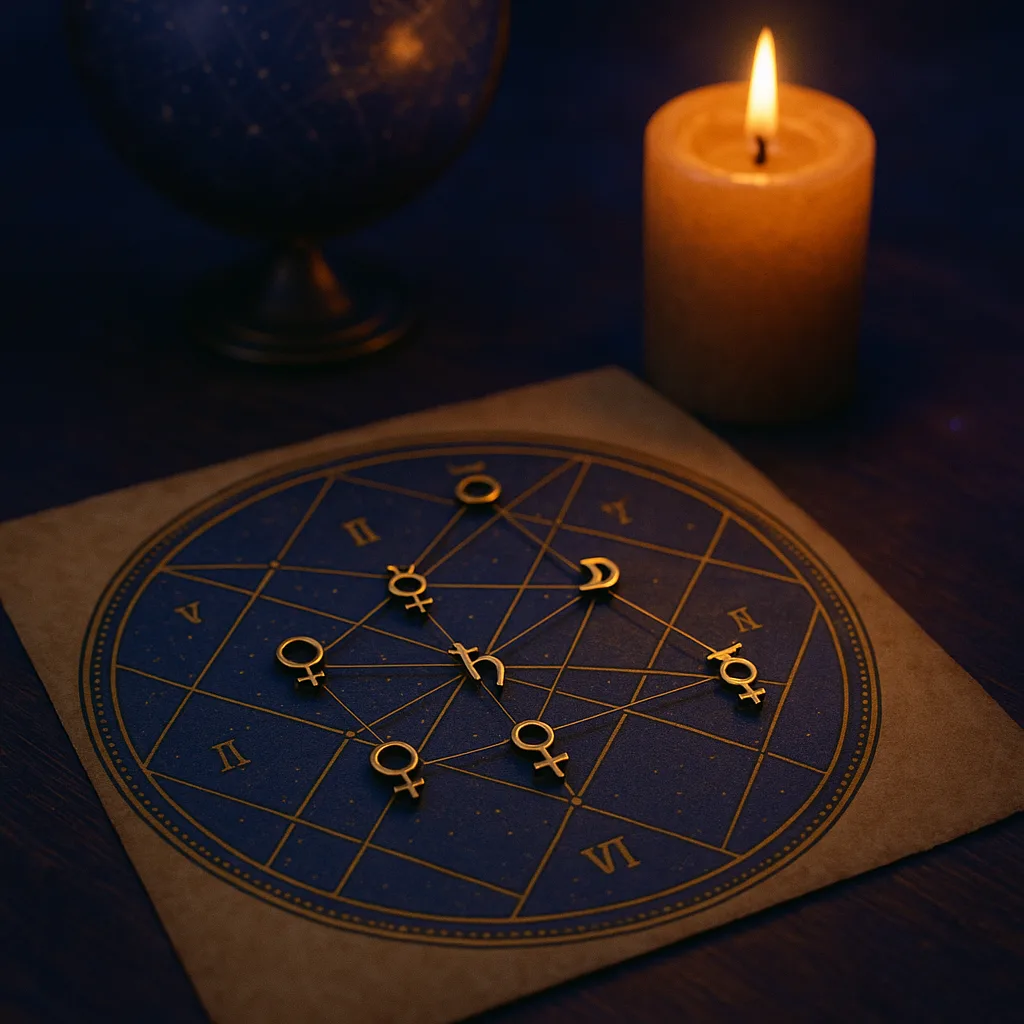
In Sanskrit, the word "yoga" comes from the root yuj, meaning to unite, to join, to link together. In Jyotish, it has nothing to do with a mat, a pose or breathing exercises: it refers to a specific combination between planets, signs and houses that produces a result different from the simple sum of its parts. It is one of the most poorly translated concepts of Vedic astrology for Western audiences, precisely because the English word sounds too familiar and misleads people.
Anyone who has already studied the nine grahas of Jyotish and the 12 houses (bhavas) separately usually runs into the same question: now how do these pieces actually talk to each other? That is exactly the gap the concept of yoga fills. If the grahas are the vocabulary and the bhavas are the settings, yoga is the grammar: the rule that determines how a planet shifts in meaning when combined with another, or when it occupies a certain position relative to the chart's most important houses.
What actually counts as a yoga
The Vedic tradition recognizes hundreds of named combinations, but all of them arise from a limited number of structural mechanisms. Understanding these mechanisms is more useful than memorizing a list of Sanskrit names, because they show up constantly when reading a chart.
- Yuti (conjunction): two or more planets occupying the same sign or house. This is the most common basis for a yoga to form, as in the conjunction between Jupiter and Rahu.
- Drishti (aspect): every planet "looks" toward the house opposite its own (the seventh from itself). Mars carries extra aspects onto the 4th and 8th houses from its position; Jupiter onto the 5th and 9th; Saturn onto the 3rd and 10th. A yoga can form through this kind of contact at a distance, without a direct conjunction.
- Parivartana (sign exchange): occurs when two planets swap positions, each sitting in the sign ruled by the other. Tradition classifies this exchange according to the type of houses involved: between rulers of kendra houses (1, 4, 7, 10) and trikona houses (1, 5, 9), it is called Maha Parivartana and considered the most favorable; when it involves the ruler of a dusthana (6, 8 or 12), it becomes Dainya Parivartana, read as weakening.
- Kendra-Trikona: houses 1, 4, 7 and 10 are the axes of action (kendras); houses 1, 5 and 9 are the axes of purpose and fortune (trikonas). A planet that simultaneously rules a kendra and a trikona for a given ascendant earns the title of Yogakaraka, a concept already covered in more depth in the article on Rajayoga.
- Neecha Bhanga (debilitation cancellation): a debilitated planet does not necessarily carry a fixed weakness. Under certain conditions, that weakness can be neutralized and even converted into potential for rising success, which is one of the most counterintuitive points of the system for anyone coming from Western chart reading.
Historical roots: where these rules come from
The Encyclopaedia Britannica entry on Jyotisha describes the system as a methodology resting on three combined pillars: nakshatras (lunar mansions), yogas (planetary combinations) and dashas (planetary periods). This confirms that yoga is not a decorative detail of Jyotish, but one of the system's three structural axes, alongside two topics Universo Astral has already covered in depth: the 27 nakshatras and the dasha system.
The same source notes that Jyotish arrived in India around the 2nd and 3rd centuries CE, when Indian astrologers adopted the Greek-influenced zodiac and integrated it with their own philosophical concepts, such as reincarnation and the doctrine of the five elements. It was during this period of synthesis that much of the classical literature on planetary combinations flourished.
One of the most cited names from this tradition is Varahamihira, an astronomer and mathematician from Ujjain who lived roughly between 505 and 587 CE. Britannica records that he wrote the Brihat Jataka and the Laghu Jataka, two treatises specifically on casting horoscopes, as well as the Pancha-siddhantika, a compendium drawing together Greek, Egyptian, Roman and Indian astronomical knowledge. Other works are commonly cited by the Vedic tradition as references on yogas, including the Brihat Parashara Hora Shastra, attributed to Parashara, and the Saravali, by Kalyanavarman, though the exact dating of these works is still debated academically, which calls for caution in treating these dates as settled fact.
Practical catalog: how to identify the most cited yogas
The list below does not exhaust the topic (Vedic literature catalogs hundreds of combinations), but it covers the yogas most frequently encountered in chart reading practice, organized by category.
Pancha Mahapurusha Yoga: when a planet becomes the "protagonist"
This group brings together five yogas formed when a specific planet (Mars, Mercury, Jupiter, Venus or Saturn) sits in its own sign or in its sign of exaltation, and that position falls in a kendra house (1, 4, 7 or 10) counted from the Lagna. The verification steps are always the same:
- Check whether the planet is in a sign it rules or in its sign of exaltation.
- Confirm whether that position falls in the 1st, 4th, 7th or 10th house from the ascendant.
- If both conditions are met at the same time, the named yoga forms.
| Planet | Yoga name | Signs involved | Traditional association |
|---|---|---|---|
| Mars | Ruchaka Yoga | Aries and Scorpio (own sign), Capricorn (exaltation) | Courage, leadership, force of action |
| Mercury | Bhadra Yoga | Gemini and Virgo (own sign and exaltation) | Quick thinking, verbal and business skill |
| Jupiter | Hamsa Yoga | Sagittarius and Pisces (own sign), Cancer (exaltation) | Wisdom, ethics, recognition |
| Venus | Malavya Yoga | Taurus and Libra (own sign), Pisces (exaltation) | Refinement, attraction, material prosperity |
| Saturn | Sasha Yoga | Capricorn and Aquarius (own sign), Libra (exaltation) | Discipline, authority earned through effort |
Gajakesari Yoga: the meeting of Moon and Jupiter
This forms when the Moon and Jupiter are in a kendra relationship to each other, meaning separated by 1, 4, 7 or 10 houses counted from the Moon itself, not from the Lagna. Tradition links this yoga to prestige, mental clarity and emotional stability, but its real strength depends on the dignity of both planets involved: a debilitated or combust Jupiter (too close to the Sun) weakens the result considerably, which explains why two people with "the same yoga" can experience it very differently.
Neecha Bhanga Raja Yoga: when the fall becomes an asset
This is perhaps the most elegant example of Jyotish's relational logic. A debilitated planet (in its fall sign) does not necessarily carry a permanent negative mark on the chart. If the ruler of the sign where that planet is debilitated is positioned in a kendra from the Moon or the Lagna, the debilitation cancels out, and the planet may even gain Rajayoga potential. Another classical rule accepts the cancellation when the debilitated planet itself sits in a kendra from the Moon. The core idea is that Vedic astrology does not treat weakness as a sentence: it can be reorganized by other layers of the chart.
Vipareeta Raja Yoga: when bad neutralizes bad
Formed when the rulers of the houses of difficulty (6th, 8th and 12th, called dusthanas) are positioned in each other's houses. It has three named variants: Harsha (ruler of the 6th in the 8th or 12th), Sarala (ruler of the 8th in the 6th or 12th) and Vimala (ruler of the 12th in the 6th or 8th). The traditional symbolic reading is one of a reversal: a configuration that promised hardship ends up producing unexpected gain, as if two obstacles canceled each other out.
Kemadruma, Chandra-Mangala and Shakata: the yogas built around the Moon
The Moon plays a leading role in several yogas because it is the most commonly used reference point in Jyotish for alternative house counts. Kemadruma Yoga forms when the Moon has no planet in the houses immediately before and after it and is also not in conjunction with anyone, a condition traditionally linked to emotional and financial instability, but canceled if the Moon is in a kendra from the Lagna or receives an aspect from benefic planets. Chandra-Mangala Yoga arises from the conjunction between Moon and Mars, associated with entrepreneurial drive and the ability to generate resources through one's own initiative, with the counterpoint of greater emotional volatility. Shakata Yoga occurs when the Moon sits in the 6th or 8th house counted from Jupiter, and is read as an indicator of fluctuations of fortune over the course of life.
Why no yoga should be read in isolation
A common mistake among those starting to study Jyotish is treating the presence of a yoga as a closed verdict: "I have Gajakesari, so I will have prestige" or "I have Kemadruma, so I will have instability." Traditional literature does not work that way. Every yoga listed above has conditions for cancellation, reinforcement or nuance described within the tradition itself, which shows that Vedic astrologers always weighed multiple simultaneous layers before confirming that a yoga is actually "active" in someone's chart.
That includes at least four additional factors: the dignity of the planets involved (exalted, debilitated, combust), the aspects they receive from other planets, the house where the yoga manifests, and finally, whether the planetary period (dasha) running at a given moment in the person's life favors the activation of that potential or not. A yoga that looks powerful on paper can remain quiet if the dasha of the planet involved never comes to rule, or it can manifest at full strength precisely when the right planetary cycle begins.
It is also worth noting that yogas are calculated from the natal chart, fixed since birth, not from the day's transits. This sets them apart from phenomena like retrogrades or full moons, which change month to month. Even so, tradition recognizes that a transit can symbolically "reactivate" a natal yoga: when Jupiter transits over the position of a natal Gajakesari, for example, it is usually read as a period of temporary reinforcement of that potential already present in the chart.
Frequently Asked Questions
What is a yoga in Vedic astrology?
It is a specific combination between planets, signs and houses that generates its own meaning, different from what each element would represent alone. The term comes from the Sanskrit root meaning to unite or combine, and has no relation to the physical practice of yoga known in the West.
What are the main yogas in a Vedic birth chart?
Among the most cited are the five Pancha Mahapurusha Yogas (linked to Mars, Mercury, Jupiter, Venus and Saturn in positions of strength), Gajakesari Yoga (Moon and Jupiter), Neecha Bhanga Raja Yoga (debilitation cancellation) and Vipareeta Raja Yoga (reversal arising from the houses of difficulty). Each has its own rules for formation and cancellation.
How do I know if I have Gajakesari Yoga?
You need to check, in a natal chart calculated with the sidereal Vedic system, whether the Moon and Jupiter are separated by a kendra distance from each other (1, 4, 7 or 10 houses, counted from the Moon itself). This requires a calculated chart, not just your sun sign, and ideally consultation with an astrologer familiar with Jyotish to also assess the dignity of both planets involved.
Neecha Bhanga Raja Yoga: what does it mean in practice?
It means that a planet technically debilitated in the chart has had that weakness canceled by another condition, usually involving the position of that sign's ruler relative to the Moon or the Lagna. In traditional reading, this often indicates that an area of life associated with that planet, which seemed fragile, carries potential for strengthening over time.
Pancha Mahapurusha Yoga: how do I spot it in a chart?
Simply check whether Mars, Mercury, Jupiter, Venus or Saturn sits in its own sign or in its sign of exaltation, and whether that position falls in one of the four kendra houses (1st, 4th, 7th or 10th) from the ascendant. When both conditions line up for the same planet, the corresponding named yoga forms, as listed in the table in this article.

Recomendado
MAPA ASTRAL E NUMEROLÓGICO PERSONALIZADO
Mapa Astral + Numerologia Um mergulho profundo na sua essência. E se tudo o que você procura… já estivesse dentro de você - esperando para ser revelado?
Universo Astral Editorial Team · Birth charts and numerology
This article was produced by the Universo Astral editorial team, with AI tools assisting research and drafting and human review before publication. If you spot anything inaccurate or outdated, let us know at our contact email.