Birth Time in Vedic Astrology: Why Minutes Matter More Than in Western Astrology
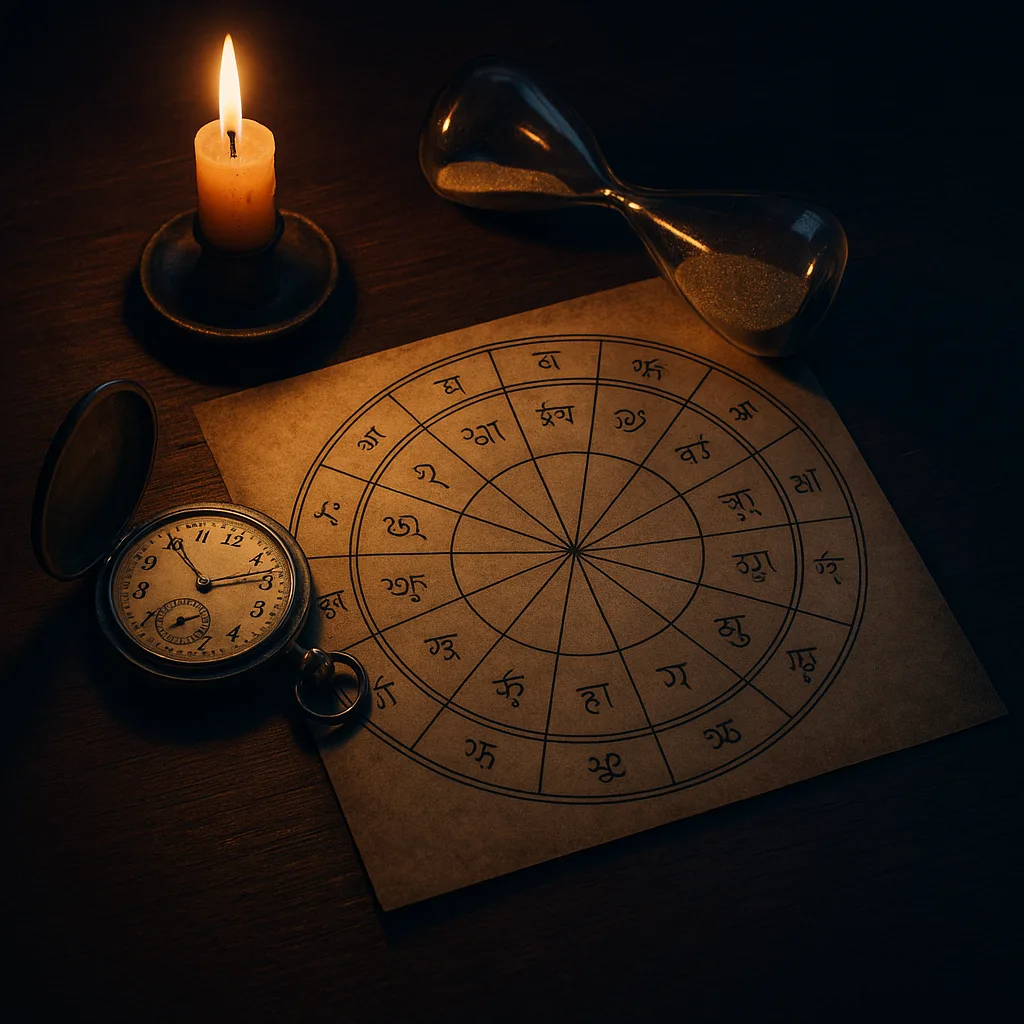
A baby is born at 8:07 am, but the birth certificate records 8:15 am. Eight minutes seems irrelevant for almost any document, but in Jyotish that gap can be enough to switch the Ascendant's sign, rearrange all twelve houses, and push decades of dashas forward or backward. This extreme sensitivity to the minute is one of the traits that sets Vedic astrology apart from Western astrology, and understanding why it happens helps decide what to do when a birth certificate isn't as precise as it should be.
The math behind the problem: how long the sky takes to turn one degree
The Earth completes one rotation relative to the fixed stars (known as a sidereal day) in approximately 23 hours, 56 minutes and 4 seconds. That gives an angular speed of roughly 15 degrees per hour, meaning 1 degree of sky rises on the horizon roughly every 4 minutes of clock time. Since each sign spans 30 degrees of the zodiac, the eastern horizon takes about two hours to cross an entire sign.
It's this figure, 1 degree every 4 minutes, that explains why the Ascendant (called the Lagna in Jyotish) is the most unstable variable on the chart. While the Sun changes sign once a month, the Lagna changes sign every two hours, and within the sign, its exact degree shifts every few minutes. The sidereal time page on timeanddate.com breaks down this calculation of Earth's rotation relative to the stars, the same astronomical basis used by both Western and Vedic astrologers to place the Ascendant at the exact moment of birth.
This was already covered in detail in the article on how to interpret the Lagna in the Vedic chart, but it's worth repeating the key point here: if the birth time is off by half an hour or more, there's a real chance the Lagna's degree falls into a different sign, and in that case house 1 changes rulership and all eleven other houses get recounted from a different starting point.
Why the West feels this problem less (but isn't immune to it)
Modern Western astrology, especially when using the Placidus house system (the most common one in birth chart software and apps), is also sensitive to birth time. Placidus divides the sky based on how long each degree of the ecliptic takes to rise from the horizon to the Midheaven, and an error of minutes can shift house cusps enough to move a planet into a different house.
The difference is that a good part of Western practice has a more forgiving alternative: the Equal House system, which takes the Ascendant's degree and divides the sky into twelve identical 30-degree slices from there. That reduces part of the problem, but doesn't eliminate the dependence on the Ascendant itself.
In Jyotish, the most traditional house system is whole sign: each house corresponds to a complete sign, counted from the Lagna's sign. At first glance this seems less sensitive, since the house only changes when the sign changes, which takes about two hours. The catch is that minute-level precision still matters decisively through two other channels that Western practice doesn't use in the same way: the Lagna's exact degree within its sign, used to assess planetary strength and yogas, and, above all, the calculation of the dasha sequence, which depends on the Moon's exact degree at the moment of birth.
The mechanism with no Western equivalent: the Moon's degree and the Vimshottari Dasha
This is the point that most sets Jyotish apart from any Western practice of life timing. The most widely used system for forecasting life's major cycles in Jyotish is the Vimshottari Dasha, a 120-year roadmap divided among nine ruling planets, described in detail in the article on how to calculate the Mahadasha. The whole calculation starts from the Moon's position within the nakshatra it occupied at the moment of birth, a system explained more thoroughly in the piece on the 27 nakshatras of the lunar zodiac.
The 27 nakshatras divide the zodiac's 360 degrees into equal slices of 13 degrees and 20 minutes each (800 arc-minutes per nakshatra). Classical tradition, recorded in the text known as the Brihat Parashara Hora Shastra, assigns each nakshatra a ruling planet, in a fixed, repeating sequence: Ketu, Venus, Sun, Moon, Mars, Rahu, Jupiter, Saturn and Mercury. Each of these planets rules a fixed number of years within the 120-year cycle: Ketu 7, Venus 20, Sun 6, Moon 10, Mars 7, Rahu 18, Jupiter 16, Saturn 19, Mercury 17.
The detail that makes the birth minute matter so much is that a person's first Mahadasha doesn't start from zero. It starts with a balance proportional to how far the Moon had already traveled within that nakshatra at the moment of birth. The more precise the Moon's position, the more exact that balance.
A worked numerical example
Imagine someone born with the Moon positioned at 43 degrees and 20 minutes in the sidereal zodiac. That degree falls within the fourth nakshatra, called Rohini, which runs from 40° to 53°20′ and is ruled by the Moon (10 years of Mahadasha).
- Calculate how much of the nakshatra has already been covered: 43°20′ minus 40° equals 3°20′ already traveled.
- Divide that value by the nakshatra's total span: 3°20′ divided by 13°20′ equals 25% already elapsed.
- The remaining balance is therefore 75% of that ruler's cycle.
- Apply that percentage to the ruling planet's total years: 75% of 10 years (the Moon's Mahadasha) equals 7 and a half years.
- That's the time left in the person's first Mahadasha, counted from birth, before the next cycle (Mars, in the fixed sequence) begins.
If the birth time is wrong, the Moon's exact degree recorded on the chart will be wrong too, since the Moon moves continuously across the sky, roughly 13 to 14 degrees per day. An error of minutes in the birth time slightly shifts that degree and, as a result, shifts the calculated balance, which can move dasha transition dates by days or weeks, according to practitioner literature (a recurring observation among Vedic astrologers, not a standardized scientific measurement).
The KP system and the extreme precision threshold practitioners cite
There's a branch of Jyotish created in the 20th century by Indian astrologer K.S. Krishnamurti, called Krishnamurti Paddhati (KP), that pushes the demand for precision even further. In this system, each house cusp receives a sub-lord within 249 subdivisions of the zodiac, calculated by combining nakshatras with proportions from the Vimshottari Dasha itself. According to teaching material used in KP courses, the Lagna's degree would need to be accurate within a range of just 3 to 9 arc-minutes for the correct sub-lord to be identified, a margin far narrower than what's usually achievable from family recollection of birth time alone.
This is precisely why KP is often used as a time rectification tool: by comparing life events that have already happened (marriage, a job change, a surgery) against the planetary periods active at different possible birth times, the astrologer tries to find the exact minute that makes those events line up with the chart. This kind of fine-tuning is a practitioner's technical tool, not scientific proof, and should be understood as such.
House systems side by side: what each one tolerates
| System | Tradition | Sensitivity to minutes | What changes with a timing error |
|---|---|---|---|
| Placidus | Modern Western astrology | High | House cusps shift, planets may change houses |
| Equal House | Alternative Western astrology | Moderate | Only the Ascendant's degree changes; the twelve divisions stay proportional |
| Whole sign | Classical Jyotish | Moderate for houses, high for the Lagna and dashas | The house only changes if the Lagna's sign changes, but the exact degree affects yogas and the Mahadasha balance |
| Krishnamurti Paddhati (KP) | 20th-century Jyotish | Extreme | Cuspal sub-lords can change with differences of just a few minutes |
What to do when there's no exact birth time
Home births, late civil registrations and approximate family recollections are common realities, especially among older generations. Jyotish literature doesn't treat this as an unsolvable dead end: there's a practice called birth time rectification, which combines ancient and modern methods to estimate the most likely time.
- Classical methods attributed to historical astrologers such as Parashara, Varahamihira and Kalidasa, which use specific rules of planetary combination.
- Nakshatra Shuddhi and regional traditions like Kerala Jyotish, which compare physical traits and personality against indicators of the lunar nakshatra.
- Rectification based on life events that have already occurred, cross-checking marriage dates, major life changes or health issues against the dasha periods calculated for different possible birth times.
- Rectification using the Krishnamurti Paddhati method, applying the technique of ruling planets at the moment of consultation to test which birth time is consistent with the life actually lived.
In practice, an astrologer working on rectification asks the client for a list of notable dates and tests different times within the possible window (generally based on what the family remembers, even if only approximately) until finding the one that best explains the events already lived. This doesn't replace an accurate record, but it narrows the margin of error when one doesn't exist.
It's also worth remembering that the Lagna organizes the reading of yogas, the planetary combinations that strengthen or weaken areas of life, a topic covered in the article on yogas in Vedic astrology. A poorly calculated Lagna compromises that entire reading, not just the layout of the houses.
Frequently Asked Questions
How many minutes of difference is enough to change a Vedic chart?
There's no fixed universal number, because it depends on how close the birth moment is to a sign change in the Lagna. Generally, errors beyond a few minutes can already alter the Ascendant's exact degree, and errors of half an hour or more raise the chance that the Lagna's sign changes entirely.
If I don't know my birth time, can I still have a Vedic chart made?
An approximate chart can be built, but the Lagna and the dashas will be imprecise. Astrologers who work with Jyotish recommend pursuing a rectification process, comparing life events already lived against different possible birth times, rather than assuming any time without verification.
Why does birth time matter more in Jyotish than in common Western astrology?
Because beyond the Ascendant (which is also sensitive in the West when using the Placidus system), Jyotish ties the dasha sequence calculation to the Moon's exact degree at birth. This life-timing mechanism has no direct equivalent in the most common Western practice, which is why a few minutes of imprecision affects two layers of the chart at once, not just one.
Is the time recorded on a birth certificate reliable for building a Vedic chart?
Not always. In many cases the recorded time is that of the administrative registration rather than the exact moment of birth, especially with home births or records made hours later. So whenever possible, it's worth confirming the time with someone who was present at the birth, or considering a rectification process.

Recomendado
MAPA ASTRAL E NUMEROLÓGICO PERSONALIZADO
Mapa Astral + Numerologia Um mergulho profundo na sua essência. E se tudo o que você procura… já estivesse dentro de você - esperando para ser revelado?
Universo Astral Editorial Team · Birth charts and numerology
This article was produced by the Universo Astral editorial team, with AI tools assisting research and drafting and human review before publication. If you spot anything inaccurate or outdated, let us know at our contact email.