Why Your Sign Changes in Vedic Astrology: Ayanamsha Explained
The question that comes up the moment someone discovers Jyotish
Someone who has always identified as a Scorpio calculates their chart using Vedic astrology and discovers the Sun was actually in Libra. There's no calculation error and no date confusion. The two systems simply measure the sky from different starting points. This is the most-asked and most poorly explained difference between Jyotish and Western astrology, and it has a technical name: ayanamsha.
The tropical zodiac, used in the West
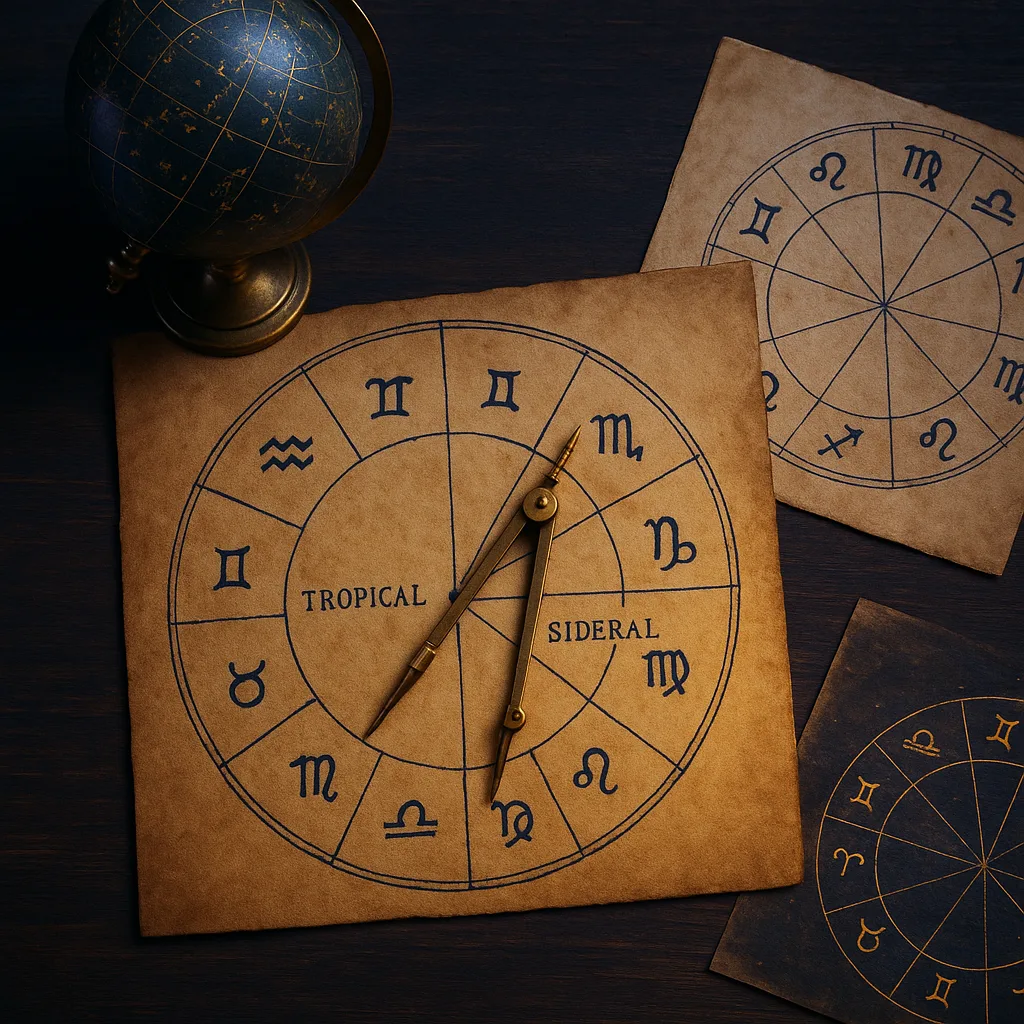
Western astrology works with what's called the tropical zodiac. In this system, the zero point of Aries isn't fixed to any star. It's fixed to the spring equinox, the moment the Sun, as seen from Earth, crosses the celestial equator. It's a system built around the relationship between Earth and Sun, tied to the rhythm of the seasons. That makes sense given the tradition it came from: ancient Greece, drawing on Babylonian and Egyptian sources. The tropical zodiac grew out of climate, agriculture, and the solar cycle as felt in the body and the landscape.
The sidereal zodiac, used in Jyotish
Vedic astrology starts from a different reference point. It uses the sidereal zodiac, which is anchored to the actual position of the constellations in the sky. While the tropical zodiac doesn't concern itself with where the fixed stars really are, the sidereal system is built specifically to track them. The catch is that Earth doesn't stay still relative to those stars over the centuries. It slowly wobbles on its axis, a phenomenon called the precession of the equinoxes. That extremely slow wobble means the equinox point (used by the tropical system) drifts, year after year, away from the position of the actual constellations (used by the sidereal system). Many centuries ago, tropical and sidereal nearly lined up. Today, they no longer do.
That accumulated drift is what explains the sign switch so many people find strange when they first encounter Jyotish. Vedic astrology isn't getting the Sun's position wrong, and Western astrology isn't out of date. They're two different rulers measuring the same sky, each faithful to its own internal logic.
Ayanamsha: the name for this gap, measured in degrees
The exact size of the offset between the two zodiacs is called the ayanamsha. Right now that offset sits at around 24 degrees, and it isn't fixed: it keeps growing slowly and continuously, year by year, because of the very precession that created it. That's why, in many cases, a planet sitting near the start of a sign in the tropical system ends up falling in the previous sign once it's recalculated sidereally. Someone's Sun at 2° Scorpio on a Western chart, for instance, might land around 8° or 9° Libra on that same person's Vedic chart, depending on their birth date.
Which ayanamsha to use: Lahiri and other schools
Since calculating this offset precisely isn't straightforward, Jyotish itself contains several competing proposals for the ayanamsha. The most widely adopted worldwide is the Lahiri ayanamsha, also called Chitrapaksha, which fixes the star Spica (known as Chitra) at exactly 0° Libra. This system was officially adopted by the Indian government in 1955 through the Calendar Reform Committee, and it has since become the reference point for most Vedic astrologers and most calculation software used around the world.
It isn't the only option, though. Schools like B. V. Raman's or the Krishnamurti system (known as KP) use slightly different starting points to calculate the same offset, which creates small degree variations from one piece of software to another, even when both call themselves Vedic. Anyone just starting to study Jyotish should check which ayanamsha their calculation program is using before comparing planetary positions across different sources. A difference of half a degree, near the border between two signs, can change the entire reading of a house or an aspect.
A second layer of difference: how houses are divided
Ayanamsha settles the question of which sign a planet falls in, but there's another structural difference between the two systems that gets far less attention outside the circle of serious Jyotish students: how houses are divided. Modern Western astrology typically uses quadrant systems, such as Placidus or Koch, which slice the sky into unequal segments based on birth latitude. Traditional Jyotish, following the classical text Brihat Parashara Hora Shastra, prefers the whole sign method instead: each house corresponds to one complete sign, counted from the ascendant. If the ascendant falls in Taurus, the entire sign of Taurus becomes the first house, Gemini becomes the second, and so on, with no uneven subdivisions. It's a simpler system on paper, but it produces house readings quite different from what a Western astrologer used to Placidus would find in the very same birth chart.
Two traditions that started close together and drifted apart
It's worth noting that these differences didn't emerge from traditions isolated from one another. Historians of astrology point to Greek and Babylonian influences circulating through ancient India as well, so tropical and sidereal astrology share a common ancestry that goes back further than most people assume. Jyotish itself went through distinct phases. The oldest known text, the Vedanga Jyotisha, dates to roughly the 12th century BCE and dealt mainly with calendars and astronomy. The form we now recognize as Vedic astrology proper, with houses, dashas, and destiny interpretation, only took shape in the first millennium CE, through works like Varahamihira's Brihat Jataka and the Brihat Parashara Hora Shastra attributed to the sage Parashara.
Knowing this helps explain why comparing Jyotish and Western astrology isn't a matter of right versus wrong. They're two measurement conventions that developed for different purposes: one tracking the rhythm of the seasons, the other tracking the actual position of the stars. Anyone who calculates both charts for their own birth date isn't getting contradictory answers. They're looking at the same sky through two lenses built centuries apart.

Recomendado
MAPA ASTRAL E NUMEROLÓGICO PERSONALIZADO
Mapa Astral + Numerologia Um mergulho profundo na sua essência. E se tudo o que você procura… já estivesse dentro de você - esperando para ser revelado?
Recomendado
Astro Reflexo
Descubra o que os astros revelam sobre quem você é. Em menos de um minuto, calculamos seu Sol, Lua e Ascendente com precisão astronômica e uma inteligência artificial escreve um resumo personalizado só para você.

Recomendado
Curso MAPA ASTRAL
CURSO DESTRAVE SUA VIDA COM MAPA ASTRAL EM ATÉ 08 SEMANAS!
Universo Astral Editorial Team · Zodiac signs and fun facts
This article was produced by the Universo Astral editorial team, with AI tools assisting research and drafting and human review before publication. If you spot anything inaccurate or outdated, let us know at our contact email.