Rajayoga: How to Spot the Planetary Combinations for Success in Your Vedic Chart
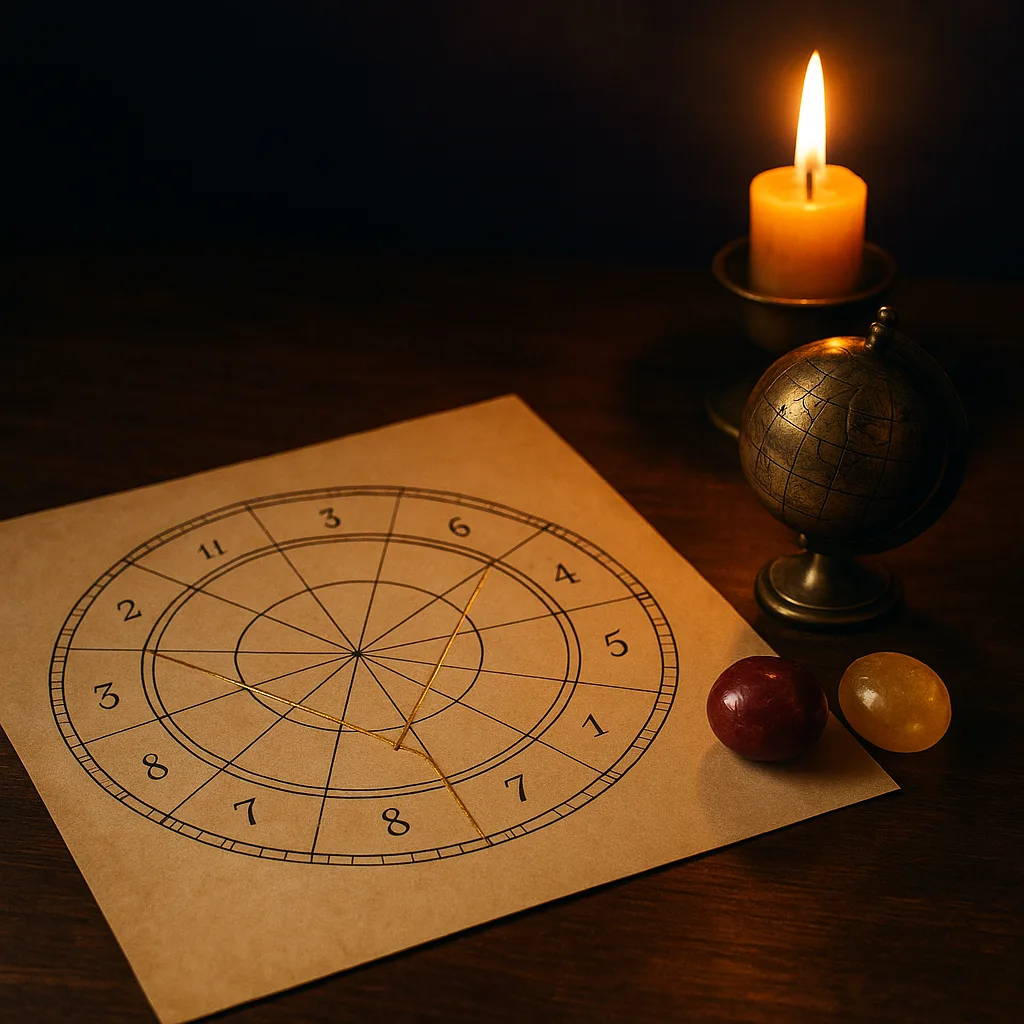
In Jyotish literature, there is a category of planetary combination reserved for describing power, status and material rise: the Rajayoga. The name itself gives away the intent: raja means king, yoga means union. Together, they point to a connection between planets that, in the Vedic tradition, is read as a sign that a person may reach a position of prominence, public recognition or authority in some area of life.
But identifying a Rajayoga does not require guesswork or secret formulas. There is a clear structural logic behind the concept, described for centuries in texts such as the Brihat Parashara Hora Shastra. This article shows how to locate that logic in your own chart, without getting into dasha calculations (which we already covered in detail in our piece on antardasha and planetary sub-periods).
The mechanism behind Rajayoga: kendra meets trikona
Jyotish organizes the chart's 12 houses into groups with distinct functions. Two of these categories are central to understanding the classical Rajayoga:
- Kendra houses (angular): 1st, 4th, 7th and 10th. They represent concrete action, personal effort and the visible results of that effort in the material world.
- Trikona houses (trine): 1st, 5th and 9th. They represent dharma, purpose, luck and what the tradition calls poorva punya, the accumulated merit from past lives.
Notice that the 1st house, the Ascendant, appears on both lists. This is no coincidence: it functions as the connecting axis between the two categories, which is why it is usually the first point checked in any Rajayoga analysis. In total, six houses take part in this logic: 1, 4, 5, 7, 9 and 10.
The core rule is simple to state: when the lord of a kendra house connects with the lord of a trikona house, a Kendra-Trikona Raja Yoga is formed. The word connect here carries three different technical meanings, and that is exactly what readers need to learn to recognize in their own chart.
The three types of connection that define Rajayoga
There isn't just one way for two planets to unite. Jyotish describes three possible mechanisms, each with its own name:
- Conjunction (Yuti): the two planetary lords occupy the same house in the chart. One example cited in classical literature is Mars, as lord of the 5th house, and Jupiter, as lord of the 9th house, meeting together in the 10th house: in this case, two trikona and kendra lords physically meet in the same spot of the chart.
- Mutual aspect (Sambandha): the lords are not in the same house, but they look at each other from a distance, usually by being positioned seven houses apart (the opposition aspect in Jyotish). One example: the lord of the 1st is in the 4th house and the lord of the 9th is in the 10th house, and the two positions aspect each other mutually.
- Sign exchange (Parivartana): the lord of the kendra house occupies the sign ruled by the lord of the trikona house, and vice versa. This is considered by the tradition the most stable and lasting of the three forms, because it creates a kind of exchange of residence between the two planets.
To locate this in your own chart, without needing dasha calculations, the path is: first, identify the Ascendant and number the 12 houses starting from it; second, check which signs occupy the 1st, 4th, 5th, 7th, 9th and 10th houses and who rules those signs; third, check whether any of those rulers are in conjunction, mutual aspect or sign exchange with another ruler from the same list.
Rajayoga variants: not all of them follow the same recipe
The term Rajayoga does not describe a single pattern, but a family of combinations, each with its own mechanism. The table below summarizes the main ones, including two that work through an almost opposite path from the classical one: turning a planetary weakness into strength.
| Yoga Name | Mechanism | Houses or planets involved | Effect described in tradition |
|---|---|---|---|
| Kendra-Trikona Raja Yoga | Conjunction, mutual aspect or exchange between kendra and trikona lords | Houses 1, 4, 7, 10 with 1, 5, 9 | Power, prosperity and recognition; the most cited among Vedic astrologers |
| Dharma-Karmadhipati Yoga | Connection between the lord of the 9th house (dharma) and the lord of the 10th (career) | Houses 9 and 10 | Considered one of the strongest Rajayogas, linked to professional success tied to purpose |
| Gaja Kesari Yoga | Jupiter in a kendra house from the Moon or the Ascendant, free of debilitation or combustion | Kendras (1, 4, 7, 10) counted from the Moon or the Lagna | Wealth, intelligence, fame and support from authority figures |
| Neechabhanga Rajayoga | Cancellation of a debilitated planet's weakness, followed by strong activation | Debilitated planet and its ruler or exaltation ruler | An apparent weakness converts into strength, producing standout results |
| Vipareeta (Viparita) Rajayoga | Lords of houses 6, 8 and 12 exchanging positions with each other | Houses 6, 8 and 12 | Success after a turnaround; initial difficulties converted into unexpected gain |
It's worth noting that Neechabhanga and Vipareeta operate through a reversal path, not through the direct combination of strong planets. This structurally sets them apart from the classical Kendra-Trikona, even though they share the Rajayoga name.
Why planetary strength changes everything
Identifying the structural combination is only half the work. The Jyotish tradition insists that the dignity of the planets involved determines whether the Rajayoga will manifest with intensity or remain practically dormant. One of the most used criteria to assess this strength is how close the planet is to its exact degree of exaltation, the point where its energy is considered most potent:
| Planet | Exaltation degree |
|---|---|
| Sun | 10° Aries |
| Moon | 3° Taurus |
| Mars | 28° Capricorn |
| Mercury | 15° Virgo |
| Jupiter | 5° Cancer |
| Venus | 27° Pisces |
| Saturn | 20° Libra |
The closer a planet sits to that exact degree, the stronger it is considered within the classical reading. A Rajayoga formed by debilitated planets, combust ones (very close to the Sun) or planets afflicted by malefic aspects tends to produce weaker results than the same combination formed by exalted planets or planets in their own sign.
There is also another layer, outside the scope of this article but worth mentioning: even a structurally strong Rajayoga can remain dormant until it is activated by a specific planetary period, which in Jyotish is calculated through the dasha system. As an illustrative transit, it's worth noting that Jupiter, a central planet in several Rajayogas since it rules dharma and fortune, changes signs several times throughout 2026: it starts the year in Gemini, turns direct on March 11, enters Cancer (its sign of exaltation) on June 2, and moves into Leo on October 31, according to planetary position data that can be checked on ephemeris aggregators such as in-the-sky.org. This kind of transit is usually observed by tradition as a possible activation trigger, not as the mechanism that creates the Rajayoga itself.
Where this concept comes from: the classical texts behind Rajayoga
The chapter dedicated to Raja Yoga appears in its most systematized form in the Brihat Parashara Hora Shastra, traditionally attributed to the sage Parashara. According to the preface of the English translation by R. Santhanam in 1984, Parashara belonged to the lineage of Vasishta and is said to have been the father of Veda Vyasa, with Saunaka as his preceptor in astrology. The exact dating of the text is debated among scholars, but there is evidence that a version of it was already circulating before authors such as Varahamihira, who cites it in his Brihat Samhita, and Kalyana Varma, who makes a similar reference in his Saravali.
Two other texts complete the classical body of work on the subject: the Phaladeepika, by Mantreswara, a treatise of 865 verses spread across 28 chapters whose dating ranges between the 13th and 16th centuries depending on the source consulted, and the Jataka Parijata, by Vaidyanatha Dikshita. This imprecision in dating is common in ancient Indian texts, passed down through generations by manuscript and oral tradition before being fixed in printed editions. A historical, public-domain translation of the Phaladeepika is available in the archive at archive.org.
It's worth remembering that Jyotish itself, as a system, arrived in India around the 2nd and 3rd centuries CE, absorbing the zodiac of Hellenistic origin and integrating it with its own philosophical concepts, such as reincarnation. Additional elements of Persian and Hellenistic origin, such as the so-called lots and triplicities, were only added to the Indian tradition much later, in the 13th century, through the Tājika texts.
What a Rajayoga does not guarantee
A common mistake is treating the presence of a Rajayoga as an automatic synonym for wealth or fame. The tradition doesn't work that way. The structural combination (the conjunction, the aspect, or the sign exchange) is a necessary condition, but not a sufficient one. It needs to be read together with the dignity of the planets involved, the presence or absence of malefic aspects, and the timing of when the corresponding planetary period becomes active. That's why two people can technically have the same Rajayoga in their chart and live through experiences of very different intensity over the course of their lives.
This same logic of combined reading appears in other tools of the Vedic chart, such as the 27 lunar constellations that organize much of Jyotish interpretation. Readers who want to go deeper into this layer can check the article on nakshatras and their role in Vedic astrology, since the nakshatra where a ruling planet is positioned also affects the strength of a Rajayoga.
Frequently asked questions
What is Rajayoga in Vedic astrology?
Rajayoga is the name given to a group of planetary combinations in Jyotish associated with power, social status and material success. The most commonly cited form happens when the lord of a kendra house (1, 4, 7 or 10) connects with the lord of a trikona house (1, 5 or 9), whether through conjunction, mutual aspect or sign exchange.
How do I know if I have a Rajayoga in my birth chart?
You need to identify the Ascendant, number the 12 houses starting from it, and find out who rules houses 1, 4, 5, 7, 9 and 10 based on the signs occupying those positions. Then, check whether any of those rulers share a house with another, aspect each other mutually from seven houses apart, or have exchanged signs with one another.
What's the difference between Kendra-Trikona Raja Yoga and Vipareeta Rajayoga?
Kendra-Trikona Raja Yoga forms through the connection between lords of angular and trine houses, associated with effort and merit. Vipareeta Rajayoga, on the other hand, arises from an almost opposite mechanism: lords of houses 6, 8 and 12, linked to hardship, exchanging positions with each other, which the tradition reads as a turnaround where initial problems end up producing unexpected gain.
Does having a Rajayoga guarantee success in life?
No. The tradition indicates that the structural presence of a Rajayoga is only part of the reading: its real strength depends on the dignity of the planets involved (whether they are exalted, debilitated or combust), any malefic aspects that might weaken them, and the timing of when the corresponding planetary period becomes active over the course of life.
What's the difference between Rajayoga and Dhana Yoga?
Rajayoga is more associated with power, authority and social status, while Dhana Yoga is the category specifically focused on combinations linked to the accumulation of material wealth, usually involving the lords of houses 2 and 11. The two categories can overlap in the same chart, but they describe different emphases.

Recomendado
MAPA ASTRAL E NUMEROLÓGICO PERSONALIZADO
Mapa Astral + Numerologia Um mergulho profundo na sua essência. E se tudo o que você procura… já estivesse dentro de você - esperando para ser revelado?

Recomendado
Curso MAPA ASTRAL
CURSO DESTRAVE SUA VIDA COM MAPA ASTRAL EM ATÉ 08 SEMANAS!
Recomendado
Astro Reflexo
Descubra o que os astros revelam sobre quem você é. Em menos de um minuto, calculamos seu Sol, Lua e Ascendente com precisão astronômica e uma inteligência artificial escreve um resumo personalizado só para você.
Universo Astral Editorial Team · Birth charts and numerology
This article was produced by the Universo Astral editorial team, with AI tools assisting research and drafting and human review before publication. If you spot anything inaccurate or outdated, let us know at our contact email.