Cardinal, Fixed, or Mutable: The Compatibility Layer Most Astrologers Overlook
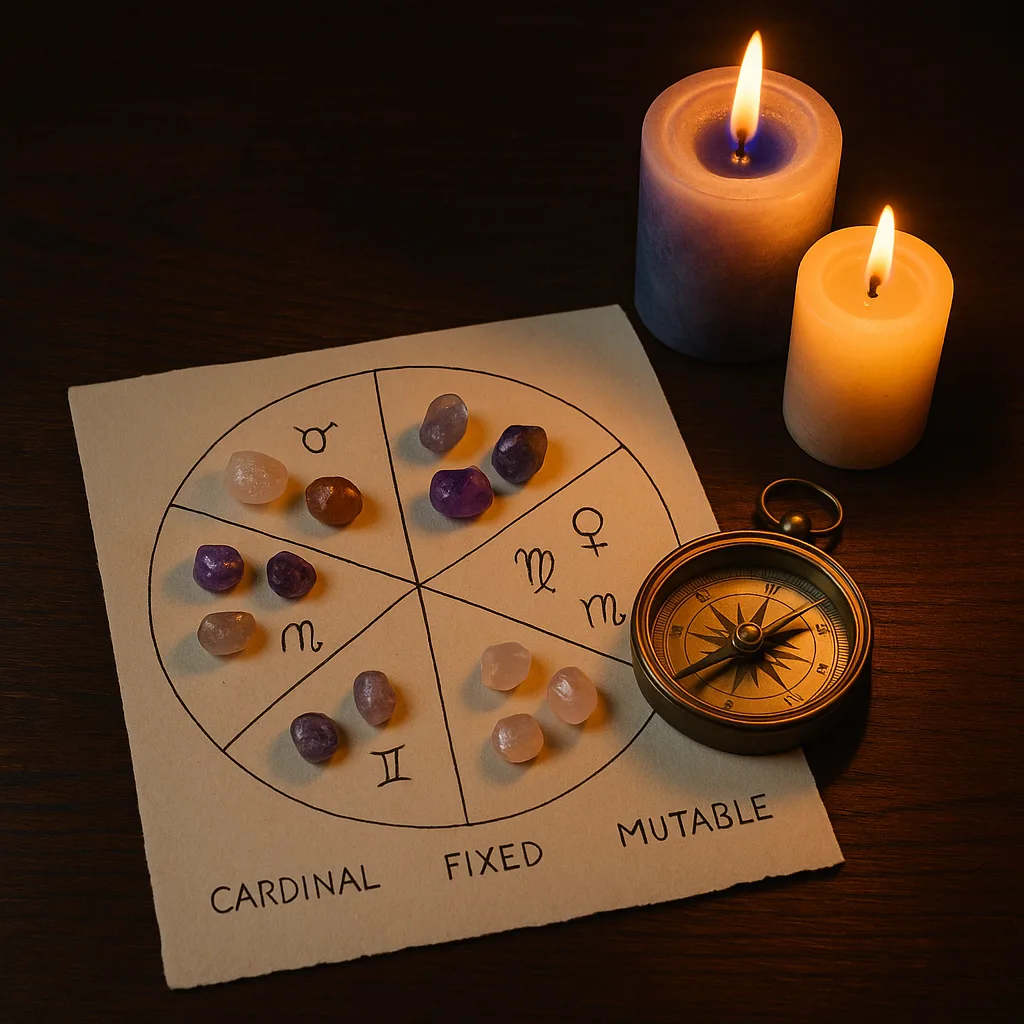
Why do a Taurus and a Leo argue so much?
Picture two friends: one is a Taurus, the other a Leo. Different elements, earth and fire, yet both possess a stubbornness that can't be explained by looking at their signs in isolation. They genuinely like each other, but even simple decisions, like where to eat dinner, turn into a minor standoff. The answer to this puzzle doesn't lie in each person's element. It lies in a layer of astrology that often gets overlooked in compatibility discussions: the modality. Taurus and Leo are both fixed signs. And fixed signs don't give ground easily, whether they're debating a menu or mapping out the entire course of a life.
This kind of situation reveals why looking only at fire, earth, air, and water doesn't tell the whole story about compatibility. There's a second framework underneath, and understanding it helps explain friction and natural harmony that the elements alone can't justify. This theme is explored more deeply in the article on the three layers that determine whether chemistry between two signs is real.
Synastry isn't about comparing two sun signs
Before diving into modalities, it's worth emphasizing a point that serious compatibility study always carries: the technique that compares two birth charts is called synastry, and it never comes down to each person's sun sign alone. An astrologer analyzing the synastry of a couple or friendship examines, among other things, how each person loves (Venus placement), how each person feels and reacts emotionally (Moon placement), how each person desires and acts on impulse (Mars placement), plus both people's ascendants. The sun sign is just the entry point, a simple reference to start the conversation, not the final word on whether two people are compatible.
Within this broader conversation, two layers consistently stand out: the element and the modality. They don't replace full synastry analysis, but they help reveal patterns that repeat across pairs of signs. It's the modality that often explains the kind of friction that the element, by itself, can't account for. For anyone wanting to go beyond the sun sign in this comparison, the guide on how to compare your birth chart with someone you love walks through that analysis step by step.
The element explains language, not pace
Briefly: the four elements show how each sign processes life. Fire (Aries, Leo, Sagittarius) acts on impulse and enthusiasm. Earth (Taurus, Virgo, Capricorn) acts on security and method. Air (Gemini, Libra, Aquarius) acts on ideas and exchange. Water (Cancer, Scorpio, Pisces) acts on intuition and sensation. Signs of the same element tend to understand each other quickly because they speak the same emotional language. Complementary elements, earth with water and fire with air, support each other well. Clashing elements, like fire with water, create that mixture of strong attraction and constant wear.
Yet the element explains language between two people. It doesn't explain pace. And it's exactly the pace that modality reveals.
Cardinal, fixed, and mutable: each sign's internal rhythm
Each of the 12 signs belongs to one of three modalities, also called quadruplicities: cardinal, fixed, or mutable. While the element is the fuel, the modality is the speed at which that fuel is used. This matters enormously when two people need to decide something together, whether it's a travel destination or the future of a relationship. It's worth noting that the number and exact boundaries of the constellations that name the signs follow a convention established by the International Astronomical Union, the body responsible for the official nomenclature of constellations, as described at iau.org. Astrology uses these names symbolically, with no direct connection to the current astronomical boundaries of the constellations.
The table below summarizes which modality each sign belongs to and what that modality tends to prioritize in everyday decisions:
| Modality | Signs | Tendency in decisions |
|---|---|---|
| Cardinal | Aries, Cancer, Libra, Capricorn | Initiates, takes the lead, feels urgency to act |
| Fixed | Taurus, Leo, Scorpio, Aquarius | Sustains, deepens, resists change |
| Mutable | Gemini, Virgo, Sagittarius, Pisces | Adapts, absorbs, transitions between phases with ease |
Cardinals with cardinals: two drivers heading the same way
Aries, Cancer, Libra, and Capricorn are the cardinals, the ones who start movements, take charge, feel the need to act. Two cardinal people together form a pair full of initiative, but they run the risk of competing over who's in control. In a friendship, this might show up as subtle competition over who organizes the hangout or picks the activity. In romance, the challenge is sharing leadership without turning the relationship into a contest over who's steering.
Fixed with fixed: deep roots, change is hard
Taurus, Leo, Scorpio, and Aquarius are the fixed signs, the ones who sustain, deepen, and resist change. This is exactly the case with the Taurus and Leo from earlier. Two fixed signs together create lasting, loyal bonds, but any negotiation demands extra patience, because neither one gives ground easily in the first round. The advantage is stability; the price is difficulty flexing when something truly needs to change. It's no coincidence that combinations between fixed signs and earth signs show up among the zodiac's most enduring pairs, as the article on Taurus and Cancer, Capricorn and Scorpio, Virgo and Pisces demonstrates.
Mutable with mutable: fluidity that can become scattered
Gemini, Virgo, Sagittarius, and Pisces are the mutable signs, the ones who adapt, absorb, and move between phases without much struggle. Two mutable people get along well because neither insists on imposing a fixed direction, but that same lightness can cause the relationship, whether friendship or love, to lose commitment, always rescheduling plans and postponing important decisions.
When modalities cross
A cardinal with a fixed sign tends to form a productive pair: one proposes, the other sustains what was proposed. A cardinal with a mutable combines well because one gives the initial push and the other adjusts to the path. Fixed with mutable can be the most challenging of the three combinations: one wants total stability, the other wants the freedom to change their mind. Learning to live with this contrast is often the real work of the relationship.
No modality is better than another. They're just different rhythms for dealing with time and change, and no good relationship needs two identical clocks.
Friendship and love feel modality in different ways
In friendship, clashing modalities tend to be easier to manage, because there's not the same daily pressure of joint decisions. Two fixed signs can be friends for decades precisely because fixed loyalty strengthens over time without demanding constant course corrections. In love, living together is more intense and everyday, and there the rhythm weighs more: a cardinal-cardinal couple that doesn't learn to alternate who takes the lead tends to burn out faster than two friends with the same combination, who simply avoid competing instead of negotiating.
That's why two signs of the same element might work wonderfully as friends yet clash as romantic partners, or the opposite: two signs with opposite elements but compatible modalities can create a surprisingly easy romance despite the more tense elemental chemistry. The modality doesn't cancel out the element; it adds another layer of reading. That layering is what brings compatibility analysis closer to what full synastry actually does: look at the whole picture, not one isolated piece. This phenomenon is explored in more detail in the article on why the same pair works in friendship but struggles in romance.
What to do with this information
Finding your sign's modality and someone else's, whether a partner, friend, or business associate, is a quick and revealing exercise. The outline below organizes how to apply it in practice:
- Identify your sign's modality and the other person's using the table above: cardinal, fixed, or mutable.
- Observe the real pattern of everyday decisions in your dynamic: who tends to propose, who tends to sustain, who tends to adapt without complaint.
- Compare that pattern with what the modality combination suggests (cardinal with cardinal tends toward competition for the lead, fixed with fixed toward mutual resistance, mutable with mutable toward lack of commitment).
- If friction shows up repeatedly in specific decisions, like organizing plans or negotiating changes, consider that the modality may weigh more than the element.
- For a fuller reading, go beyond the sun and observe Venus, Moon, and Mars in each chart, since that's where synastry shows its full picture.
This doesn't guarantee anything about a relationship's future, but it works as a concrete lens for understanding why certain negotiations flow and others demand more flexibility. The same kind of reading also works outside romance, as the article on synastry without romance applied to friendships and partnerships shows.
Frequently asked questions
What is modality in astrology?
It's the way each sign deals with time and change: cardinal initiates and takes the lead, fixed sustains and resists change, mutable adapts and moves through phases with ease. Each of the 12 signs belongs to one of these three modalities, also called quadruplicities.
What's the difference between element and modality in compatibility?
The element (fire, earth, air, or water) explains the emotional language of each sign, meaning how it processes feelings and situations. The modality explains the pace, that is, the speed and manner in which that sign acts when facing a shared decision. Both layers combine, and neither one alone closes the compatibility question.
Can two fixed signs get along well?
Yes, like the Taurus and Leo example at the start: two fixed signs create lasting, loyal bonds, but any negotiation takes more patience, because neither one gives ground easily at first.
Does modality change between friendship and romantic relationships?
The effect of modality shifts in intensity. In friendship, the clash tends to be easier to manage because there's no daily pressure of shared decisions. In romance, living together is more intense, and the same modality pair can create more strain than it would in a friendship.
Do only modality and element define compatibility between two signs?
No. These two layers help reveal patterns, but the full analysis happens through synastry, which compares entire birth charts, including Venus, Moon, Mars, and each person's ascendant, not just the sun sign.

Recomendado
Astrologia, Simbolismo e Mapa das Personalidades
A astrologia acompanha a humanidade desde as primeiras grandes civilizações. A ideia de que a vida biológica na Terra pode ser influenciada pelos astros gerou e gera grande fascínio no homem.
Universo Astral Editorial Team · Zodiac signs and fun facts
This article was produced by the Universo Astral editorial team, with AI tools assisting research and drafting and human review before publication. If you spot anything inaccurate or outdated, let us know at our contact email.