Synastry Beyond Romance: What Your Birth Chart Reveals About Friendships and Partnerships
The Scorpio friend and the Scorpio boyfriend
It's common to have an easy friendship with someone whose sign, in another context (a romantic relationship, a business partnership), would create significant friction. This isn't chance or a contradiction of the zodiac: it's proof that compatibility isn't a single score applied to a pair of signs, but a reading that shifts based on the type of bond in play. Astrology has specific tools for this that go beyond the common habit of comparing only the Sun of two people. This topic appears in more detail in the article about why the same pair of signs works in friendship and stalls in love.
The starting point: elements and modalities
Before any deeper analysis, there's a basic layer that already tells you quite a bit: the element of each sign. The twelve zodiac signs, according to the International Astronomical Union (IAU), correspond to traditional constellations used for centuries to mark the Sun's apparent position throughout the year, and it's on this foundation of twelve signs that astrology organizes the four elements. Fire (Aries, Leo, Sagittarius) and Air (Gemini, Libra, Aquarius) tend to stimulate each other, one bringing energy, the other bringing ideas for that energy to circulate. Earth (Taurus, Virgo, Capricorn) and Water (Cancer, Scorpio, Pisces) complement each other in a similar way: Earth gives structure so Water's feelings don't get lost, and Water softens what Earth has that's too rigid.
Fire with Water usually creates a mix of fascination and exhaustion: the intensity of both can seem seductive at first, but without adjustments it becomes constant misunderstanding. Earth with Air is the classic meeting between someone who wants practical results and someone who wants to discuss possibilities, one speaks from the ground, the other from the clouds. This doesn't prevent the bond, but it requires more translation between the parties. Add to that the modality of each sign (Cardinal, which initiates; Fixed, which sustains; and Mutable, which adapts) and you already have a reasonable sketch of how two people tend to handle decisions and changes within the relationship, romantic or not. This second layer is detailed in the article about how Cardinal, Fixed, or Mutable modality affects compatibility between two signs.
Why synastry isn't exclusive to romance
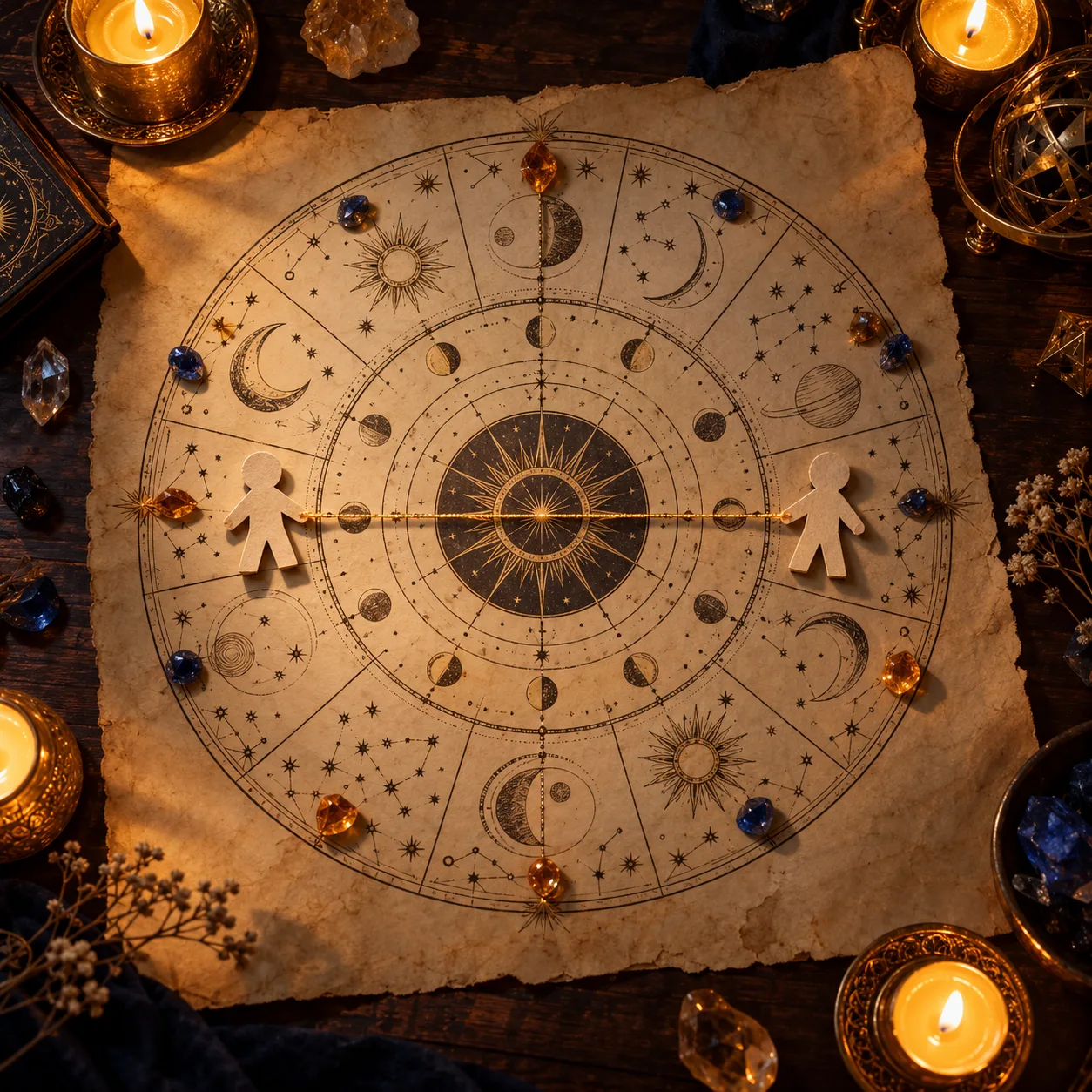
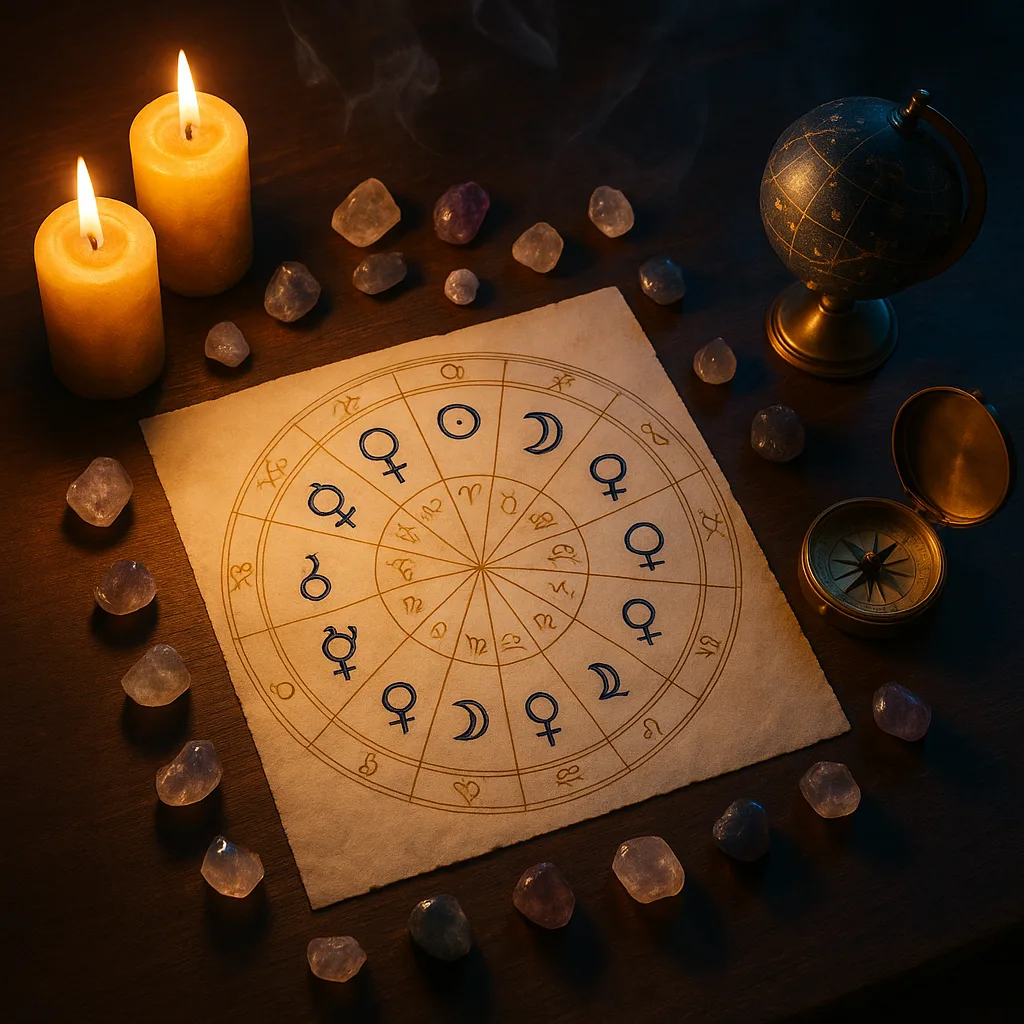
The technique most commonly used to go beyond that sketch is called synastry: it consists of overlaying two birth charts and observing the angles that one person's planets form with the other person's planets. It's this crossing that reveals where two energies fit naturally and where they create friction. And here's a point rarely mentioned: synastry wasn't designed only to evaluate romances. It works equally well for understanding years-long friendships, relationships between parent and child, or professional partnerships.
In friendship bonds, for example, aspects between one person's Mercury and the other's Mercury (or Moon) usually say much more than aspects of Venus, which carry greater weight when romantic attraction is the subject. This explains why sometimes there's incredible mental rapport with someone (you trade ideas for hours, finish each other's sentences) without any romantic spark at all: it's Mercury talking to Mercury, not Venus talking to Mars.
Translating the glyph: the aspects that appear in the reading
To understand these crossings, it's worth knowing the basic vocabulary of angles between planets. Conjunction, when two planets occupy nearly the same degree, merges energies: it can be excellent or suffocating, depending on the planets involved. Sextile and trine are the angles of flow, things happen without requiring effort, which is great in a light friendship, but sometimes also indicates a comfort zone that no one bothers to shake. Squaring and opposition bring tension, and here lies an important subtlety: tension is not a synonym for failure. Many long-lasting partnerships, emotional or professional, are sustained precisely by the friction that forces both people to grow.
To visualize this logic, here's how each type of aspect tends to behave in different kinds of bonds:
| Aspect | Nature | Common effect in friendships | Common effect in work partnerships |
|---|---|---|---|
| Conjunction | Merging of energies | Sense of immediate identification, almost like being 'twins' | Can create unified vision, but also role competition |
| Sextile | Light flow | Easy conversation, coexistence without friction | Tranquil collaboration in daily tasks |
| Trine | Strong flow | Comfortable bond, sometimes without challenge to strengthen it | Natural division of labor, but risk of complacency |
| Square | Active tension | Recurring friction that can mature the relationship | Conflicts of method that force process adjustments |
| Opposition | Tension of polarity | Marked differences that require constant negotiation | Opposing viewpoints that, well managed, balance decisions |
The composite chart: when the relationship becomes its own character
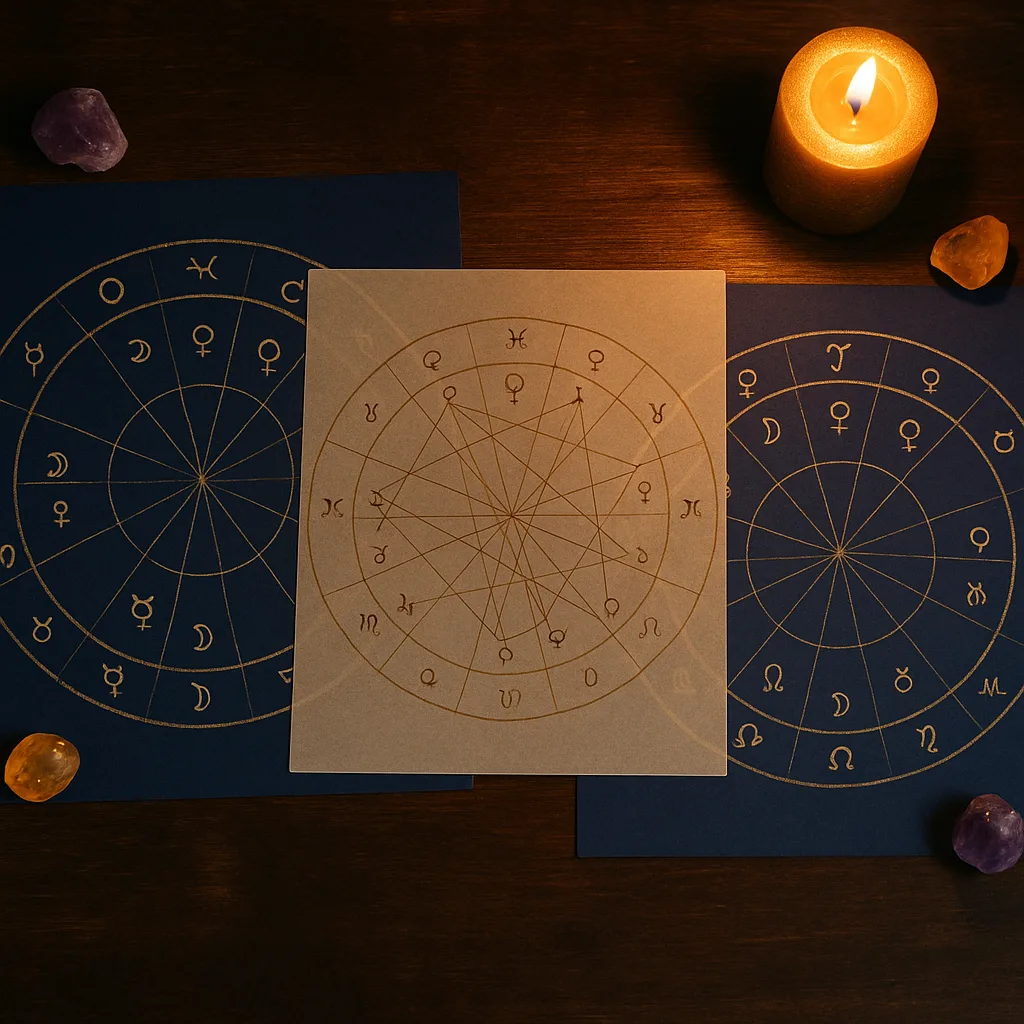
If synastry compares two charts, the composite chart creates a third chart, calculated from the midpoints between the planets of two people. This chart doesn't belong to either of them alone: it represents the relationship itself, as if the bond were an entity with its own personality, strengths, and vulnerabilities.
For friendships and work partnerships, two houses of the composite chart deserve special attention: the 11th house, linked to shared goals and the sense of belonging to a group, and the 10th house, associated with the public image of that pair, how it's seen from outside and what it builds together in the world. A friendship with strong planets in the 11th house of the composite tends to be one that survives distance and time, because the bond arises from a shared purpose, not just momentary affinity. How the astrological houses function in this type of analysis is explored in more depth in the article about the 12 houses of astrology and how to interpret each one in your chart.
One planet for each type of bond
It's worth reinforcing this logic: each planet tends to explain a certain type of bond better. Venus and Mars govern romantic attraction; one person's Venus in conjunction with another's Mars often indicates that immediate chemistry made of desire and mutual enchantment. The Moon speaks of care, emotional intimacy, and affective memory, which is why it appears with such force in family relationships, between parents and children, or between friends who've become almost family. Mercury, on the other hand, is the planet of words, exchange of ideas, shared humor, which makes it the main protagonist in friendships sustained by conversation. Saturn and slower planets enter as witnesses to time: they show whether that bond has the structure to last decades or if it will dissolve once novelty wears off.
This division of roles among planets becomes clearer when organized in stages of observation. For anyone who wants to apply this logic to a real relationship, the path usually follows this order:
- First observe the element and modality of the Sun of each person, to get the general sketch of how the two handle energy and change.
- Compare one person's Moon position with the other's planets, since this is the strongest indicator of emotional comfort in any kind of bond, not just romantic.
- See how Mercury of one speaks with Mercury or Moon of the other, to understand if there's harmony of reasoning and humor.
- Only then evaluate Venus and Mars, if the bond in question is romantic, since these planets carry less weight in friendships and work partnerships.
- Finally, calculate the composite chart of the pair and look at houses 10 and 11, seeking signs of shared purpose and how the relationship appears to those outside it.
The limit of any compatibility reading
An astrologer with decades of practice sums up well the care any serious reading needs to have:
I've seen thousands of charts compared together, some that looked incredible and the two people couldn't make it work... and others where I couldn't find the 'glue' of the relationship and yet they seemed incredibly happy.
This statement sums up what any synastry or composite chart analysis should carry as a warning: the aspects show tendencies, ease points and likely friction, not verdicts. Two people with a synastry full of squares can build, over the years, a complicity that no chart predicted, precisely because they decided to work through what was difficult. And two people with generous trines can drift apart simply because life didn't prioritize the bond.
What to do with this information
In practice, the first step is to resist the temptation to compare only the solar signs. It's worth looking at the Moon of whoever is nearby, as it usually explains why certain people calm you and others agitate you for no apparent reason. Notice how Mercury talks between the two charts before assessing whether a friendship will have things to discuss for a lifetime. And if curiosity is strong, calculating the composite chart of an old friendship can explain, with surprising clarity, why that specific bond resisted changes of city, life stage, and everything else that usually pushes people apart. Anyone wanting to deepen the technical step-by-step of comparing two birth charts will find a specific guide in the article about how to compare your birth chart with someone else's using synastry.
Frequently asked questions
Does synastry only work for romantic relationships?
No. Synastry overlays the birth charts of two people and can be applied to any kind of bond: friendships, relationships between parents and children, or work partnerships. What changes is which planets carry more weight in the reading. Venus and Mars weigh more in romance, while Mercury and Moon usually explain lasting friendships better.
What's the difference between synastry and composite chart?
Synastry compares the two birth charts side by side, observing the angles between one person's planets and the other's. The composite chart is different: it creates a third chart, calculated from the midpoints between the two people's planets, representing the relationship as if it were its own entity, with specific houses and planets.
Does the same element guarantee a good friendship?
Not necessarily. Element and modality give only the initial sketch of compatibility. Two people of the same element can have quite different personalities, and the full synastry, looking at aspects between specific planets, usually explains more precisely why a friendship flows or requires effort.
Are square and opposition aspects in synastry always bad?
No. These aspects bring tension, but tension isn't a synonym for failure. Many long-lasting partnerships, emotional or professional, are sustained precisely by the friction that forces both people to adjust and grow over time.
How do I calculate the composite chart of a friendship?
The composite chart is calculated from the midpoints between the two people's planets, requiring the complete birth charts of both (date, time, and place of birth). After it's calculated, it's worth observing mainly houses 10 and 11, linked to the pair's public image and shared goals.
Recomendado
Astro Reflexo
Descubra o que os astros revelam sobre quem você é. Em menos de um minuto, calculamos seu Sol, Lua e Ascendente com precisão astronômica e uma inteligência artificial escreve um resumo personalizado só para você.
Universo Astral Editorial Team · Zodiac signs and fun facts
This article was produced by the Universo Astral editorial team, with AI tools assisting research and drafting and human review before publication. If you spot anything inaccurate or outdated, let us know at our contact email.