Sign Compatibility: The Three Layers That Determine If the Chemistry Is Real
Aries and Sagittarius meet at a party. Both are Fire signs: spontaneous, resistant to routine, driven by the impulse to live intensely. On paper, it's the perfect match. In reality, it can become a quiet disaster, because both temperaments want to decide everything first and tire of each other's company as quickly as they were drawn to it. Sign compatibility isn't just about adding up similarities. It's a layered reading, and most people stop at the first layer.
The first layer: what each element feels
Fire, Earth, Air, and Water indicate the nature of experience for each sign. Fire (Aries, Leo, and Sagittarius) lives through enthusiasm and action. Earth (Taurus, Virgo, and Capricorn) seeks solidity and tangible results. Air (Gemini, Libra, and Aquarius) processes life through the mind, through the exchange of ideas. Water (Cancer, Scorpio, and Pisces) feels before understanding, and intuits before deciding. This division into four elements is an ancient astrological convention, quite different from the official nomenclature of constellations that the International Astronomical Union recognizes: the IAU treats the twelve zodiacal constellations as regions of sky delimited by coordinates, without assigning them any elemental or symbolic nature.
The classical rule of elemental affinity says that Earth combines well with Water, and Fire combines well with Air. It makes sense: Earth gives structure so Water doesn't lose itself in its own intensity, and Air gives words and context to Fire's impulse. A Taurus next to a Cancer tends to offer the kind of stability that helps that Water flourish rather than drown in itself. A Gemini next to a Leo feeds Fire's shine with ideas, contacts, and new subjects, and receives in return the emotional warmth that Air, by itself, rarely produces.
But notice that there are also crossings considered more challenging: Fire and Water tend to create steam, intense attraction, but unstable, because Fire may find Water excessively sensitive, and Water may see Fire as too impulsive. Earth and Air, meanwhile, are practically two different languages: one speaks of doing, the other of thinking, and the bond only matures if both make an effort to translate each other. To understand why signs of the same element still behave in such distinct ways from each other, it's worth reading this article about the differences within the same element.
The cliché that needs to be dismantled
Here's the point that usually escapes those just beginning: same element is not a guarantee of compatibility. Aries and Sagittarius share a worldview, yes, but a similar worldview is not the same as wanting the same things within a relationship. Two Fire signs may compete for the spotlight, two Earth signs may get locked in mutual stubbornness, two Water signs may sink together in the same emotional tide with no one to pull the rope out. Element explains emotional language; it doesn't explain the script of living together.
The second layer: what each modality does with that energy
This is where the reading gains depth. Beyond the element, each sign belongs to a modality (cardinal, fixed, or mutable), and this layer doesn't speak about what the person feels, but about how they react to life.
- Cardinals (Aries, Cancer, Libra, and Capricorn) are the ones who initiate: they propose the meeting, suggest the trip, start the project.
- Fixed (Taurus, Leo, Scorpio, and Aquarius) are the ones who sustain: they keep the bond firm, resist change, and value consistency.
- Mutable (Gemini, Virgo, Sagittarius, and Pisces) are the ones who adapt: they bring flexibility, change plans midway, close cycles naturally.
A friendship between two cardinals can have energy to spare for starting a thousand plans and no patience to finish any. Two fixed signs together create a foundation solid as stone, until both of their rigidity prevents any necessary adaptation. The combination between different modalities, meanwhile, tends to generate growth: a fixed sign next to a cardinal gains pushes to act; next to a mutable, it learns to let go of control. It's a stimulating dynamic, sometimes tense, because modality, unlike element, speaks to rhythm, and different rhythms require constant adjustment. This layer is explored in greater depth in this article about cardinal, fixed, and mutable.
The third layer: why two signs never tell the whole story
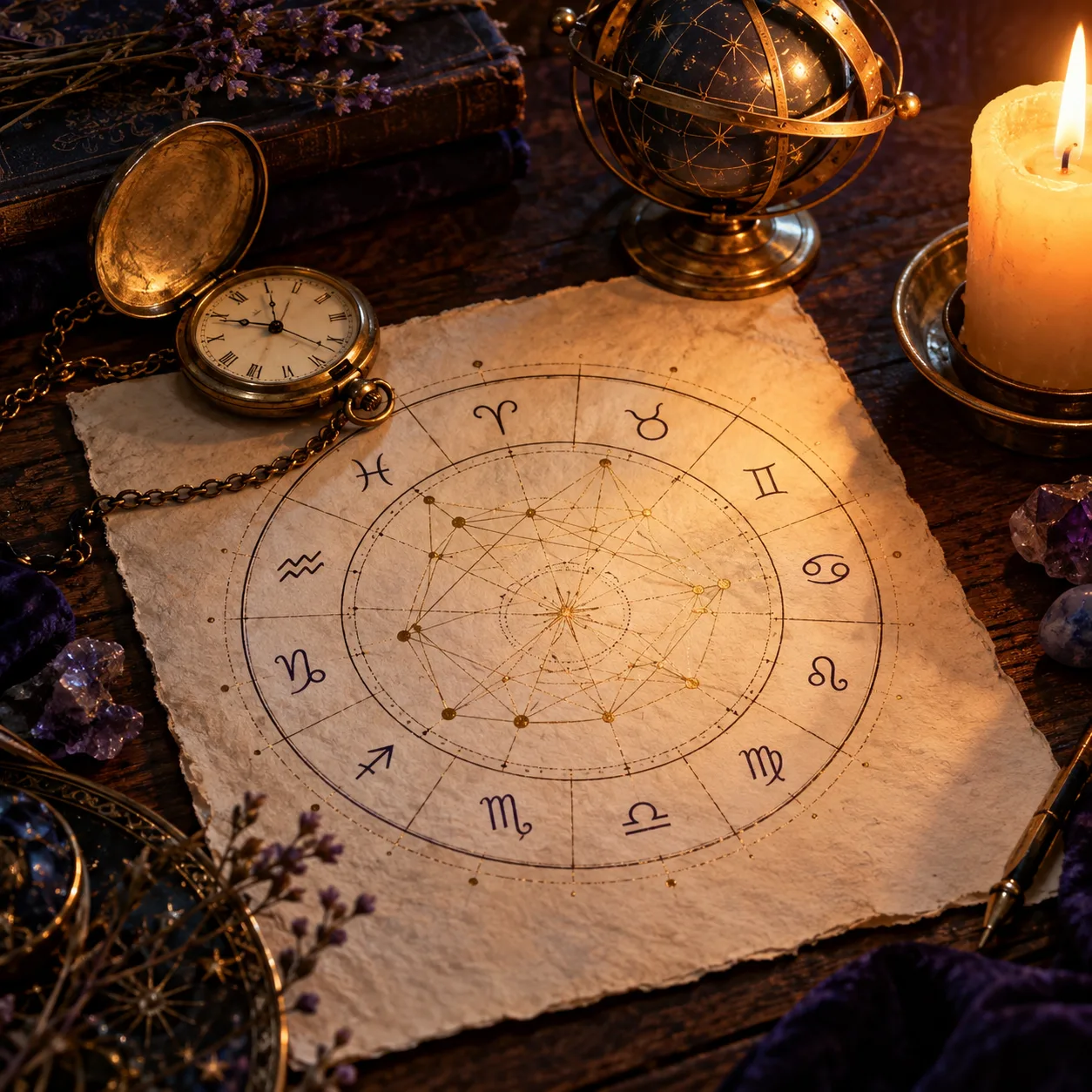
Element and modality explain the generalized behavior of the sun sign, but no one is made of a single point in the sky. The technique that really deepens this reading is synastry: the comparison between two complete charts, observing how one person's planets speak to the other's planets, not just the Sun, but also Moon, Venus, Mars, Ascendant, and the aspects each one forms with the other.
This is why a pair of supposedly opposite elements, like Fire and Earth, can surprise: if one's Ascendant is in Earth and the other's Moon is in Water, there are emotional bridges that the sun sign, isolated, would never reveal. Real compatibility emerges from the meeting of whole charts, not from comparing two symbols loose on paper. The step-by-step guide for building that comparison is in this guide to astrological compatibility between two charts.
Sun sign shows the facade; synastry shows the rooms inside the house.
Pairs that astrological tradition repeats, and why
Some meetings appear frequently among lasting relationships, and not by chance: Taurus and Cancer, Capricorn and Scorpio, Virgo and Pisces. All are pairs of Earth with Water: Earth helps Water organize its own feeling into something functional, and Water returns to Earth the emotional depth that it, on its own, tends to set aside in the name of productivity. It's a genuine exchange: each element offers what the other lacks. These three specific pairs are analyzed in greater detail in this article about the most lasting sign pairs in astrology.
In friendships, the logic of modalities weighs more than one might think. A group with a cardinal to propose the plans, a fixed sign to keep the friendship alive in difficult years, and a mutable to bring lightness and adaptation when everything changes course tends to last longer than a group formed only by people of the same type, because the variety of functions sustains the bond in different ways over time.
The table below summarizes how the three layers behave and what each reveals about a pair of signs:
| Layer | What it reveals | Example mentioned in the text |
|---|---|---|
| Element | Emotional language and nature of experience (Fire, Earth, Air, Water) | Taurus (Earth) and Cancer (Water): Earth structures Water's emotional intensity |
| Modality | Rhythm of reaction to life (cardinal, fixed, mutable) | A fixed sign next to a cardinal gains pushes to act |
| Synastry | Dialogue between complete charts: Moon, Venus, Mars, Ascendant, and aspects | Ascendant in Earth on one side and Moon in Water on the other create bridges the Sun alone doesn't show |
What to do with these three layers in practice
Before dismissing someone for sun sign incompatibility or getting too excited about an element match, it's worth asking: what are the modalities of the two signs involved? And, going further, how are the Moon and Venus positioned in each chart? The answer completely changes the reading and explains why, in the end, two signs said to be incompatible sometimes build the firmest bonds one knows, while two signs said to be perfect for each other end without understanding exactly where things went wrong. This same logic explains, for example, why a pair can work well in friendship and get stuck completely in love, as shown in this article about the same sign pair in different contexts.
Frequently Asked Questions
Are signs of the same element always compatible?
No. The same element indicates similar emotional language, but doesn't guarantee that both want the same things in a relationship. Two Fire signs, for example, may compete for the spotlight instead of completing each other.
What's the difference between element and modality in compatibility?
Element shows the nature of each sign's experience (how the person feels and processes life), while modality shows the rhythm of reaction (cardinal initiates, fixed sustains, mutable adapts). The two layers add up to explain the behavior of the sun sign.
Why is synastry more important than comparing two sun signs?
Because the sun sign is just one point of the chart. Synastry compares the complete charts, including Moon, Venus, Mars, and Ascendant, revealing emotional bridges or tensions that comparing two isolated signs would never show.
Which sign pairs are considered most lasting by astrological tradition?
Taurus and Cancer, Capricorn and Scorpio, and Virgo and Pisces appear frequently among the most stable pairs, all combining Earth with Water: Earth organizes Water's emotional intensity, and Water returns depth to Earth.

Recomendado
Bruxaria e astrologia
Guia prático para entrar em sintonia mágica com os 12 signos do zodíaco
Universo Astral Editorial Team · Zodiac signs and fun facts
This article was produced by the Universo Astral editorial team, with AI tools assisting research and drafting and human review before publication. If you spot anything inaccurate or outdated, let us know at our contact email.