Fears and Insecurities of Each Zodiac Sign: What Really Scares Them
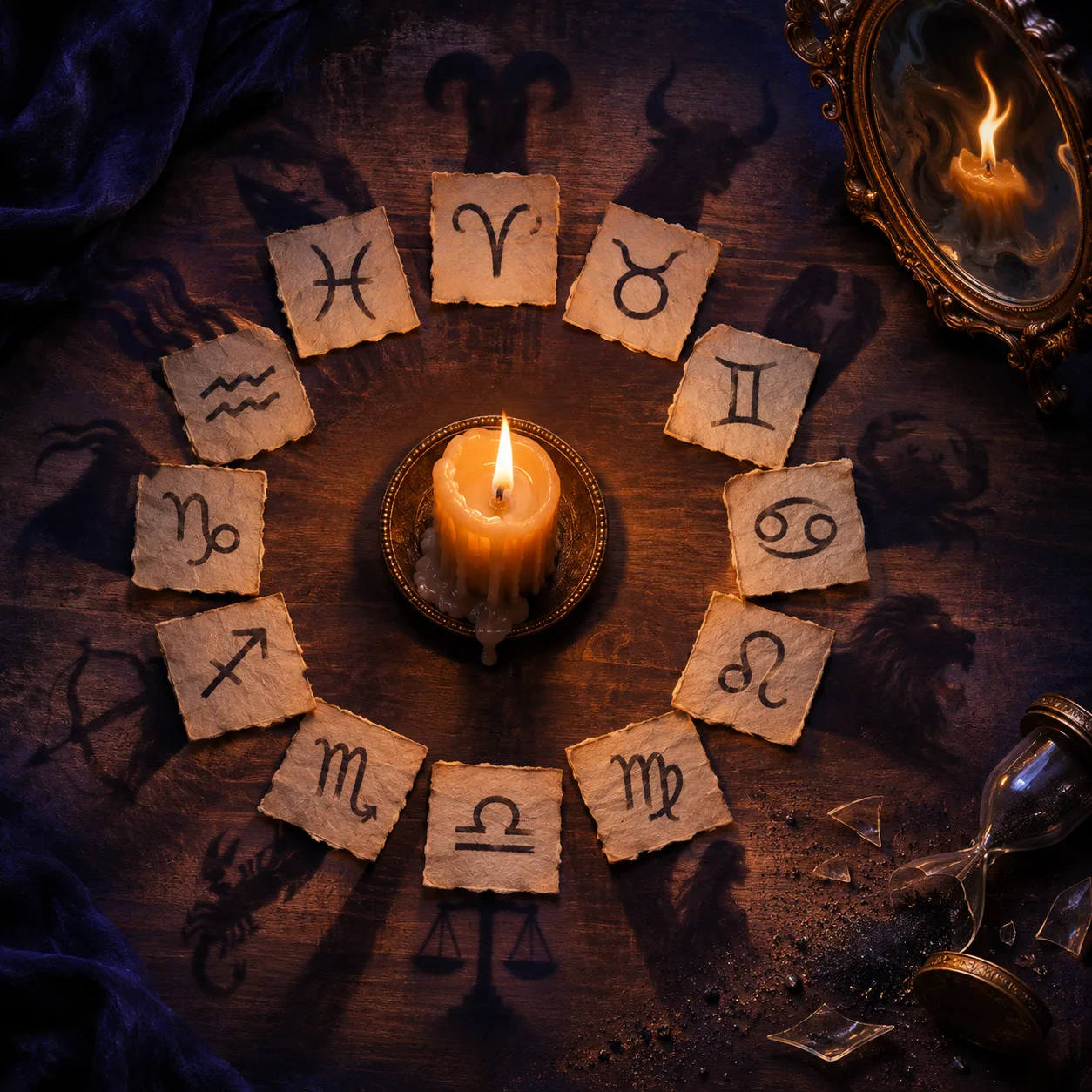
Every sign has a public reputation: Aries is brave, Virgo is organized, Pisces is a dreamer. But astrological tradition has always read these traits as a facade built over something more fragile. The reasoning is simple: if a sign needs to insist so hard on being a certain way, it must be defending itself against something. This article follows that interpretive logic, sign by sign, to show not what each one projects, but what tradition says each one fears losing.
Before diving into the twelve sections, a necessary disclaimer: there is no scientific proof that sun signs determine real psychological fears. What exists is a symbolic reading built up over centuries, one that combines element, modality and ruling planet to sketch a temperament, and which 20th-century astrologers, influenced by Jungian psychology, began reading as a map of vulnerabilities too. It is culture and symbol, not diagnosis.
Where the idea of linking signs to fear comes from
The zodiac we know today was born in Babylonian astrology and was reorganized by the Greeks during the Hellenistic period, later consolidated in the Tetrabiblos, written by the astronomer Ptolemy in the 2nd century AD. This Greco-Babylonian tradition also lent character to the planets: Mars carried the mark of Nergal, god of destruction, and Venus that of Ishtar, goddess of love and desire. These mythological traits later became the basis for describing what we now call benefic and malefic planets, according to the Encyclopaedia Britannica, in its survey of the history of Western astrology.
The next layer came from Greek medicine: the four Hippocratic qualities (hot, cold, moist, dry) were applied to the four astrological elements, so that air became hot and moist, fire hot and dry, earth cold and dry, and water cold and moist. This system of qualities is the direct ancestor of the modern idea of temperament, and it was on this foundation that 20th-century astrologers, already under the influence of psychology, began interpreting not just each sign's strength, but what that strength might be compensating for.
The logic behind each sign's fear
Tradition works like this: it takes a sign's most recognizable defensive trait and asks what it might be protecting. A sign that insists on appearing strong probably fears appearing weak. A sign that seeks harmony at any cost probably fears conflict. This reversal is not science, it is symbolic reading, but it is consistent with the elements, modalities and rulers that tradition has assigned to each sign for centuries.
| Sign | Ruler | Defensive trait | Associated symbolic fear |
|---|---|---|---|
| Aries | Mars | Impulsiveness, needs to act first | Appearing weak or becoming stuck and irrelevant |
| Taurus | Venus | Attachment to the concrete, resistance to change | Material loss and sudden instability |
| Gemini | Mercury | Scattered focus, multiple interests | Boredom and being trapped in a single version of self |
| Cancer | Moon | Attachment to home, protective shell | Abandonment and emotional exposure with no defense |
| Leo | Sun | Need for recognition and spotlight | Being ignored or publicly humiliated |
| Virgo | Mercury | Perfectionism and self-criticism | Making mistakes or being inadequate |
| Libra | Venus | Search for harmony, indecision | Open conflict and being left alone |
| Scorpio | Mars / Pluto | Emotional control, hidden intensity | Betrayal and loss of control |
| Sagittarius | Jupiter | Search for freedom and expansion | Being trapped and losing purpose |
| Capricorn | Saturn | Discipline and responsibility | Public failure and loss of status |
| Aquarius | Saturn / Uranus | Independence and detachment | Losing individuality, forced conformity |
| Pisces | Jupiter / Neptune | Escaping into fantasy and compassion | Harsh reality and rejection |
Saturn, the planet tradition links to fear
Among the seven bodies the Greeks called planets, only two were directly associated with limits and fear. Saturn (Cronos) carried weight, discipline and time, in a lineage that comes from Hellenistic astrology, where the significant bodies were Helios, Selene, Ares, Hesperos, Hermes, Zeus and Cronos. Saturn is the classical and modern ruler of Capricorn, and the classical ruler of Aquarius (now shared with Uranus). It is no coincidence that these two signs appear in the table linked to fear of failure and loss of control: both carry Saturn's mark of demands and structure.
This association is where the popular concept of the Saturn return comes from: the moment the planet completes its orbit and returns to the position it occupied in a person's birth chart, in cycles of roughly 29 and a half years. Tradition reads this phase as a direct confrontation with accumulated structural fears, though any specific date within this cycle requires individual calculation, not a generic calendar.
Why Uranus, Neptune and Pluto change the reading for some signs
It is worth noting that three of the modern rulers in the table (Uranus, Neptune and Pluto) are recent discoveries by the standards of astrology's history: Uranus was identified in 1781, Neptune in 1846 and Pluto in 1930. Ptolemy and the Hellenistic astrologers did not know them, which is why they assigned double rulership of Mars, Jupiter and Saturn over two signs each. This dual rulership is the reason Scorpio, Aquarius and Pisces appear in the table with two planets: the older layer (Mars, Saturn, Jupiter) describes the more primitive, defensive fear, while the modern layer (Pluto, Uranus, Neptune) adds a more psychological nuance that is less visible at first glance.
When this fear surfaces most strongly
Specific transits tend to put pressure on this core vulnerability, bringing out exactly what each sign avoids feeling. Mercury retrograde, for example, is traditionally linked to communication insecurities and forced reconsiderations, something that can intensify Gemini and Virgo's fear (both ruled by Mercury) of appearing confused or incompetent. In 2026, according to the ephemeris calendar from in-the-sky.org, Mercury goes retrograde three times: from February 26 to March 20, from June 29 to July 23, and from October 24 to November 13. These are windows when, according to traditional interpretation, it is worth paying closer attention to one's own anxiety patterns, without treating it as a guaranteed forecast.
To understand why two signs ruled by the same planet, like Gemini and Virgo, react so differently under pressure, the article on each sign's ruling planet explains how the same ruler produces distinct temperaments depending on the element and modality involved. For readers who want to see how this underlying fear shows up in real moments of tension, rather than just in theory, there is also a piece on how each sign reacts under pressure when things get tough.
Frequently Asked Questions
What is each zodiac sign's biggest fear?
According to traditional symbolic interpretation, each sign fears the opposite of what it defends: Aries fears appearing weak, Cancer fears abandonment, Leo fears being ignored, Capricorn fears public failure. The full table in this article breaks down all twelve signs based on their ruler and element.
Why is Scorpio afraid of betrayal?
Scorpio is ruled by Mars in classical tradition and by Pluto in modern astrology, two planets linked to intensity, power and control. Tradition interprets that because the sign maintains so much emotional control and keeps so much intensity beneath the surface, it fears precisely losing that control through betrayal or forced exposure.
Which sign is most afraid of being alone?
In traditional interpretation, Libra is the sign most associated with this fear, due to its connection with Venus and its constant search for harmony and partnership. Its tendency toward indecision and the need to please others is read as a defense against isolation and open conflict.
What is Capricorn's hidden insecurity?
Capricorn is ruled by Saturn, a planet traditionally linked to discipline, time and limits. Tradition reads its demanding nature and focus on responsibility as a defense against the fear of failing publicly or losing the status and control it worked so hard to earn.
What does Saturn represent in astrology and why is it linked to fear?
Saturn is one of the seven bodies recognized since Hellenistic astrology (called Cronos by the Greeks), and has long carried associations with limits, time and discipline. That is why tradition links it to the psychological mechanism of fear and self-control in the face of obstacles. Saturn rules Capricorn and, in classical tradition, Aquarius as well.

Recomendado
Astrologia, Simbolismo e Mapa das Personalidades
A astrologia acompanha a humanidade desde as primeiras grandes civilizações. A ideia de que a vida biológica na Terra pode ser influenciada pelos astros gerou e gera grande fascínio no homem.
Universo Astral Editorial Team · Zodiac signs and fun facts
This article was produced by the Universo Astral editorial team, with AI tools assisting research and drafting and human review before publication. If you spot anything inaccurate or outdated, let us know at our contact email.