Your Natal Lunar Phase: The Moon That Never Changes
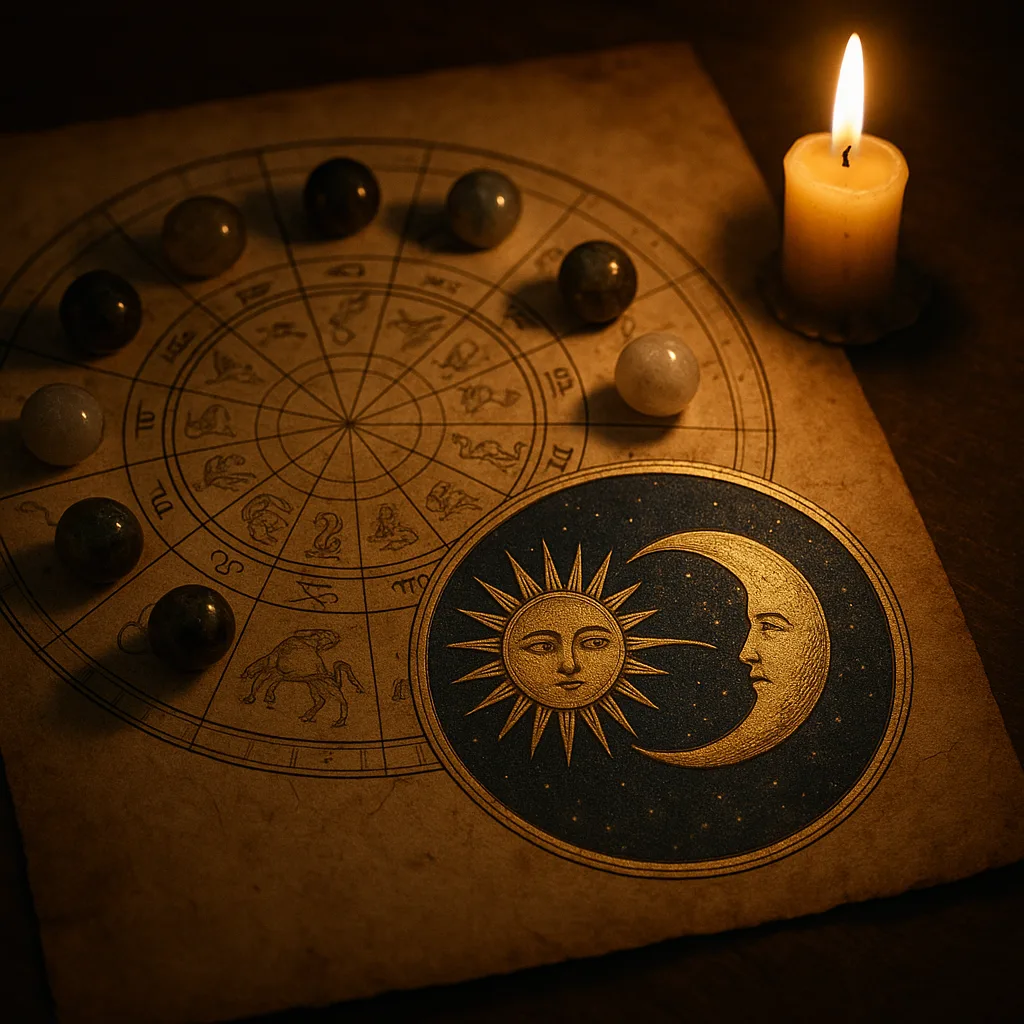
The Moon that stays with you forever
Every month, the Moon cycles through the same four main phases (new, waxing, full, and waning) and starts over. That is the Moon in transit, the collective rhythm everyone sees in the sky and feels in their own way, shifting position every few days. But there is another Moon, less discussed, that never changes: the exact phase it occupied at the moment of your birth. This fixed snapshot of the sky is what astrology calls natal lunation, and it functions as a lunar temperament, a natural, almost factory-programmed way of handling beginnings, crises, and endings.
While the Moon in the sky asks what this month demands of you, your natal lunation answers a different question: what is your inborn style of moving through any cycle, in any month of your life. This second layer, personal and fixed, almost a signature, is worth knowing. For those who first want to understand the meaning of each phase that repeats in the sky every month, the article on New Moon, Waxing, Full and Waning Moon explains the symbolic foundation that natal lunation uses, just anchored to a single date.
How to find your birth phase
To discover your natal lunation, you need two pieces of information: the position of the Sun and the position of the Moon on the day you were born, data that any basic birth chart shows. The angle between these two points defines your phase. If Sun and Moon were close together, you were born near a New Moon. If they were on opposite sides of the sky, your natal Moon was Full. The angles in between produce the remaining phases. You do not need to calculate degrees yourself; simply consult a birth chart (printed or from an online service) and note the angular distance between Sun and Moon at the moment of birth.
The website timeanddate.com maintains a calendar of lunar phases, eclipses, and ephemerides organized by city and date, which serves as a cross-check: after consulting your birth chart, you can verify on the same birth date which phase the Moon was in on that specific day, without relying solely on the chart reading.
In practice, the process follows a clear sequence. Here are the steps:
- Gather the exact date, time, and location of your birth (the time matters for the precise degree of your Ascendant, but for lunar phase, the essential data is the date).
- Generate a birth chart from any service that shows the positions of the Sun and Moon in zodiacal degrees.
- Calculate the angular distance between Sun and Moon: 0° indicates a New Moon, 180° indicates a Full Moon, and 90° and 270° mark the quarters.
- Compare the angle you found with the list of eight phases described below and identify which range it falls into.
- Confirm the phase by looking up your birth date on a lunar calendar, such as the one available at timeanddate.com.
The eight types of natal lunation
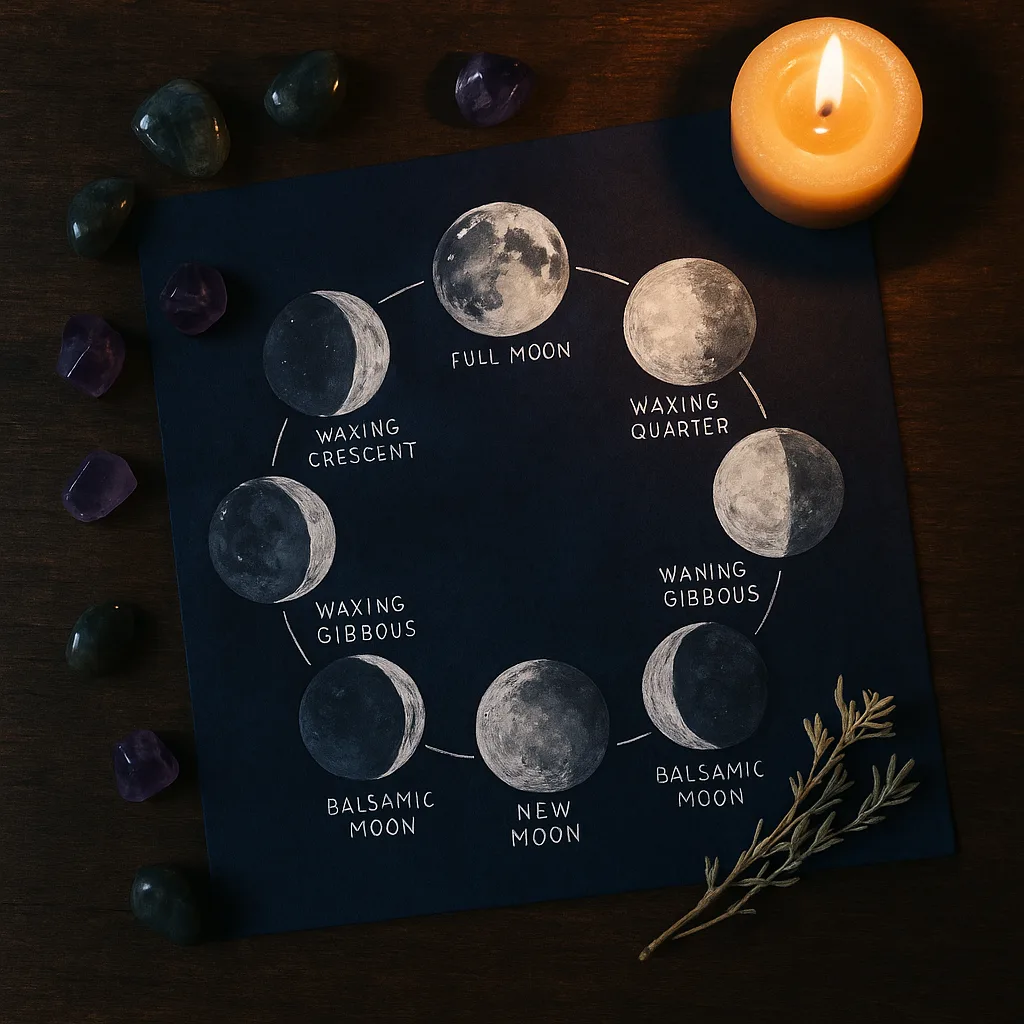
Astrologer Dane Rudhyar, one of the first to systematize this concept in the twentieth century, divided the lunar cycle into eight natal phases, each with an associated psychological disposition. It is worth knowing all eight, even though you were born under only one:
- Natal New Moon: instinctive drive, people who act before fully understanding why, moved by an almost blind call to begin things.
- Natal Waxing Moon: the strength of those who build against environmental resistance, sometimes fighting for a new idea to be accepted by others.
- Natal First Quarter Moon: a crisis-driven temperament and action-oriented nature, people who grow by facing direct obstacles and learn by dealing with them, not avoiding them.
- Natal Gibbous Moon: an inclination to refine, adjust details, perfectionism in service of a larger purpose not yet fully visible.
- Natal Full Moon: clarity and self-awareness from an early age, people who tend to see themselves from outside, sometimes with weight, sometimes with a strong sense of mission.
- Natal Disseminating Moon: a calling to communicate, spread, and teach what has already been lived and understood; figures who naturally attract those seeking guidance.
- Natal Last Quarter Moon: a temperament of transition and inner reorganization, constant questioning of old structures, whether your own or inherited.
- Natal Balsamic Moon: a sense of closing something larger than your individual life, often described as standing between one ending civilization and another not yet begun.
The three intermediate phases (Gibbous, Disseminating, and Balsamic) tend to create more confusion because they do not have as immediate a symbol as new, full, or the quarters. To deepen your understanding of what each of these three phases represents when appearing in the sky in transit, the article Gibbous, Disseminating, and Balsamic Moon details the meaning of each, which also helps clarify the natal version of these phases.
Why this changes how you experience the month
Here is the overlap that makes this concept worthwhile: your natal lunation does not replace the Moon in the sky, it filters your experience of it. Two people can be under the same Full Moon in transit and live it in opposite ways. Someone with a natal New Moon tends to feel the month's Full Moon as a call to act on what became clear, almost a push. Someone with a natal Balsamic Moon might experience that same Full Moon as uncomfortable exposure, something they prefer to observe from a distance rather than take center stage.
Similarly, someone with a natal Last Quarter Moon might find the waning Moon in the sky redundant, since they already live in questioning mode almost every month, eclipse or not. This does not mean the Moon's transit stops mattering: it adds to a background pattern you have carried since birth, rarely mentioned when talking only about what the Moon is doing today. Those who want to better understand this difference between what weighs personally and what is merely a passing sky movement can check the article on fast and slow transits, which addresses exactly this distinction between what passes quickly and what truly marks you.
The Moon in the sky shifts phases every week. The Moon you were born under never changes; it just waits to be recognized.
To see all eight phases side by side, the table below summarizes the temperament associated with each, according to Rudhyar's classification:
| Natal phase | Approximate Sun-Moon angle | Associated disposition |
|---|---|---|
| New Moon | 0° to 45° | Instinctive drive, action before full understanding |
| Waxing Moon | 45° to 90° | Building against environmental resistance |
| First Quarter | 90° to 135° | Crisis and direct action facing obstacles |
| Gibbous Moon | 135° to 180° | Refinement of details, purposeful perfectionism |
| Full Moon | 180° to 225° | Clarity and self-awareness, sometimes weighted |
| Disseminating Moon | 225° to 270° | Calling to communicate and teach lived experience |
| Last Quarter | 270° to 315° | Transition and questioning of old structures |
| Balsamic Moon | 315° to 360° | Sense of closing a larger cycle |
What to do with this information
Knowing your natal lunation does not predict anything; it names a pattern you may already notice in yourself without having words for it. If you have always acted first and understood later, you might find meaning in a natal New Moon. If you have always felt you were closing a chapter even during seemingly calm phases, the key might lie in a Balsamic lunation. The simplest exercise is this: find your phase, read the matching description, and notice whether it illuminates something (a tendency, a recurring difficulty, a way of handling endings) that you already carried but had never connected to the sky on the day you were born.
Remember that natal lunation is just one layer within your complete birth chart, which also includes your Ascendant, houses, and planetary aspects. Those wondering why a standalone Sun sign reading often feels generic can check the article on why your Sun sign horoscope barely fits, which addresses the same oversimplification problem applied to the Sun instead of the Moon.
Frequently asked questions
Is natal lunation the same as Moon sign?
No. Your Moon sign indicates which of the twelve signs the Moon occupied at birth, while your natal lunation indicates the phase of the cycle (new, full, first quarter, etc.), which depends on the angular distance between Sun and Moon, not the sign itself. You can have the Moon in any sign combined with any of the eight phases.
Do I need an exact birth time to calculate my natal lunation?
Exact birth time is important for calculating your Ascendant and astrological houses, but the lunar phase depends mainly on your birth date, since the Moon changes phase over several days, not minutes. Still, having the correct time helps confirm your overall chart.
How do I know if my natal lunation is Gibbous, Disseminating, or Balsamic, since those are harder to identify?
These three phases fall in the angles between 135° and 360° in the Sun-Moon sequence, right after the Full Moon and before the next New Moon. A birth chart showing the exact degrees of Sun and Moon lets you calculate that distance and identify which of the three ranges applies to your birth.
Does natal lunation change over your lifetime?
No. The phase the Moon occupied at the moment of birth is fixed and does not change, unlike the Moon in transit, which cycles through the four main phases every month for the rest of your life.
Universo Astral Editorial Team · Tarot and moon transits
This article was produced by the Universo Astral editorial team, with AI tools assisting research and drafting and human review before publication. If you spot anything inaccurate or outdated, let us know at our contact email.