Gibbous, Disseminating, and Balsamic Moon: The Hidden Lunar Phases
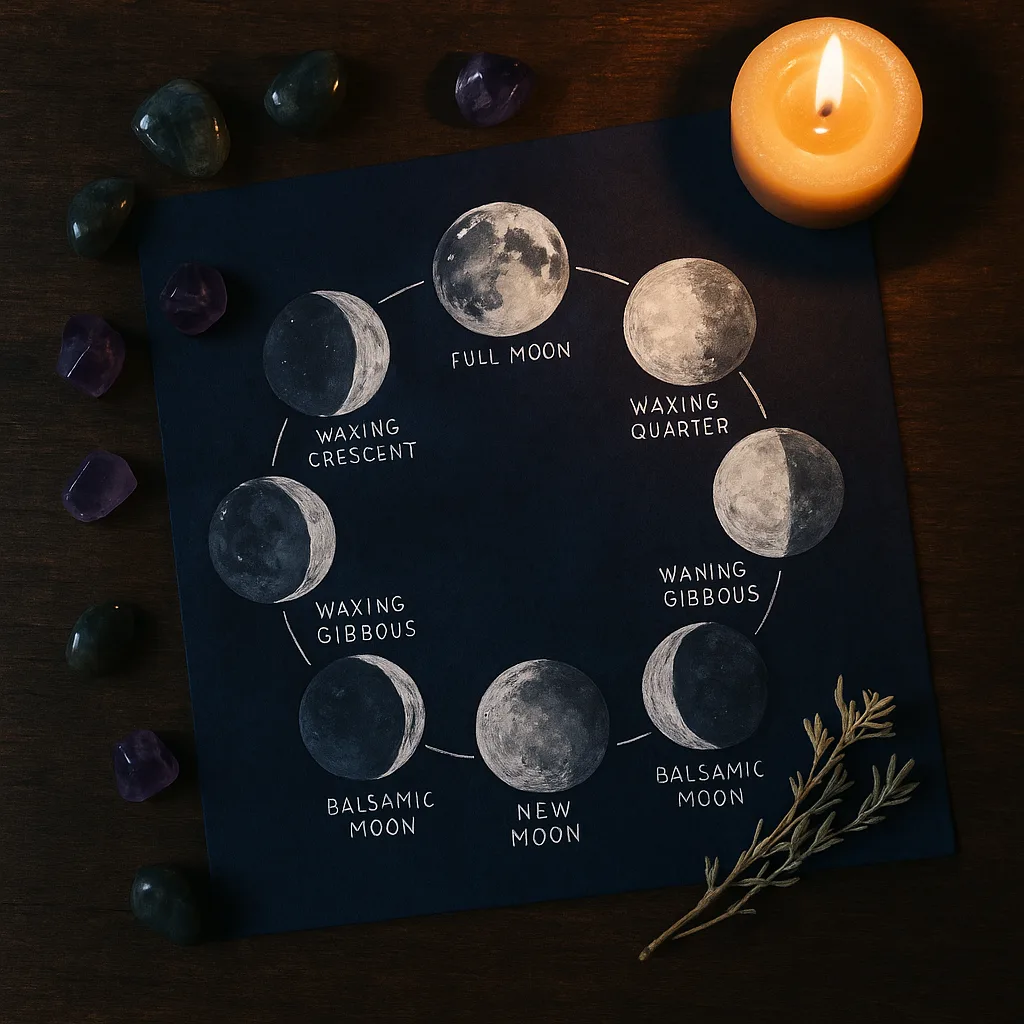
Most lunar calendars reduce the Moon's cycle to four simple images: a dark circle, a crescent, a full circle, and an inverted crescent. This simplified version is what most people learn, and it isn't wrong, just incomplete. Between the New Moon and the Full Moon, and between the Full Moon and the next New Moon, astrology recognizes four additional phases with their own symbolic meaning: Waxing Gibbous, Gibbous, Disseminating, and Balsamic. Together, they complete a cycle of eight phases lasting approximately 29.5 days, known as the synodic month.
These four intermediate phases don't appear in every astrology app, but they matter for anyone wanting to track the sky with more precision than just "today is a full moon." Each occupies a specific point between the major phases and carries its own symbolic reading, connected to what the New Moon, First Quarter, Full Moon, and Last Quarter represent as the larger turning points of the cycle. If you're already familiar with those four main phases, it's worth reviewing their meaning in the article about New, Waxing, Full, and Waning Moons before moving on to the intermediate ones.
The cycle has eight phases, not four
Astronomically, what changes from one phase to the next is the portion of the Moon's sunlit face that we can see from Earth. The Moon produces no light of its own: the brightness we see is reflected sunlight. When the illuminated face points entirely away from Earth, we have a New Moon, and the sky shows no visible Moon. When the illuminated face aligns with the face pointing toward us, we have a Full Moon. Between these two extremes, the amount of visible light increases or decreases gradually, and it's in this middle ground that the intermediate phases live.
In astrology that works with the complete cycle, these eight stages divide into four main phases, called active (New Moon, First Quarter, Full Moon, and Last Quarter), and four intermediate phases, called receptive: Waxing Crescent, Gibbous, Disseminating, and Balsamic. Each of the eight lasts roughly three to four days, since the 29.5-day cycle divides evenly among them. Anyone wanting to track exactly which day each phase begins can consult the lunar phase calendar at Time and Date, which also provides eclipse times and ephemerides calculated by location.
The eight phases of the lunar cycle, in order
The table below outlines the complete sequence, showing where each phase falls in the cycle and its symbolic meaning.
| Phase | Type | Position in cycle | Symbolic meaning |
|---|---|---|---|
| New Moon | Active | Start of cycle, illuminated face points away from Earth | Beginning, planting intention |
| Waxing Crescent | Intermediate | Between New and First Quarter | First steps into action |
| First Quarter | Active | Half the disc illuminated, halfway to Full | Turning point, decision-making |
| Gibbous | Intermediate | Between First Quarter and Full | Fine-tuning, refinement |
| Full Moon | Active | Illuminated face aligns with face toward Earth | Revelation, maximum clarity |
| Disseminating | Intermediate | Just after Full, illumination starting to shrink | Share what was revealed |
| Last Quarter | Active | Half the disc illuminated, halfway back to New | Release, handle loose ends |
| Balsamic | Intermediate | Final stretch before complete darkness | Closure, emptying out |
First Quarter: the action turning point
The First Quarter marks the moment when half the lunar disc is illuminated, halfway between the New Moon and the Full Moon. It's considered an active phase because it typically coincides with decisions: what was planted symbolically at the New Moon begins to demand concrete movement. After it comes the Gibbous Moon, one of the least discussed intermediate phases but with a well-defined role in the cycle.
Gibbous Moon: fine-tuning before fullness
The Gibbous Moon occupies the stretch between the First Quarter and the Full Moon, when the illuminated face already exceeds half the disc but hasn't yet reached one hundred percent. Symbolically, it's read as a phase of refinement: the project or intention has already taken shape, but still needs adjustment before reaching the peak exposure of the Full Moon. It's a moment tied to reviewing details, testing what has been built, and adjusting course rather than simply waiting for results to appear on their own.
After the Full Moon, when illumination begins to decrease, the first intermediate phase of the waning side begins: the Disseminating Moon.
Disseminating Moon: sharing what the Full Moon revealed
The Disseminating Moon comes right after the Full Moon, at a time when the illuminated face is still large but has begun to shrink. In symbolic reading, this phase carries the name that defines it: it's time to disseminate, to share what became evident during the full phase. If the Full Moon is the point of revelation and maximum clarity, the Disseminating Moon is the moment to turn that clarity into something useful for others, whether information, learning, or an achievement worth dividing. A recent example of this dynamic is described in the article about the Sturgeon Moon eclipse, which passed through all four main phases in a single month.
After it, the illumination continues to shrink until reaching the Last Quarter, the second active phase on the waning side of the cycle, traditionally tied to releasing what no longer serves and handling what was left unfinished. Only after the Last Quarter does the cycle enter its most silent phase of all: the Balsamic Moon.
Balsamic Moon and the so-called Dark Moon: deep closure
The Balsamic Moon is the last of the eight phases, the final stretch before the Moon disappears completely and restarts as a New Moon. During it, the illuminated face is just a thin sliver, almost vanishing from the sky. More esoteric astrology traditions call the final three days of this phase the Dark Moon, understood as the deepest closure of the entire cycle: less about starting something new and more about emptying out, resting, and letting go of what has already served its purpose before the New Moon restarts everything. It's worth noting that this popular name Dark Moon is different from the astrological point called Lilith, sometimes also nicknamed Dark Moon in the birth chart: anyone wanting to understand that other reference can check the article on Lilith in the birth chart.
This reading helps explain why the New Moon is usually described as a beginning and the Balsamic as an ending: one is a direct consequence of the other. The fresh start only makes sense after the emptying of the Balsamic has actually happened, which is why many astrological traditions recommend observing the last days before the New Moon with more quiet than urgency to act.
How to identify each phase by watching the sky
For anyone wanting to train their eye and recognize these eight phases without relying only on an app, a simple path is to follow this observation sequence over a month:
- Mark the New Moon day on your calendar (the sky shows no visible Moon at night) and note the date.
- Over the next three or four days, observe the Waxing Crescent: a thin sliver of light, growing each night.
- Around day seven, identify the First Quarter: half the disc illuminated, shaped like a D.
- In the days that follow, track the Gibbous Moon: more than half illuminated, but not yet a complete circle.
- Around day fourteen or fifteen, observe the Full Moon: the entire disc illuminated.
- Right after, identify the Disseminating Moon: the disc begins losing light at the edge.
- Around day twenty-two, mark the Last Quarter: half illuminated, shaped like a C.
- In the final days before the next New Moon, observe the Balsamic Moon: just a thin sliver of light, until it disappears again.
Why tracking these phases matters
Anyone looking only at the four main phases tends to divide the month into four large blocks: plant, act, reveal, release. This works, but oversimplifies a cycle that in practice has more nuance. The Gibbous Moon signals there's still time to adjust before the exposure of the Full Moon. The Disseminating Moon suggests that what was revealed holds more value when shared than kept. And the Balsamic Moon reminds us that every new beginning, including the next New Moon, depends on a preceding emptiness; you can't skip directly from exhaustion to a fresh start without passing through that interval.
There's also a parallel with how tides actually behave: the strongest tides, called spring tides, happen exactly at the New Moon and Full Moon, when the Sun, Earth, and Moon align. At the quarters, waxing and waning, tidal force drops significantly, what astronomers call neap tide. It's a good physical metaphor for what astrology describes symbolically: the main points of the cycle concentrate more intensity, while the intermediate phases ask for more subtle adjustments, almost behind the scenes.
Paying attention to these four less-discussed phases doesn't replace looking at new, waxing, full, and waning, but it completes the picture. It's the difference between tracking the sky through four separate photographs or watching the entire film, with the transitions that connect one scene to the next. For anyone wanting to go beyond the monthly cycle and discover the lunar phase set at birth, the article on natal lunation explains how to calculate that personal phase.
Frequently asked questions
How many phases does the Moon actually have?
The complete cycle has eight phases: four main ones (New, First Quarter, Full, and Last Quarter) and four intermediate ones (Waxing Crescent, Gibbous, Disseminating, and Balsamic). Together, they last approximately 29.5 days, known as the synodic month.
What's the difference between Gibbous and Disseminating Moons?
The Gibbous Moon occurs before the Full Moon, between the First Quarter and Full, when illumination is still increasing. The Disseminating Moon comes after the Full Moon, when illumination has started to decrease. One precedes the cycle's peak, the other follows it.
Is Balsamic Moon the same as Dark Moon?
In the context of this cycle, yes: the final three days of the Balsamic phase are often called Dark Moon by more esoteric traditions, associated with the deepest closure before the New Moon. This name is different from the astrological point Lilith, which is also nicknamed Dark Moon in another sense, in the birth chart.
Why do most apps show only four phases?
Because four phases provide a general view of the cycle (plant, act, reveal, release). The four intermediate phases exist in the same astronomical sequence, but call for more detailed reading, which is why they appear only in calendars and more specialized astrological traditions.
Where can I find the exact dates of each lunar phase for the month?
Astronomical calendars like Time and Date provide the time of each phase by location, including eclipses, which helps you identify with precision when an intermediate phase like Gibbous or Disseminating is underway.

Recomendado
Astrologia, Simbolismo e Mapa das Personalidades
A astrologia acompanha a humanidade desde as primeiras grandes civilizações. A ideia de que a vida biológica na Terra pode ser influenciada pelos astros gerou e gera grande fascínio no homem.
Universo Astral Editorial Team · Tarot and moon transits
This article was produced by the Universo Astral editorial team, with AI tools assisting research and drafting and human review before publication. If you spot anything inaccurate or outdated, let us know at our contact email.