What Moon Phase Were You Born Under? Your Natal Lunar Phase Explained
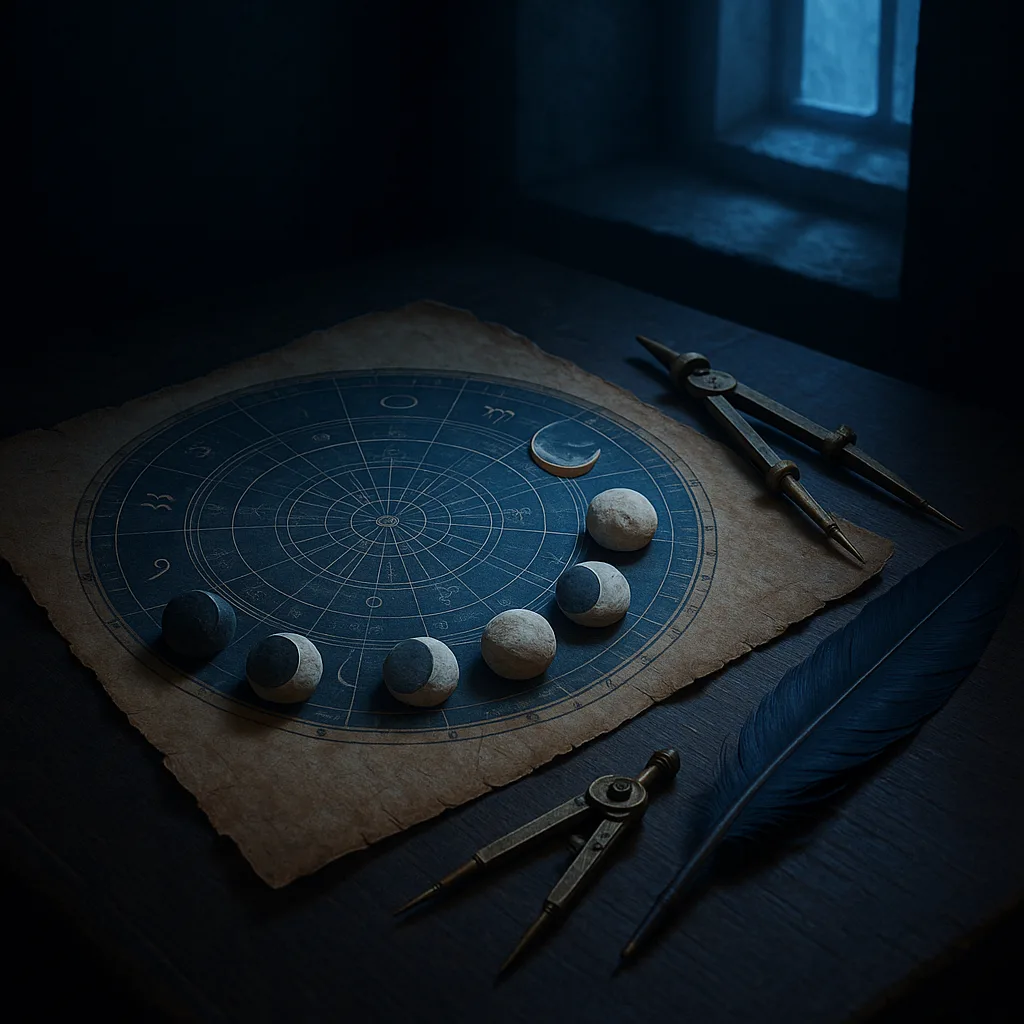
Every month, the Moon is born, waxes, reaches fullness, and wanes in the sky for everyone at the same time. This collective cycle governs calendars of planting and symbolic harvest, and you can track it daily on sites like timeanddate.com, which publishes lunar phase calendars, eclipses, and ephemerides calculated for each city. But there is a second layer, less discussed and far more personal: the relationship between the Sun and Moon at the exact moment of your birth also corresponded to a specific phase of that cycle. According to a line of astrology that traces back to the work of Swiss-American astrologer Dane Rudhyar, this phase never changes. It functions as a fixed energetic signature, an archetype that accompanies a person for life, regardless of what the Moon is doing in the sky today.
The question here is not "what should I do during this August Full Moon." It's something else: under what light did you come into the world, and what does that reveal about how you handle new beginnings, conflicts, and endings throughout your life?
How to discover your natal lunar phase
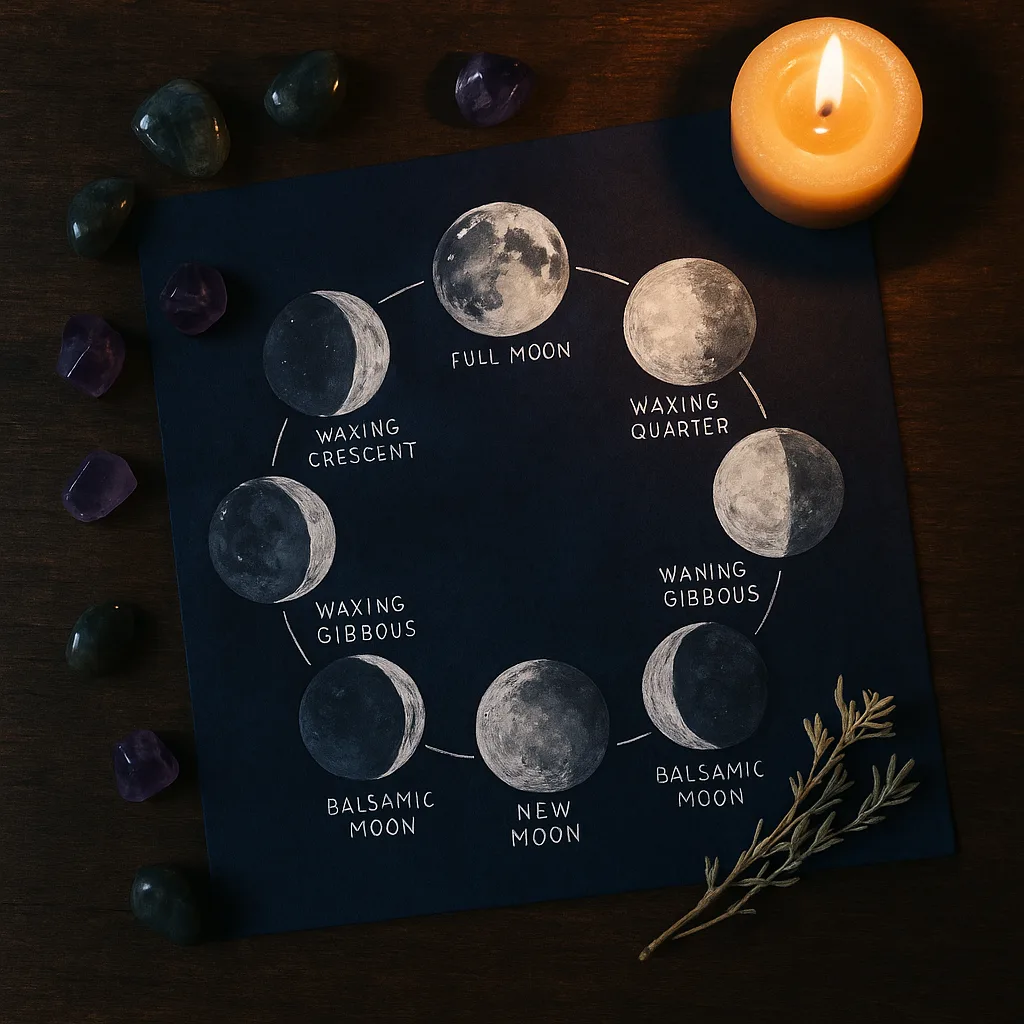
The calculation is simple in theory: it's the angle between the Sun's position and the Moon's position at the exact moment of birth. When the two are close together (0° to 45° apart), the person was born near a New Moon. When they're in near perfect opposition (around 180°), they were born under a Full Moon. And so on, in eight possible fractions of the cycle. In practice, the most reliable way to find this is to enter exact date, time, and place of birth into a free online birth chart calculator. Many already indicate the natal lunar phase directly, without needing to do the math by hand. If you want to understand the logic behind this type of calculation before applying it to your lunar phase, the article How to Read a Planetary Transit explains the mechanism of planet, natal point, and aspect that underlies this kind of reading.
An important note: this does not replace or contradict your lunar sign (the Moon's position in a zodiac sign). These are two different pieces of information that complement each other. Your lunar sign speaks to what you feel; your natal lunar phase speaks to how you navigate time, cycles, and change. This distinction is similar to the one between the generic sun sign and the full birth chart, discussed in Why Your Horoscope Almost Never Matches.
Step-by-step to identify your natal lunar phase
- Gather your exact birth date, time, and city. Without the time, the Moon's position calculation becomes imprecise because it moves quickly across the sky.
- Enter this information into a free online birth chart calculator that computes planetary positions.
- Locate the Sun's position and the Moon's position in degrees on the generated chart.
- Calculate the angular distance between the two: subtract the Sun's degree from the Moon's degree (or vice versa, following zodiac direction).
- Compare the result against the eight ranges of the cycle: 0° to 45° is New Moon, 45° to 90° is Waxing Crescent, 90° to 135° is First Quarter, 135° to 180° is Waxing Gibbous, around 180° is Full Moon, 180° to 225° is Waning Gibbous, 225° to 270° is Last Quarter, and 270° to 360° is Balsamic Moon.
- Read the description of the corresponding archetype and notice if it resonates with patterns you already recognize in yourself throughout your life.
The eight archetypes of the natal lunar cycle
New Moon: born to open the way
Being born under a New Moon, when Sun and Moon are only a few degrees apart, is often linked to instinctive personalities who act before having complete certainty of the outcome. It's not reckless impulsiveness: it's a kind of trust in your own instincts. People born in this phase tend to be described as pioneers, those who start things more easily than they finish them, and who feel most alive at the beginning of a project than in its maintenance.
Waxing Crescent: the bridge between impulse and form
A bit further along the cycle, this phase usually indicates someone born to give structure to ideas already floating in the air before them: the person who arrives, absorbs what was already being developed by others, and finally gives it shape. There is constant tension between the past (what already existed) and the impulse to create something new from there.
First Quarter: born in the midst of constant creative crisis
Associated with a moment of creative tension within the cycle, this phase usually corresponds to personalities that grow through friction. These are people who handle obstacles well because, in a way, they've always needed them to move forward. It's not uncommon to find people here who only feel fully active when solving a concrete problem.
Waxing Gibbous: refinement as a calling
People born in this phase, just before the Full Moon, tend to carry a subtle and constant restlessness: the sense that something can still be improved, revisited, refined. It's the phase most associated with productive perfectionism, with the habit of analyzing and refining before the final delivery. The intermediate phases of the cycle, including this one, are detailed in Waxing Gibbous, Disseminating, and Balsamic Moons.
Being born in a lunar phase is not a closed destiny. It's a lens through which certain life themes tend to repeat with more intensity.
Full Moon: born to make visible
When Sun and Moon are born on opposite sides of the sky, tradition associates this phase with personalities marked by the need for relationship, reflection, external recognition. Not from vanity, but because people born under a Full Moon tend to understand who they are through contrast with the other. Partnerships, conflicts, and intense relationships tend to be the ground where these people most reveal themselves.
Waning Gibbous: the impulse to share what has been lived
Just after the peak, this phase usually corresponds to those who feel the need to transmit, teach, or distribute what they have already gathered, literally or symbolically. Teachers, mentors, and figures who translate experience for others tend to recognize themselves in this description.
Last Quarter: born to question structures
A phase associated with personalities uncomfortable with what is already established, people who tend to deconstruct inherited systems, values, or habits to make room for what is still to be born. There is a natural willingness here to let go of conventions that no longer make sense.
Balsamic Moon: born between two worlds
The final phase of the cycle, immediately before the next New Moon, is usually associated with an almost prophetic sensitivity. These are people who seem to carry ancient wisdom, somewhat displaced from their own time, often described as "wise before their years." It is the phase of closure, dissolution, but also of quiet preparation for what is still to come.
Summary of the eight archetypes
| Natal lunar phase | Approximate Sun-Moon angle | Central theme |
|---|---|---|
| New Moon | 0° to 45° | Instinct and beginning |
| Waxing Crescent | 45° to 90° | Giving form to what already existed |
| First Quarter | 90° to 135° | Growth through friction |
| Waxing Gibbous | 135° to 180° | Refinement |
| Full Moon | Around 180° | Relationship and visibility |
| Waning Gibbous | 180° to 225° | Sharing experience |
| Last Quarter | 225° to 270° | Questioning structures |
| Balsamic Moon | 270° to 360° | Dissolution and preparation |
A map that explains patterns, not fixes destinies
It's worth emphasizing: this is a symbolic reading, one among several possible layers within a birth chart, not a final verdict about who you are. It works better as a question than as a definitive answer. Do your life's new beginnings tend to look more like a sudden impulse (New Moon), a productive crisis (First Quarter), or a quiet dissolution before turning the page (Balsamic Moon)? Observing your own patterns over the years in light of this birth phase usually reveals more about you than any isolated prediction for the current month. To compare this personal layer with the cycle that repeats every month in the sky, it's worth looking at the meaning of each phase in New, Waxing, Full, and Waning Moons.
Frequently asked questions
How do I calculate my natal lunar phase?
You need your exact birth date, time, and city to generate a birth chart and check the angular distance between the Sun and Moon. Many online birth chart generators already provide the natal lunar phase directly, without requiring manual calculation.
Is natal lunar phase the same as lunar sign?
No. Your lunar sign indicates which zodiac sign the Moon was in at birth and speaks to what you feel. Your natal lunar phase indicates the angular relationship between Sun and Moon and speaks to how you navigate time, cycles, and change. The two pieces of information complement each other within the same chart.
How many possible natal lunar phases are there?
Eight: New Moon, Waxing Crescent, First Quarter, Waxing Gibbous, Full Moon, Waning Gibbous, Last Quarter, and Balsamic Moon. Each corresponds to a range of angular distance between the Sun and Moon at the moment of birth.
Do I need to know my exact birth time for this calculation?
Yes, because the Moon moves quickly through the zodiac and an error of just a few hours can change the phase identified. Without the exact time, the result becomes imprecise and may indicate a neighboring phase instead of the correct one.
Does this natal lunar phase change over your lifetime?
No. Your natal lunar phase is fixed, calculated once from the moment of birth. What changes constantly is the Moon phase in the sky day to day, which is the collective cycle of roughly one month.

Recomendado
Mapa Astral Kármico
Você já sentiu que certos padrões se repetem em sua vida? Relacionamentos que seguem o mesmo roteiro, desafios que parecem voltar ou talentos que surgem naturalmente? Nada disso é por acaso.
Universo Astral Editorial Team · Tarot and moon transits
This article was produced by the Universo Astral editorial team, with AI tools assisting research and drafting and human review before publication. If you spot anything inaccurate or outdated, let us know at our contact email.