The Origins of Astrology: How Ancient Peoples Read the Sky
The sky as humanity's first writing
Before printed birth charts or transit apps existed, there was the sky, and there were people willing to observe it for hours, trying to understand what those lights meant. Astrology did not emerge from a single people or a single moment: it arose, almost simultaneously, in different regions of the ancient world, as if humanity shared a common need to find meaning in the sky. This text traces some of these origins (Mesopotamia, Egypt, Greece, and India), not to list dates, but to show how each culture interpreted the same sky in its own way, and how these perspectives intertwined to form the astrology we know today. The historical encyclopedia World History Encyclopedia gathers records of these ancient civilizations and helps situate how each organized time, religion, and celestial observation within its own context.
Mesopotamia: when the gods spoke through the stars
The best-documented birthplace of astrology as we know it lies in the fertile region between the Tigris and Euphrates rivers, where Sumerians, Akkadians, Babylonians, and Chaldeans succeeded one another over millennia. For these peoples, the natural world and the divine world were not separate things: the gods inhabited the cosmos and manifested through it. Observing the sky was not scientific curiosity, but a way of listening to divine will.
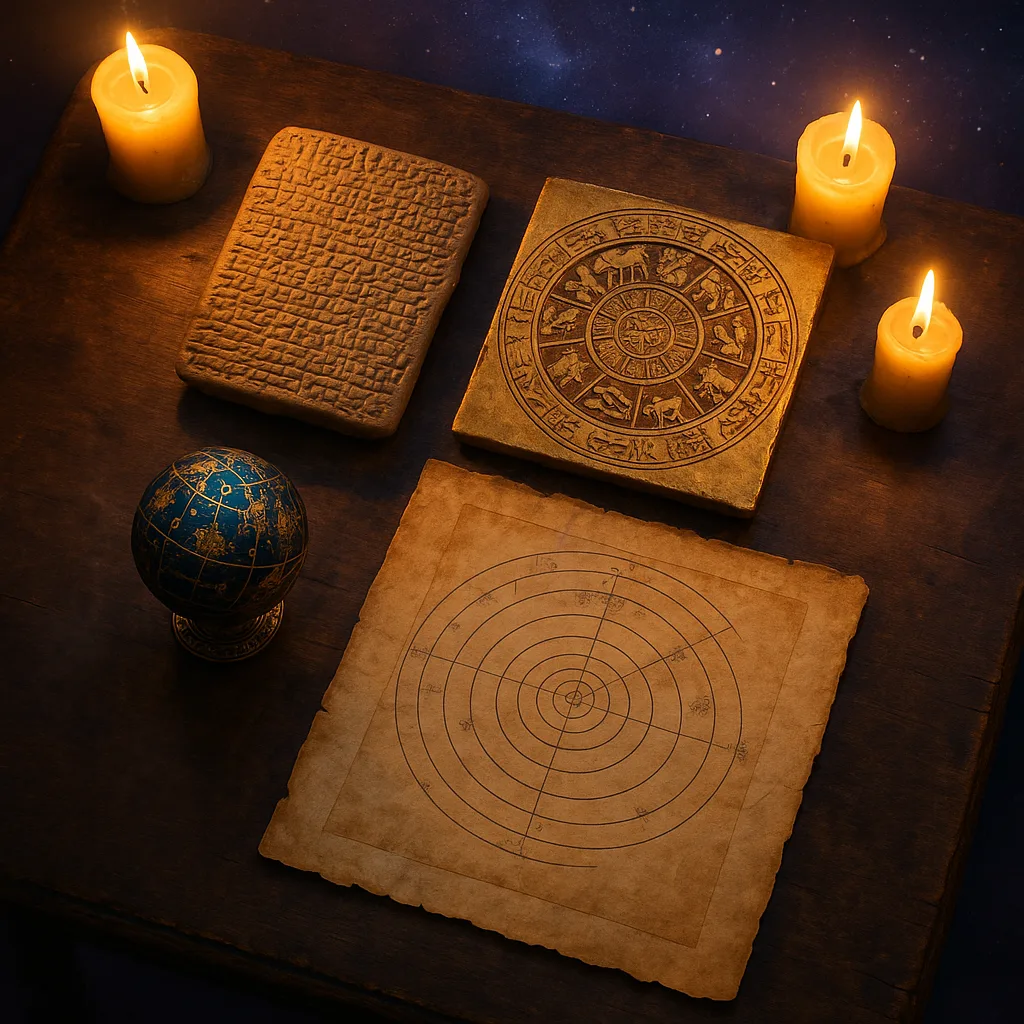
It was in Babylon, around the second millennium BCE, that this listening became methodical. Specialized priests observed the movement of stars and planets to interpret omens, primarily related to the fate of the king and the State, not yet to the individual as happens today with birth charts. This knowledge was collected in the Enuma Anu Enlil, a collection of seventy clay tablets containing about seven thousand celestial omens, compiled around the seventh century BCE.
Among the various forms of divination practiced at the time, including the reading of animal entrails, the omens read in the sky were considered the most reliable, because they did not depend on any human interference. It was there too that technical notions emerged that survive to this day, such as the perception of the precession of the equinoxes and the sexagesimal number system, still used to measure degrees and hours. When Alexander the Great conquered the ancient Persian territory, this Mesopotamian astrological knowledge crossed borders and reached Greek thought. Those interested in how ancient observatories and temples recorded the sky can supplement this reading with the history gathered in Temples of the Sky: ancient observatories and humanity's first records of the stars.
Egypt: the zodiac carved in stone
Along the banks of the Nile, a parallel civilization also observed the sky. Ancient Egypt developed, almost in the same period as Mesopotamia, its own system of astral observation, linked to religion and the organization of time. One record of this tradition is carved on the ceiling of the Temple of Dendera: a circular zodiac, now removed from its original location and displayed in the Louvre Museum in Paris.
The Egyptian legacy most present in everyday life, however, is nearly invisible: we still use the calendar they helped shape, with the year divided into twelve months and the day into twenty-four hours. Less known is the system of decans, thirty-six divisions of ten days each, associated with specific stars, which the Greeks would later incorporate and reorganize into the logic of the twelve zodiacal signs we use today.
Greece: when astrology became a system
If Mesopotamia provided the raw material and Egypt contributed the calendar and decans, it was in Greece, mainly in the Hellenistic period, that astrology gained the theoretical structure we recognize today. The most important name in this phase is Claudius Ptolemy, an astronomer and astrologer who lived in Alexandria in the second century CE and wrote two fundamental works: the Almagest, dedicated to astronomy, and the Tetrabiblos, its astrological equivalent, which gathered rules, foundations, and the history of the discipline up to that point.
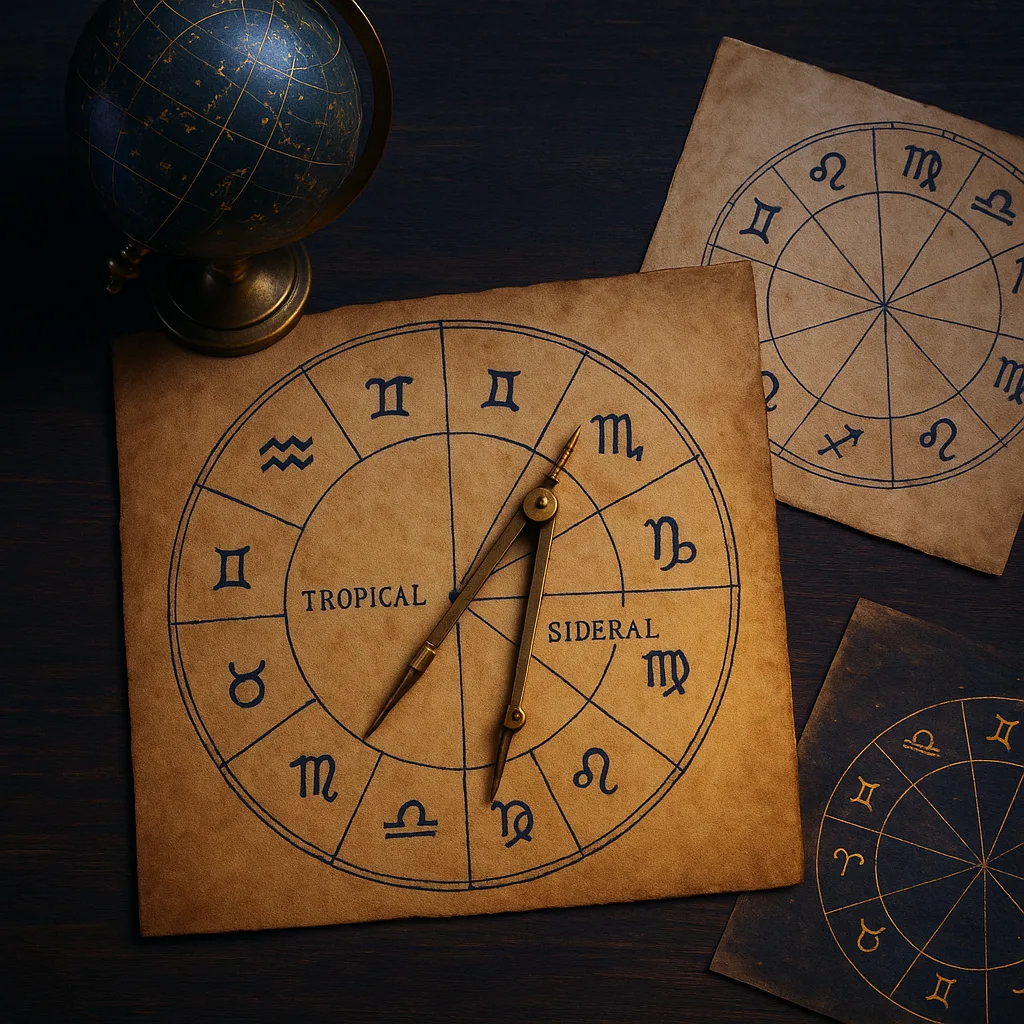
It was Ptolemy who consolidated the use of the zodiac created by Hipparchus, a system that counts from the spring equinox, rather than from the actual position of the constellations in the sky. This technical choice is the origin of the difference that exists to this day between tropical astrology, used in the West, and sidereal astrology, practiced in the Indian Vedic tradition: two ways of organizing the same sky, each with its own logic. This divergence explains, for example, why the same birth can result in different sun signs depending on which system is used, as shown in the article about the ayanamsha and why the sign changes in Vedic astrology.
This systematization did not happen in isolation: it dialogued with Greek philosophy of the time, especially ideas present in Plato's Timaeus, about the soul of the world and the harmony between sky and human existence. Another relevant name from the period is Vettius Valens, Ptolemy's contemporary, whose work Anthology brings together over one hundred interpreted real charts, a rare practical record of how Hellenistic astrology was applied in daily life. This knowledge almost disappeared over time and only regained strength starting in the 1990s, when a movement of translators and researchers began to recover original Greek texts, an effort that still fuels interest in what is called traditional astrology. Ptolemy's trajectory as a dual figure, astronomer and astrologer at once, is discussed in more detail in The Mathematicus of the Sky: astrologers and astronomers who were the same person in history.
India: the Lord of Light and Vedic astrology
Further east, India developed its own astrological tradition, Jyotisha, a Sanskrit word that combines jyoti (light) and isha (lord), forming something like 'lord of light', a direct reference to the Sun, Moon, planets, and stars. Jyotisha holds a prominent place among the six traditional branches of Vedic study, considered the oldest of them, originally created with a practical function: to establish a reliable calendar for rituals and harvests.
There is, however, an academic debate about how far this astrology is actually as ancient as the Vedas themselves. The systematized written records we know are more recent, developed mainly in medieval texts after the seventh century. Some hypotheses suggest this tradition formed through contact between Indo-Aryan peoples and Babylon, through the first Persian empire; others point to more direct Hellenistic influence, reaching India after Alexander's conquests. In the great Indian epics, like the Ramayana and the Mahabharata, what appears is still something simpler: elective astrology, dream interpretation, and reading of physical features, not the complex system of natal charts that would later develop, with texts like the Brihat Parashara Hora Shastra, attributed to the sage Parashara. Those who want to understand how this system works in practice can move on to Jyotish beyond the switched sign: nakshatras, Rahu and Ketu in Vedic astrology or to Vimshottari Dasha: the 120-year planetary calendar that Western astrology doesn't have.
One sky, many languages
What this journey through different cultures shows is not that one tradition copied another, but that the impulse to seek meaning in the sky appears in practically all of them. Mesopotamians, Egyptians, Greeks, and Indians, each in their own time and with their own symbols, felt something similar to what many people feel today when looking up on a clear night: the sense that there is a relationship between what happens above and what happens in everyday life.
The table below summarizes the central points of each tradition addressed in this text, organizing what each civilization produced and when approximately it happened:
| Civilization | Approximate period | Main contribution | Central record or figure |
|---|---|---|---|
| Mesopotamia (Babylon) | 2nd millennium BCE onward, compilation in 7th century BCE | Celestial omens linked to the fate of king and State, sexagesimal system, precession of the equinoxes | Enuma Anu Enlil, 70 tablets, approximately 7,000 omens |
| Ancient Egypt | Parallel to Mesopotamia | Calendar of 12 months and 24-hour day, system of decans | Zodiac of the Temple of Dendera, now in the Louvre Museum |
| Greece (Hellenistic period) | 2nd century CE | Theoretical systematization of the tropical zodiac, connection with philosophy | Ptolemy (Tetrabiblos) and Vettius Valens (Anthology) |
| India (Vedic tradition) | Systematized texts from 7th century CE onward | Jyotisha, calendar for rituals and harvests, sidereal zodiac | Brihat Parashara Hora Shastra, attributed to Parashara |
The astrology practiced today is, in essence, a mosaic: a bit of Babylonian precision, a bit of Egyptian symbolism, Greek theoretical structure, and Vedic spiritual depth, all of it crossing centuries to reach our days.
Knowing these origins helps to understand the birth chart with greater depth: when observing it today, we are participating in a conversation that began long before us, between peoples who never met, but shared the same question before the starry sky.
Frequently asked questions
Which ancient civilization is considered the origin of astrology?
Mesopotamia, mainly Babylon, is the most documented tradition and is usually pointed to as the birthplace of systematized astrology, with records like the Enuma Anu Enlil dating back to the second millennium BCE. Egypt, Greece, and India developed their own traditions that later crossed with this Mesopotamian foundation.
What is the difference between tropical and sidereal astrology?
Tropical astrology, consolidated by Ptolemy from Hipparchus's zodiac, counts the signs from the spring equinox. Sidereal astrology, used in the Indian Vedic tradition, is based on the actual position of the constellations. This technical difference is what explains why the same birth can receive different signs in each system.
What is Jyotisha?
Jyotisha is the name of Indian Vedic astrology, a Sanskrit term meaning something like 'lord of light'. It is one of the six traditional branches of Vedic study, originally created to establish a reliable calendar for religious rituals and agricultural activities, before becoming the complex system of natal chart interpretation that exists today.
Who was Ptolemy and what was his role in astrology?
Claudius Ptolemy was an astronomer and astrologer who lived in Alexandria in the second century CE. He wrote the Tetrabiblos, a work that systematized rules and foundations of Hellenistic astrology, and consolidated the use of the tropical zodiac that the West uses to this day.
Were Egyptian and Mesopotamian astrology the same?
No. They were parallel traditions, developed almost at the same time, but with different focuses: Mesopotamian astrology was more linked to omens about the fate of the State and the king, while Egyptian astrology concentrated on calendar organization and the system of decans, which later influenced the division of the twelve Greek zodiacal signs.

Recomendado
Manual Prático da Astrologia
O universo sempre exerceu um fascínio indescritível sobre a humanidade. De todas as suas maravilhas, a astrologia se destaca como uma antiga arte que tem intrigado e inspirado gerações.
Universo Astral Editorial Team · Zodiac signs and fun facts
This article was produced by the Universo Astral editorial team, with AI tools assisting research and drafting and human review before publication. If you spot anything inaccurate or outdated, let us know at our contact email.