The Life Line in Palmistry: How to Read It Without Confusing It with Lifespan
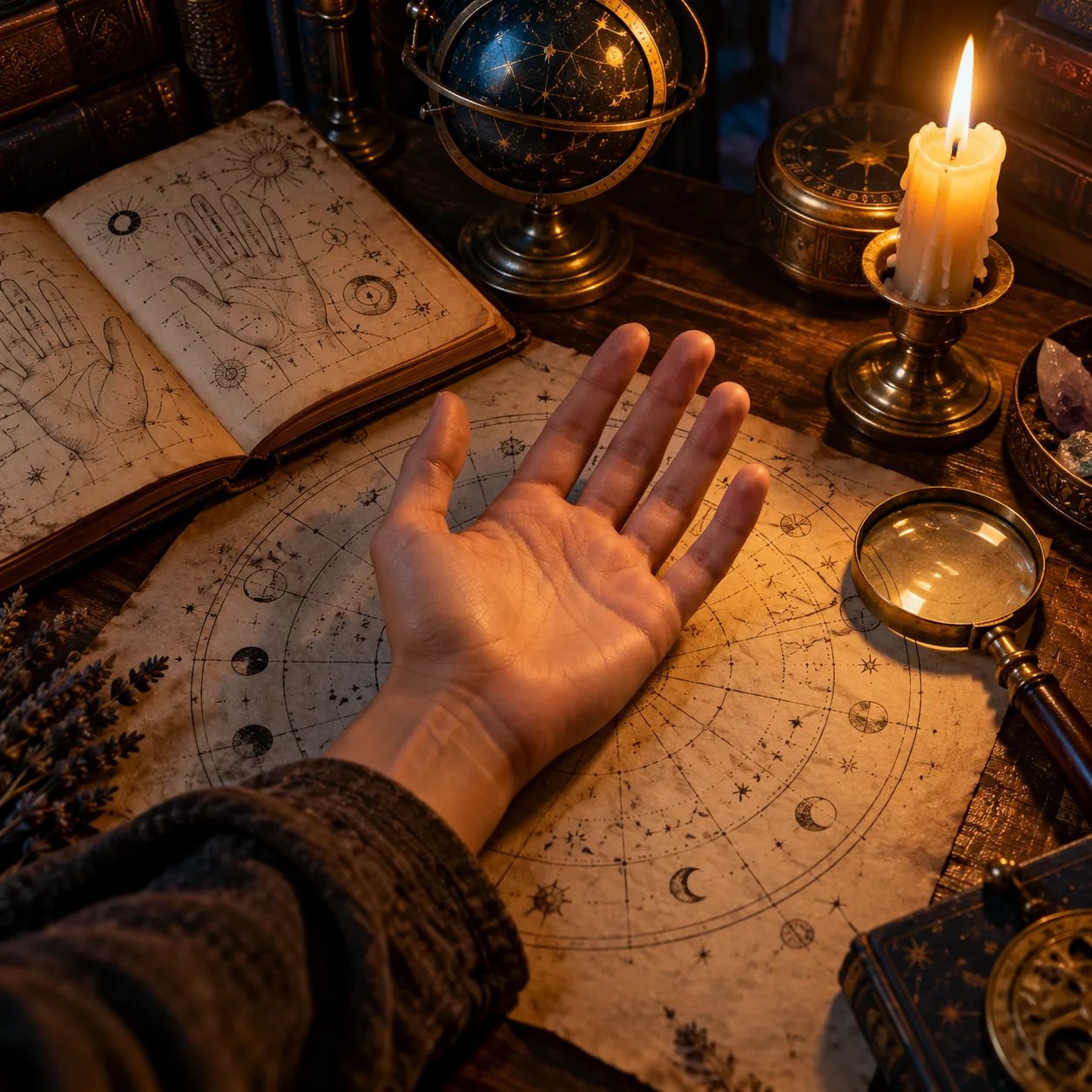
If there is one belief about palm reading that has spread faster than any other, it is this: that a short line on the palm means an early death. The idea shows up in movies, in family conversations, in memes. And according to palmistry's own tradition, it is wrong, or at least oversimplified to the point of distorting what the life line actually represents.
The myth that even classic palmists do not support
The claim that the length of the life line predicts how long someone will live is, today, the most cited and most disputed misunderstanding within palmistry itself. It is not a rule that appears consistently in the systematic texts of Indian, Chinese or Western tradition. It has much stronger roots in 19th century folklore, especially in the parlor fortune-telling that became fashionable among European and American aristocracy at the time, than in any codified reading system.
Part of the confusion can be traced back to Cheiro himself, the pen name of Irishman William John Warner (also known as Count Louis Hamon), the most influential palmist of the late 19th and early 20th century. In his 1894 work, Cheiro used ambiguous language when describing the life line, which helped cement the popular confusion. Even so, in that same text, he argued that the line reflected everything affecting a person's life, including physical strength and changes of climate or country, not just its duration. In other words, even the author most cited behind the popularization of the idea was already pointing to a broader reading than simply counting years.
What science found when it tested the hypothesis
Curiously, the correlation between life line length and actual life expectancy has already been the subject of formal research, with results that contradict each other and, taken together, do not support a literal reading. An early study from 1974 statistically compared line length with life expectancy and found no significant correlation. A second study, from 1990, which measured the line on a hundred cadavers, reached the opposite result, reporting a meaningful correlation. Later research that tried to replicate that finding, using linear regressions to compare line length with age at death, did not confirm the 1990 correlation, and also found no relevant differences between men and women or between right and left hands.
The overall picture from these tests is one of conflicting results and, in most replication attempts, an absence of statistical correlation. This does not erase the symbolic or cultural value of palmistry, but it does make clear that treating the life line as a literal marker of longevity holds up neither in the more careful tradition nor in attempts at empirical verification.
Where palmistry comes from and why it has survived for centuries
The exact origin of palm reading is uncertain, but much of the tradition points to ancient India as one of its most likely birthplaces, from where the practice may have spread to other regions, including influencing the fortune-telling traditions of the Roma people. In India, the system is known by the Sanskrit term Hasta Samudrika Shastra, also spelled Samudrik Shastra, and is historically linked to Vedic astrology, or Jyotish. Indian tradition attributes to the sage Valmiki a text of 567 verses devoted to reading men's hands, though this dating is treated as cultural tradition rather than something with rigorous academic proof.
The practice was also recorded in China, Tibet, Persia, Mesopotamia and ancient Egypt, and went through significant development in Greece, where figures such as Aristotle, Anaxagoras, Hippocrates and Galen reportedly addressed the subject in their writings. According to the Encyclopaedia Britannica entry on palmistry, the practice crossed different cultures over the centuries, and in medieval Europe it was even distorted and used by witch hunters, who interpreted skin pigmentation marks as signs of a pact with evil forces (source: britannica.com).
In the 19th century, two authors helped systematize the modern vocabulary of Western palmistry. Besides Cheiro, with his works Cheiro's Language of the Hand (1894) and Cheiro's Palmistry for All (1916), palmist William Benham published The Laws of Scientific Hand-Reading in 1900, establishing an important technical distinction: chirognomy, the study of the hand's overall shape, and chiromancy, the specific reading of the lines. It was also during this period that the system of seven main lines attributed to Cheiro became popular: Life, Head, Heart, Girdle of Venus, Health, Sun and Fate.
What the life line actually represents
Setting aside the idea of counting years, palmistry traditionally links the life line to a much richer set of symbolic meanings:
- Physical vitality and overall energy: a person's constitutional strength, not an expiration date.
- Major turning points: moves to a new home, a new country, a change of climate, or important biographical crossroads, a reading that already appeared in Cheiro's own writings.
- Periods of personal transformation: breaks and fresh starts, usually identified through specific marks along the line itself.
- Physical resilience: the depth and clarity of the line, traditionally read as signs of a stronger or more vulnerable constitution, with no clinical basis whatsoever.
The life line also plays a structural role on the palm: it curves around the Mount of Venus, the fleshy area at the base of the thumb. In tradition, the more developed that mount is, the more vital the combined reading of both features is considered.
Step by step: how to locate and interpret the line
For anyone who wants to examine their own hand more closely, the traditional reading follows a fairly simple sequence of steps:
- Find the curved line that starts in the space between the thumb and index finger and runs down around the base of the thumb toward the wrist.
- Note its length, but keep in mind that, in the more careful tradition, this relates to the breadth of a person's sphere of vitality, not a count of years.
- Assess the depth and clarity of the line: a deep, continuous line is usually read as a sign of a resilient physical constitution, while a faint or fragmented one suggests periods of vulnerability.
- Look for breaks: interruptions in the line, traditionally associated with abrupt changes or specific health or life crises.
- Look for islands: small oval shapes within the line itself, read as periods of low energy or greater difficulty.
- Check for parallel lines, known as sister lines, running alongside the main line, which are read as an extra boost of vitality during a particular phase of life.
- Relate what you observe to the development of the nearby Mount of Venus, considered complementary to the reading.
- Compare the dominant hand with the non-dominant one: in the distinction proposed by Cheiro, the non-dominant hand would show innate tendencies, while the dominant hand would reveal what has been shaped by life experience. This is a symbolic reading, with no proven empirical basis.
How the life line differs from the other main lines
Part of the confusion around the life line also comes from mixing it up with the other lines on the palm. The table below organizes the four most commonly cited lines in classic palmistry, what tradition attributes to each, and the most common popular myth associated with it:
| Line | Location on the palm | What tradition says it reveals | Common associated myth |
|---|---|---|---|
| Life Line | Curves around the Mount of Venus, at the base of the thumb | Vitality, physical energy, major turning points | Predicts how many years you will live |
| Head Line | Horizontal, crossing the center of the palm | Thinking style and decision-making | Determines your IQ |
| Heart Line | Horizontal, near the base of the fingers | Emotional tendencies and openness in relationships | Determines if and when you will get married |
| Fate Line | Vertical, in the center of the palm | Career shifts and life trajectory | Shows whether you are guaranteed professional success |
It is worth noting that, much like astrology works with multiple layers of interpretation (a single planet never tells the whole story, just as the first astrological house needs to be read alongside the rest of the chart), traditional palmistry never treats a single line as the final word on an entire life.
Why it makes more sense to treat the life line as a symbolic system
Palmistry, like astrology or tarot, works as a symbolic language built over centuries, not as a tool for scientific prediction. Formal research testing the hypothesis that life line length predicts actual lifespan has produced conflicting results, and the most recent replication attempts found no meaningful statistical correlation. This reinforces that the most honest reading, even within palmistry's own tradition, is one that links the line to vitality and moments of transformation, not to a deadline etched into the skin.
Anyone drawn to other symbolic self-knowledge systems, such as numerology, will find a similar logic: numbers and features reveal tendencies and potential, not fixed sentences. It is the same reasoning applied, for example, to calculating your destiny number in numerology, where the result points to likely paths rather than absolute certainties.
Frequently Asked Questions
Does a short life line mean an early death?
No, according to both the more careful palmistry tradition and the empirical studies that tried to test this hypothesis. Results found over the decades have conflicted with each other, and the most recent replication attempts found no correlation between line length and actual life expectancy.
What does the life line actually represent in palmistry?
It is traditionally linked to physical vitality, a person's overall energy, and major turning points, such as moving to a new country, a change of climate, or important biographical crossroads. Breaks, islands and doubled lines along the way are read as markers of specific periods of transformation or recovery.
How do you find the life line on your hand?
It is the curved line that starts in the space between the thumb and index finger and runs down around the base of the thumb, the area known as the Mount of Venus, toward the wrist. It is one of the easiest lines to identify on the palm because of this distinctive curve.
What does a break in the life line mean?
In traditional reading, a break, or interruption in the line, is usually associated with abrupt changes or specific periods of crisis, whether related to health or life circumstances. When a parallel line appears near that break, tradition reads it as a sign of recovery or extra vitality support during that phase.
Is there scientific proof behind palmistry?
No. Palmistry is a symbolic, cultural system with centuries of tradition across different civilizations, but it has no scientific standing as a predictive tool. Studies that specifically tested the correlation between life line length and actual lifespan have produced conflicting results, and most recent replications have not confirmed that correlation.
Universo Astral Editorial Team · Zodiac signs and fun facts
This article was produced by the Universo Astral editorial team, with AI tools assisting research and drafting and human review before publication. If you spot anything inaccurate or outdated, let us know at our contact email.