The Sky's Mathematicians: When Astrologers and Astronomers Were the Same Person
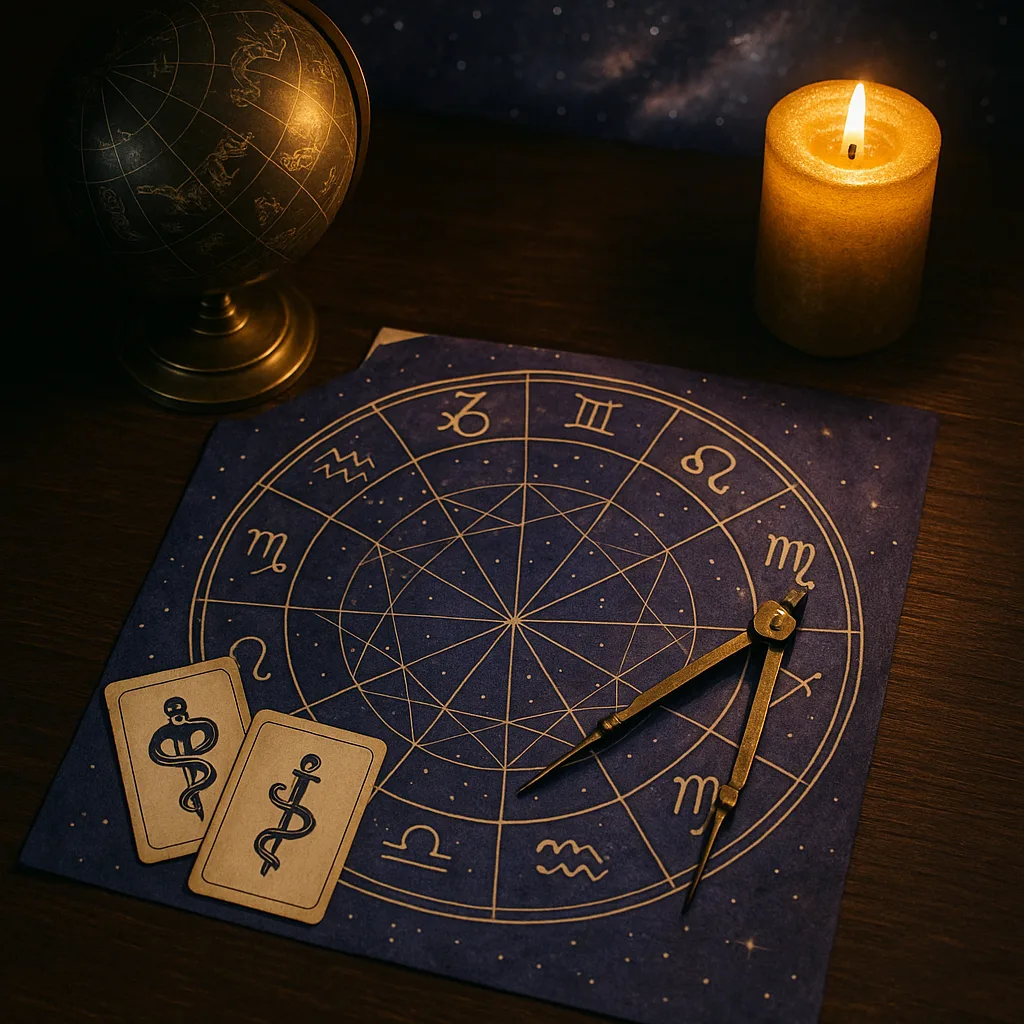
There was a time when asking “are you an astrologer or an astronomer?” made absolutely no sense — because the answer was always both at once. In European courts up through the 15th century, nearly every king, pope, or emperor kept a professional on staff who calculated planetary movements with mathematical rigor and, in that very same task, read those movements for signs of human fate. This professional even had a title of their own: mathematicus, a word that blended mathematics, astronomy, and astrology into a single job description. In this journey through history, we'll meet some of the figures we'd now sort into two separate categories, but who at the time were simply people who knew how to read the sky.
Long before it all: the sky-watchers of Mesopotamia
The roots of this fusion lie in Mesopotamian records dating back thousands of years BCE, when the phases of the Moon were already being carved into pieces of bone as a form of omen-reading. The region's political instability led kings and emperors to keep teams of “sky watchers” — officials who reported on eclipses, comets, and planetary positions to guide matters of state. Fragments from the reign of Sargon of Akkad, around 2870 BCE, show predictions based on the Sun, the Moon, the planets, and even atmospheric phenomena. There was no distinction between watching the sky out of scientific curiosity and watching it to foresee the future: it was the same activity, carried out by the same kind of professional.
Ptolemy: the name behind both traditions
If one figure perfectly sums up this fusion, it's Claudius Ptolemy, who lived in Alexandria around the 2nd century CE. He authored two texts that, on their own, held up a thousand years of knowledge about the sky: the Almagest, the undisputed reference for calculating planetary motion, and the Tetrabiblos, a treatise that organized much of natal and horary astrology as we know it today, laying out the division of signs, houses, and each planet's influence on human temperament.
Historian F. E. Robbins described the Tetrabiblos as a text that held something close to “the authority of a Bible” among astrologers for over a thousand years — quite a testament to the weight Ptolemy carried across generations of sky scholars. He also cataloged over a thousand stars, three hundred of which he recorded for the very first time. Ptolemy saw no contradiction whatsoever between cataloging stars with precision and writing about how Mars shapes a person's temperament: to him, it was all part of the same effort to understand the order of the cosmos.
The Arab and Persian bridge that carried the torch through the Middle Ages
When Greek knowledge reached the Islamic world, it wasn't just preserved — it was expanded upon. Abu Ma'shar, known in the West as Albumasar, lived in Persia between 787 and 886 and wrote more than a hundred works spanning astrology, astronomy, philosophy, and theology. His Kitab al-Mawalid (Book of Nativities) and his Great Introduction to Astrology were translated into Latin and became standard reference manuals in medieval Europe, to the point that his name was cited with the same reverence given to Ptolemy.
Meanwhile, in 13th-century Italy, Guido Bonatti served as astrologer and court mathematician to powerful figures like Emperor Frederick II and King Henry III of England. He gathered his knowledge into the Liber Astronomiae, a seven-part work written around 1277 — one of the most comprehensive compendiums of medieval astrology, blending astronomical technique and destiny interpretation without any separation between the two.
Also worth mentioning is Regiomontanus, a 15th-century German astrologer who traveled to Italy in search of original Ptolemy manuscripts and, in 1471, set up in Nuremberg what's considered the first European astronomical observatory. He was the one who printed ephemerides valid for thirty years and developed a house-division system that some astrologers still use today. One man, two crafts, no perceived contradiction.
Recomendado
Astro Reflexo
Descubra o que os astros revelam sobre quem você é. Em menos de um minuto, calculamos seu Sol, Lua e Ascendente com precisão astronômica e uma inteligência artificial escreve um resumo personalizado só para você.