Vedic Astrology 101: Nakshatras, Rahu, Ketu & Jyotish Explained
One Sky, Two Different Ways of Measuring It
Two people can watch the same sunset and describe it differently: one checks the time on a clock, the other notes the Sun's exact position against the mountains on the horizon. Both descriptions are accurate. They just use different reference points. That's close to how Western astrology and Jyotish, the Vedic astrology practiced in India for thousands of years, relate to each other. Neither system is right or wrong. They are two internally consistent ways of reading the sky, each following its own logic.
The technical reason someone can be one sun sign in Western astrology and another in the Indian tradition has been covered before. That's only the starting point, though. Jyotish includes entire layers of technique with no direct equivalent in the astrology most Westerners grow up with, and that's where the real difference between the two systems shows up.
The Root of the Divide: One Zodiac Tied to the Seasons, the Other Tied to the Stars
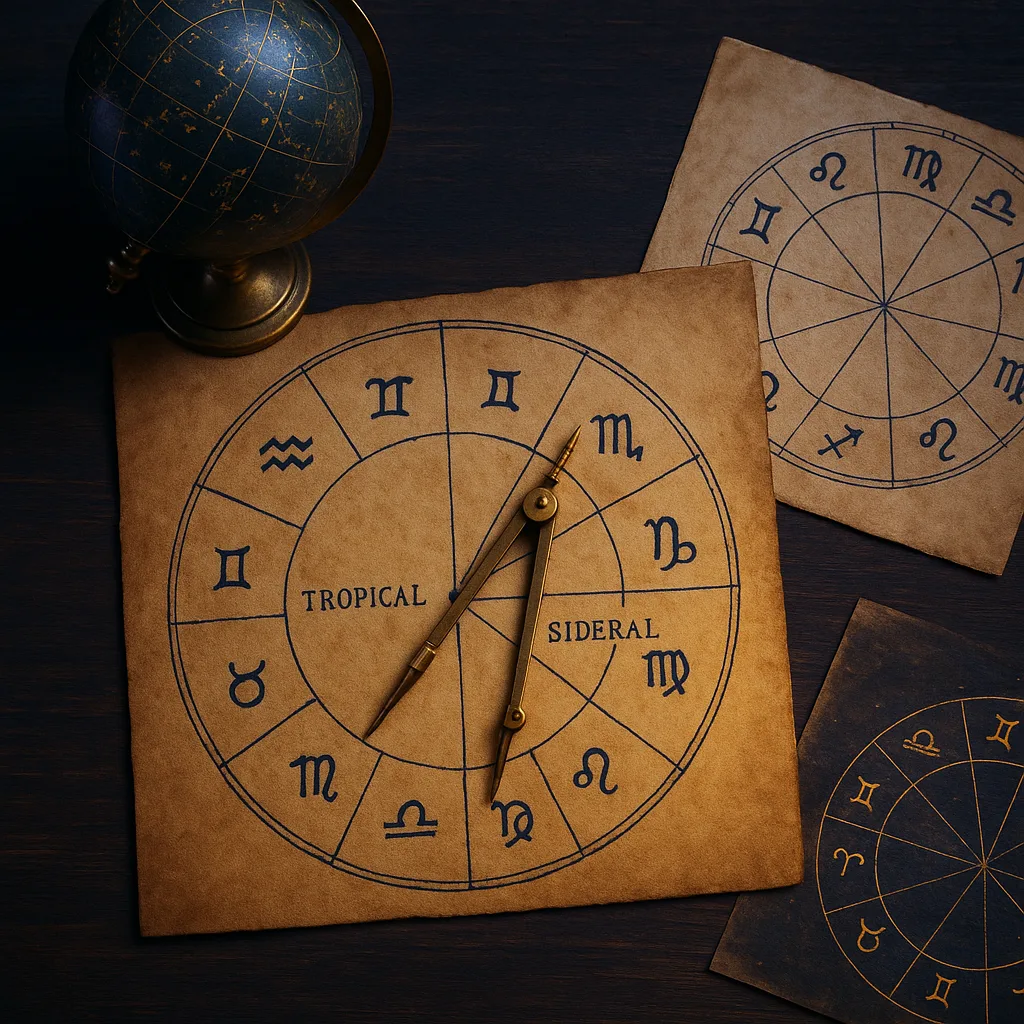
Western astrology uses the tropical zodiac, which begins at Aries the moment the Sun crosses the celestial equator during the Northern Hemisphere's spring, in March. This zodiac moves with the seasons: it works essentially as a symbolic solar calendar. Jyotish uses the sidereal zodiac instead, anchored to the constellations actually visible in the sky. When a Vedic astrologer says the Sun is in Aries, they mean the Sun is physically aligned with the constellation Aries at that moment, as seen from Earth.
About two thousand years ago, the two zodiacs nearly lined up. Earth's axis wobbles slowly, similar to a spinning top losing momentum, completing a full cycle in 26,000 years. This is known as the precession of the equinoxes. Each year the drift pushes the two systems about 50 arc-seconds further apart, and over two millennia that adds up to a gap of roughly 24 degrees between the tropical and sidereal zodiacs today.
This gap, not a calculation error, explains why someone born in April might be an Aries in a Western chart and a Pisces in a Vedic one. The two systems measure different things. One tracks the Sun's relationship to the seasons, the other tracks the Sun's position against the fixed stars.
The Ayanamsha: The Measuring Stick Even Vedic Astrologers Don't Agree On
To calculate the correction between the two zodiacs, Jyotish uses a value called the ayanamsha, an adjustment that shows exactly how many degrees separate the tropical starting point of Aries from the sidereal one. The system officially adopted in India is the Lahiri, also called Chitrapaksha, used as the reference for the Indian Astronomical Ephemeris and for official government calculations. It's anchored to the fixed star Spica, placed at exactly zero degrees of sidereal Libra, and currently sits around 24 degrees and 7 to 8 minutes, increasing by about 50 arc-seconds each year.
Lahiri isn't universally agreed upon, though. Other ayanamshas are also used, such as Fagan-Bradley, currently near 24 degrees and 44 minutes, and Raman, around 22 degrees and 30 minutes, almost a full degree and 40 minutes smaller than Lahiri. That might sound like a minor detail, but a difference of just six arc-minutes can shift which nakshatra, or even which subdivision of a nakshatra, a planet falls into. Even within the Vedic tradition, chart calculation isn't a single-formula matter. Different schools use different technical standards.
Seven Visible Planets, Two Invisible Points
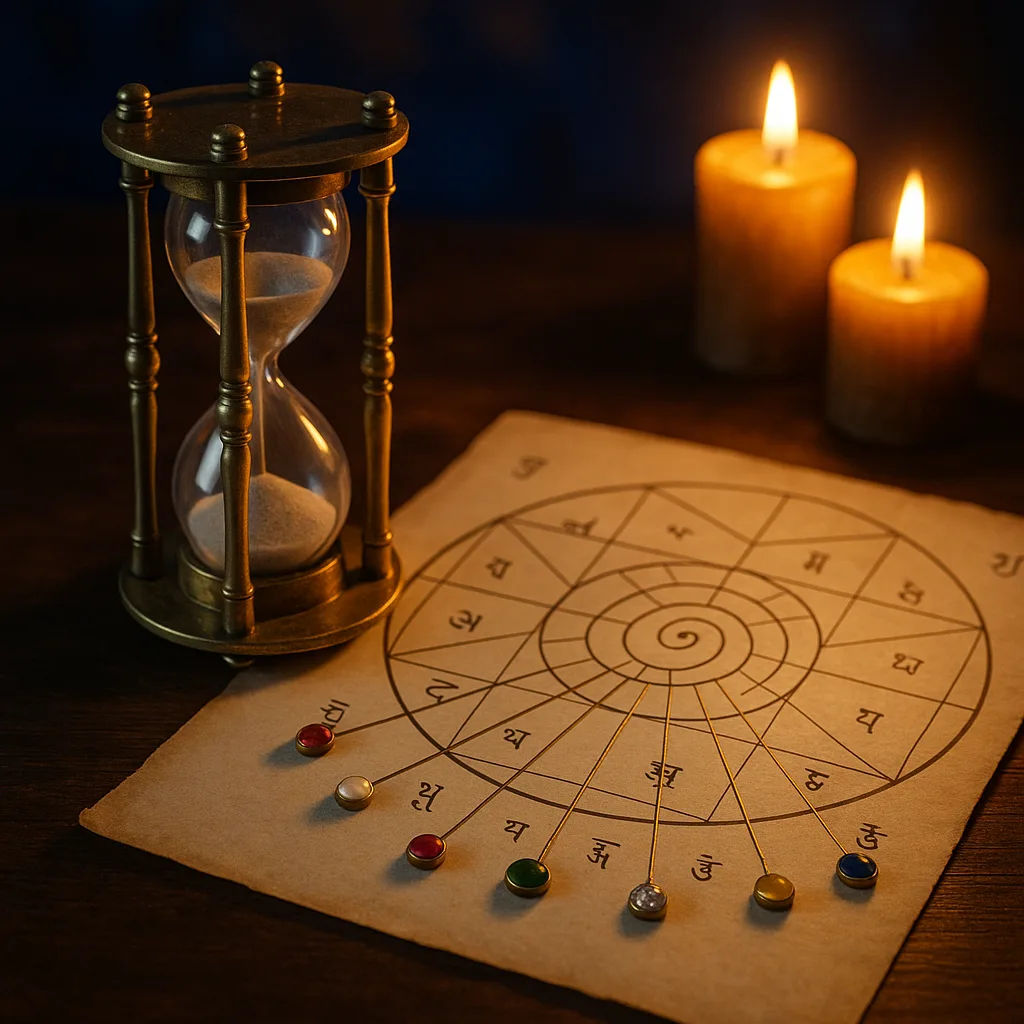
Another major difference is which bodies count. Modern Western astrology works with ten: the seven traditional ones (Sun, Moon, Mercury, Venus, Mars, Jupiter, and Saturn) plus Uranus, Neptune, and Pluto, discovered only in the last few centuries. Jyotish sticks to the seven bodies visible to the naked eye and adds two mathematical points: Rahu, the north lunar node, and Ketu, the south lunar node.
Rahu and Ketu aren't physical bodies. They are the points where the Moon's orbit crosses the Sun's apparent path. Western astrology acknowledges them, but mostly in a decorative role, mentioned occasionally in discussions about karma or recurring patterns. In Jyotish it's different: Rahu and Ketu carry the same analytical weight as a personal planet, tied to desire, obsession, detachment, and the karmic lessons a person carries. Skipping the nodes in a Vedic reading would be like reading a Western chart without considering the Moon.
The meaning of the traditional planets shifts too. Mars, for instance, takes on responsibilities in Jyotish beyond conflict and action. In certain readings it also relates to property, land, and, in some schools, the mother figure, associations that would sound unfamiliar to anyone who only knows the warrior Mars of Western tradition.
Bhavas: Houses Counted from the Ascendant
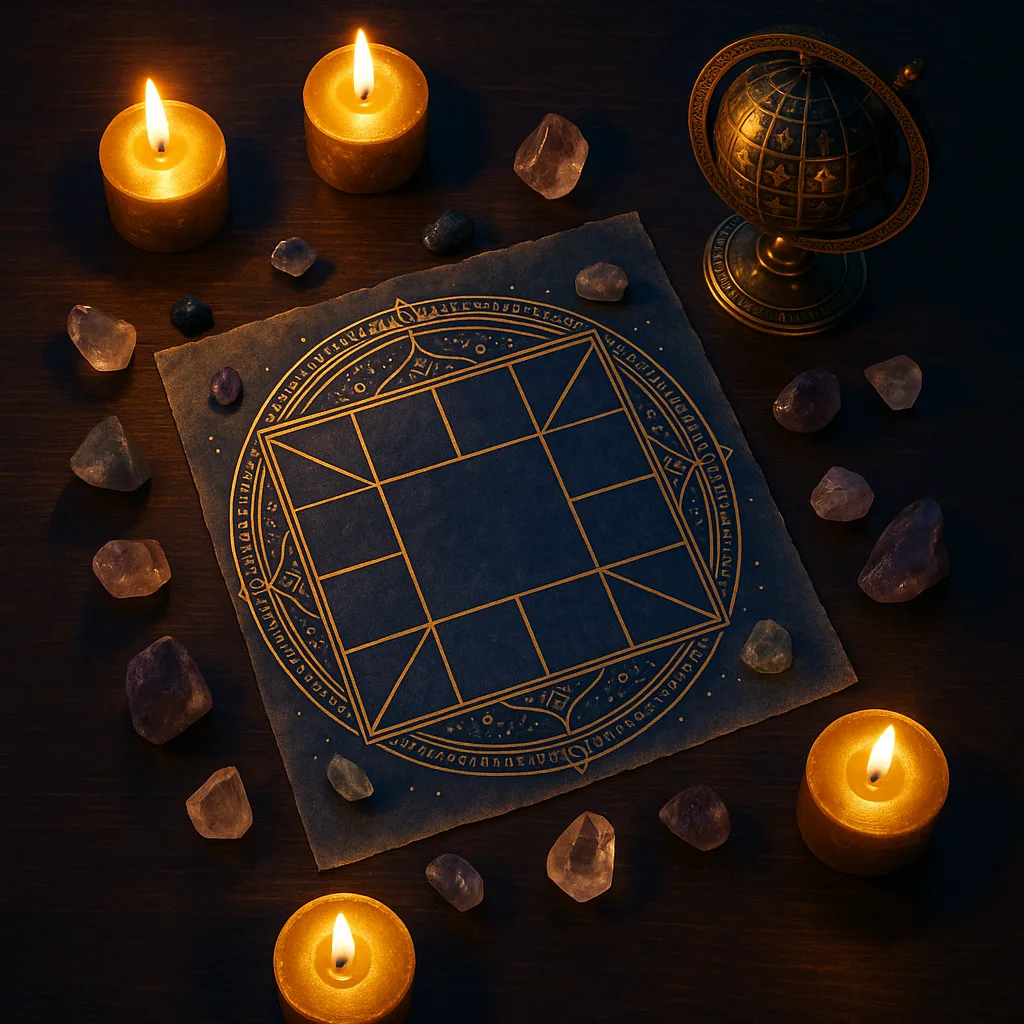
The house system follows its own logic too. In Vedic astrology houses are called Bhavas, and the starting point for the whole reading is the Lagna, the sign rising on the exact horizon at the moment of birth, equivalent to the Western Ascendant. From the Lagna, the astrologer maps out the twelve Bhavas and observes where each planet falls within that structure. The idea of using the Ascendant as an anchor exists in Western astrology too, but Jyotish gives it a bigger role: nearly the entire chart interpretation flows from the position and strength of that starting point.
Nakshatras: The Layer the West Simply Doesn't Have
If there's one element of Jyotish with no direct Western counterpart, it's the nakshatras, the 27 lunar mansions. Each nakshatra covers roughly 13 degrees and 20 minutes of the zodiac, and together they complete the full circle. The division follows the Moon's own rhythm: it travels through the zodiac in about 27 days, and each day corresponds, symbolically, to one of these lunar stations.
Western astrology tends to focus on the twelve signs and houses, but a Vedic astrologer also checks which nakshatra the Moon, and every other planet, occupies. Each nakshatra carries its own mythology, ruling deity, and symbolic temperament. It's as if, beyond knowing which neighborhood a planet lives in (the sign), Jyotish also wants to know which street of that neighborhood it's on. This extra layer of detail is one of the reasons techniques like lifespan calculations, the dasha system of planetary periods, and more detailed predictions have historically been more developed in the Vedic system than in the Western one.
Two Trees, One Mesopotamian Root
Neither system developed in isolation. Traditional astrology, modern Western astrology, and Vedic astrology all share influences tracing back to Mesopotamian civilization. The only major astrological system that developed independently of that common root was Chinese astrology. The Vedic tradition traces its own origins to the Vedas and the sage Parashara, placed by traditional accounts around five thousand years ago, a dating with symbolic and religious weight rather than academic historical consensus. It reflects how deeply this practice sees itself as part of an ancient spiritual revelation, not merely a calculation technique.
Understanding these differences isn't about deciding which system is more correct. It's about grasping what each one sets out to see. Anyone drawn to Jyotish isn't correcting Western astrology. They're opening a door to a different celestial language, with its own vocabulary of planets, stars, and cycles.

Recomendado
MAPA ASTRAL E NUMEROLÓGICO PERSONALIZADO
Mapa Astral + Numerologia Um mergulho profundo na sua essência. E se tudo o que você procura… já estivesse dentro de você - esperando para ser revelado?

Recomendado
Manual Prático da Astrologia
O universo sempre exerceu um fascínio indescritível sobre a humanidade. De todas as suas maravilhas, a astrologia se destaca como uma antiga arte que tem intrigado e inspirado gerações.

Recomendado
Astrologia, Simbolismo e Mapa das Personalidades
A astrologia acompanha a humanidade desde as primeiras grandes civilizações. A ideia de que a vida biológica na Terra pode ser influenciada pelos astros gerou e gera grande fascínio no homem.
Universo Astral Editorial Team · Zodiac signs and fun facts
This article was produced by the Universo Astral editorial team, with AI tools assisting research and drafting and human review before publication. If you spot anything inaccurate or outdated, let us know at our contact email.