Crystals for Each Zodiac Sign: How to Choose by Astrology
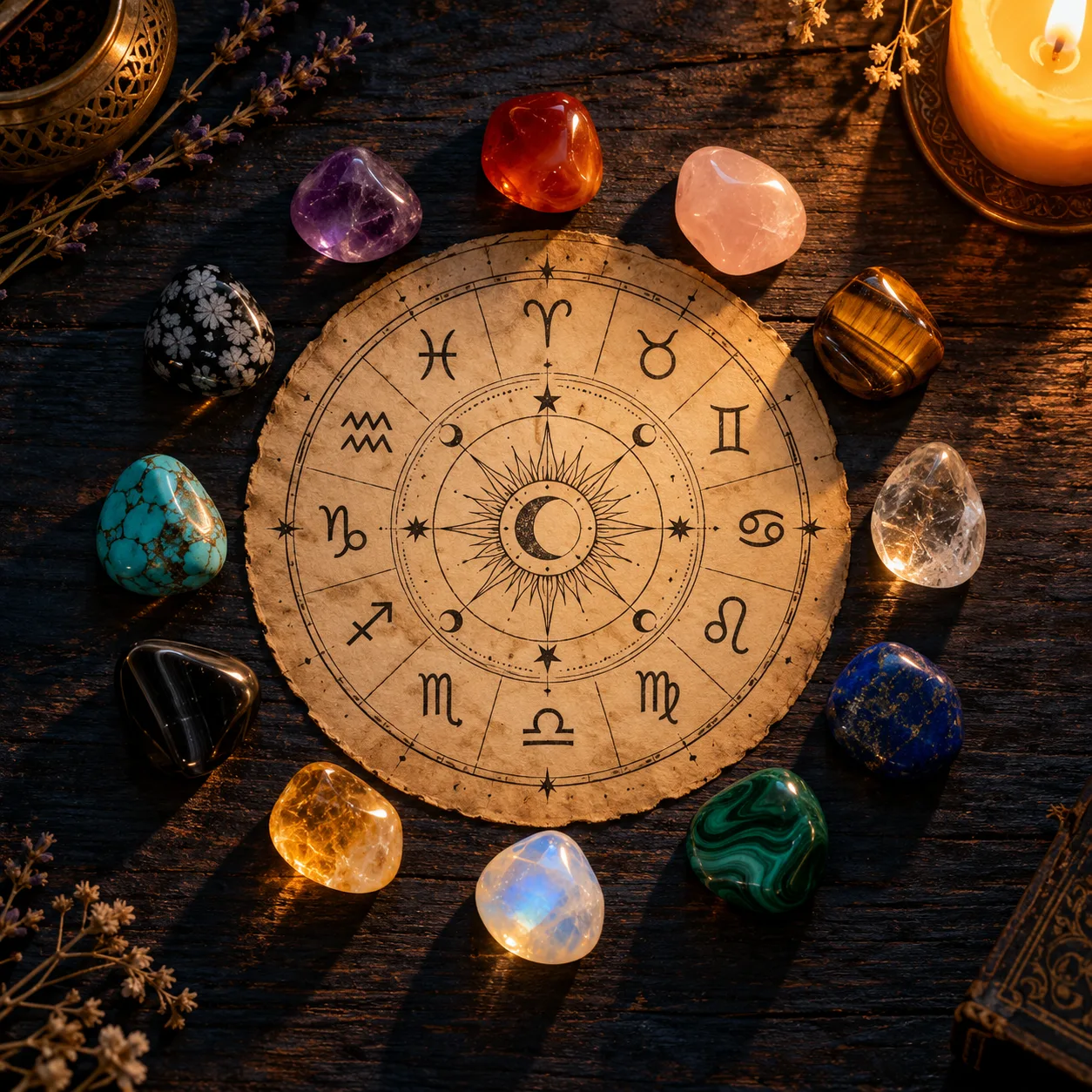
Anyone looking for their sign's crystal usually runs into lists that contradict each other: one site says turquoise for Sagittarius, another recommends citrine, a third bets on sodalite. That's nobody's mistake. Crystal healing has no single founding text that definitively assigns a stone to a sign. What exists is a logic repeated by different authors, built on two pillars borrowed from astrology itself: the sign's element and its ruling planet. Understanding that logic helps you choose a crystal with more awareness than simply copying the first list that pops up in a search.
A direct note before going further: the idea that crystals emit frequencies capable of acting on the body or emotions is language popularized by the New Age movement between the 1970s and 1980s, without physical evidence for the therapeutic effect usually attributed to it. The Encyclopaedia Britannica notes that, even at the height of this movement's popularity, critics quickly pointed out the unscientific nature of these claims (britannica.com). That doesn't invalidate the symbolic and ritual use of crystals, practiced for centuries across different cultures. It just means that here, we treat the crystal-sign pairing as a system of meaning, not a proven healing mechanism.
The real logic behind crystal and sign: element plus ruling planet
The twelve zodiac signs split into four elements (fire, earth, air and water) and three modalities (cardinal, fixed and mutable), and each one has a ruling planet. That pair, element and ruler, is the criterion most crystal healing authors use to justify a stone choice. The reasoning is associative: fire signs, linked to action and heat, tend to get red and orange-toned crystals; earth signs, linked to solidity, get green or earthy stones; air signs, linked to the mind, get clear or translucent crystals; water signs, linked to emotion, get blue or milky stones.
This reasoning isn't astronomy or mineralogy applied to health. It's symbolism built through color and thematic analogy. Even so, it has an internal coherence worth knowing before picking a stone, because it explains why two different lists can point to similar crystals (same color, same logic) even when coming from authors who never cited each other.
Table: element, ruler and the stone most cited by popular tradition
The table below crosses each sign's astrological data with the crystal most mentioned by contemporary crystal healing sources. Since there's no single authority on the subject, treat the right-hand column as the most common option among popular authors, not a fixed rule.
| Sign | Element | Ruling planet | Crystal most cited by popular tradition |
|---|---|---|---|
| Aries | Fire | Mars | Carnelian or red jasper |
| Taurus | Earth | Venus | Rose quartz or emerald |
| Gemini | Air | Mercury | Agate or citrine |
| Cancer | Water | Moon | Moonstone |
| Leo | Fire | Sun | Tiger's eye or citrine |
| Virgo | Earth | Mercury | Jasper or amazonite |
| Libra | Air | Venus | Rose quartz or lapis lazuli |
| Scorpio | Water | Mars (traditional) / Pluto (modern) | Obsidian or malachite |
| Sagittarius | Fire | Jupiter | Turquoise or sodalite |
| Capricorn | Earth | Saturn | Garnet or onyx |
| Aquarius | Air | Saturn (traditional) / Uranus (modern) | Amethyst or aquamarine |
| Pisces | Water | Jupiter (traditional) / Neptune (modern) | Amethyst or moonstone |
Notice that Scorpio, Aquarius and Pisces have dual rulership, one traditional (used since ancient astrology, before the modern planets were discovered) and one modern. That changes the logic behind the suggested stone: for Aquarius, those who follow Uranus's rulership tend to point to crystals associated with electricity and rapid transformation, like amethyst; those who follow Saturn prefer denser stones, like onyx. Neither is right or wrong, they're just different systems within astrological tradition itself.
Step by step: choosing a crystal from your own chart
Instead of searching for a ready-made list, you can apply the same reasoning crystal healing authors use, but consciously:
- Identify your sun sign from your birth date.
- Check that sign's element (fire, earth, air or water) in the table above.
- Check the ruling planet, deciding whether to use the traditional or modern rulership in the case of Scorpio, Aquarius and Pisces.
- Match the crystal's color and texture to the element's theme: fire calls for warm tones, earth calls for green or earthy tones, air calls for transparency, water calls for pale, milky tones.
- Within that color group, look for the stone whose symbolism is closest to the ruling planet's theme (Venus points to beauty and harmony, Mars to action, Saturn to structure, and so on).
- If you want to follow the popular custom of charging the crystal under the moon, pick the date of the next full moon or new moon to do it.
A worked example: someone with a Libra sun wants to choose a crystal using this method. Libra is air, ruled by Venus. Air suggests clear or translucent stones; Venus points to harmony and relationships. The overlap points to crystals like rose quartz (linked to Venus in nearly every list) or lapis lazuli (associated with the mental clarity of the air element). That's exactly the logic behind most recommendations circulating for this sign.
Where the idea of linking stone to sign comes from
This association didn't start with the New Age movement, though it was popularized by it. There's a much older precedent: the priestly breastplate described in the biblical tradition of Exodus carried twelve stones linked to the twelve tribes of Israel. In the first century, the historian Flavius Josephus linked these twelve stones to the twelve months and, by extension, to the twelve zodiac signs. In the fifth century, the theologian Jerome reinforced that same connection. It's one of the oldest Western roots of the idea that a stone is tied to a period of the year.
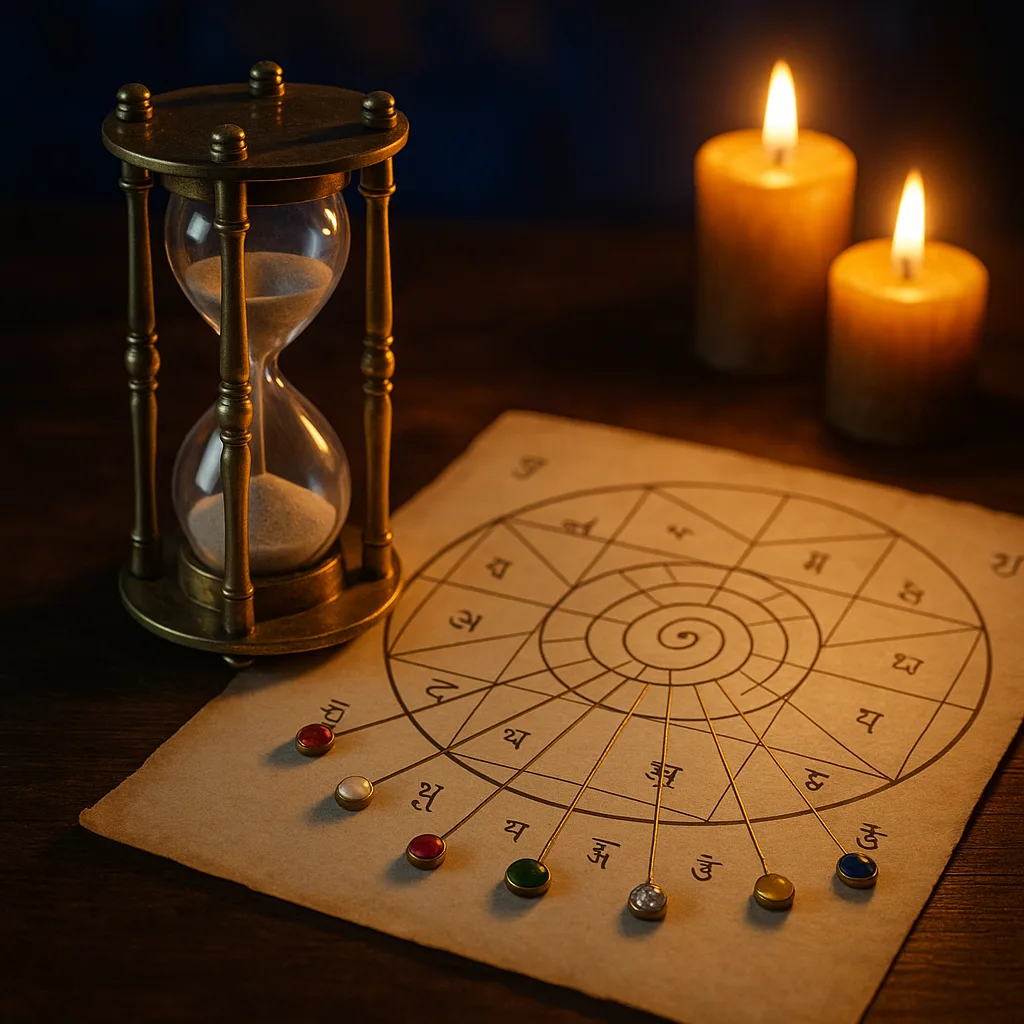
Outside the West, Indian Vedic astrology developed its own well-documented system: the Navaratna, nine gems linked to the nine celestial bodies called Navagrahas (Sun, Moon, Mars, Mercury, Jupiter, Venus, Saturn and the lunar nodes Rahu and Ketu). In this system, ruby corresponds to the Sun, pearl to the Moon, red coral to Mars, emerald to Mercury. It's a system of nine planets, not twelve signs, but it shows that the logic of linking a stone to a ruling celestial body is ancient and appears independently across different cultures.
It's important not to confuse this logic with the so-called birthstone, tied to the calendar month. That list was only standardized in 1912, by a jewelers' association in the United States, and follows a commercial criterion distinct from the element-ruler logic used in today's popular crystal healing. Anyone researching which crystal matches their zodiac sign is, most of the time, talking about a different tradition from the birthstone, even though the two sometimes overlap.
What's mineral fact and what's symbolic belief
One real piece of mineralogy is often cited to back up crystals' reputation: quartz has a piezoelectric property, meaning it generates a small electrical current under mechanical pressure. This phenomenon is verifiable and is used, for example, in quartz watches and certain industrial sensors. The problem is when this technical fact is used to suggest, without any basis, that the same crystal has a therapeutic effect on the human body when worn as a pendant or placed on the skin. These are two phenomena with no proven relationship to each other.
A review conducted by the British Psychological Society in 2001 on crystal therapies concluded there's no evidence of any effect beyond placebo. That doesn't mean the symbolic use of a crystal, as a gesture of attention, intention and personal ritual, has no subjective value for those who practice it. It just means that value is personal and cultural, not clinical.
Anyone wanting to follow the lunar logic used for charging crystals, another common crystal healing custom, can check the 2026 full moon calendar: January 3, February 1, March 3, April 1, May 1 and May 31, according to the astronomical calendar at timeanddate.com, which also covers the rest of the year with times adjusted for local time zones. To better understand how to read the sky day to day beyond this specific date, check out the guide on how to read planetary transits in your chart.
Why your sign's list might not feel right for you
If the suggested stone for your sun sign doesn't click, remember that the sun sign is just one layer of the birth chart. Many people identify more with the traits attributed to their own rising sign or natal Moon than to their Sun. That explains, for example, why someone with a Taurus sun might feel more represented by a crystal associated with Pisces, if their rising sign or Moon falls there. To understand this difference more deeply, the article on the difference between sun sign and rising sign helps map which point in the sky you're actually trying to represent with the stone you choose.
Frequently asked questions
What's the crystal for my sign?
It depends on which list you consult, since there's no single official source. The most consistent way to find out is to cross your sign's element (fire, earth, air or water) with your ruling planet's theme, and look for a crystal whose color and symbolism match both factors.
Is there scientific proof that a sign's crystal works?
No. Reviews like the one from the British Psychological Society in 2001 found no evidence of any effect beyond placebo in crystal therapies. The idea of vibrational frequency comes from the New Age movement of the 1970s and 1980s and should be understood as symbolic language, not measurable fact.
Why do some zodiac crystal lists differ from each other?
Because each crystal healing author applies the same general principle (element plus ruling planet) in a slightly different way, and because signs like Scorpio, Aquarius and Pisces have dual rulership, traditional and modern, which changes which crystal seems most fitting.
Are birthstones and zodiac crystals the same thing?
No. The birthstone follows a list tied to the calendar month, standardized by American jewelers in 1912. The zodiac crystal, used in crystal healing, follows a different logic, based on the element and ruling planet of the zodiac sign.
How do people typically activate the crystal linked to their sign?
A common custom, with no scientific basis, is leaving the crystal exposed to the light of the full moon or new moon overnight, as a symbolic gesture of renewal. This has no connection to the mineral's physical properties, it's simply a cultural ritual associated with the practice.

Recomendado
Astrologia, Simbolismo e Mapa das Personalidades
A astrologia acompanha a humanidade desde as primeiras grandes civilizações. A ideia de que a vida biológica na Terra pode ser influenciada pelos astros gerou e gera grande fascínio no homem.
Universo Astral Editorial Team · Zodiac signs and fun facts
This article was produced by the Universo Astral editorial team, with AI tools assisting research and drafting and human review before publication. If you spot anything inaccurate or outdated, let us know at our contact email.