Tarot for Beginners: The 22 Major Arcana and How to Start Learning
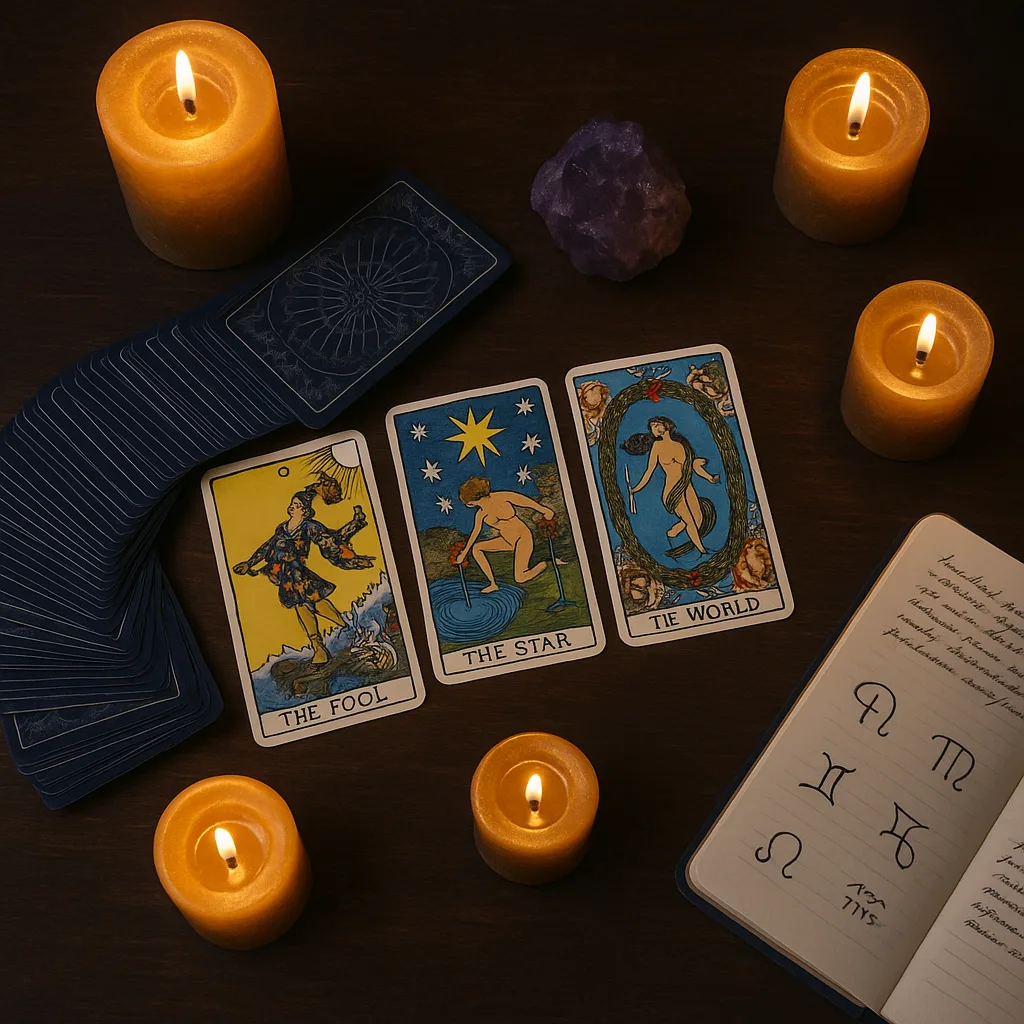
Tarot as a mirror, not a sentence
Some people come to tarot out of curiosity, some out of pain, and some simply because a card fell in front of them at a moment that seemed too perfect to be coincidence. Whatever the entry point, there's an important invitation from the start: approach tarot as a symbolic mirror, not as an oracle that carves fates in stone. The cards don't write the future. They illuminate possible paths, tendencies, and inner voices we often prefer not to hear. This is the spirit behind our conversation about the Major Arcana, the symbolic heart of the deck.
78 cards, two different natures
A traditional tarot deck has 78 cards, divided into two families that speak to each other but deal with distinct things. The Minor Arcana, made up of 56 cards organized into four suits, speak to daily life: a misunderstanding with a friend, anxiety before an interview, the joy of a small but meaningful achievement. The Major Arcana, by contrast, are the 22 cards that carry the great themes of human existence: transformation, purpose, love, loss, symbolic death, rebirth. When one of these cards appears in a reading, it's often said that the moment being lived carries archetypal weight, that it goes beyond the detail of daily life and touches something broader in the path of the person asking.
The word arcana itself comes from Latin and means 'secret' or 'mystery', a fitting name for cards that, across centuries, have been read as fragments of wisdom older than any of us.
To better understand how these themes unfold in specific contexts, it's worth exploring how tarot suits speak about work and money, since this language of the Minor Arcana complements the structure of the Major.
The Fool's Journey: a story told in 22 scenes
Of the 22 Major Arcana cards, 21 carry numbers and only one has no number at all: The Fool. This absence is no accident: The Fool represents the starting point, the moment before any label, when we don't yet know what we'll become. From there, the numbers go from I to XXI, and this progression is traditionally read as a continuous narrative, called by many scholars the Fool's Journey.
The sequence works like a story in chapters. The Fool sets out into the world with faith and spontaneity. The Magician awakens his talents and tools. The Priestess reveals silent intuition. The Empress and Emperor teach about creation and structure. The story advances through trials like Death (not literal, but symbolic: the necessary end of a cycle) and The Hanged Man (the pause that demands a new perspective), until it reaches cards of rescue and light, like The Star, and finally The World, the arcanum numbered XXI, which closes the cycle with a sense of completeness and integration.
The journey is not a straight line, but a spiral: we revisit the same themes at different levels of consciousness, each time understanding a little more.
This idea of a spiral might be the most generous teaching the Major Arcana offer: growth is not moving forward without looking back, but returning to the same lessons with different eyes.
| Arcanum | Number | Central Theme |
|---|---|---|
| The Fool | 0 (no number) | Departure, innocence, risk |
| The Magician | I | Will, manifestation, personal power |
| The Priestess | II | Intuition, mystery, hidden knowledge |
| The Empress | III | Creation, fertility, abundance |
| The Emperor | IV | Authority, structure, order |
| The Hierophant | V | Tradition, teaching, faith |
| The Lovers | VI | Choice, love, union of opposites |
| Death | XIII | Transformation, ending, renewal |
| The World | XXI | Conclusion, completeness, integration |
One curiosity helps explain why tarot is not a closed system: the position of two cards, Strength and Justice, shifts depending on the deck's tradition. In the Tarot of Marseille, Strength holds number XI and Justice holds VIII. In the Rider-Waite-Smith deck, this order was reversed to align with astrological correspondences developed by occultist scholars in the early twentieth century, who linked each arcanum to a zodiac sign. There's no error here, only different languages within the same tradition.
A brief, and not at all dogmatic, history of tarot
One common myth worth dispelling: tarot was not born as a mystical tool. Before the seventeenth century, the cards circulated in fifteenth-century Italian courts as entertainment among nobility, and their allegorical figures had simpler meanings, tied to virtues and situations of courtly life.
The esoteric turn came only in the eighteenth century, when Swiss cleric and Freemason Antoine Court de Gébelin argued, without solid historical evidence, that tarot originated in Egypt and held hidden Kabbalistic meanings. From there, other names added new layers to the system: Etteilla created methods of divination, Éliphas Lévi deepened the symbolic correspondences, and in the twentieth century the Hermetic Order of the Golden Dawn linked tarot to astrology, giving rise to the popular Rider-Waite-Smith deck.
According to Britannica, tarot's transition from game to occultist system was gradual across the eighteenth and nineteenth centuries, reflecting a broader shift in European thought about symbols and hidden meaning. Later, in the twentieth century, Jungian psychologist Sallie Nichols read the Major Arcana as a map of the individuation process, bringing tarot closer to depth psychology.
In other words: the tarot we know today is a mosaic built from different historical layers: card game, French occultism, astrological symbolism, Jungian psychology, and more recently, a popular language reinvented through apps and social media. There is no single original truth. There is a living tradition that continues to be reinterpreted.
Where to start: choosing your first deck
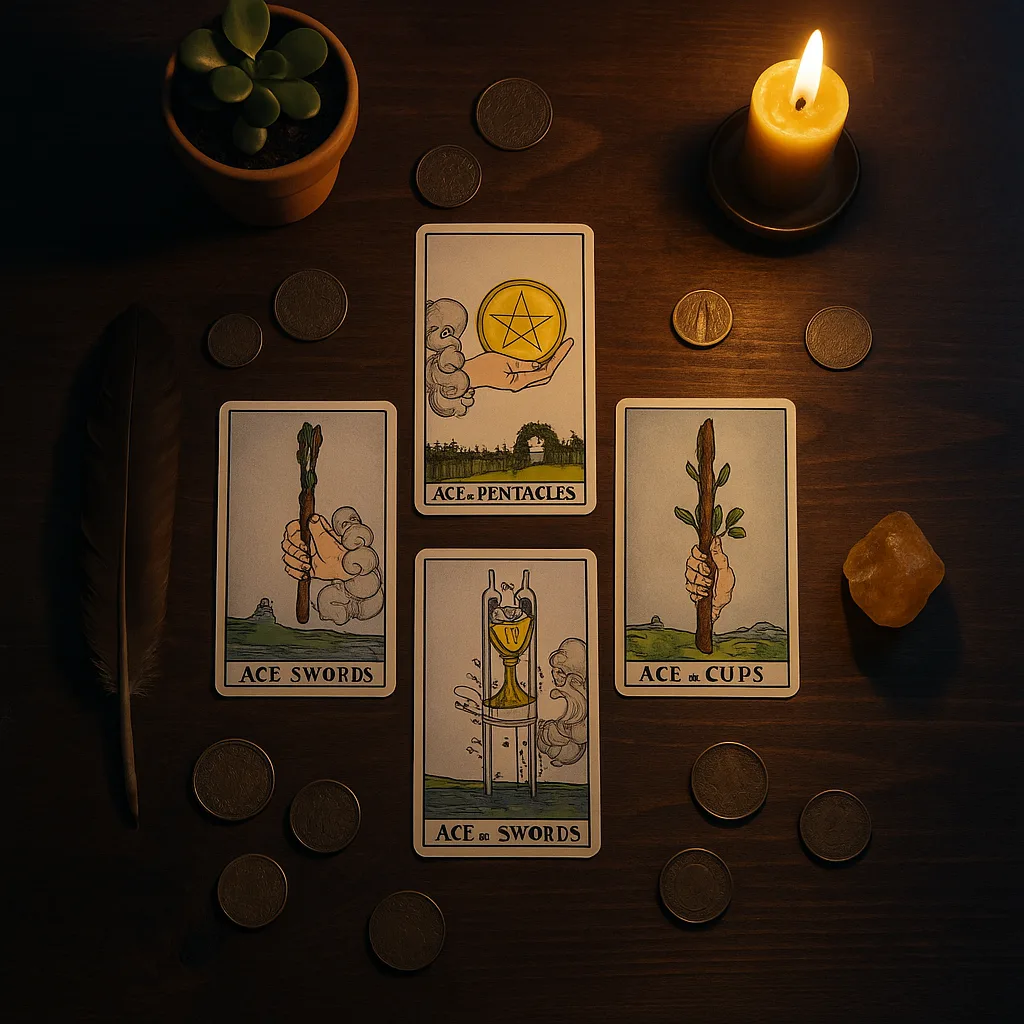
For those taking first steps, the simplest recommendation is to begin with the Rider-Waite-Smith deck. Unlike older decks like the Tarot of Marseille, where the Minor Arcana show only the repetition of suits (three cups or four swords, without narrative scenes), Rider-Waite illustrated all 78 cards with complete scenes. When you pull the Three of Cups, for example, three figures appear celebrating together, and the meaning of friendship and celebration almost jumps out before any study at all.
The vast majority of people studying tarot today start with this system, and practically all introductory material (books, courses, videos) follows this same visual base. This doesn't make other decks wrong. It simply means Rider-Waite offers a more intuitive entry door, leaving more symbolic and abstract decks, like the Marseille, for a later stage of study.
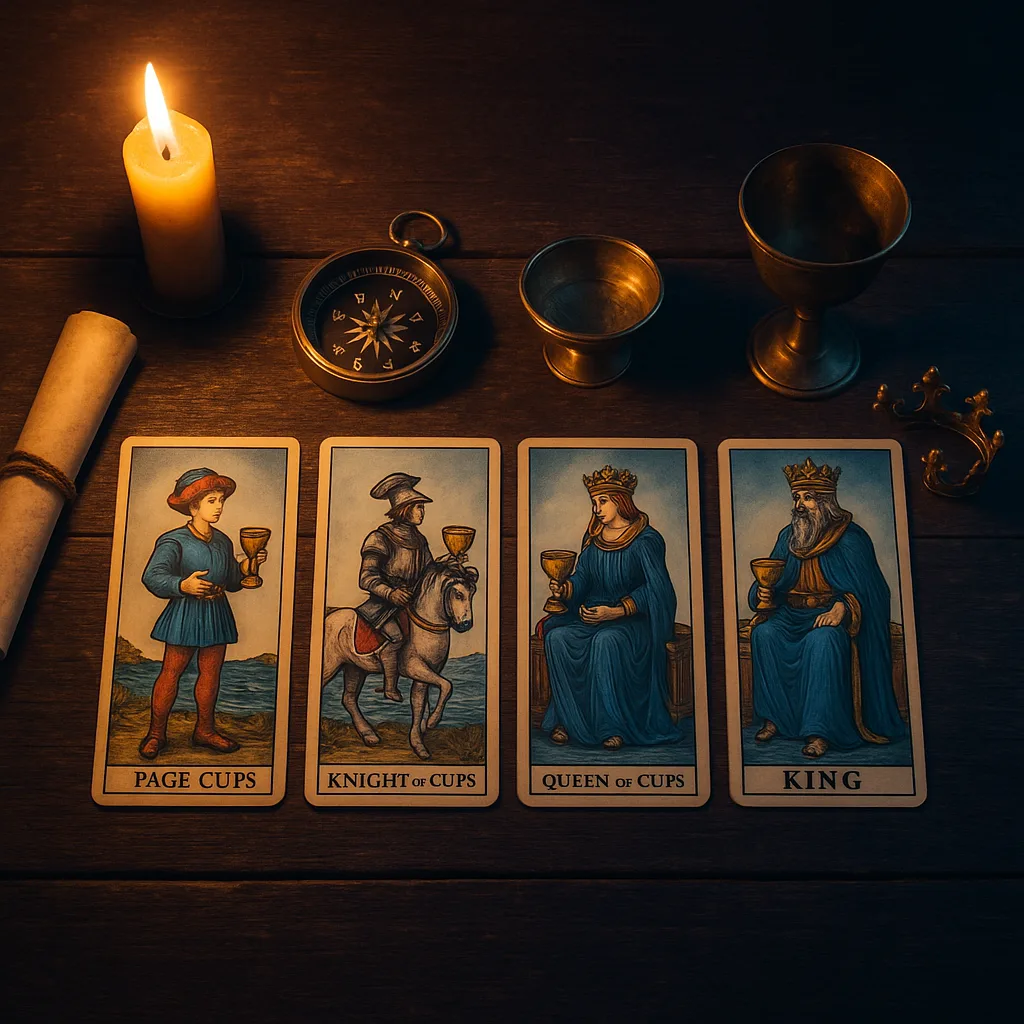
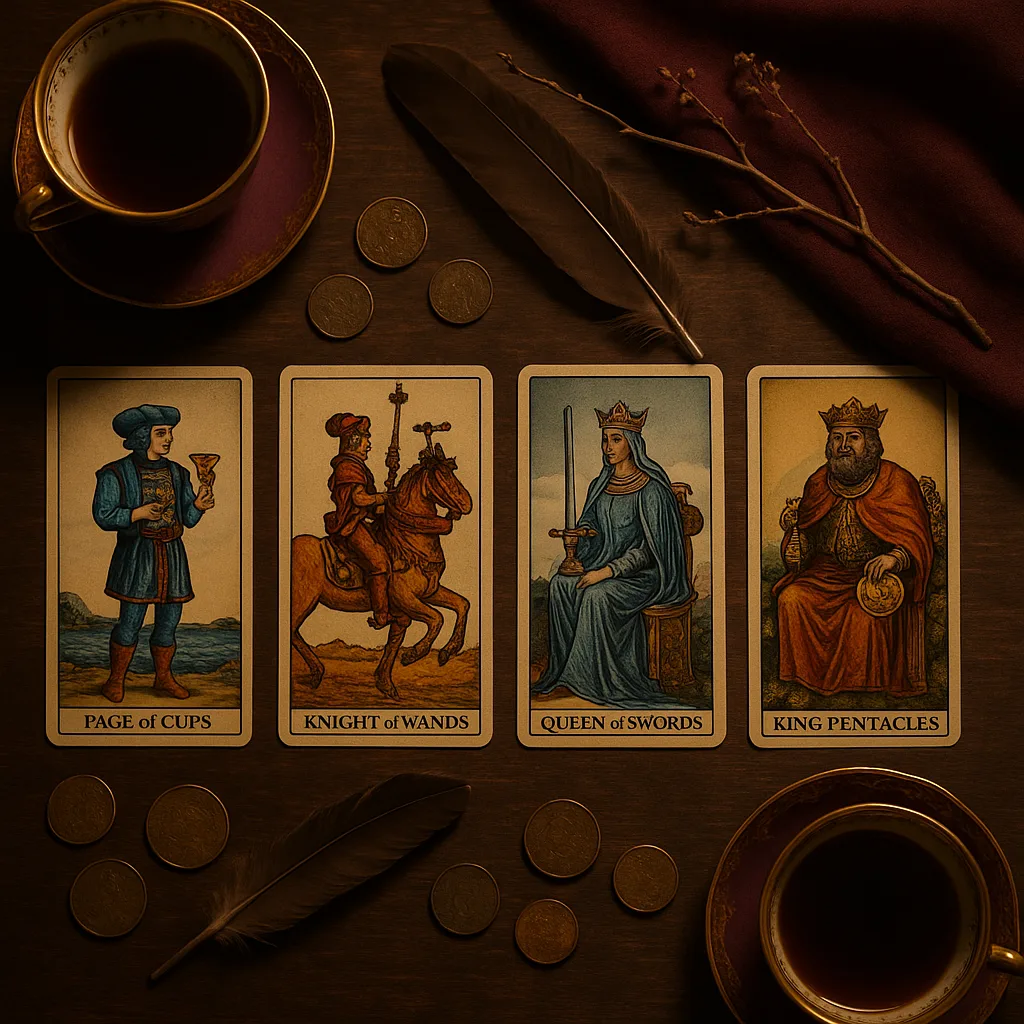
Understanding how the court cards function is also essential in this choice. The different positions in the tarot court, beyond their astrological correspondences, help you understand how the deck works in depth.
How to study tarot in practice, step by step
There's no single right way to learn, but some paths tend to work well for those starting out. A structured approach follows this order:
- Begin with the 22 Major Arcana, leaving the Minor Arcana for later. They concentrate the big themes and are fewer in number, making initial study lighter and easier to remember.
- Observe the image before memorizing the meaning. Before opening a book, ask yourself what the scene makes you feel, what colors, gestures and symbols appear. Intuition is also a study tool.
- Follow the Fool's Journey in order, like reading a novel. This helps you understand why each card exists in relation to its neighbors, not as an isolated meaning.
- Keep a tarot journal, noting your own impressions of each card before consulting books. Compare afterward: often your intuition was already on the right track.
- Draw one card a day as reflection, without grand questions, just to observe what energy speaks to your day.
- Don't rush through the Minor Arcana. They gain more meaning once you're already familiar with the major archetypes.
This personal study process works best when paired with reflective practice. One practical way to deepen is to use the three-card spread as a mirror of the present moment, since this simple structure allows you to work with both Major and Minor Arcana without losing focus on self-knowledge.
To close
Studying tarot is, at its core, an exercise in self-knowledge disguised as symbolic language. The Major Arcana don't exist to predict with certainty what will happen tomorrow, but to help you recognize which chapter of your own journey you're in: whether you're still The Fool about to depart, whether you're passing through the darkness of The Tower, or whether you already feel the quiet completeness of The World. The best path is to start slowly, with curiosity and without rush. Tarot rewards those who treat it as a companion for reflection, not as a ready-made answer.
Frequently asked questions
What's the difference between Major and Minor Arcana?
The Major Arcana are 22 cards that address the big themes of existence, like transformation, purpose, and symbolic death. The Minor Arcana are 56 cards divided into four suits that speak to everyday situations: relationships, work, daily feelings. For beginners, learning the Major first makes study more accessible.
Why did tarot start as a game and become an occultist system?
In the fifteenth century, tarot was entertainment in Italian courts. The shift to mystical meaning happened gradually between the eighteenth and nineteenth centuries, when occultists like Antoine Court de Gébelin, Éliphas Lévi and others created symbolic correspondences with Kabbalah, astrology, and Hermetic philosophy. This transformation reflects a larger shift in European thought about symbols and occultism during that period.
Is Rider-Waite-Smith the best deck for beginners?
It's an excellent choice for beginners because all 78 cards have complete illustrated scenes, making meanings more intuitive. Most introductory courses and books follow this system, which makes it easier to find supporting material. Other decks like the Tarot of Marseille are better suited for a later stage of study.
Should the Fool's Journey be studied in order?
Yes, studying the 22 Major Arcana in numerical sequence helps you understand how each card relates to its neighbors and how they form a continuous story. Beginning with The Fool (0) and ending with The World (XXI) provides context that makes learning more meaningful than memorizing each card in isolation.
How long does it take to learn the Major Arcana?
There's no fixed timeline. Most people become familiar with the 22 arcana in 2 to 3 months of regular study, drawing one or two cards a day and noting their observations. Time varies with dedication, but what matters is not rushing: tarot rewards slow, thoughtful study.
Can I study tarot without believing in predicting the future?
Yes. Tarot works perfectly as a tool for self-knowledge and symbolic reflection, without promising to predict future events. Many people use the deck as a mirror to understand personal patterns, blocked emotions, and stages of their own journey. This approach is just as valid as any other.
Recomendado
Astro Reflexo
Descubra o que os astros revelam sobre quem você é. Em menos de um minuto, calculamos seu Sol, Lua e Ascendente com precisão astronômica e uma inteligência artificial escreve um resumo personalizado só para você.

Recomendado
Lewtemi Espelho de tarô acrílico tarô
Lewtemi Espelho de tarô acrílico tarô cartão decoração de parede mística presentes de bruxa para mulheres espaço sagrado cartomante espiritualidade astrologia bruxa magos arte decoração

Recomendado
Estátua Gato Bastet Egito Antigo
Inspiração Egípcia Autêntica Representa Bastet, a deusa egípcia da proteção, harmonia e energia feminina.
Universo Astral Editorial Team · Tarot and moon transits
This article was produced by the Universo Astral editorial team, with AI tools assisting research and drafting and human review before publication. If you spot anything inaccurate or outdated, let us know at our contact email.