Common Mistakes in Three-Card Tarot Readings (And How to Fix Them)
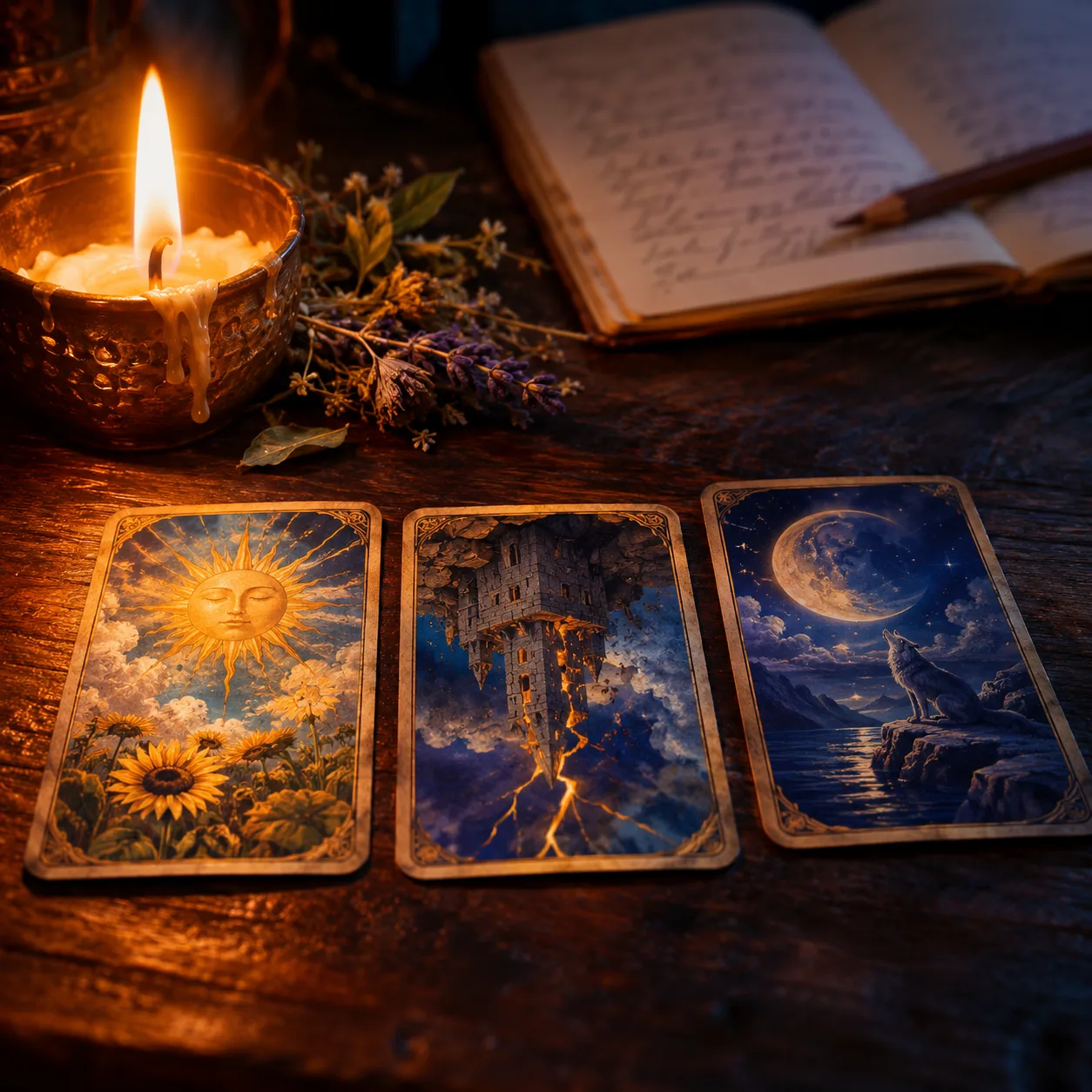
Pulling three cards looks simple: shuffle, draw, interpret. But most readings that leave the querent confused or frustrated don't fail because of the deck, they fail because of interpretation habits nobody ever questions. This piece won't repeat the basic steps of shuffling or phrasing a question: it maps out the five most common slip-ups made by people who already know how to draw cards, but still stumble when it's time to read what those cards are saying.
Mistake 1: treating a card's meaning as a fixed, ancient truth
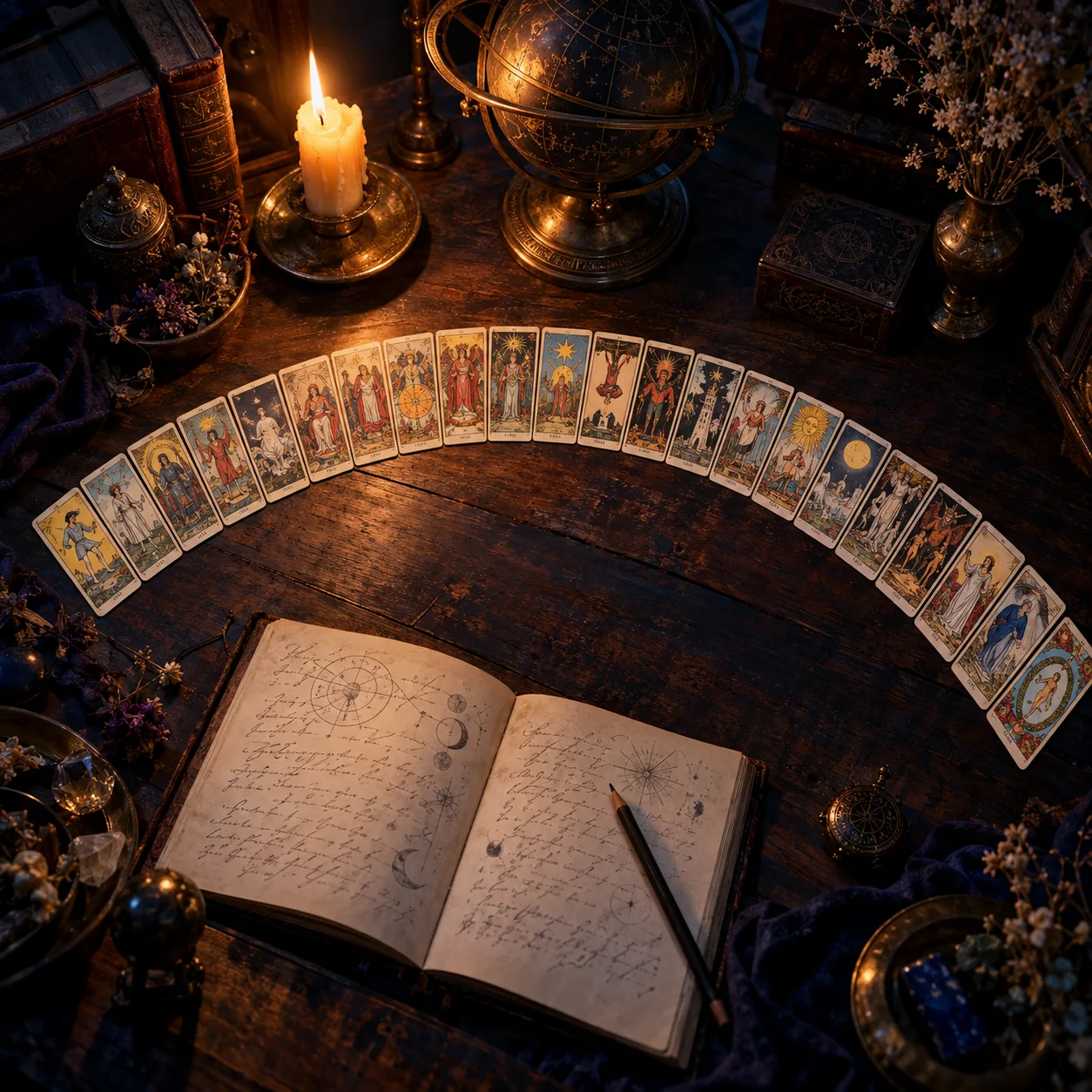
A recurring habit among beginners is assuming each card carries an unchanging meaning, handed down through a thousands-year-old, almost sacred tradition. The actual history of tarot tells a different story. According to the Encyclopaedia Britannica, tarot cards were created in Italy in the 1430s, originally for table games, with no divinatory purpose whatsoever (britannica.com). The shift toward occult and fortune-telling use only happened in France, around 1780, nearly 350 years later. In other words: the symbolic reading that feels so firmly established today is, historically, a layer far more recent than the deck itself.
The format of the cards also varied over time. The Metropolitan Museum of Art notes that today's standard deck has 78 cards, but the Visconti Tarot, one of the oldest surviving luxury decks (made before Filippo Maria Visconti's death in 1447), had up to six court cards per suit, including male and female versions of each rank. Today, 69 of those cards survive, preserved at Yale's Beinecke Library (metmuseum.org). Even the imagery most people associate with tarot, the Rider-Waite-Smith deck, dates only to 1909, created by artist Pamela Colman Smith. There is no single correct, eternal meaning for each card: there's a convention that has shifted multiple times. Treating a card as a sealed oracle strips away the very thing that makes it useful for self-knowledge, which is its symbolic openness.
Practical fix: when looking up a card's meaning, ask yourself which tradition or author is being cited, and let the image speak to your current situation instead of accepting a rigid definition as the final word.
Mistake 2: overreacting to a Major Arcana card
It's common to hear that drawing a Major Arcana card signals something important, almost fated, is at play. A simple probability calculation, based on the standard 78-card structure (22 Major Arcana and 56 Minor Arcana) confirmed by the Metropolitan Museum of Art, tells a different story.
In a three-card draw without replacement, the number of possible combinations using only the 56 Minor Arcana is 27,720, out of a total of 76,076 possible combinations in the full deck. That puts the odds of a draw containing zero Major Arcana cards at roughly 36.4%, which means the odds of getting at least one Major Arcana card sit around 63.6%. That's not the exception, it's the most common outcome.
The odds of drawing three Major Arcana cards in a row are much rarer: only 1,540 combinations out of 76,076, about 2%. That specific case can, with some restraint, be read as a moment of heightened intensity. But a single, isolated Major Arcana card doesn't justify the dramatic weight it usually gets.
| Event in a 3-card draw | Approximate probability | How to interpret it |
|---|---|---|
| At least 1 Major Arcana card | 63.6% | Expected outcome, not an exceptional sign |
| 3 Major Arcana cards in a row | 2.0% | Rare event, may point to a moment of heightened symbolic intensity |
| At least 1 reversed card (mixed orientation) | 87.5% | Also the expected pattern, shouldn't be ignored for convenience |
Mistake 3: deciding mid-reading whether reversed cards count
Another frequent slip is shuffling the deck so cards end up facing different directions, but only deciding whether to acknowledge reversals after seeing the result, usually dismissing a reversed card when it complicates the story the querent already had in mind. If your shuffling method mixes upright and reversed orientations, the math is straightforward: with a 50% chance per card, the probability of none of the three cards coming up reversed is only 12.5%. That leaves the odds of at least one reversed card at 87.5%. Systematically ignoring reversals, in that case, discards the most likely outcome of the draw, not some rare exception.
Practical fix: decide before you shuffle, not during the reading, whether your method will account for reversals. If you decide it will, keep that rule consistent across every reading going forward. Consistency of method is what makes a reading comparable over time, something covered in more depth in the guide on how to build a three-card reading step by step.
Mistake 4: reading each card in isolation, without building the sentence between them
Reading three cards isn't the same as reading three separate definitions back to back. Beginners often jot down what each card means on its own and then try to stitch together a final summary, but that ignores the role of position. The same card carries a different weight in the position of cause than it does in the completely different position of outcome.
Think of the spread as a sentence with a subject, verb and object, not as a list of items separated by commas. In a Situation, Action and Outcome layout, for instance, the Action card is the only position actually under the querent's control, yet it's also the one most often skipped over in favor of the anxiety to already know the Outcome. This specific layout, along with other variations beyond the classic past-present-future, is explored in more detail in the article on how to choose the right three-card spread for each situation.
Example of how position changes a card's weight
- Suppose the Tower card lands in the Situation position: it describes a context of rupture or collapse already underway, something already happening.
- If that same Tower lands in the Action position: it suggests the movement required is itself a deliberate break, not a break suffered passively.
- If it lands in the Outcome position: it indicates the path taken likely leads to the breakdown of an old structure, not as punishment, but as a natural consequence of the process.
It's the same card, three completely different readings, because position changes its grammatical function within the sentence the spread is building.
Mistake 5: not recognizing your own projection onto the image
Before any textbook meaning comes into play, a card's imagery already triggers an immediate emotional reaction in whoever looks at it. The problem arises when that reaction isn't identified as such, and the person starts reading the card as confirmation of something they already expected to hear, usually whatever they fear most or want most. This is close to what cognitive science calls confirmation bias: the tendency to give more weight to information that reinforces an existing belief.
Practical fix: before looking up any textbook meaning, write down your first emotional reaction to the image and ask yourself: what did I already expect to see in this scene? This exercise helps separate the card's objective symbolism from the querent's prior expectations, a precaution that matters especially in introspective spreads like Self, Shadow and Potential, where the Shadow card tends to get judged negatively instead of being read as something to integrate, not fight.
Bonus mistake: reading to confirm an external answer, not to know yourself
It's worth mentioning one framing mistake that precedes the other five: phrasing the question to the deck as if asking for a fixed prediction about an external event, instead of using the spread as a mirror of the present moment. This distortion starts before the shuffle even happens, in how the question itself is built, and tends to contaminate the whole reading with the expectation of a right or wrong answer, when three-card tarot actually works best as a tool for self-reflection. This framing is covered in the guide on how a three-card spread exposes internal conflicts.
Frequently asked questions
Why doesn't my tarot reading make sense?
Usually because the cards were read in isolation, without considering each one's position in the spread, or because the question asked of the deck was vague, or sought an external confirmation instead of reflecting on the present. Revisiting how the question was framed before shuffling usually clears up most of the confusion.
Should I account for reversed cards in a three-card reading?
That depends on the method you choose, but the decision needs to be made before shuffling, not after seeing the result. If the deck is shuffled with mixed orientations, the odds of getting at least one reversed card out of three sit around 87.5%, so ignoring them systematically discards the most likely scenario of the draw.
Does drawing a Major Arcana card mean something more significant?
Not necessarily. The odds of getting at least one Major Arcana card in a three-card draw run around 63.6%, making it the most common outcome, not a rare exception. Three Major Arcana cards in a row, on the other hand, happen in about 2% of cases, and that scenario can suggest a more intense symbolic moment.
How do I avoid confirmation bias when reading my own cards?
Before looking up any textbook meaning, write down your first emotional reaction to the card's image and ask yourself what you already expected to see in that scene. This exercise helps you tell apart the card's objective symbolism from the expectation you already carried before drawing it.

Recomendado
Lewtemi Espelho de tarô acrílico tarô
Lewtemi Espelho de tarô acrílico tarô cartão decoração de parede mística presentes de bruxa para mulheres espaço sagrado cartomante espiritualidade astrologia bruxa magos arte decoração
Universo Astral Editorial Team · Tarot and moon transits
This article was produced by the Universo Astral editorial team, with AI tools assisting research and drafting and human review before publication. If you spot anything inaccurate or outdated, let us know at our contact email.