The 22 Major Arcana of Tarot: What Each Card Means and Where to Start Studying
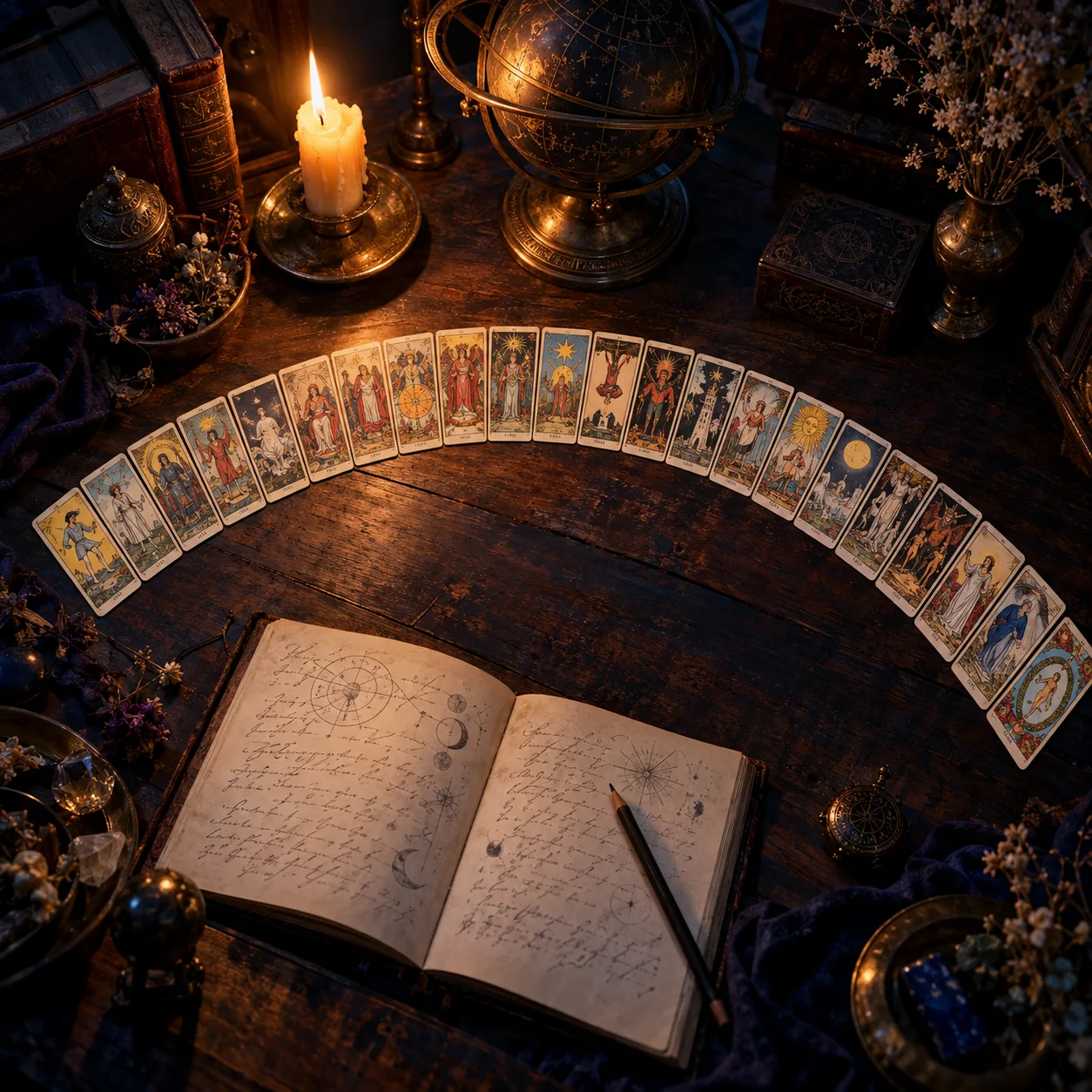
Seventy-eight cards intimidate anyone opening a tarot deck for the first time. But if you're just starting out, you don't need to memorize everything at once: the smarter path is to understand the 22 major arcana first, because on their own they tell a complete story, beginning to end. It's not a dictionary of 22 separate meanings. It's a sequence, with its own internal logic, and it pays off far more to read it as a narrative than as a list.
This focus isn't just a teaching convenience. The tarot deck as we know it today was born in northern Italy in the 15th century, in Ferrara and Milan, when someone had the idea of adding the Fool and 21 more trump cards (known as trionfi) to an ordinary four-suit deck. The oldest surviving example is the Visconti-Sforza deck, commissioned for the court of Milan around the middle of that century, with surviving pieces now divided between Yale's Beinecke Library, the Accademia Carrara and the Morgan Library. The Metropolitan Museum in New York outlines this origin and the 78-card structure (22 trumps plus 56 suit cards) in an article on the history of tarot, available in the museum's collection.
Why read the major arcana as a journey, not 22 separate entries
The idea that the major arcana form a single story has a name: the Fool's Journey. The phrase was coined by American author Eden Gray in her book "A Complete Guide to the Tarot," with an earlier self-published edition from 1960 and the concept fully developed around 1970. In her framing, the Fool represents the soul of any person who, embodied in flesh, moves through the world living out the experiences depicted in the other 21 cards, each one functioning almost like an archetype of the unconscious.
It's worth being honest here: this psychological reading is modern. The cards were assembled in the 15th century, and for most of their existence nobody interpreted them as the arc of a single character. Jungian analyst Sallie Nichols deepened this view decades later, in 1980, in her book "Jung and Tarot: An Archetypal Journey," treating the 22 arcana as a map of individuation. It's a valuable interpretive lens, not the original intent of the artisans who painted the Visconti-Sforza deck.
Even so, this lens helps enormously if you're a beginner, because it turns rote memorization into an understanding of plot. Instead of asking "what does card X mean," you start asking "at what point in the journey does this card show up, and what does that moment demand from someone living through it."
The three acts of the journey: from the Magician to the World
The numbered sequence of the major arcana can be split into three blocks, each with a different psychological task. The Fool, unnumbered, is the prologue: the leap of faith before any experience begins.
In the first act (I through VII), the journey builds the foundation of personality in the outer world. The Magician asserts the will to act. The High Priestess represents inner voice and mystery not yet revealed. The Empress and the Emperor function as the archetypal mother and father figures, creation and structure. The Hierophant brings the teaching of tradition. The Lovers mark the first real, meaningful choice. The Chariot closes the block with an initial mastery gained over one's own direction.
In the second act (VIII through XIV), the journey turns inward, because outer success is no longer enough. Strength calls for quiet courage rather than brute force. The Hermit withdraws the journey into introspection. The Wheel of Fortune reminds us that everything moves in cycles. Justice demands awareness of cause and effect. The Hanged Man forces a pause and a shift in perspective. Death closes a cycle that no longer fits. Temperance ends the block with balance that's been earned, not imposed.
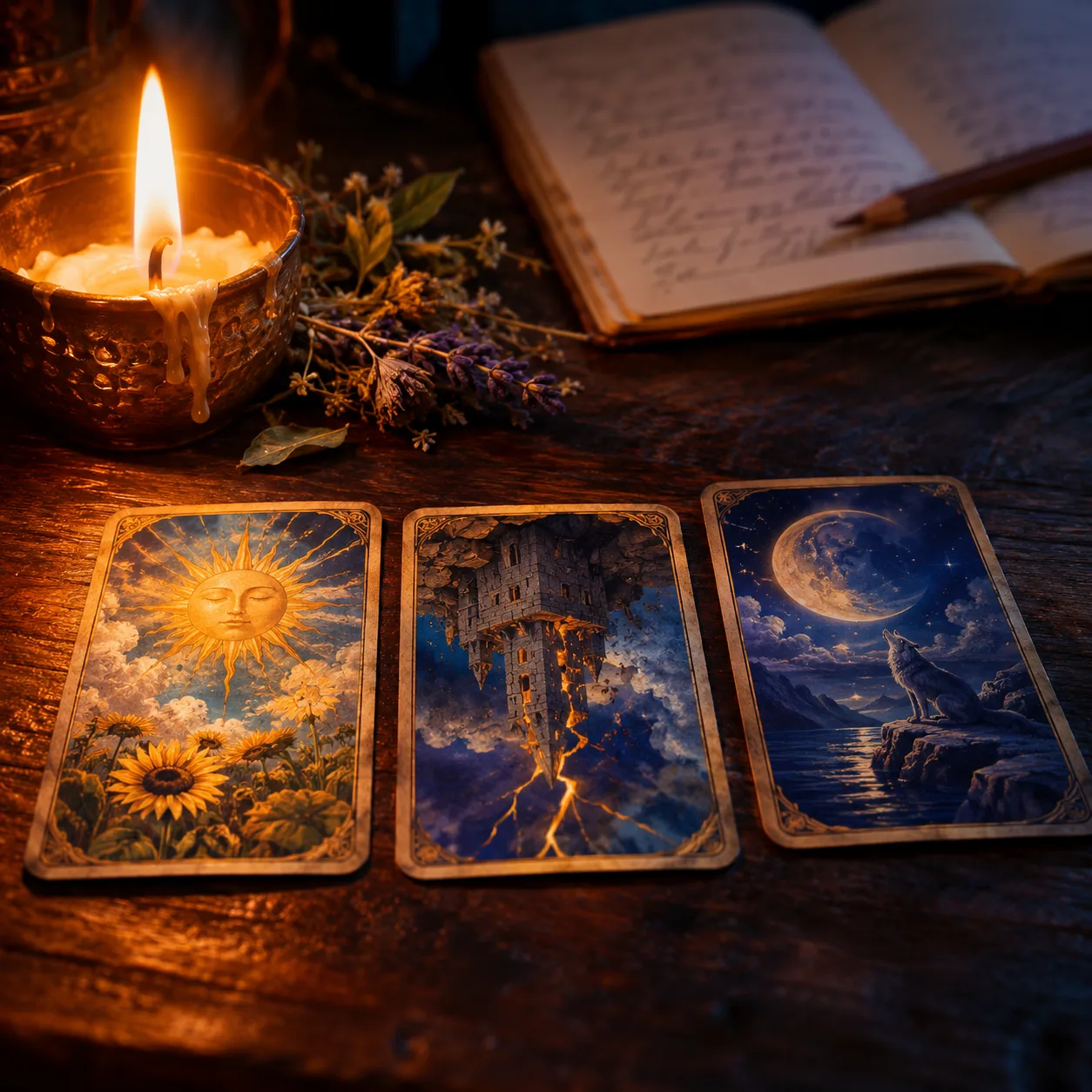
In the third act (XV through XXI), the journey meets the most intense forces of the whole sequence. The Devil shows entrapment in attachments and illusions. The Tower brings a sudden, necessary collapse. After that comes renewal: the Star brings hope, the Moon stirs the unconscious and uncertainty, the Sun restores clarity and vitality, Judgement calls for a conscious rebirth. The World closes everything with a sense of wholeness and fulfillment. Interestingly, mythologist Joseph Campbell identified this same three-part structure across mythologies worldwide and named it the Hero's Journey, which helps anyone already familiar with that concept see the parallel.
The complete table of the 22 major arcana
To see the whole sequence at a glance, check the table below, organized by the order most commonly used today (the Rider-Waite-Smith deck), with the act of the journey and the core keyword for each card.
| Number | Card | Act of the journey | Keyword |
|---|---|---|---|
| 0 | The Fool | Prologue | beginning, leap of faith |
| I | The Magician | Act 1 | will, manifestation |
| II | The High Priestess | Act 1 | intuition, mystery |
| III | The Empress | Act 1 | abundance, creation |
| IV | The Emperor | Act 1 | structure, authority |
| V | The Hierophant | Act 1 | tradition, teaching |
| VI | The Lovers | Act 1 | choice, union |
| VII | The Chariot | Act 1 | direction, affirmed will |
| VIII | Strength | Act 2 | quiet courage |
| IX | The Hermit | Act 2 | introspection |
| X | Wheel of Fortune | Act 2 | cycles, fate |
| XI | Justice | Act 2 | cause and effect |
| XII | The Hanged Man | Act 2 | pause, new perspective |
| XIII | Death | Act 2 | end of a cycle |
| XIV | Temperance | Act 2 | balance |
| XV | The Devil | Act 3 | attachment, illusion |
| XVI | The Tower | Act 3 | sudden upheaval |
| XVII | The Star | Act 3 | hope |
| XVIII | The Moon | Act 3 | uncertainty, the unconscious |
| XIX | The Sun | Act 3 | clarity, vitality |
| XX | Judgement | Act 3 | calling, rebirth |
| XXI | The World | Epilogue | fulfillment, wholeness |
It's worth noting that some names vary from deck to deck: the High Priestess appears as the Popess in older versions, and the Hierophant as the Pope or High Priest in the Marseille tradition.
The swap that proves the order is no accident: Strength and Justice
If you compare different decks, you'll notice something odd: Strength and Justice swap positions depending on the tradition. In the Tarot de Marseille, a deck that took shape in 17th-century France, Justice holds position VIII and Strength position XI. In the Rider-Waite-Smith, released in 1909, that order was reversed: Strength became VIII and Justice, XI.
This change was neither random nor a printing error. Occultist Arthur Edward Waite belonged to the Hermetic Order of the Golden Dawn, founded in London in 1888, which linked each major arcanum to a zodiac sign through Hebrew letters. In that system of correspondences, position XI belonged to Libra and position VIII to Leo. But Libra, the sign of the scales, matched symbolically with Justice, and Leo, a sign of courage, matched with Strength. To make the numbering align with the order's astrology, Waite swapped the two cards.
It's the clearest concrete proof that the sequence of the major arcana carries deliberate choices, not just aesthetic ones. A regional variant called Besançon, used in France, Switzerland and southern Germany, keeps the Marseille numbering but replaces the Popess and Pope figures with Juno and Jupiter, another sign of how each tradition reorganizes the same 22-card skeleton according to its own symbolic logic.
| Tradition | Strength | Justice | Logic of the order |
|---|---|---|---|
| Tarot de Marseille | VIII | XI | Ethical discernment before raw instinct |
| Rider-Waite-Smith (1909) | VIII | XI (swapped) | Aligned with Golden Dawn astrology: Leo at position VIII, Libra at XI |
| Besançon | XI | VIII | Keeps Marseille numbering, swaps religious figures for mythological ones |
Where to start studying, in practice
Once you understand the logic of the sequence, the actual study becomes much simpler. One possible path, designed for someone who has never drawn a card before, follows these steps:
- Memorize the numbered sequence of the 22 major arcana first, from 0 to 21, before worrying about the 56 suit cards.
- Split the sequence into the three acts described above: outer world (I through VII), inner trial (VIII through XIV) and transcendence (XV through XXI). This builds an emotional logic before you even memorize individual meanings.
- Pick one reference tradition (Marseille or Rider-Waite-Smith) and stay consistent with it, since the position of Strength and Justice changes depending on the deck, as shown in the table above.
- Pay attention to the number before the card's name: 0 signals pure potential, XIII usually means deep transformation, XXI closes with wholeness. Basic numerology already hints at the tone of each arcanum.
- Practice with one card a day, always noting where it falls in the journey (beginning, middle or end of the arc) before opening any book of ready-made meanings.
- Save the more advanced layers for later: Hebrew letters, the Kabbalistic Tree of Life and the Golden Dawn's astrological correspondences are additions from the 19th and early 20th centuries, not the origin of the cards in the 15th century.
That last point deserves attention, because it explains much of the mythology surrounding tarot today. In 1781, French writer Antoine Court de Gébelin claimed, without any historical evidence, that tarot came from an ancient Egyptian book of Thoth. That claim, repeated for decades, became the foundation of tarot's occult mythology, later reinforced by occultist Éliphas Lévi, who in 1854 and 1856 connected the 22 major arcana to the 22 letters of the Hebrew alphabet. It's an interesting symbolic layer to explore further down the road, but it doesn't match the factual origin of the deck, which began as a card game in Renaissance Italy.
If you want to go deeper later into the court cards, which also make up the full 78-card deck, check out the article on what each tarot court position means. And if you're already comfortable with the major arcana and want to see how tarot applies to practical career decisions, it's worth reading the piece on tarot suits at work and with money.
Frequently asked questions
What's the difference between major and minor arcana?
The major arcana are the 22 numbered cards, from 0 to 21, that carry the big themes of life and transformation, from the Fool to the World. The minor arcana are the other 56 cards, split into four suits of 14 cards each, dealing with more everyday, specific situations.
Do I need to memorize the meaning of all 78 cards to start reading tarot?
No, and trying to do that all at once tends to discourage beginners. The smarter path is to study the 22 major arcana first as a narrative sequence, understand the logic of the three acts of the journey, and only then move on to the minor arcana.
Why doesn't the Fool have a number in tarot?
In the reading established by Eden Gray around 1970, the Fool represents the starting point of the journey, before any experience has happened, which is why it's usually shown as 0 or unnumbered, acting as a prologue to the sequence of the other 21 major arcana.
Do the Tarot de Marseille and the Rider-Waite-Smith have the same meanings?
The core themes of each arcanum are similar, but the numeric order of Strength and Justice differs between the two traditions, and some figures change names, such as the Popess and the High Priestess. It's worth choosing one tradition and studying from it before comparing the two.
What was the first tarot deck with all 78 cards illustrated?
The Rider-Waite-Smith, released in London in 1909 with artwork by Pamela Colman Smith and concept by Arthur Edward Waite, was notable for fully illustrating all 78 cards, at a time when usually only the 22 major arcana received illustration, with the exception of the rare 1491 Sola Busca deck.

Recomendado
Lewtemi Espelho de tarô acrílico tarô
Lewtemi Espelho de tarô acrílico tarô cartão decoração de parede mística presentes de bruxa para mulheres espaço sagrado cartomante espiritualidade astrologia bruxa magos arte decoração
Universo Astral Editorial Team · Tarot and moon transits
This article was produced by the Universo Astral editorial team, with AI tools assisting research and drafting and human review before publication. If you spot anything inaccurate or outdated, let us know at our contact email.