When Swords Dominate Your Tarot Spread: What Too Much Conflict Means
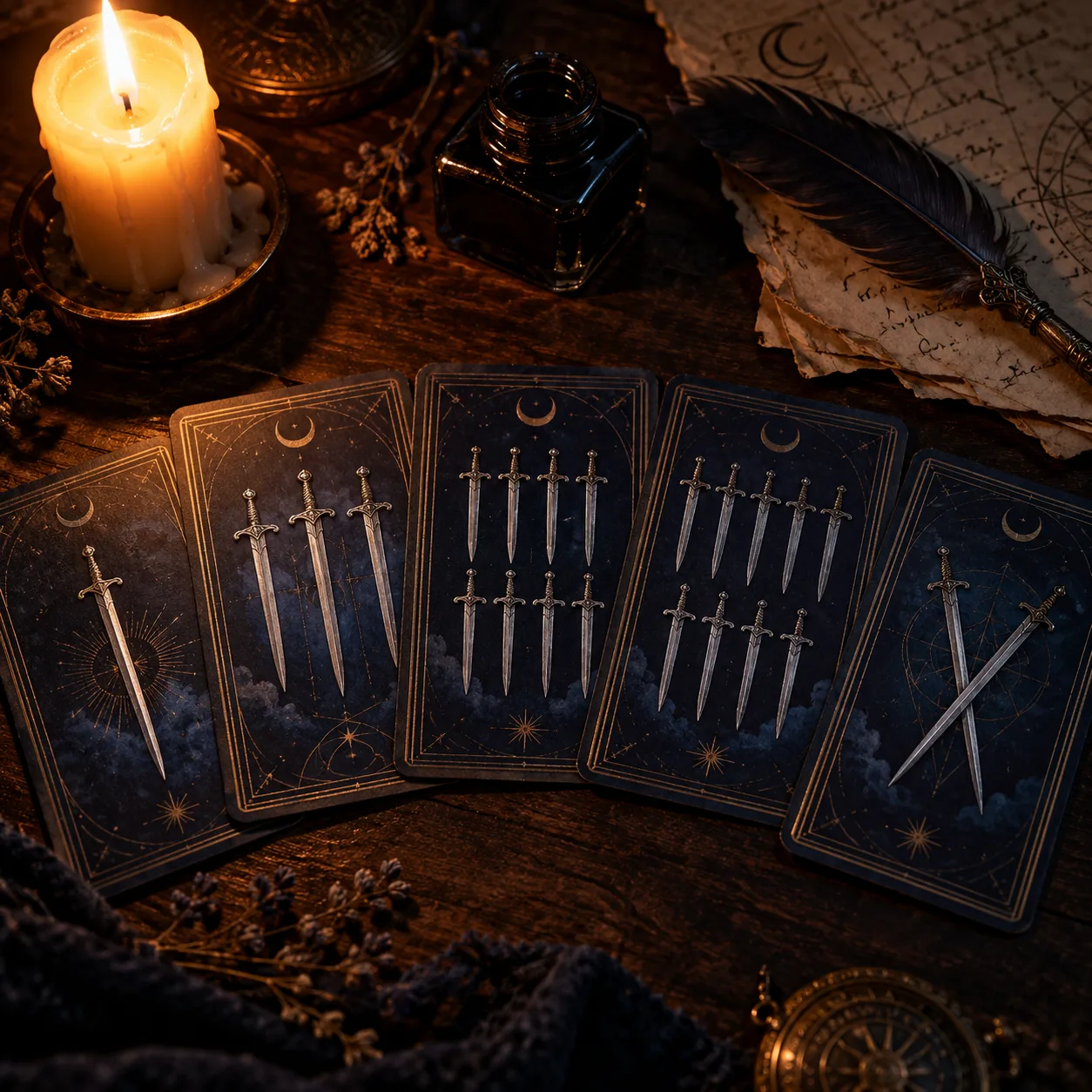
You draw a five-card spread and three of them are Swords. The feeling is immediate: something heavy is being said. Before reading this as an isolated message from the universe, it's worth asking a colder question: is this actually rare, or is your mind just finding a pattern where none exists? Surprisingly, the answer can be calculated.
Why Swords carries this particular weight
The tarot deck used today has 78 cards: 22 major arcana and 56 minor arcana, split into four suits of 14 cards each (Ace through 10, plus Page, Knight, Queen and King). Swords, Cups, Pentacles and Wands all carry exactly the same numerical weight in the deck: 14 cards each, or about 17.9% of the total. Statistically, no suit should appear more often than the others in a random, well-shuffled draw.
The difference isn't in quantity, it's in the nature of the conflict each suit represents. Cups speaks to emotional conflict, Wands to conflict around action and initiative, Pentacles to material tension. Swords is the only suit whose core is cognitive and verbal: repetitive thinking, argument, hard decisions, lies, breakdowns in communication. The element tied to this suit, since the nineteenth-century French esoteric tradition later picked up by the Golden Dawn, is Air, linked to the mind and to speech rather than the body or feeling. That's why, when Swords multiply in a reading, the feeling tends to be a crowded head rather than a broken heart.
What the suit's heaviest cards show in practice
In the Rider-Waite-Smith deck, released in 1909 by A. E. Waite with illustrations by Pamela Colman Smith, every numbered card received a full narrative scene, which helps explain visually why Swords feels so heavy when it repeats in a spread. Of the suit's ten numbered cards, at least five carry imagery directly tied to mental suffering, defeat or imprisonment, a higher proportion than in any other suit in the deck.
- Three of Swords: a heart pierced by three blades under rain, the classic image of pain caused by words or by a hard truth.
- Five of Swords: a figure gathers swords off the ground while two others walk away defeated, a scene of hollow victory and conflict that ended without being resolved.
- Eight of Swords: a blindfolded, bound figure surrounded by eight blades stuck in the ground around her, symbolizing a paralysis of decision that, in most readings, is self-imposed.
- Nine of Swords: someone sitting up in bed with their head in their hands, nine swords on the wall behind them, tied to anxiety and insomnia, with the detail that the blades never touch the person, reinforcing that the suffering here is mental.
- Ten of Swords: a fallen figure with ten blades in the back, the suit's lowest point, read both as a painful ending and as relief that a cycle of conflict has finally run its course.
When two or three of these cards show up together in the same spread, traditional card reading usually points not to a single event but to a pattern: a mind stuck replaying the same argument, a decision being postponed, a truth that needs saying and is being avoided.
The math: what are the real odds of Swords taking over by chance
Here's the part most articles on suits skip: you can actually calculate, with simple math, the probability of a spread turning up loaded with Swords purely from the shuffle. The model used is the hypergeometric distribution, the same logic behind drawing balls from an urn without replacement: of the 78 cards, 14 are Swords and 64 are not.
In a three-card spread, the odds of all three being Swords are roughly 0.48%, or less than 1 in every 200 draws. The odds of at least two out of three being Swords rise to about 8.1%, roughly 1 in every 12 draws. In a five-card spread, a common format for current-situation readings, the probability of pulling 3 or more Swords is approximately 3.8%, or fewer than 4 in every 100 random draws.
That means a Swords-dominated spread, while not impossible, is statistically uncommon. The number doesn't prove anything about the future, but it does justify pausing to look at the pattern instead of brushing it off as mere coincidence.
| Spread size | Scenario | Approximate probability |
|---|---|---|
| 3 cards | All 3 cards are Swords | 0.48% |
| 3 cards | At least 2 of 3 are Swords | 8.1% |
| 5 cards | 3 or more cards are Swords | 3.8% |
How to read the excess without panicking
The first practical step is separating quantity from intensity. Two Swords in a five-card spread isn't excess, it falls within the expected range. The meaningful signal shows up when three or more cards of the same suit cluster together with court cards (Page, Knight, Queen, King) of Swords, which reinforces the theme of verbal conflict or a pending decision even further, since these figures tend to represent people or attitudes tied to direct, sometimes cutting, communication.
The second step is noticing which specific Swords cards repeat. A combination of the Eight and Nine of Swords, for instance, usually points to mental stagnation: the person knows they need to decide something but is stuck in anxiety or in a loop of thinking that goes nowhere. The Three and Five together point more toward a relationship conflict that already caused pain and still carries unresolved resentment. Reading a dominant suit, in this sense, works better as a diagnosis of the current mental climate than as a forecast of a specific event.
It's worth noting that this reading of Swords in excess is different from noticing a suit's absence in your spreads, a topic covered in detail in the article about the suit that disappears from your spreads. While absence speaks to what you avoid, excess speaks to what's front and center, often in a way too uncomfortable to ignore.
Where the suit comes from and why it still carries this symbolism today
The link between Swords and mental conflict isn't a modern invention from little booklets sold with decks. The traditional Italian suits (cups, swords, batons and coins) already structured tarot decks in the fifteenth century, with values from 1 to 10 plus king, queen, knight and page figures, totaling 56 cards in the minor arcana. The Metropolitan Museum's collection preserves pieces from the Visconti-Sforza Tarot, produced around 1450 by the workshop of court painter Bonifacio Bembo, including the Queen of Swords and the Knight of Swords, showing that the suit already carried this identity since tarot's birth as an art object in Milan and Venice, as catalogued by the museum itself at metmuseum.org.
The narrative reading of Swords cards we use today, though, only came together centuries later, with the 1909 Rider-Waite-Smith deck. Before that, many decks showed only repeated symbols on the numbered cards, with no scene at all. It was the 1909 redesign that gave each Swords card a face, a posture and a setting, making it possible to describe so precisely what a blindfolded figure surrounded by blades means, or someone fallen with ten swords in their back.
What to do when the pattern repeats across several readings
If Swords dominance shows up once, it probably reflects a one-off tension: a pending conversation, a decision that's been nagging at you, a misunderstanding that hasn't been cleared up yet. If the pattern repeats over several weeks of separate readings, it's worth looking more closely at how communication is playing out in daily life, whether in relationships or at work.
For anyone who wants to compare this excess pattern within specific contexts, the articles on tarot suits in love and tarot suits in work and money break down how Swords behaves in each of these areas separately, which helps clarify whether the indicated conflict is more personal or more professional.
Frequently Asked Questions
Is having lots of Swords in a spread always negative?
Not necessarily. The suit points to mental tension, a pending decision or a communication conflict, but cards like the Ten of Swords also carry the idea that a hard cycle has come to an end. The surrounding cards matter more than the simple suit count.
How many Swords in a spread already counts as excess?
In a five-card spread, three or more cards of the same suit already fall outside what chance would predict, since this combination occurs in fewer than 4% of random draws. In three-card spreads, two or more Swords already stand out, since that happens in about 8% of cases.
Is an excess of Swords the same thing as an excess of Wands?
No. Both point to conflict, but of different kinds: Wands speaks to conflict tied to action, initiative and drive, while Swords speaks to mental, verbal conflict tied to decisions, arguments and hard truths that need facing.
Do I need to understand statistics to read this pattern in my own spreads?
You don't need to run the math yourself to notice the pattern. Just pay attention, across several readings, to whether one suit keeps coming back more often than the others. That alone is a practical sign it's worth looking into that theme in your life more closely.

Recomendado
Lewtemi Espelho de tarô acrílico tarô
Lewtemi Espelho de tarô acrílico tarô cartão decoração de parede mística presentes de bruxa para mulheres espaço sagrado cartomante espiritualidade astrologia bruxa magos arte decoração
Universo Astral Editorial Team · Tarot and moon transits
This article was produced by the Universo Astral editorial team, with AI tools assisting research and drafting and human review before publication. If you spot anything inaccurate or outdated, let us know at our contact email.