Page, Knight, Queen, and King: What Each Tarot Court Card Really Means (Beyond Its Sign)
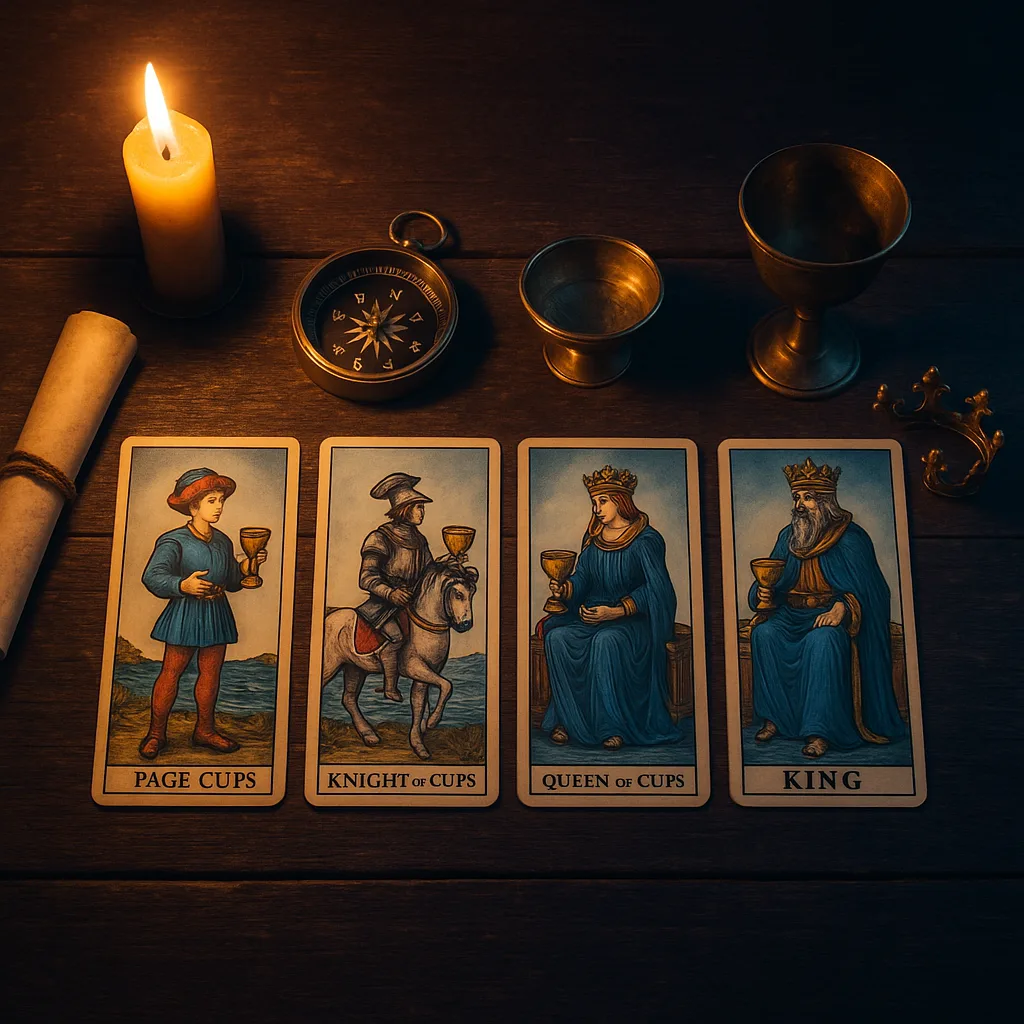
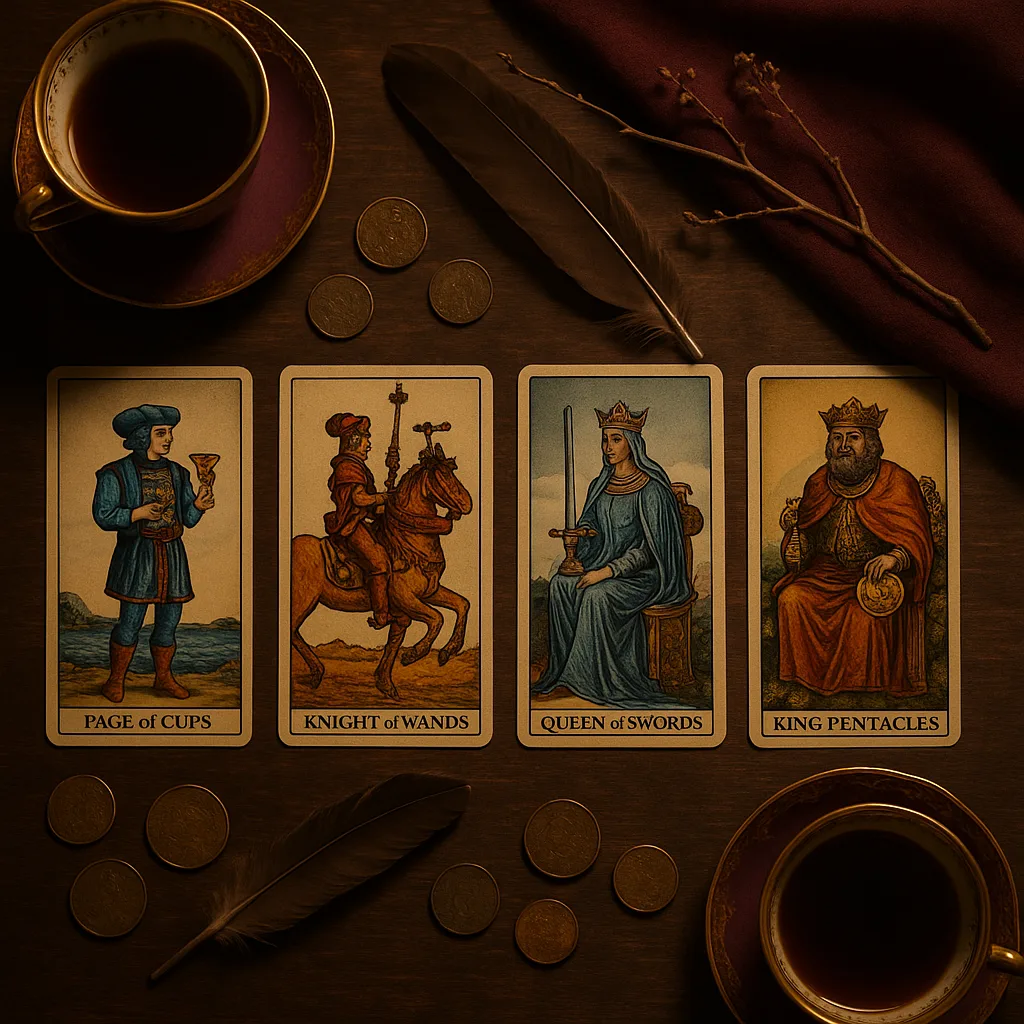
A standard tarot deck has sixteen court cards, four for each suit. But it wasn't always this way. When this type of figure first arrived in Europe from the Islamic world, back in the late 13th century, it was part of an ordinary playing card deck, and each suit had only three officers: a king and two subordinates. There was no queen. It was Europe that, in adapting the deck to its own titles of nobility, ended up creating this fourth figure, and it wasn't until around the 15th century that the court settled into the format we know today: king, queen, knight, and page (or jack).
This detail matters because it reveals something many people overlook: the court didn't start out as an astrological or spiritual symbol. It started as a mirror of a real social structure, the hierarchy of a medieval court. And it's precisely this social origin that explains why these cards, unlike the numbered arcana, represent people, personalities, and stages of development, rather than situations or processes.
The court as a bridge between two worlds of the deck
Court cards occupy a curious position within the structure of tarot: they act as a link between the major arcana, loaded with universal archetypes, and the numbered cards of each suit, more tied to events and circumstances. This is why reading a court card usually calls for a shift in focus: instead of asking 'what will happen,' the right question is 'what kind of energy, or what person, is on the scene.'
This energy can refer to someone real in the life of the person consulting the cards, to a trait of the querent's own personality, or to a quality that needs to be developed at that moment. None of the four figures is tied to a biological gender: they describe active and receptive postures that anyone can take on, depending on the card and the context of the reading.
Page: the beginning that hasn't taken shape yet
Historically, the page (or jack) represented something quite specific: a child, often from a noble family, sent to live in the household of another influential family. It was a kind of learning by immersion, a way to grow politically and absorb the customs of a new house. This background explains why the page, in tarot, carries the symbol of raw potential: a newborn idea, a curiosity that hasn't yet become mastery, a fresh start that demands humility because everything is still to be learned.
When a page shows up in a reading, the invitation is usually toward openness and willingness, not execution. It's the card of someone studying, testing, experiencing something from that suit for the first time, whether it's ideas (swords), feelings (cups), action (wands), or material matters (pentacles).
Knight: movement, risk, and drive
If the page represents the quiet beginning, the knight is the energy that has already left the starting point. He acts, pursues, takes risks, often without fully weighing the consequences. He's the most dynamic figure in the court, associated with movement (literal or symbolic), decisions made in the heat of the moment, and a readiness to face the unknown.
This impulsiveness isn't always positive: depending on the suit and the position in the spread, the knight can point to either productive courage or haste that runs over the process. It's a card of transition in motion, the opposite of the page's still, dormant potential.
Queen: authority that comes from within
The queen tends to be read as the receptive, interiorized face of each suit's power: emotional, intuitive, relational mastery. But there's a historical nuance worth noting that rarely gets mentioned. Throughout the actual history of monarchies, there were reigning queens, with real power over the kingdom, something rare within patriarchal structures, and consort queens, whose power depended on their husband's position. This distinction helps explain why the queen's symbolism in tarot is more ambiguous than it first appears: she can represent either full, autonomous authority or influence exercised indirectly, through relationships and diplomacy rather than direct command.
In practical readings, the queen usually points to emotional maturity within the suit: someone (or a part of yourself) who no longer needs to prove anything, who holds mastery over that energy naturally.
King: consolidated, visible authority
The king closes out the hierarchy as the most outward and openly recognized version of mastery in a suit. While the queen holds power from the inside out, the king exercises it publicly, with structure, rules, and responsibility over others. It's the card of mature leadership, of experience that has turned into recognized authority, but it can also signal rigidity, when that authority closes in too tightly on control.
The shake-up the Golden Dawn brought to court card names
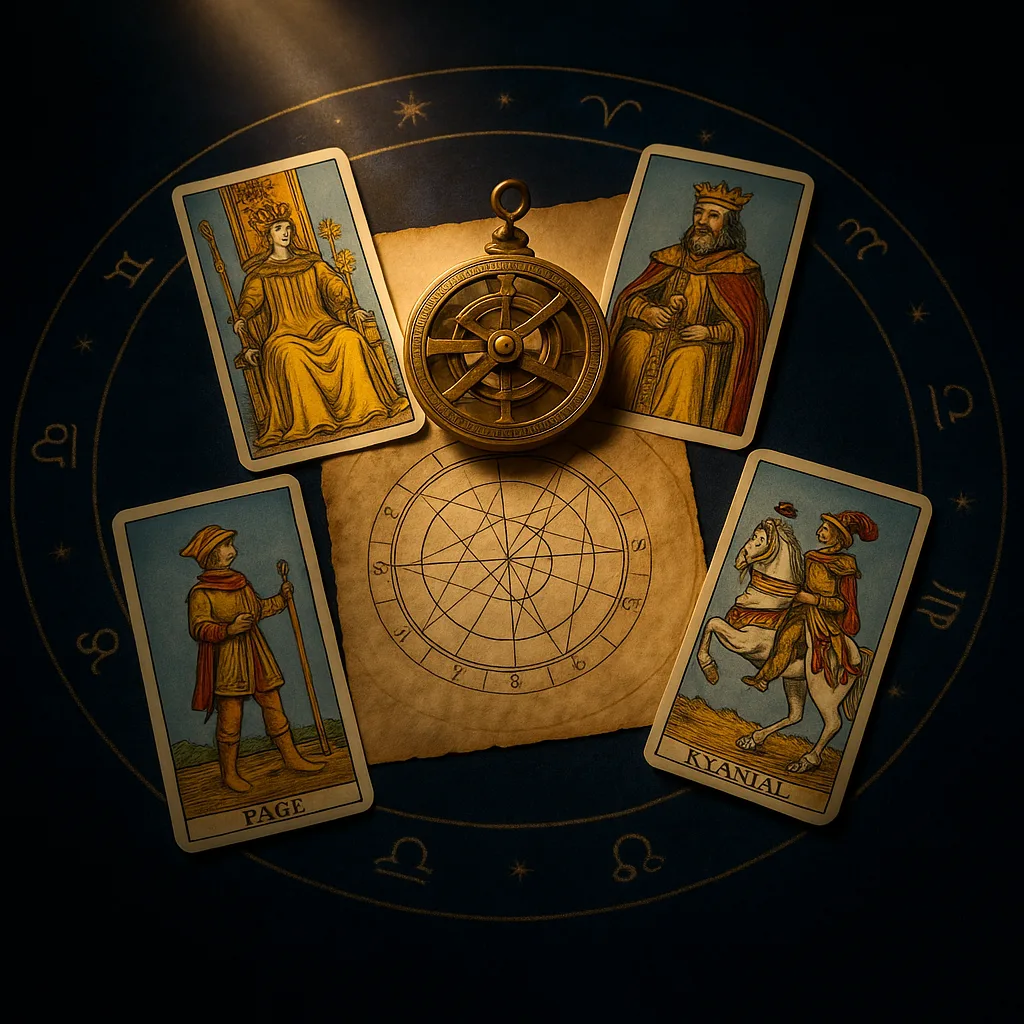
If you've ever seen the same suit called different things across different decks, the explanation lies with the Hermetic Order of the Golden Dawn, at the end of the 19th century. To fit the court into a system of correspondence with the Tetragrammaton and the four Kabbalistic Worlds, the order completely reorganized the hierarchy: the knight took the place of king, the queen kept her position, the former king became a prince, and the page was renamed princess.
This renaming of the page to princess wasn't just cosmetic. Within the order's Kabbalistic logic, this figure came to represent the synthesis of the other three forces, and the gender swap created a symbolic balance within the court: two feminine figures (queen and princess) and two masculine ones (the reworked king/knight and prince).
The practical effect of this still shows up today in the difference between two widely used decks. Arthur Edward Waite, in creating the Rider-Waite-Smith deck, was influenced by the Golden Dawn in many internal aspects of the symbolism, but rejected the renaming: his deck went back to the classic structure of the Tarot de Marseille, with king, queen, knight, and page. Aleister Crowley, on the other hand, kept the Golden Dawn structure in his Thoth deck: knight, queen, prince, and princess.
A common mistake when comparing different decks
It's tempting to simplify the equivalence between the two systems by saying the Rider-Waite knight corresponds to the Thoth prince, and that the Rider-Waite king corresponds to the Thoth knight. This correspondence circulates a lot among tarot students, but both assumptions are wrong. The positions aren't directly interchangeable because each system follows a different internal logic: Rider-Waite preserves the traditional social hierarchy, while Thoth reorganizes everything around a symbolic equation with the Tree of Life. Reading the two decks as if they were simply 'renamed' versions of each other erases this structural difference and tends to produce misreadings.
What this changes when you draw a card
In practice, the most useful approach is to first identify which deck you're working with and respect its internal logic, rather than trying to mentally translate a figure from one tradition into another. Then, look at the card's position (page, knight, queen, or king) as a stage of maturity for that suit's energy: raw potential, action in motion, internal mastery, or external authority. Only after that does it make sense to cross-reference this with the meaning of the suit itself, to arrive at the full reading of the card.
Understanding this hierarchy behind the names helps avoid a common habit among beginners: treating the four figures as interchangeable characters, when in fact each one carries its own history, with roots that stretch from the medieval European court to the esoteric reform of the late 19th century.

Recomendado
Lewtemi Espelho de tarô acrílico tarô
Lewtemi Espelho de tarô acrílico tarô cartão decoração de parede mística presentes de bruxa para mulheres espaço sagrado cartomante espiritualidade astrologia bruxa magos arte decoração

Recomendado
Incensário Cascata Refluxo Cerâmica
Efeito cascata hipnotizante A fumaça desce como uma cachoeira, criando um visual relaxante perfeito para momentos de calma e foco
Universo Astral Editorial Team · Tarot and moon transits
This article was produced by the Universo Astral editorial team, with AI tools assisting research and drafting and human review before publication. If you spot anything inaccurate or outdated, let us know at our contact email.