Personal Number, Destiny Number, and Soul Number: Key Differences in Numerology
Search for personal number on three different numerology websites and you'll likely get three different answers. On one, the term appears as a synonym for the current year's cycle. On another, as a generic umbrella for any number describing personality. This lack of standardization isn't a research mistake: it's a real feature of contemporary numerology, which brings together schools with different origins and vocabularies. Before calculating anything, it's worth understanding where this confusion comes from and, most importantly, what each number actually calculates and reveals.
One label, different traditions
Some numerologists use personal number exclusively to refer to the Personal Year: the twelve-month cycle lived within a larger Universal Year, indicating trends for that specific period (a year tilted toward new beginnings, another toward closure, another toward introspection, and so on). Other schools use the same expression more loosely, as a general category that encompasses destiny, soul, expression, and other numbers on the numerological chart, without a fixed technical definition.
This divergence is recognized by professionals themselves, who often warn that other schools may name and calculate things differently. This lack of a single system also appears in the history of astrology, an area close to numerology in symbolic origin: according to the Encyclopaedia Britannica, different ancient traditions (Babylonian, Hellenistic, Indian) developed their own systems for interpreting numbers and celestial bodies, without universal consensus on naming or method. For this reason, in this text, personal number will be treated as the Personal Year (the annual cycle), as it's the most technical and practical use: it changes each year and serves short-term readings, unlike the other two numbers, which are fixed from birth.
Destiny Number: the mission written in your birth date
The Destiny Number, also called the Life Path in Anglo-Saxon sources, comes from the complete sum of the birth date: day, month, and year, reduced to a single digit or a master number (11, 22, or 33). The calculation is straightforward. Taking a date like 14/08/1992, you add all the digits: 1+4+0+8+1+9+9+2, which equals 34; adding 3+4, you arrive at 7. That 7 would be, in this example, the person's Destiny Number. The complete step-by-step of this calculation, including what to do when the intermediate result is 11, 22, or 33, is detailed in the article on how to calculate your Life Path.
What this number reveals is not personality in the behavioral sense, but direction: the mission that this specific life came to fulfill, the central learnings that repeat throughout the journey, and the themes that return, in different forms, at different life stages. This is why many numerologists describe it as the most important number in the chart: it functions as the thread behind choices, even if the person is unaware of it.
Watch for a common trap: in some Brazilian sources, the Destiny Number is calculated not from the birth date, but from the full name, adding vowels and consonants, which corresponds to what the international tradition calls the Expression Number. In other words, depending on which website or book you consult, Destiny can mean two mathematically different things. This impasse between calculation by date and calculation by name is explained in more detail in the article on the two calculations of the destiny number. When researching on your own, always confirm which calculation basis is being used before comparing results between different sources.
Soul Number: the desire not always spoken aloud
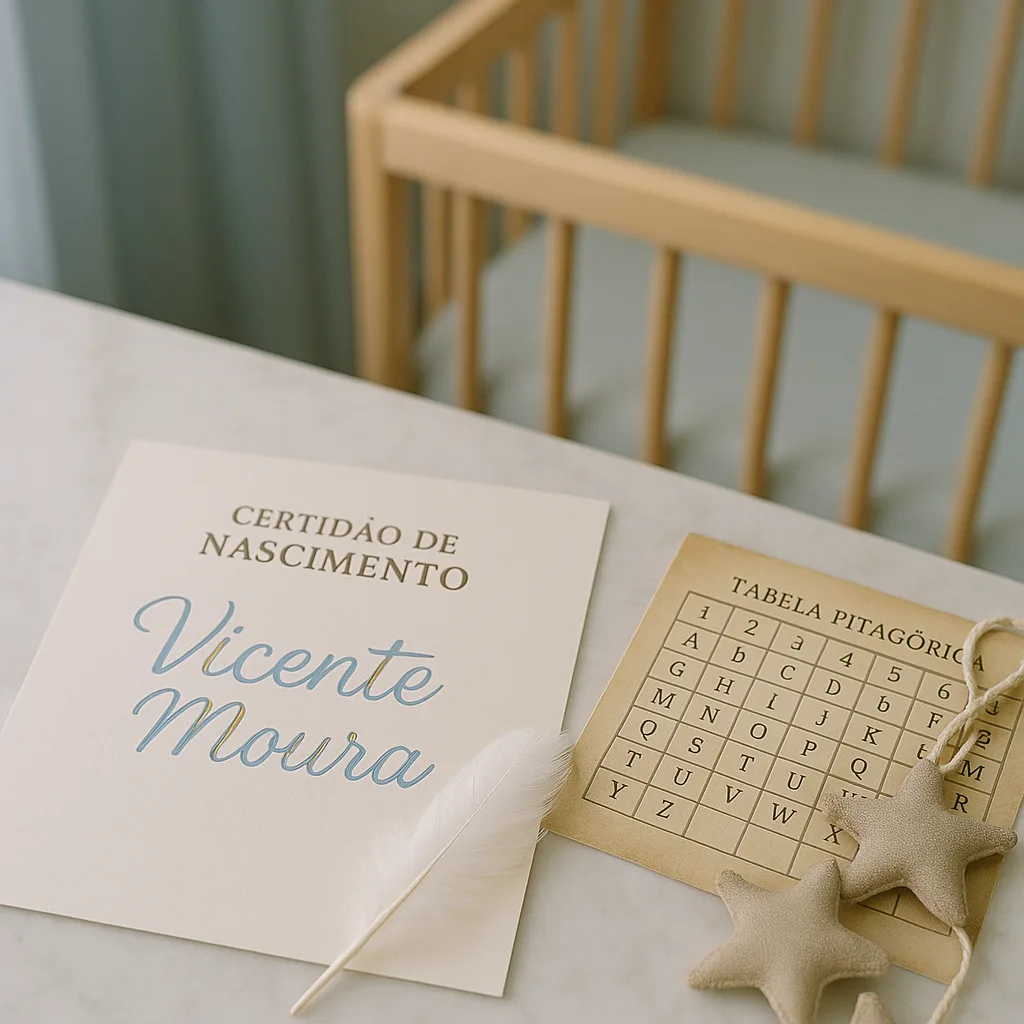
While Destiny looks at the birth date, the Soul Number, also known as the Heart's Desire Number or Soul Urge, comes exclusively from the vowels of the full birth name, as registered on the birth certificate. Each vowel receives a fixed numerical value: A is 1, E is 5, I is 9, O is 6, and U is 3. You add the value of all vowels in the name and reduce the result to a single digit (or master number).
A simple example: in the fictional name Lua Silva, the vowels are U, A, I, I, A, with values 3, 1, 9, 9, 1, which when added equal 23; reducing, 2+3=5. That 5 would be the Soul Number in this case.
Numerologist Liggia C. Ramos summarizes the essence of this number well in a press interview:
It's the person in their deepest self. It's the north we seek in life. It's a pure essence that's not always externalized, meaning the person won't always tell the world who they really are.
This is the central difference between Soul and Destiny: Destiny shows what the person came to do; Soul shows what they desire deep down, often in silence. When these two numbers point in very different directions, it's common to feel a kind of internal tension, as if life asks for one thing and the heart wants another. It's not cause for alarm: it's precisely this friction that often drives more conscious growth, a theme explored in depth in the article on what to do when your chart numbers don't align. Those who want to understand this number's specific mechanics can also read the text on why success doesn't guarantee feeling fulfilled, which addresses exactly this gap between Soul and external trajectory.
Personal Number (Personal Year): the year's climate, not a snapshot of your soul
If Destiny and Soul are fixed photographs taken at the moment of birth, the Personal Year is a moving picture. It's calculated by combining the day and month of birth with the current year, and renews every twelve months within a larger cycle called the Universal Year. While Destiny speaks of lifelong purpose, the Personal Year speaks of trends, opportunities, and challenges of that specific year: one period more suited to new beginnings, another to harvest, another to review.
Confusing the two creates mismatched expectations: someone might read about the Personal Year expecting to find their life's mission, when they're actually reading about the climate of the next twelve months. They're tools on completely different time scales, and using the wrong ruler is the most common way to leave a numerology reading feeling like nothing rang true. The complete nine-year cycle that organizes these phases is explained in the article on how to discover what phase of the 9-year cycle you're in, and those who want to zoom in further (from year to month and day) will find the step-by-step in Personal Year, Personal Month, and Personal Day.
How these three numbers speak to each other
For those studying their own numerological chart, the most interesting part isn't looking at each number in isolation, but observing how they dialogue. Destiny draws the broad terrain of your journey; Soul reveals the emotional fuel driving your choices within that terrain; Personal Year shows the specific climate at the moment you're walking that path now. Someone with Destiny 7 (introspection, search for meaning) and Soul 5 (desire for freedom and movement) might live a subtle conflict between the urge to dive deep alone and the urge to explore the world. It's in exactly this kind of cross-reading that numerology becomes more useful than any isolated number.
The table below summarizes the central differences between the three numbers, bringing together what was explained throughout the text:
| Number | Calculation basis | What it reveals | Nature |
|---|---|---|---|
| Destiny Number (Life Path) | Complete sum of birth date (day, month, year) | Life mission and direction, themes that repeat | Fixed from birth |
| Soul Number (Heart's Desire) | Sum of vowels only in full birth name | Intimate desire, essence not always expressed to the world | Fixed from birth |
| Personal Number (Personal Year) | Birth day and month combined with current year | Trends and opportunities of that specific year | Changes every 12-month cycle |
It's worth emphasizing: these three layers belong to distinct traditions and calculations, and there is no absolute consensus among schools about naming. The real value in knowing the differences isn't getting which website is right, but knowing exactly what question each number is answering, and reading your own results with that clarity in mind.
Frequently asked questions
Are personal number and destiny number the same thing?
Not necessarily. Depending on the numerology school, personal number can refer to the Personal Year (a cycle that changes every 12 months) or be used as a generic term for any number on your chart. The Destiny Number, meanwhile, is fixed, calculated from your complete birth date, and indicates your life mission, not a temporary cycle.
How do I calculate the soul number from a name?
Add only the numerical value of the vowels in your full birth name (A=1, E=5, I=9, O=6, U=3) and reduce the result to a single digit or master number (11, 22, or 33). The result indicates the person's intimate desire, often different from what they show publicly.
Why does the same numerology term appear with different meanings on different websites?
Because numerology brings together schools with different origins and vocabularies, without a single standardized system. This kind of divergence between traditions also appears in other ancient symbolic areas, as shown by the Encyclopaedia Britannica in describing how different cultures developed their own systems for interpreting celestial bodies and numbers throughout history.
Does the Personal Year replace the Destiny Number when doing a reading?
No. They answer different questions: the Destiny Number points to lifelong direction, while the Personal Year shows the climate and trends of a specific 12-month period. Using one in place of the other usually produces readings that feel like they don't match reality.

Recomendado
Mapa Astral & Mapa Numerológico
Descubra seu número da sorte e previsões sobre o seu futuro.
Universo Astral Editorial Team · Birth charts and numerology
This article was produced by the Universo Astral editorial team, with AI tools assisting research and drafting and human review before publication. If you spot anything inaccurate or outdated, let us know at our contact email.