Expression Number: How to Calculate It From Your Name

The Expression Number is calculated from the letters of your birth name. In Western numerology, each letter is assigned a value; the sum goes through reductions until it reaches the result used for interpretation. This number is associated with abilities and talents, while the Destiny Number, obtained from the birth date under the convention used in this article, refers to the course of a person's life. These are readings from a symbolic and cultural system, with no scientific proof of predictive ability.
The origins of the link between letters and numbers
Pythagoras lived in the 6th century BC, and his followers developed symbolic interpretations for numbers. The Encyclopaedia Britannica entry on number symbolism describes 1 as an expression of origin and unity in Pythagorean thought. The classification also linked even numbers to the feminine and odd numbers to the masculine. Within this set of associations, 2 and 3 corresponded to the two principles, respectively, and 5 represented their union.
Another element of this tradition was the tetraktys. According to the Stanford Encyclopedia of Philosophy, the Pythagoreans of the 5th century BC gave a special place to the total obtained from 1 + 2 + 3 + 4. The result, 10, expressed perfection and pointed to the mathematical order of the universe.
The table that today converts the alphabet into numeric values, however, has no proven authorship by Pythagoras. The modern method of calculating numbers from names was put together much later, with contributions from Mrs. L. Dow Balliett. Born in 1847 and deceased in 1929, she published The Philosophy of Numbers in 1908. Another of her works, Vibration of Numbers, from 1925, is available in digital form on the Internet Archive.
Juno Jordan, a student of Balliett's, was born in 1884 and died in 1984. She founded the California Institute of Numerical Research and, in 1965, published Numerology: The Romance in Your Name, drawing distinctions between the components of the numerology chart. The label "Pythagorean" points to a connection with Pythagoras's thinking. It does not prove that today's rules were actually taught by him.
What changes between Expression and Destiny
The names used for these calculations vary by school or author. Some sources call the result drawn from the name "Destiny"; others use that word for the figure calculated from the birth date. Here, the terms follow these definitions:
- Destiny or Life Path: calculated from the birth date, it is interpreted in connection with the direction and themes of a person's journey.
- Expression: obtained from the vowels and consonants in the birth name, it is interpreted as a set of personal abilities and resources.
Within this symbolic reading, the Expression Number describes abilities a person can draw on along the path represented by the Destiny Number. Results that are close in meaning can suggest an alignment between talents and goals. Different results are read as aspects that need to be reconciled.
The article How to Calculate the Destiny Number walks through the calculation based on the birth date. Keeping the two operations separate helps clarify what each reading is meant to describe.
Consider the combination of Expression 7 and Destiny 3. The number 7 is associated with analysis and introspection; 3, with communication and creativity. A numerology reading might point to tension between researching quietly and presenting ideas publicly. One way to reconcile this, in this interpretation, would be giving creative, accessible form to the knowledge produced through research.
Letter values in the Pythagorean table
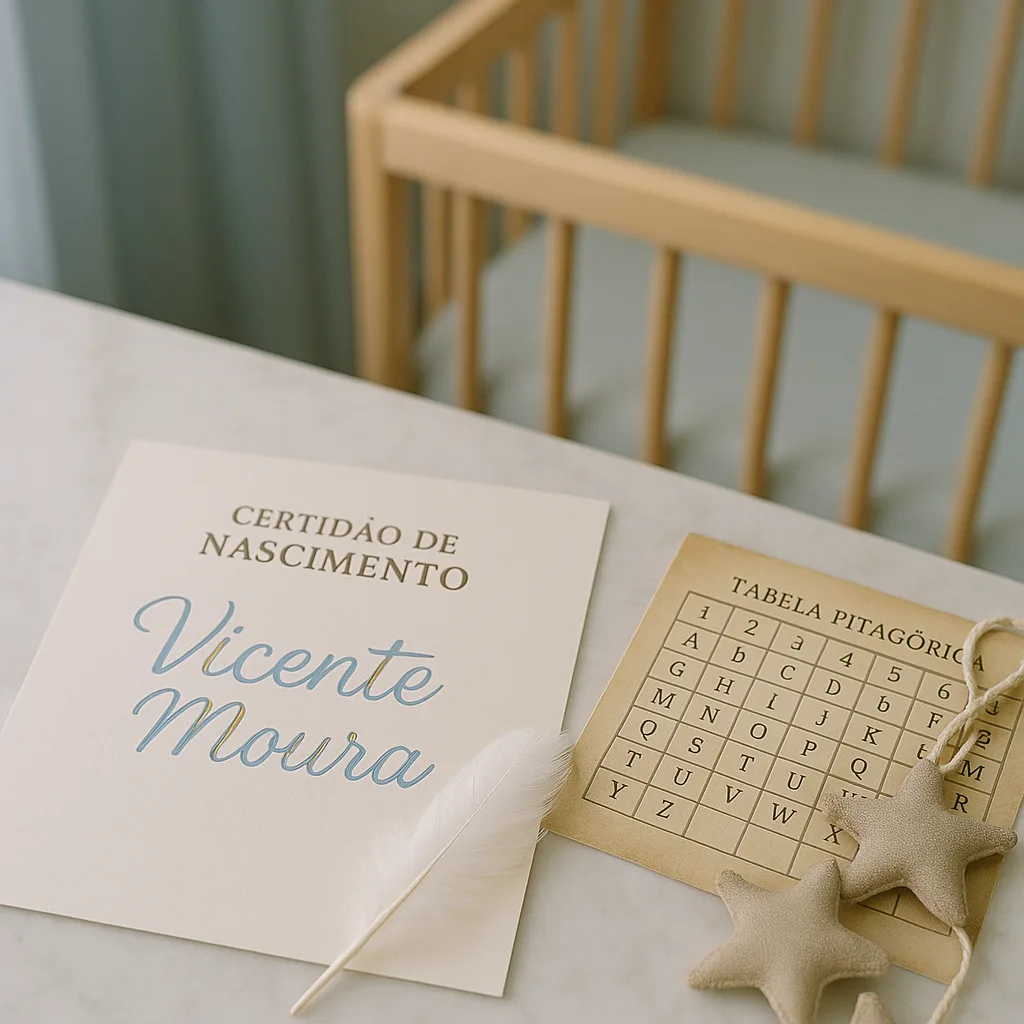
The Western correspondence spreads the letters across a sequence from 1 to 9. After I, the count starts over at J; after R, it goes back to 1 at S. The full distribution looks like this:
| Value | Corresponding letters |
|---|---|
| 1 | A, J, S |
| 2 | B, K, T |
| 3 | C, L, U |
| 4 | D, M, V |
| 5 | E, N, W |
| 6 | F, O, X |
| 7 | G, P, Y |
| 8 | H, Q, Z |
| 9 | I, R |
J occupies the tenth position in the alphabet, yet corresponds to 1 in this table. The reduction of 10 explains why: 1 + 0 = 1. This is the same rule of adding up digits used in every other reduction in the calculation.
Other correspondences exist. The Chaldean tradition, of Babylonian origin, spreads letters across eight values, from 1 to 8. The number 9 is left without letters because it carries a sacred meaning tied to divine wholeness. The calculations in this article follow only the Pythagorean table shown above.
How to calculate the Expression Number
Use the full name recorded at birth. For this method, the starting point is not a nickname or a name adopted later through marriage or social use. Look up the value of each letter and add them up part by part.
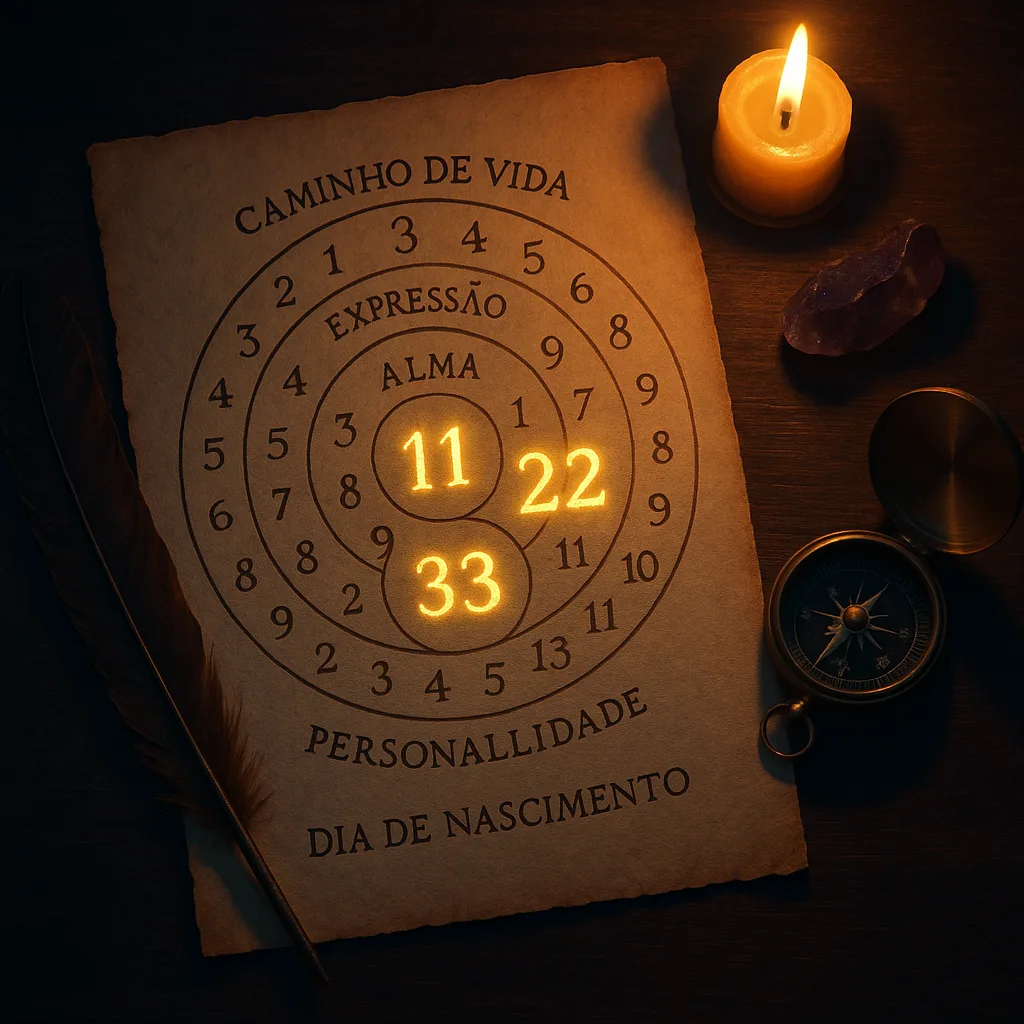
Reduction means adding the digits of a result until you reach a single digit. The convention used here keeps 11, 22 and 33 whenever they appear as results of the reduction steps. These values are known as master numbers.
- First, write out every first name and surname from the birth record.
- Next, calculate each part separately, replacing its letters with the corresponding values.
- Add up the values for each part and reduce the subtotal, keeping 11, 22 or 33 whenever they appear.
- Combine the already-reduced subtotals into a new sum.
- Do the final reduction, with the same exception for master numbers.
The fictional example "Carlos Eduardo Silva" lets us walk through every step. The letters convert as follows:
- In "Carlos," C is worth 3; A, 1; R, 9; L, 3; O, 6; and S, 1. The sum comes to 23, which reduces to 2 + 3 = 5.
- In "Eduardo," the values are 5 for E, 4 for D, 3 for U, 1 for A, 9 for R, 4 for D and 6 for O. The subtotal of 32 reduces to 3 + 2 = 5.
- In "Silva," S corresponds to 1; I, to 9; L, to 3; V, to 4; and A, to 1. The total is 18, reduced by 1 + 8 = 9.
- The partial results are 5, 5 and 9. Together, they add up to 19. The following reductions are 1 + 9 = 10 and then 1 + 0 = 1.
So this name produces Expression 1. In the numerology reading, this result relates to initiative, leadership and originality.
This procedure is known as reduction by name. It keeps the intermediate results of each part visible, including any master numbers that appear. For that reason, under the convention described here, these steps should not be automatically replaced by a single sum of all the letters at once.
What information goes into each number on the chart
The same table allows for different readings depending on which letters are selected. All letters go into the Expression Number; only the vowels go into the Soul Urge, also called Motivation; the consonants form the Personality Number. Each calculation carries its own interpretation:
- Expression: considers the full birth name and relates to skills and abilities. This base stays the same, though interpretations vary on the effect of names adopted later in life.
- Destiny or Life Path: uses the birth date to describe a person's journey. Since the date never changes, the result is fixed.
- Soul Urge: draws on the vowels in the birth name and is associated with motivations, desires and inner needs. Using this same base, the number does not change.
- Personality: uses the consonants in the birth name to interpret the impression a person gives in social settings. This result also stays fixed under this convention.
- Mission Number: combines Expression and Destiny into a sum, read as a meeting point between personal abilities and purpose. Its source values are fixed.
Differences between these readings don't necessarily point to a calculation error. Each one draws on distinct information. The article Soul Number vs. Destiny Number covers the interpretation of personal desires that seem to diverge from the path indicated by destiny.
Common mistakes to avoid when calculating
Using a name different from the one recorded at birth changes the letters and can change the result. In the traditional practice described here, the original birth record is the reference point because it carries the meaning of an originating vibration. Some numerologists read a later name as an added influence, while still keeping the original calculation as the base.
It's also worth checking how the source you're reading defines its terms. The phrase "destiny by name," for instance, may refer to what this article calls the Expression Number. Comparing results without checking for this kind of difference in terminology can create a contradiction that isn't really there.
Frequently Asked Questions
Are Expression and Destiny the same calculation?
Here, they are separate operations: the letters in the birth name generate the Expression Number, while the numbers in the birth date generate the Destiny Number. The first reading relates to abilities, and the second, to life's journey. Since terminology varies between authors, it's important to check the definition before comparing interpretations.
Which name is used after marriage or a name change?
The method shown here continues to use the full birth record. A social name, married name or nickname does not replace that reference point. Some approaches assign additional meanings to names used later on, but still keep the original calculation separate.
When should I keep 11, 22 or 33 without reducing them further?
Under this convention, these results are preserved at every reduction step. So 11 stays 11 instead of becoming 2; the same goes for 22 and 33, which don't turn into 4 and 6. This special treatment of master numbers is linked to Balliett's modern work, developed in the early 20th century. It doesn't correspond to a documented rule from the ancient Pythagorean school.
How should I interpret a difference between Expression and Destiny?
The two numbers serve different functions in a numerology reading. Expression represents abilities; Destiny, a life direction. When the meanings seem to diverge, the interpretation usually looks for ways to apply those abilities to the indicated path. The difference, on its own, doesn't point to an arithmetic error.
Is the Pythagorean table the only way to convert letters into values?
No. The Chaldean approach, tied to Babylonian tradition, uses a different distribution: its correspondences run from 1 to 8. There, the sacred character assigned to 9 keeps it from being linked directly to any letter. Since these tables follow different conventions, you need to pick one and stick with it throughout the entire calculation.

Recomendado
MAPA ASTRAL E NUMEROLÓGICO PERSONALIZADO
Mapa Astral + Numerologia Um mergulho profundo na sua essência. E se tudo o que você procura… já estivesse dentro de você - esperando para ser revelado?
Universo Astral Editorial Team · Birth charts and numerology
This article was produced by the Universo Astral editorial team, with AI tools assisting research and drafting and human review before publication. If you spot anything inaccurate or outdated, let us know at our contact email.