Moon in the Birth Chart and Relationships: Why It Beats Venus
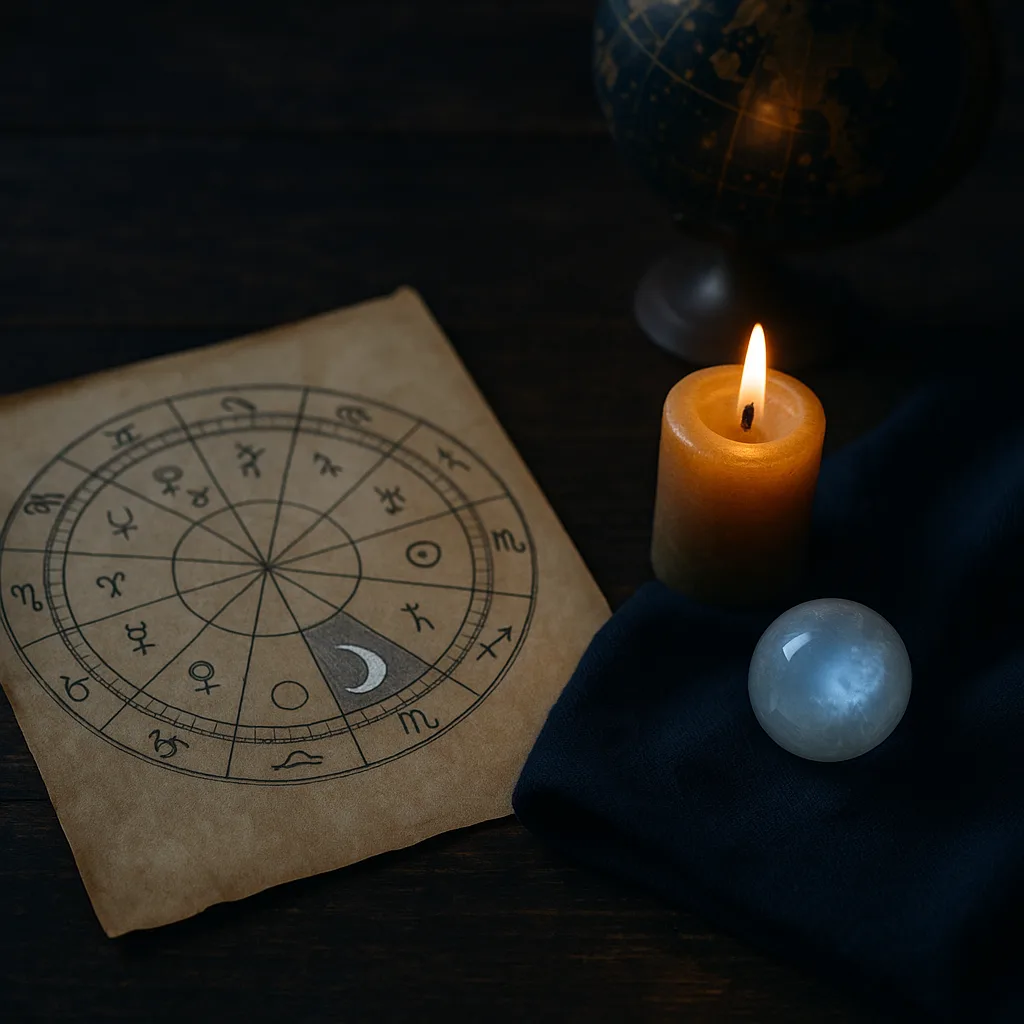
Two people fall for each other fast, text all day long, feel that instant chemistry that seems to confirm everything. Months later, one complains the other is too cold, the other complains the first is too clingy. Venus never lied about the attraction. The problem is that nobody checked the Moon.
In natal astrology, the Moon does not speak to what attracts you or how you show affection. It speaks to what you need to feel, day after day, in order to relax inside a bond. It is the point in the chart tied to instinct, to emotional memory built since childhood, and to the feeling of being at home, literally and symbolically, next to someone. While Venus shows what you value aesthetically in a partner, the Moon shows what happens when the lights go out and there is no more performance, just raw need.
The difference between Venus and Moon that most people miss
Venus rules taste, charm, what sparks interest and aesthetic pleasure. It is the planet that explains why you are drawn to a certain sense of humor, a certain style, a certain way of flirting. The Moon operates on a deeper layer: it governs automatic reactions, what calms you down when you are anxious, the kind of care that makes you feel truly loved rather than merely admired.
That is why someone can share Venus placements, or harmonious Venus signs, with a partner and still feel a persistent distance that attraction alone cannot explain. Venus chemistry happens at the meeting point, at the beginning, on the visible surface. Lunar compatibility shows up in daily life: in how each person reacts to an argument, asks for comfort, needs silence or conversation after a bad day. If you have already read on this site about how to find your Venus sign, it is worth understanding that it only tells half the story. The other half belongs to the Moon.
There is also an important difference from other points in the chart linked to love. Lilith, for instance, points to what you repress and refuse to give up, as covered in the article on Lilith and boundaries in love. The Moon works in different territory: it does not show what you defend tooth and nail, it shows what keeps you from needing to defend yourself in the first place. It is the difference between a boundary and a need that, once met, requires no boundary at all.
Why the Moon moves so fast (and why that changes the whole calculation)
While the Sun stays roughly a month in each sign, the Moon moves much faster. According to NASA's science site on the Moon, it completes its orbit relative to the stars, known as the sidereal month, in approximately 27.3 days. Dividing that period by the 12 zodiac signs, the Moon spends about 2.3 days in each one, just over 48 hours.
This technical detail has a huge practical consequence for anyone trying to work out their own Moon sign: birth date alone guarantees nothing. Since the Moon changes signs every two and a half days or so, two people born on the same day can have Moons in completely different signs, depending on the exact time of birth. It is a problem similar to what was already discussed in the article on the importance of an exact birth time, except here the sensitive point is not the Ascendant, it is the Moon itself.
It is also worth noting that the Moon's orbit is not a perfect circle: it is elliptical, ranging from about 225,000 miles at its closest point to Earth (perigee) to 251,000 miles at its farthest (apogee), according to the same NASA source. This variation in orbital speed is one more reason why calculating a Moon sign cannot be done by rough guesswork: it requires a full birth chart, with correctly entered time and place of birth.
How to find your natal Moon and what it asks of you
The process for locating the Moon in a chart follows a simple logic, but one that depends on accurate input data.
- Gather the date, the exact time (as precise as possible, ideally taken from the birth certificate) and the city of birth.
- Generate the birth chart on an ephemeris platform, which will calculate the Moon's exact position in degrees and sign at the moment of birth.
- Identify also the astrological house where the Moon sits: the 4th house reinforces the need for home and roots, the 7th house ties that emotional need directly to a partner.
- Check whether the Moon forms relevant aspects, such as conjunction, opposition, square or trine, with other natal planets, since this intensifies or softens how that need plays out day to day.
- Compare the Moon sign with that of a partner to understand where each person's emotional needs meet or clash, an exercise explored further in the synastry method already explained in the article on astrological compatibility between two charts.
- Factor in the element of the Moon sign (fire, earth, air or water) as an initial shortcut for reading the chart, before getting into finer details.
What each lunar element needs to feel secure
Sorting the Moon by the element of its sign is a practical way to get a first read on what kind of emotional security a person instinctively seeks in a relationship.
| Moon Element | Signs | What it needs to feel secure | Where it tends to struggle |
|---|---|---|---|
| Water | Cancer, Scorpio, Pisces | Deep emotional connection, constant shows of care and intimacy | Feels rejected next to partners who are more rational or emotionally distant |
| Earth | Taurus, Virgo, Capricorn | Stability, predictable routine and concrete proof of commitment | Clashes with partners who are inconsistent or frequently change plans |
| Fire | Aries, Leo, Sagittarius | Autonomy, room for spontaneous enthusiasm and active recognition | Feels suffocated by excessive control, pressure or rigid routine |
| Air | Gemini, Libra, Aquarius | Constant dialogue, intellectual exchange and lightness in the bond | Feels trapped by heavy emotional demands or silent pressure |
It is worth remembering that the Moon also holds a position traditionally linked to greater ease in classical astrology: it rules its own domicile in Cancer and is considered exalted in Taurus, placements where astrological literature describes lunar energy working in a steadier, less reactive way. That does not make other Moon signs problematic, but it helps explain why certain combinations of needs flow with less friction.
When chemistry is not enough: the clash of incompatible Moons
It is entirely possible for two people to have favorable Venus and Mars placements between them, with strong attraction and clear mutual desire, as already described in the article on Mars and the intensity of desire, and still feel constant wear and tear in daily life together. The reason usually traces back to the Moon.
A Moon in Cancer, which needs daily closeness and rituals of care, can feel chronically abandoned next to a Moon in Aquarius, which processes security through space and independence. Neither one is wrong. They simply need opposite things in order to relax. This kind of clash does not show up during the initial flirtation, it shows up later, in routine, when one person asks for comfort and gets distance instead, or asks for space and gets pressure instead.
This is a different pattern from what the North Node describes, which speaks to a direction of growth and evolution over a lifetime, as already covered in the article on the North Node and romantic destiny. The Moon does not point to where you should go. It describes the ground you have already had under your feet since childhood, shaped by how you were cared for in your earliest years.
The symbolic backdrop: lunar eclipses and emotional peaks
Astrological tradition links lunar eclipses to moments of heightened emotion, peaks that bring pent-up feelings to the surface. This does not mean proven causation, but it is a useful symbolic marker for observing your own patterns over time. According to NASA's eclipse catalog, 2026 will bring two lunar eclipses: a total eclipse on March 3 and a deep partial eclipse on August 28, when about 96% of the lunar disk will enter Earth's shadow, with good visibility across the Americas. In 2027, three penumbral lunar eclipses are expected, in February, July and August.
New moon and full moon dates also work as reference points for anyone who wants to track their own emotional rhythm across the year. In 2026, for example, there are full moons on March 3 (coinciding with the total eclipse), August 28 (partial eclipse) and October 26, plus new moons in January, February, March, June, August, October and December. Using this calendar is not about expecting something to happen, it is about having reference points to notice how you react, alone or with a partner, during different phases of the month.
Ancient roots of the lunar symbol
The link between the Moon and emotional need is not a recent invention. Ancient civilizations already treated the Moon as a celestial body of symbolic weight equal to, or even greater than, the Sun's. In Mesopotamia, the moon god Sin, also called Nanna, was invoked as witness to international treaties for nearly a thousand years, between 1900 and 900 BCE, and his cult was directly tied to observing the Moon's phases as a tool of wisdom and prediction.
In Greek mythology, Selene personified the Moon, distinct from Aphrodite, the goddess of love and beauty who inspires the modern reading of Venus. That mythological separation reinforces the same distinction contemporary astrology still holds: one thing is the symbol of love and attraction, another is the symbol of instinct and need.
It is also worth mentioning that the founding text of Western astrology, the Tetrabiblos, written by the Alexandrian astronomer Ptolemy in the 2nd century CE, already treated the Moon as one of the central points in reading an individual chart, alongside the Sun and the Ascendant. And in Vedic astrology, a tradition that runs parallel to the Western one, the Moon takes on an even greater role through the nakshatras, the 27 lunar mansions that divide the sky into segments of 13°20' each, a system detailed in the article on nakshatras and the lunar constellations of Jyotish. An old Vedic myth tells how the moon god Soma received 27 wives, each representing one of these mansions, a mythological record that already linked the Moon to multiple bonds and cycles of partnership long before Western astrology formalized this reading.
Frequently Asked Questions
What does my Moon in the birth chart mean for love?
The Moon indicates the kind of emotional security you need to feel in a relationship in order to truly relax, based on attachment patterns formed since childhood. It does not speak to attraction or desire, but to what makes you feel cared for in daily life and intimacy.
What is the difference between the Moon and Venus in a relationship?
Venus rules attraction, aesthetic taste and how you show affection. The Moon rules the emotional need behind all of that, what remains once the novelty fades and only the daily reality of your instinctive reactions is left.
How do I find my Moon sign accurately?
You need to enter the exact date, time and place of birth into an ephemeris platform to generate a full birth chart, since the Moon changes signs roughly every two and a half days, making birth time a decisive factor in the calculation.
Do incompatible Moons mean a relationship will not work?
Not necessarily. Lunar incompatibility means both people's emotional needs call for different things, which requires more dialogue and conscious adjustment, but it does not fix the fate of a relationship, which depends on many other factors in the chart and on the relationship itself.
Why do I feel distant from someone even with strong chemistry?
This usually happens when Venus and Mars indicate strong attraction, but the natal Moons call for opposite forms of emotional security, for example one person needing constant closeness next to another who needs space and autonomy.
Recomendado
MAPA ASTRAL E NUMEROLÓGICO PERSONALIZADO
Mapa Astral + Numerologia Um mergulho profundo na sua essência. E se tudo o que você procura… já estivesse dentro de você - esperando para ser revelado?
Universo Astral Editorial Team · Tarot and moon transits
This article was produced by the Universo Astral editorial team, with AI tools assisting research and drafting and human review before publication. If you spot anything inaccurate or outdated, let us know at our contact email.