Mars in Your Birth Chart: How Your Mars Sign Reveals the Desire You Can't Control
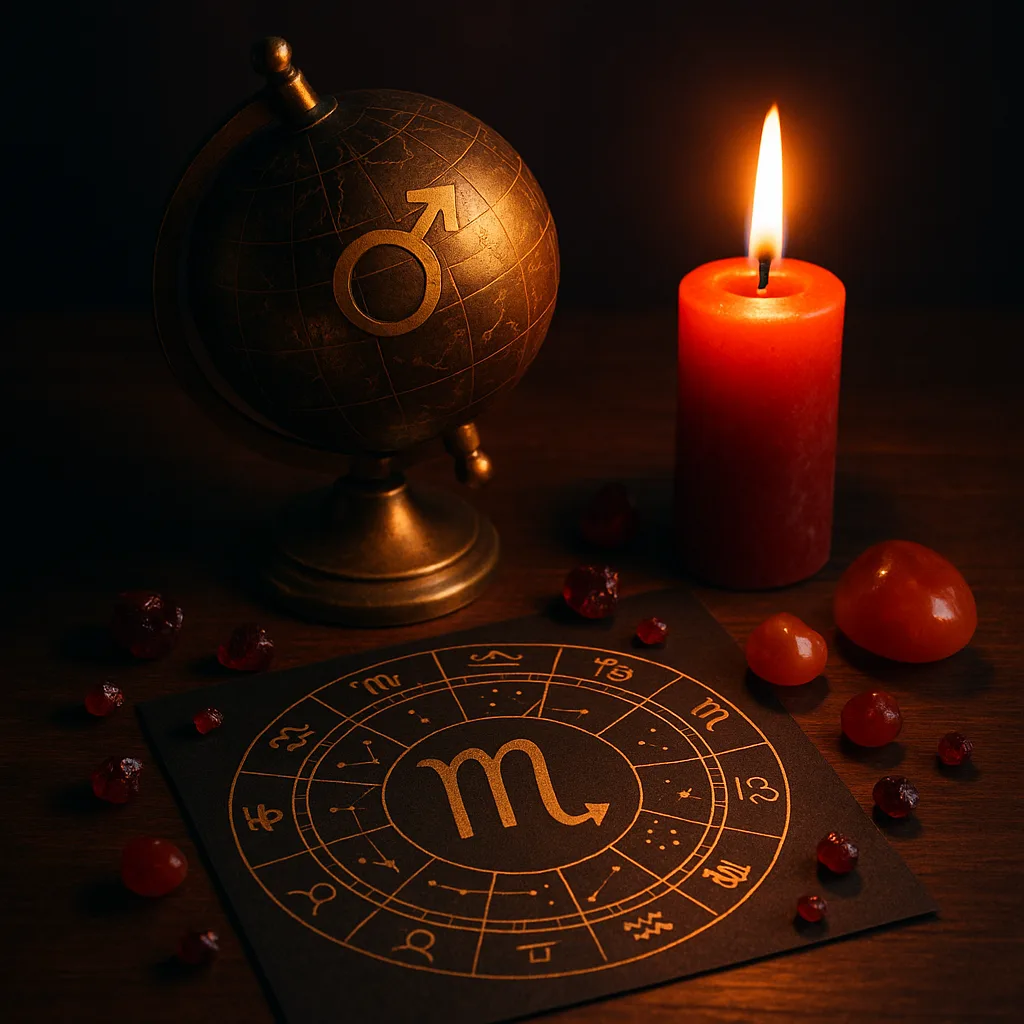
Venus tells you what you value in a partner. Lilith points to what you keep locked away. Mars negotiates none of that: it's the planet that pushes you to act when desire takes hold, whether in pursuit, in conflict, or in bed. It's the point in the birth chart least suited to diplomacy and most suited to pure impulse.
The name already gives part of it away. The Romans named the planet after the god of war, because of the reddish color that resembled blood. The Egyptians read it in a similar way, calling the planet Her Desher, something like 'the red one.' Even today the popular nickname is the Red Planet, because iron minerals on the Martian surface oxidize and produce that tone, according to data compiled by NASA. Same symbol, same color, the same association running through different cultures: force, blood, action.
Mars isn't Venus or Lilith: what it actually shows
It's easy to mix up the three when the subject is love, but each one answers a different question. Venus explains your affectionate style, what attracts you and what you consider beautiful in a bond. Lilith speaks to the boundaries and desires that stay hidden, what doesn't come easily. Mars is something else entirely: it's how desire turns into action, how a person chases what they want, argues, gets frustrated, and experiences physical attraction.
| Chart point | What it reveals in love | Symbolic nature |
|---|---|---|
| Venus | How a person loves, what they value, and what they find attractive in a partner | Affection, attraction, values |
| Lilith (Black Moon) | Boundaries, repressed desires, what isn't given up easily | Shadow, taboo, autonomy |
| Mars | How a person acts on desire: pursuit, confrontation, physical passion | Impulse, action, sexual energy |
Traditions in applied astrology often split this analysis into three layers when it comes to sexuality: Mars is said to symbolize sexual energy itself and satisfaction (or lack of it) within a relationship, Venus is thought to measure erotic tension, and Pluto is linked to deeper, more transformative sexuality. This breakdown helps explain why reading only the sun sign is never enough: each planet handles a different part of the same subject. It's also the thread this site already explored in the article on astrological houses of love: the sun sign explains very little when it comes to the real mechanics of a relationship.
The mythology behind the planet that asks no permission
In Roman mythology, Mars ranked second in importance only to Jupiter, and even without much clarity about his original character, he became the protective god of Rome. In Greece, the equivalent, Ares, had a far less noble reputation: he was treated almost as an embarrassment among the gods, despite carrying the same function of war. The cultural difference is curious: the same martial energy was read as a foundation in one place and as a disgrace in another, proof that intensity isn't the same thing as a flaw, just force that needs direction.
There's another mythological detail that fits well with this topic. Legend has it that Ares was involved with Aphrodite, the goddess of love, and the two had children named Phobos (fear) and Deimos (panic). Coincidence or not, those are exactly the names of Mars's two real moons, named by astronomers in reference to that myth. Desire and fear walking side by side: it's an image that sums up well what Mars tends to stir up when it enters the picture in love.
How to find your Mars sign (step by step)
Unlike the Sun, which spends about a month in each sign, Mars changes position every six to seven weeks under normal conditions. That means two people born in the same week can have Mars in different signs, and the calculation requires more care than simply looking at a birth date.
- Gather your exact birth date, time, and city. The time matters because, on transition days, Mars can shift signs hours before or after midnight.
- Use a reliable birth chart generator to build your full natal chart.
- Locate the Mars symbol (♂) and check four things: the sign, the astrological house it falls in, whether it was retrograde at the moment of birth, and what aspects it makes with Venus, the Moon, and the Ascendant.
- Identify the element of your Mars sign (fire, earth, air, or water). That element sets the overall tone for how desire gets expressed.
Desire style by Mars element
Cross-referencing your Mars sign with its element helps you understand the tone of your passion without falling into sun-sign stereotypes.
| Mars element | Signs | Desire style |
|---|---|---|
| Fire | Aries, Leo, Sagittarius | Direct, physical, impulsive, seeks immediate contact |
| Earth | Taurus, Virgo, Capricorn | Sensory, built up gradually, tied to the body and to consistency |
| Air | Gemini, Libra, Aquarius | Mental, needs intellectual stimulation before the physical |
| Water | Cancer, Scorpio, Pisces | Emotional, intense, tied to fusion and vulnerability |
Scorpio is often treated as the most intense sign of the zodiac when it comes to desire, and there's a technical explanation for that: despite being a water sign, it's ruled precisely by Mars (in the tradition that still uses the classical ruler, before Pluto entered the picture). It's that combination, water's emotion plus Mars's impulse, that creates the sign's near-proverbial reputation for intensity.
Mars's dignities: where it acts with more or less friction
Hellenistic astrology, systematized by Ptolemy in the Tetrabiblos, ranks each planet's strength by sign through the system of essential dignities. For Mars, the logic works like this:
- Domicile (home turf, most direct action): Aries and Scorpio.
- Exaltation (special boost): Capricorn, with particular strength at the 28th degree.
- Detriment (needs to negotiate more than act): Taurus and Libra.
- Fall (energy more contained, indirect): Cancer.
In practice, this helps explain why Mars in Aries tends to act without hesitation, while Mars in Libra tends to weigh pros and cons before any move, and Mars in Cancer tends to dam up desire rather than express it openly.
Mars retrograde: the calendar detail many people confuse with Mercury
Mars goes retrograde far less often than Mercury or Venus: the phenomenon happens roughly every 26 months and lasts about ten weeks, a relatively rare event on the astrological calendar. The most recent period ran from December 6, 2024 to February 23, 2025, moving from Leo back into Cancer. The next one is set for January 10 to April 1, 2027, crossing from Virgo into Leo, according to calculations compiled by observatories and ephemeris sites such as In-The-Sky.org.
One detail worth stressing: there's no Mars retrograde period at all in 2026. If you've felt something like blocked desire or pent-up energy this year, it's more likely coming from Mercury or Venus retrograde, which do occur during this stretch, not from Mars.
It's worth remembering that retrograde motion is an optical effect, not an actual backward movement of the planet in space. It's an astronomically real and calculable phenomenon, predictable centuries in advance, since it depends only on the orbital geometry between Earth and Mars. What astrology adds is the symbolic reading layered on top of that apparent movement, not any physical change in the universe.
A concrete example of how much this matters: the 2024-2025 transit kept Mars in Cancer, the sign of its fall, for 23 weeks, four times longer than the usual six to seven weeks per sign. For anyone who felt desire grow more dammed up or indirect during that period, it wasn't a weak way of expressing it: it was a prolonged transit landing exactly in the sign where Mars acts most cautiously.
The Vedic reading: when Mars becomes a matter for arranged marriage
Indian astrology (jyotish) treats Mars, called Mangal or Kuja, as a planet tied directly to marriage, not just to isolated desire. There's even a technical concept for it: Mangal Dosha (also called Kuja Dosha), which forms when Mars occupies houses 1, 4, 7, 8, or 12 of the birth chart. This placement is traditionally linked to possible delays, obstacles, or friction within a marriage.
The system isn't purely a warning sign. When Mars is well placed, Vedic tradition holds that it supports mutual backing, harmony, and a satisfying sex life, acting like the fire element that keeps a relationship's flame burning. There's even an old practical procedure: cross-checking both partners' charts (kundalis) to see whether Mangal Dosha shows up in both, since traditional belief holds that two people with the same pattern cancel out the effect in each other. It's a good reminder that the idea of Mars weighing on a relationship isn't some recent astrology-app invention: it has centuries of structured practice behind it, in a tradition quite different from the Western one.
For anyone who has already studied the method of comparing two birth charts through synastry, it's worth adding Mars to the comparison: it's not enough to check whether the Venuses get along, you also need to see whether the Marses complement each other or generate constant friction.
Frequently Asked Questions
What does Mars mean in the birth chart?
Mars represents the energy of action, drive, and desire in the natal chart. In love, it shows how a person pursues what they want, how they react to frustration and conflict, and the style of physical intensity and passion they carry, different from Venus, which shows the affectionate style, and from Lilith, which shows the boundaries.
How do I find my Mars sign?
You need to generate a full birth chart with your exact date, time, and place of birth, since Mars changes signs every six to seven weeks. Once the chart is built, just locate the Mars symbol (♂) and identify the sign it's positioned in.
What does Mars in Scorpio mean in love?
Mars is in domicile in Scorpio, which makes this one of the most intense placements in the chart. This person tends to experience desire in a deep, far from superficial way, seeking emotional connection alongside physical attraction, and tends to avoid involvements that feel shallow or short-lived.
Does natal Mars retrograde change romantic behavior?
When Mars was retrograde at the moment of birth, the symbolic tendency is toward a more introspective desire, one that takes time to express openly or goes through phases of doubt before acting. That's different from living through a Mars retrograde transit, which temporarily affects everyone roughly every 26 months.
What's the difference between Venus and Mars in astrology?
Venus shows how a person loves, what they value, and what they find attractive in a partner. Mars shows how that attraction turns into action: pursuit, confrontation, and the expression of physical passion. Together, the two give a far more complete picture than either one alone.

Recomendado
MAPA ASTRAL E NUMEROLÓGICO PERSONALIZADO
Mapa Astral + Numerologia Um mergulho profundo na sua essência. E se tudo o que você procura… já estivesse dentro de você - esperando para ser revelado?
Universo Astral Editorial Team · Tarot and moon transits
This article was produced by the Universo Astral editorial team, with AI tools assisting research and drafting and human review before publication. If you spot anything inaccurate or outdated, let us know at our contact email.