Astrological Houses of Love: Why Your Sun Sign Doesn't Determine Your Timing
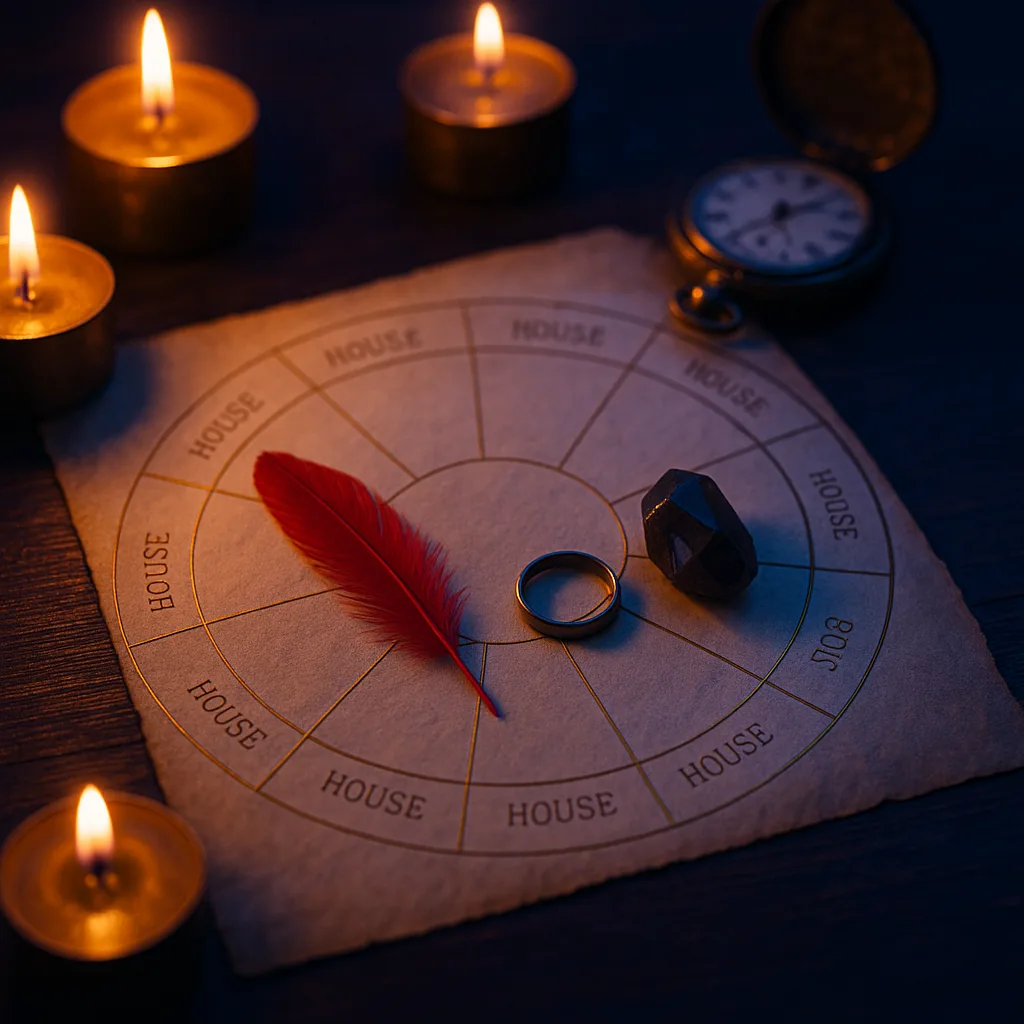
Two people born on the same day, under the same sun sign, can experience love at completely different points in life. One finds a serious partnership at 24, another doesn't feel that pull until well past 30. This isn't about luck, and it isn't about one person being more mature than the other. It comes down to a detail of the birth chart that rarely gets mentioned in conversations about compatibility: the position of the astrological houses tied to love, calculated from the exact time and place of birth, not from the sun sign.
While the sign of Venus explains your style of loving, and synastry compares two charts to measure affinity, the houses do something different: they mark the ground where romantic circumstances unfold across a lifetime. They explain why certain matters of the heart seem 'switched on' during some phases and dormant during others.
The three houses the zodiac sets aside for love
Astrological tradition mainly links three sectors of the chart to romantic experience, each with its own distinct flavor.
The 5th house is the territory of spontaneous romance: the passion that sparks on a first date, lighter affairs, that initial jolt of excitement. It's the house of first contact, of flirting at parties, concerts or casual encounters. When it comes to sex, the 5th house speaks to pleasure that's more carefree and comfortable, without the weight of fusion.
The 7th house, opposite the Ascendant in the chart, governs formal partnerships: marriage, engagement, business partnership, any bond that requires a declared commitment. It shows the kind of partner someone seeks to balance their own essence, and how they build long-term connections. The tone shifts depending on the element of the sign occupying this house: in an Air sign, the bond leans on conversation and intellectual exchange; in Fire, on passion and shared action; in Earth, on security and common goals; in Water, on emotional depth and intuition.
The 8th house, meanwhile, speaks to intimacy on another level: fusion, deep sexuality, shared resources (inheritances, joint assets), and the transformation an intense relationship can trigger. Sex here carries a different texture, more like a pact, threaded through with fear of loss, control and total surrender, body and soul.
The difference between the 5th and the 8th house, then, isn't just about intensity, it's about nature: one is lightness, the other is fusion. The 7th house sits in between, handling the commitment that holds a relationship together over time.
Why birth time changes everything (and sun sign changes nothing)
Astrological houses are calculated from the Ascendant, a point determined by the exact time and place of birth. That means two Taurus natives, born on the same day but in different cities or at different hours, can have their 7th house falling in entirely different signs: one in Leo, another in Scorpio, for example. The sun sign stays the same, but the map of romantic circumstances is completely different.
This is the detail that tends to slip past anyone reading only sun sign horoscopes: your birth date gives you the Sun, but it doesn't give you the Ascendant or the houses. Without an accurate birth time, there's no way to know where the 5th or 7th house actually sits in the chart. That's why an earlier article on this site about birth chart compatibility treats synastry as a full comparison between two natal charts, not just between two sun signs (see more in astrological compatibility: how to compare your birth chart with the person you love).
There's also a technical layer that few beginner astrologers explain: different house systems exist, and the system chosen changes which house a planet falls into. The Equal House system divides the circle into 12 sections of 30 degrees each, starting from the Ascendant. The Whole Sign system, one of the oldest, already used in the Hellenistic era, makes each house correspond to an entire sign. Placidus, the most popular system in the West today, was popularized by Placidus de Titis, a monk and professor of mathematics, physics and astronomy at the University of Pavia in the 17th century, although the technique had already been attributed (perhaps mistakenly) to Ptolemy by earlier astrologers, such as the 12th-century Hebrew scholar Abraham Ibn Ezra. In the Placidus system houses are unequal in size, calculated from the diurnal motion of the planets, which can cause distortions at very high latitudes. According to the Encyclopaedia Britannica, an astrological house is one of the twelve sectors into which the celestial sphere is divided for chart interpretation (britannica.com).
In practice, this means the same chart can place Venus in the 6th house under one system and the 7th house under another, changing the reading of exactly when a romantic theme gets activated. That's not a cosmetic detail: it's the difference between saying a commitment phase starts this year or not for a few more years.
A bit of history: where the idea of love houses comes from
The idea of dividing the sky into sectors of meaning (the so-called topoi, or places) originates in the Hellenistic tradition, between the 2nd century BCE and the 2nd century CE, in Alexandria, blending Babylonian astrology, Egyptian tradition and Greek philosophy. The name most cited from that period is Claudius Ptolemy, the Alexandrian astronomer and astrologer, author of the Tetrabiblos, a 2nd-century CE treatise that became the founding text of Western astrology, the astrological counterpart to his own astronomical work, the Almagest. Another author from the same era, Vettius Valens, wrote the Anthologiarum, a work scholars consider an even more practical source on how astrology was actually practiced at the time, in contrast to Ptolemy's more theoretical tone.
This Hellenistic foundation is the skeleton on which nearly all modern house readings (including the distinction between the 5th, 7th and 8th houses) still rest, even when today's vocabulary sounds more psychological than the original texts.
The real timing: how planetary transits activate each house in different years
Here's the practical core of the matter. Planets like Saturn and Jupiter take a fixed amount of time to complete one trip around the zodiac, and that time is the same for everyone. What changes from person to person is the moment when that transiting planet touches the natal 5th or 7th house of each individual chart.
| Celestial body | Orbital period (NASA data) | Average time per house | What it tends to indicate in the love house |
|---|---|---|---|
| Saturn | about 29.4 Earth years | approximately 2.45 years per house | Maturation, commitment, structural tests (the Saturn return, around age 29-30, is a classic marker) |
| Jupiter | about 12 Earth years | approximately 1 year per house | Expansion, new encounters, romantic optimism |
| Lunar Nodes | precession cycle of about 18.6 years | approximately 1.55 years per house | Encounters that feel fated, reunions and shifts in direction within relationships |
| Moon (transit) | cycle of about 27.3 days | a few hours to about 2 days per house | Very short-term emotional micro-windows |
The orbital data for Saturn and Jupiter used here follows the solar system planet fact sheets maintained by NASA (solarsystem.nasa.gov). The key point is this: since Saturn takes nearly 30 years to travel through the entire zodiac, it only enters someone's 7th house when the sign occupying that house matches the planet's current position in the sky. If someone's 7th house is in Leo, the activation window arrives when Saturn crosses through Leo; if another person's 7th house (same sun sign) is in Scorpio, activation only happens years later, when Saturn reaches Scorpio. Two Taurus natives can, this way, experience the same type of Saturn transit through the 7th house in entirely different decades of their lives.
There's an even finer layer of analysis, less commonly discussed outside technical circles: the progressed Moon (a secondary progression technique, where one day after birth corresponds to one year of life) changes sign and house roughly every 2.25 to 2.5 years, completing the full zodiacal cycle in about 27 to 29.5 years. When this progressed Moon enters the natal 5th or 7th house, some traditional astrologers consider that period an emotional window favorable to new bonds. It's an additional layer of interpretation, not settled consensus, but it helps explain why certain phases of life feel more 'open' to love than others.
Step by step: finding your own activation windows
For anyone who wants to apply this logic to their own chart, the path is technical but doable:
- Gather the exact time and place of birth, ideally confirmed against a birth certificate.
- Generate the birth chart using reliable software, choosing a house system (Placidus is the most commonly used default).
- Locate the cusp of the 5th and 7th houses: note the sign and exact degree of each.
- Check whether any natal planets fall within those houses, which tends to intensify that theme for that specific person.
- Check current ephemeris data to see what sign and degree Saturn, Jupiter and the Lunar Nodes currently occupy (sources like timeanddate.com and in-the-sky.org provide this data).
- Compare: when transiting Saturn or Jupiter enters the sign occupying the natal 5th or 7th house cusp, that's considered the activation period for that life theme.
- To project the next window, add roughly 29.4 years to Saturn's cycle or about 12 years to Jupiter's, counting from the last known activation.
Anyone who has already mapped their own Ascendant and wants to understand why some houses in the chart carry more weight than others when interpreting these transits can pair this with the article on angular, succedent and cadent houses, which explains why an angular 7th house tends to manifest more concretely than a cadent one.
A real-date example to anchor the idea
A practical way to visualize this is through a public, verifiable transit. Saturn moves into Aries on February 13, 2026, kicking off a new cycle that runs through 2028 (double-check this date against ephemeris calendars like in-the-sky.org or timeanddate.com before making any personal plans). For anyone with the 7th house cusp in Aries, this entry marks the start of roughly two and a half years in which themes of commitment, partnership and demands for maturity tend to move to the foreground. For someone whose 7th house sits in a different sign, this same astronomical event passes almost silently, without directly touching their love life, though it may activate a different area of life instead.
This mechanism, not the sun sign, is what explains why friends who share the same sign, born just days apart, report such different chapters of their love lives.
Frequently Asked Questions
Which astrological house represents love in the birth chart?
There isn't a single house of love: the 5th house speaks to spontaneous romance and initial passion, the 7th house covers formal partnership and long-term commitment, and the 8th house deals with deep intimacy and emotional and sexual fusion. Each one describes a different layer of romantic experience.
How do I find my 7th house without knowing how to calculate a birth chart myself?
You need to generate a full birth chart using specialized software or a website, entering your date, exact time and place of birth. The 7th house will appear automatically marked on the chart, along with the sign and exact degree of its cusp, plus any natal planets positioned there.
Why do two people with the same sun sign experience love at different times?
Because astrological houses depend on the Ascendant, which is calculated from the exact time and place of birth, not the sun sign. Two people with the same sign, born at different times or in different cities, can have their 5th or 7th house in completely different signs, which changes when transits like Saturn's and Jupiter's activate those areas of life.
Does the house system used in the chart calculation actually make a difference?
Yes. Systems like Placidus and Whole Sign divide the sky in different ways, and the same planet can fall into different houses depending on the method chosen. This directly changes the interpretation of when a romantic theme is being activated by a transit.
Does the Saturn return really affect relationships?
In astrological tradition, the Saturn return, which occurs around age 29 to 30 when the planet returns to the position it held at birth, is often linked to demands for maturity and structural tests within relationships, especially when it touches the natal 7th house. It's a symbolic reading, not a guarantee of what will happen.
Recomendado
Astro Reflexo
Descubra o que os astros revelam sobre quem você é. Em menos de um minuto, calculamos seu Sol, Lua e Ascendente com precisão astronômica e uma inteligência artificial escreve um resumo personalizado só para você.
Universo Astral Editorial Team · Tarot and moon transits
This article was produced by the Universo Astral editorial team, with AI tools assisting research and drafting and human review before publication. If you spot anything inaccurate or outdated, let us know at our contact email.