North Node in the Birth Chart: What Your Love Destiny Asks You to Grow Into
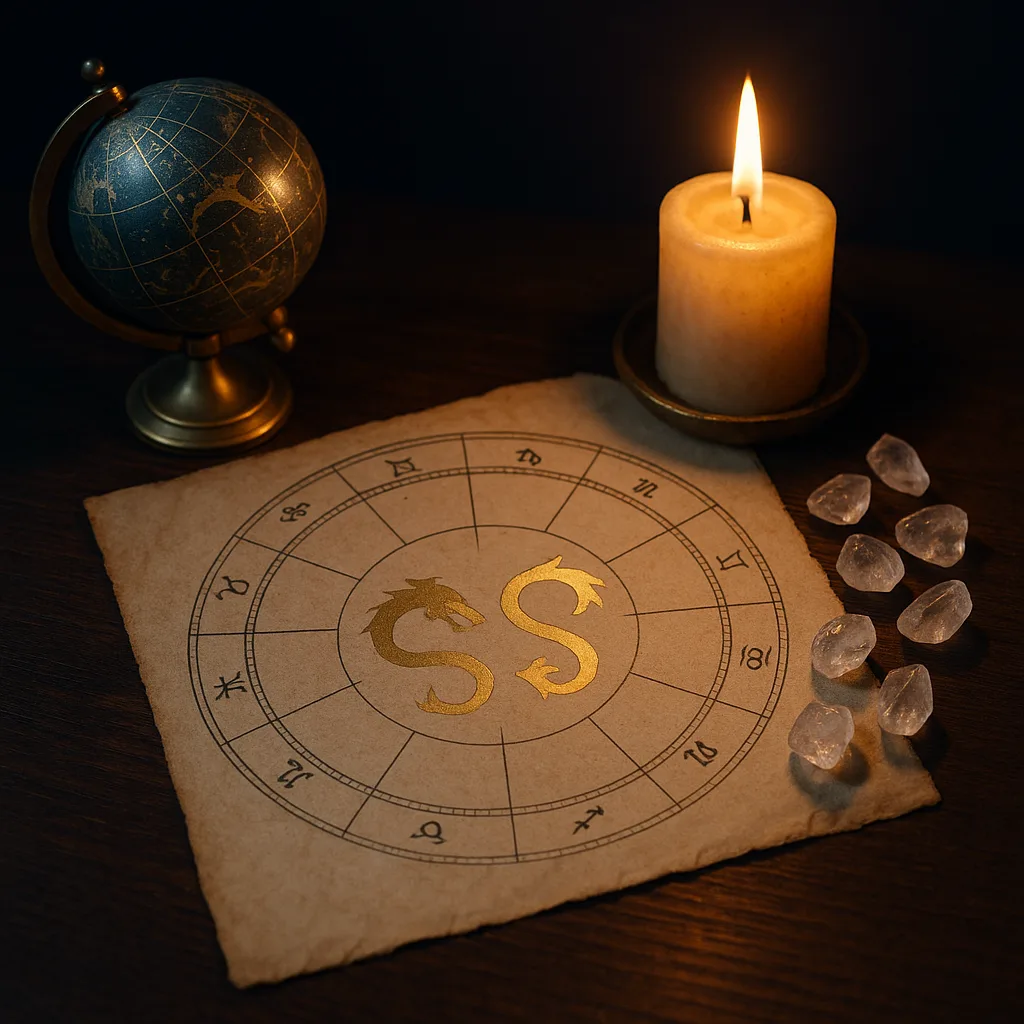
There is a basic distinction that changes how you read the love story in a birth chart: one thing is how you already love, another is the direction that love needs to expand toward. The first shows up in Venus. The second lies in the North Node, a point astrology has interpreted for decades as a sign of purpose and maturing, not comfort.
The lunar nodes are not planets or physical bodies. They are mathematical points where the Moon's orbit crosses the ecliptic, the apparent path the Sun seems to follow across the sky as seen from Earth. The ascending node (North Node) and the descending node (South Node) always sit opposite each other, 180 degrees apart, forming an axis. One cannot exist without the other: they are the two ends of the same line.
Where this reading comes from and what astronomy says about the nodes
From an astronomical standpoint, the ascending node takes about 18.6 years to complete a full cycle around the ecliptic, always moving retrograde, meaning in the opposite direction from most planetary transits. That is why the nodal axis changes sign roughly every year and a half, unlike Venus or Mars, which spend most of their time moving forward through the zodiac.
This same point determines when eclipses happen: the Sun or Moon must be near one of the nodes for an eclipse to occur. According to the astronomical calendar in NASA's eclipse catalog, 2026 brings four events tied to that period's Pisces/Virgo nodal axis: an annular solar eclipse in February, a total lunar eclipse in March, a total solar eclipse in August, and a partial lunar eclipse, also in August. This is a reminder that the nodal axis is not pure symbolic invention: it corresponds to a real orbital phenomenon, even though the karma and purpose reading applied to it is an interpretive layer, built up culturally over time.
In medieval Latin astrology, the north node was called Caput Draconis, and the south node, Cauda Draconis, a direct reference to the head and tail of a dragon. This naming appears in ancient astronomical calculation instruments, used to determine the Moon's position relative to the ecliptic within the geocentric model of the time. In Vedic astrology, the same points are called Rahu and Ketu, a topic already covered in the article on Ketu and Rahu in Vedic astrology. The evolutionary and karmic interpretation we know today, with the South Node tied to patterns inherited from the past and the North Node to this lifetime's purpose, emerged in the 20th century, spread by authors devoted to karmic astrology.
South Node and North Node: the line between the familiar and the necessary
The South Node works like autopilot. It gathers the talent that comes ready-made, the behavior that takes the least effort but, when overused, turns into repetition and complacency. The North Node represents the opposite: less familiar ground that demands deliberate effort, but one that evolutionary tradition points to as the direction of maturing in this life.
In love, that difference becomes tangible. Venus reveals someone's natural affectionate style: what they value, what sparks attraction, the spontaneous way they express affection (a topic covered in detail in the article on your Venus sign in the birth chart). The North Node, on the other hand, does not describe what a person already knows how to do. It points to what needs practice: the relational capacity someone avoids because it feels uncomfortable, but which evolutionary astrology considers essential for relationships to mature.
The nodal axis by sign: what each polarity invites in love
Since the nodal axis always connects two opposite signs, the love reading is organized in pairs. Here is how evolutionary tradition tends to interpret some of these combinations:
| Nodal axis (South → North) | Comfort zone (South Node) | What the North Node invites in love |
|---|---|---|
| Libra (South) → Aries (North) | Constantly seeking approval, fearing conflict, dissolving into a partner's wishes | Recognizing your own desire and finding the courage to take a stand before giving up ground |
| Aries (South) → Libra (North) | Acting alone out of habit, resisting shared decisions | Developing listening, fair exchange, and building the relationship together |
| Virgo (South) → Pisces (North) | Need for control, constant criticism, chasing the perfect relationship | Practicing surrender, building trust, and accepting a bond's natural flaws |
| Pisces (South) → Virgo (North) | Romanticizing the partner, merging emotionally without clear limits | Cultivating practical clarity, concrete gestures of care, and healthy day-to-day boundaries |
None of these readings suggest a character flaw. On one side, they describe a comfortable habit, and on the other, a direction of conscious effort. The nodal axis for anyone born in 2024, for example, currently sits in the Pisces/Virgo pair, since the North Node entered Pisces on January 11, 2025, and stays there until July 26, 2026, when it moves into Aquarius. That is generational, collective information. What makes the reading personal is the house where that axis falls in the natal chart, which depends on the exact time and place of birth.
North Node in the 7th house: when love's purpose means learning to share
The 7th house is traditionally linked to partnerships, marriage, formal agreements, and the figure of the other. When someone's North Node sits in this house, the evolutionary reading usually points to cooperation and balance within committed relationships as a central life theme. The corresponding South Node would fall in the 1st house, forming the classic axis between isolated individuality and building something together.
The same logic repeats in two distinct situations when comparing charts:
- In synastry, when one person's North Node falls on another's 7th house, tradition tends to point to meaningful potential for mutual growth, as long as the bond is lived as a conscious partnership rather than total fusion.
- In the composite chart, which represents the relationship itself as its own symbolic entity, a composite North Node in the 7th house suggests the couple's evolutionary purpose lies in deliberately negotiating each other's needs: commitment as an ongoing practice, away from both fusion and isolation.
It is worth telling apart the two layers covered here: the natal North Node, fixed from birth and unique to each person, and the transiting North Node, which represents a collective moment shared by anyone born within the same roughly year-and-a-half window. Mixing the two up is a common mistake. The transit points to a general climate of the times; the natal placement speaks to an individual path.
How the North Node fits alongside other familiar points in love
Anyone who has already studied Venus, Lilith, and the 7th house separately may wonder how the North Node fits into that picture. The key difference: Venus is about taste and value (what attracts and gives pleasure); Lilith is about limits and non-negotiable desire (what a person refuses to give up, a topic already explored in the article on Lilith in the birth chart); and the North Node is about the direction of growth, the relational dynamic that asks for effort outside the comfort zone. These are complementary layers, not competing ones, and none of them replaces the study of the 7th house, which indicates the timing and context in which relationships form.
Frequently Asked Questions
What does it mean to have the North Node in Pisces for love?
People with the North Node in Pisces (active from January 2025 to July 2026) are often described, in evolutionary astrology, as being called to let go of excessive control and criticism in love, developing trust and emotional openness instead. This is a generational trend, and how strongly it shows up for each person depends on the house where that North Node falls in their natal chart.
Are the natal North Node and the transiting North Node the same thing?
No. The natal North Node is fixed from birth and describes an individual's evolutionary purpose. The transiting North Node changes sign roughly every 18 months and reflects a collective theme, experienced by an entire generation at the same time, without carrying a specific personal message.
How do I find out which house my North Node is in?
You need a full birth chart calculation, with the exact date, time, and place of birth. The sign position repeats for everyone born in the same period, but the house depends entirely on those individual details. Without the correct birth time, there is no way to pin down the house accurately.
Does a North Node in the 7th house guarantee a good relationship?
No. Traditional interpretation links this placement to a life theme centered on learning partnership and cooperation, but it guarantees nothing specific: it points to ground for effort and growth, not an automatic outcome.

Recomendado
Mapa Astral Kármico
Você já sentiu que certos padrões se repetem em sua vida? Relacionamentos que seguem o mesmo roteiro, desafios que parecem voltar ou talentos que surgem naturalmente? Nada disso é por acaso.
Universo Astral Editorial Team · Tarot and moon transits
This article was produced by the Universo Astral editorial team, with AI tools assisting research and drafting and human review before publication. If you spot anything inaccurate or outdated, let us know at our contact email.