I Ching: How the Ancient Chinese Oracle Works and How to Consult It
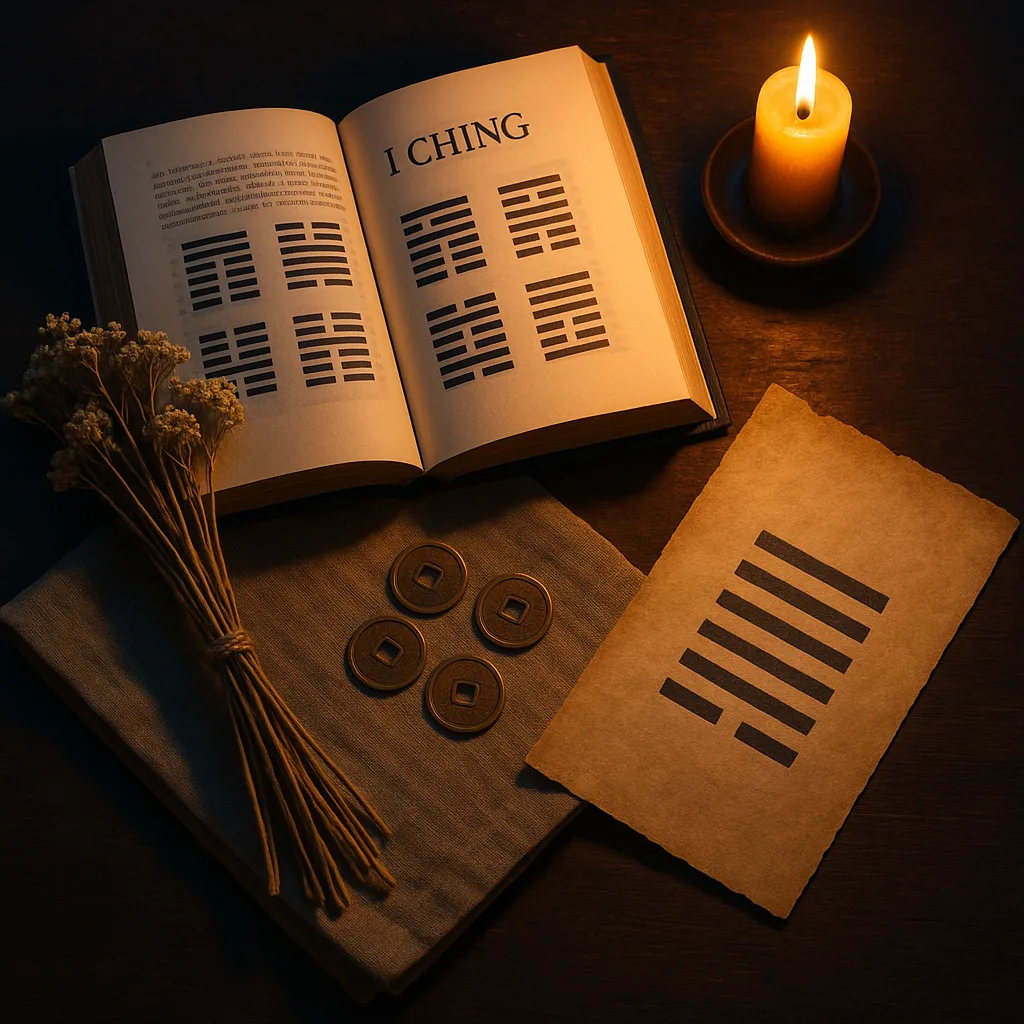
A book that doesn't predict the future, but teaches you how to move through it
The I Ching, also written as Yi Jing and translated as the Classic of Changes, is an ancient Chinese text that survived book burnings, the fall of dynasties, and centuries of reinterpretation. People still consult it today, often by tossing coins on a table in search of an answer. Unlike oracles that claim to reveal what's coming, the I Ching has a different goal: to explain the logic of change itself, so the person consulting it knows how to respond.
Among ancient Chinese texts that survive nearly intact, the I Ching occupies an unusual place. It is neither pure philosophy nor a simple divination manual, but a blend of both.
From Fu Hsi to the Zhou dynasty: a layered origin
Chinese tradition credits the creation of the I Ching's fundamental symbols to Fu Hsi, a legendary figure regarded as the founder of Chinese civilization, placed in a mythical period before any reliable historical record. This origin reads more like a founding myth than a historical fact, which may be the point: it places the oracle outside ordinary time.
The more historically accepted version, however, points to the Zhou dynasty, around the 12th century BCE, although fragments of the thinking behind the text may trace back to even older oracular practices, already in use during the Shang dynasty. In that period, priests and diviners handled stalks made from yarrow (a plant also known as milfoil) to obtain answers from the heavenly powers.
Chinese tradition usually names four figures as responsible for the text's final form: Fu Hsi himself, King Wen, the Duke of Zhou, and, centuries later, Confucius. According to legend, King Wen organized the sixty-four hexagrams and wrote short judgments on each one while imprisoned by order of a tyrannical ruler. His son, the Duke of Zhou, is said to have completed the work by detailing the meaning of each line. Only much later did the commentaries attributed to Confucius add the book's deeper philosophical layer, bringing it closer to Taoist thinking about the constant transformation of all things.
This layered structure explains why the I Ching is usually presented in two parts: the Classic Text, with the hexagrams and their more direct meanings, and the Commentaries, which deepen the symbolic reading of each situation.
Trigrams and hexagrams: the structure behind the I Ching
At the heart of the I Ching are figures made of horizontal lines, either unbroken or split in the middle. The unbroken lines represent the Yang principle, the split lines the Yin principle. Combined in groups of three, these lines form the eight trigrams, seen as images of everything that happens between heaven and earth: movements, forces, and states of transition that repeat throughout the natural world.
When two trigrams stack on top of each other, a hexagram is formed, a six-line figure. Combining all possible trigrams produces the 64 hexagrams that make up the book. The answer sought in each consultation lies within them.
A detail that's not obvious at first but matters for beginners: the lower trigram, formed by the hexagram's first three lines, is usually read as the inner world of the person consulting, their resources, disposition, and emotional state. The upper trigram, meanwhile, represents the external scenario, the situation or challenge being faced. Reading a hexagram, then, always means observing the meeting point between these two planes.
Each of the 64 hexagrams also carries its own name (the ideogram that identifies it), a judgment (a brief summary of its meaning), and specific commentary on each of the six lines, which carry extra weight when they appear as moving lines, about to transform into their opposite.
How to consult the oracle, in practice
The most traditional and ritualistic way to consult the I Ching involves fifty yarrow or bamboo stalks. One is set aside right at the start and placed out of reach: it doesn't take part in the drawing process, but symbolizes the link between the questioner and the greater plane, the Tao. The remaining forty-nine stalks are then shuffled in the hands while the person focuses on the question, and divided repeatedly into smaller piles, following a sequence of counts that, after several rounds, determines one line of the hexagram. The process repeats six times, until all six lines are complete.
It's a slow method, deliberately so. The delay and repetition work almost like a meditation: they force the questioner to slow down, revisit the question several times, and arrive at the result in a state of presence very different from a decision made on impulse.
Over time, a faster method became popular, especially outside China: tossing three coins, repeated six times to form the hexagram's six lines. Each toss is scored according to values assigned to heads and tails, and the result indicates whether the line is Yin or Yang, and whether or not it's in motion, about to turn into its opposite and thus point to a second, complementary hexagram. It's a quicker path, but one that calls for the same essential care: silence, a well-formed question, and attention to what emerges, not haste to confirm what you already wanted to hear.
Formulating the right question
- Favor open questions about attitude and conduct over closed yes-or-no questions.
- Avoid asking only what will happen; ask what to do about what is happening.
- Write the question down before you begin. This helps keep the mind focused during the tosses.
- Reread the hexagram's judgment and the meaning of the moving lines before turning to outside interpretations.
From divination to a book of wisdom
There's a subtle but decisive shift in how the I Ching came to be used over the centuries. At first, the question was about fate: what's going to happen to me? Over time, especially as the philosophical commentaries gained weight, the central question shifted elsewhere: given this hexagram, what is the right action? The oracle stopped being merely a predictor of events and became a mirror for conduct: an invitation to act in harmony with the moment, rather than simply wait for it.
This philosophical dimension is part of why the I Ching found so much interest in the West throughout the 20th century. The most influential translation remains the work of German sinologist Richard Wilhelm, who rendered the text directly from Chinese into German with extensive commentary. The English edition carried a foreword by Swiss psychiatrist Carl Gustav Jung. It was through reflecting on the I Ching that Jung refined much of his concept of synchronicity, the idea that certain events connect not through cause and effect but through shared meaning, even when there's no direct causal link between them.
The question is no longer what will happen, but what should I do, and it's in that shift that the divination book also becomes a book of wisdom.
First steps for anyone who wants to consult the I Ching
If you've never tossed coins or stalks before, start small: choose a trustworthy edition (Richard Wilhelm's translation remains a solid entry point), set aside a quiet moment, and formulate a single question at a time, calmly. Write down the hexagram you receive, reread the judgment and the moving lines without rushing to decode everything at once. Like any symbolic system with three thousand years of history behind it, the I Ching gives more to those who return to it again and again than to those hoping for a final answer on the first try. With every consultation, the invitation remains the same as it was in the days of the Zhou dynasty: pause, observe the present moment, and choose, with discernment, how to act within it.
Recomendado
Astro Reflexo
Descubra o que os astros revelam sobre quem você é. Em menos de um minuto, calculamos seu Sol, Lua e Ascendente com precisão astronômica e uma inteligência artificial escreve um resumo personalizado só para você.
Universo Astral Editorial Team · Zodiac signs and fun facts
This article was produced by the Universo Astral editorial team, with AI tools assisting research and drafting and human review before publication. If you spot anything inaccurate or outdated, let us know at our contact email.