I Ching: The Origins of the Chinese Oracle and How to Do Your First Reading
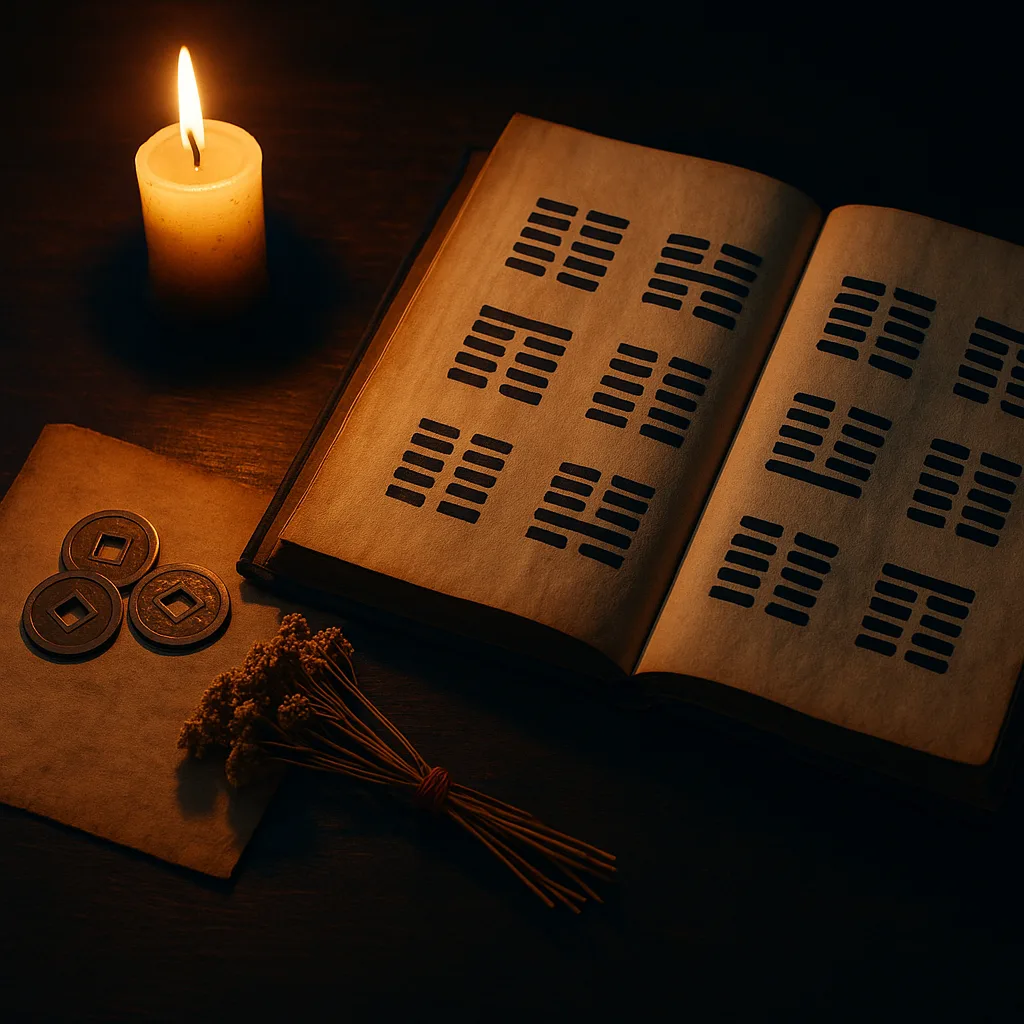
A Book That Has Crossed Three Thousand Years Without Losing Its Voice
Few texts in the world carry the age and continuity of the I Ching. Its origins go back roughly 3000 years before Christ, when Chinese tradition credits the legendary Emperor Fu Hsi with creating the eight trigrams, the building blocks of the entire system. Accounts vary by region and era, but many say Fu Hsi received this knowledge in an almost supernatural way: through symbols seen on a tortoise shell, in visions attributed to celestial beings, or in other similarly symbolic stories. This is not history in the academic sense. It works as a founding myth, valued more for what it means than for what it proves.
The decisive step came much later, during the Shang dynasty, between 1766 and 1122 BC. During this period, King Wen, then a political prisoner, is said to have used his time in confinement to reorganize the eight trigrams into combinations of six lines, the hexagrams, naming each of the 64 possible outcomes and writing what is now called the Judgment, a short summary of each figure's meaning. His son later overthrew the Shang dynasty and founded the Chou dynasty. It was the Duke of Chou, uncle to the new ruler, who completed the work by writing short explanatory texts for each of the six lines in every hexagram.
Centuries later, Confucius studied the material and produced a set of philosophical commentaries known as the Ten Wings. Among them are the Tuan Chuan, dedicated to the judgments, the Hsiang Chuan, focused on symbolic images, and the Ta Chuan, or Great Treatise, which discusses the cosmological foundations of the system. It was also King Wen, around 1143 BC, who fixed the order of the 64 hexagrams that has come down to modern Western translators such as Richard Wilhelm and Alfred Huang. The terms "trigram" and "hexagram," familiar today to anyone studying the subject, are not Chinese in origin. They were coined by the British sinologist James Legge, in his translation published by Oxford in 1882.
The name I Ching is usually translated as The Book of Changes, and that translation already reveals the spirit of the work. Its central theme is not predicting a fixed destiny, but describing how the forces of change move: the constant interplay between yin and yang, between states endlessly transforming into one another. It is possibly the oldest wisdom text still in active use in the world, having circulated orally for generations before it was written down.
How the Hexagrams Are Built
The complete I Ching system consists of 64 hexagrams, each made up of six stacked horizontal lines. Each line is either yang, shown as an unbroken line, or yin, shown as a line broken in the middle. The traditional reading runs from the bottom up: the line at the base is the first, and the one at the top is the sixth. This order carries symbolic weight, since the hexagram "grows" from bottom to top, much like a situation unfolds over time, from the beginning of a question to its final outcome.
Each hexagram combines two trigrams, figures of three lines stacked on top of one another. There are eight possible trigrams, known as the Ba Gua, each corresponding to a force of nature: Heaven, Earth, Water, Fire, Wind, Lake, Thunder, and Mountain. This set of symbols has spread well beyond divination. It also appears in Feng Shui, and some countries have incorporated it into their national identity: Vietnam features the Fire trigram on its flag, while South Korea displays four trigrams (Heaven, Water, Earth, and Fire) around the Taegeuk symbol.
A reading widely used among contemporary practitioners holds that the lower trigram of a hexagram speaks to the inner world of the person consulting (their feelings, disposition, present state), while the upper trigram represents the external scenario, the situation or challenge faced at the time of the question. This is not a rule set by the classical texts, but it helps beginners organize the reading. More advanced practitioners also look at the nuclear hexagram, formed from the central lines of the original hexagram, as an extra layer of meaning hidden within the main figure. It is a technique worth knowing, but it can wait until after your first few readings.
Methods of Consultation: From Yarrow Stalks to Coins
The oldest way to consult the I Ching is also the most laborious: the yarrow stalk ritual, described in the Great Appendix of the book itself. The traditional procedure used 50 dried stalks of this plant, considered sacred for its supposed divinatory properties, one of which was set aside at the start to represent the original unity from which everything springs. The remaining 49 stalks were randomly divided into two piles, followed by a precise sequence of counting and separating, repeated eighteen times until the value of a single line of the hexagram was obtained. A full ritual, covering all six lines, could take twenty to forty minutes, performed in near silence. Historically, mastering this technique was the task of court diviners, Taoist monks, and Confucian scholars, people who devoted their lives to studying the text. In regions where yarrow could not be found, bamboo stalks stood in for the original plant, which shows that the essence of the ritual lay in the gesture and intention, not the specific material.
There is also a simpler variation using sixteen markers or beads, which follows the same logic as the stalks in a quicker, quieter way. It suits those who want to keep something of the original ritual without the time it demands.
A more direct method popularized the I Ching in the West and remains, today, the entry point for most practitioners: the three-coin method.
How to Consult the I Ching with Three Coins
Before tossing any coins, take a moment of silence to formulate your question clearly. The I Ching responds better to open, honest questions than to closed yes-or-no ones. Something like "what do I need to understand about this situation" tends to bring richer answers than "should I or shouldn't I do this."
- Set aside three identical coins and assign a value to heads and tails (traditionally, one side is worth 3 and the other 2, but what matters is keeping the same convention throughout the reading).
- Toss all three coins together and add up the values obtained. The result will always be 6, 7, 8, or 9.
- Note the line type: even numbers (6 and 8) form yin lines, while odd numbers (7 and 9) form yang lines. The values 6 and 9 are called "changing" lines, moments of greater intensity that indicate where the situation is heading.
- Repeat the toss six times, always recording the result from bottom to top, until you have formed all six lines of the hexagram.
- Identify the resulting hexagram by consulting a table or reference book, and read the Judgment and the images associated with that figure. If there are changing lines, also look at the hexagram that emerges from their transformation.
The process usually takes just a few minutes, which explains its popularity. It keeps the logic of the oracle alive, chance guided by intention, without requiring the technical practice of the yarrow stalk method.
A Reading That Asks for Time, Not Haste
The I Ching was never meant to be a system of ready-made answers. Its texts are deliberately enigmatic, almost poetic, meant to be read slowly. It is not unusual to reread the same hexagram days after a reading and notice a layer of meaning that went unnoticed the first time. That may be exactly why the Book of Changes continues to be consulted after so many centuries: it does not hand out certainties, but invites deeper reflection on the moment the question was asked.
Universo Astral Editorial Team · Zodiac signs and fun facts
This article was produced by the Universo Astral editorial team, with AI tools assisting research and drafting and human review before publication. If you spot anything inaccurate or outdated, let us know at our contact email.