Collective vs. Personal Transits: Is the Crisis Yours or the World's?
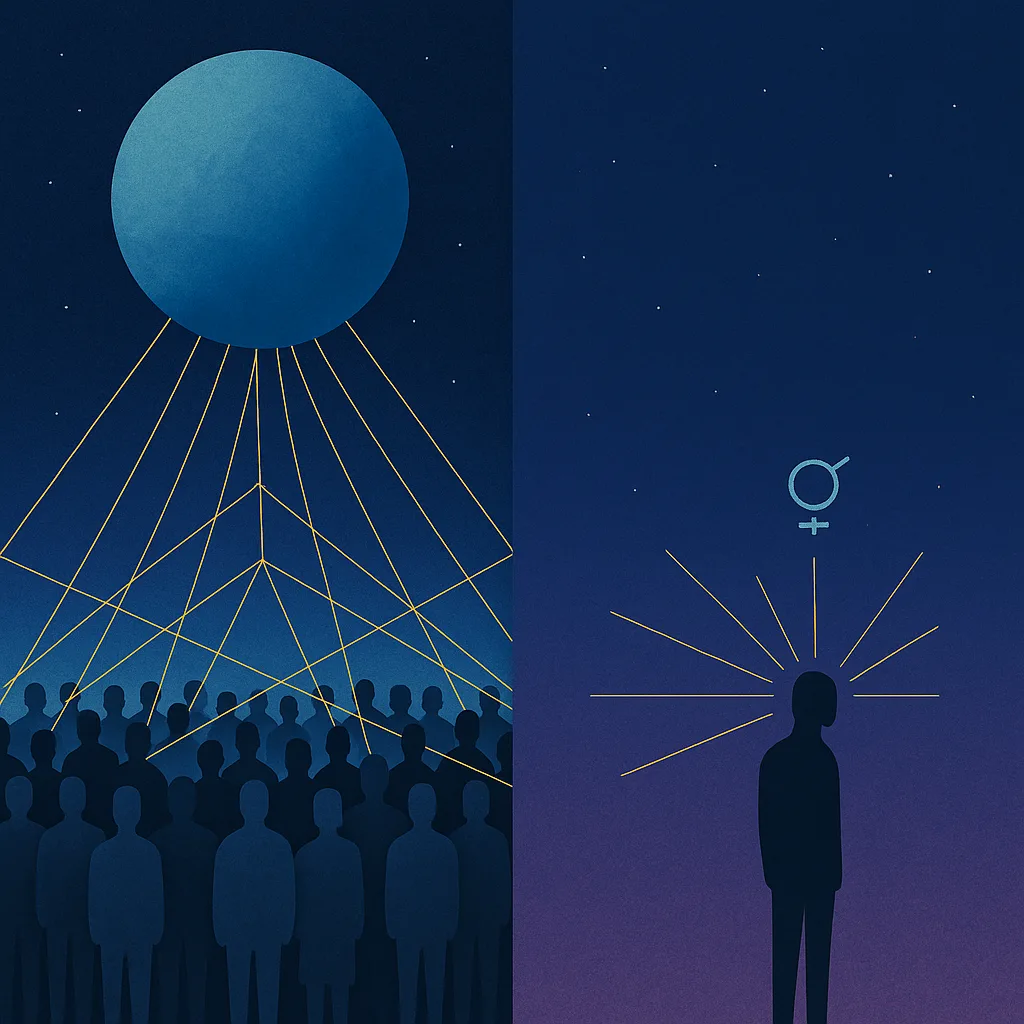
Why does everyone seem anxious at the same time?
There are periods when instability feels like more than just your own. It surfaces in family conversations, in posts from strangers, in the news, in your therapist's office. It's not coincidence or baseless collective suggestion. It's largely a reflection of what astrologers call generational transits: the movements of Uranus, Neptune, and Pluto, planets so slow they can take seven to more than twenty years to move through a single sign. While this happens, everyone born within that window carries the planet in the same position in their birth chart and feels its current transits in nearly identical ways, like a shared backdrop for an entire generation.
To understand the mechanics behind this phenomenon, it helps to review how a transit works in general: a planet in motion forms an angle with a point in your birth chart, and it's that meeting between today's sky and your natal sky that produces the sense of activation. The article on the method behind reading a planetary transit details this mechanism more thoroughly. The difference between a collective transit and a personal one isn't in the technique used to read it, but in the speed of the planet involved and how many people share that same position at the moment of birth.
The map of your birth generation
Take two people born in 1998: both likely have Uranus in Aquarius and Neptune in Capricorn, in exactly the same zodiacal house, regardless of where they were born or how they live today. These points form what some call a generational map: the part of the sky you share with millions of others and that, because of this, says less about your individuality and more about the historical moment in which you and your generation entered the world. This is the layer of the chart that activates when a collective transit, like Pluto changing signs, creates waves of unease, rupture, or renewal that seem to touch society as a whole, not just you.
It's worth noting that this logic doesn't apply only to slow planets. Mercury, for example, also goes through phases that affect everyone at the same time, but much more briefly: while Pluto spends more than a decade in a sign, Mercury retrograde lasts about three weeks and repeats several times a year. Anyone wanting to understand this difference in scale between fast and slow transits will find the contrast explained in the article on fast and slow transits, which helps calibrate expectations: not every discomfort in the sky calls for the same response.
A practical example: Pluto in Aquarius
Since Pluto entered Aquarius between 2023 and 2024, themes like technology, surveillance, collective networks, and the role of the individual within groups have gained weight in public debate: strikes, discussions about artificial intelligence, reconfigurations of entire communities. If you felt your relationship with social media, remote work, or belonging to groups shifted abruptly during this period, you're likely picking up on this collective transit. The question few ask is: is this touching a sensitive point in my personal chart, or am I simply absorbing the temperature of the times?
The three-filter test to tell collective from personal
Before interpreting a life phase as an individual call from the universe, it's worth running a simple test with three questions, in order:
- Is the transiting planet touching a unique point in my chart? If Pluto is making an aspect to your personal Sun, Moon, or Ascendant, and not merely repeating a position it already held generationally, the experience tends to be more intense and personal than that of your generation's peers.
- Does this theme appear only in my life or in conversations around me too? If friends, family members, and even strangers on social media mention similar feelings of exhaustion, rupture, or reinvention, part of the weight is collective, not a personal message from the cosmos.
- Is the astrological house being activated rare or common in my generation? Transits in houses tied to career, relationships, or family tend to be more personal, because they depend on your exact birth time, unlike the sign of the slow planet, which is shared by millions.
This third filter depends on a piece of information many people overlook: the house system of your chart only becomes accurate when your birth time is correct. That's why two people born on the same day but in different cities or times can experience the same collective transit in very different ways. The article on why your sun sign horoscope almost never fits explains why this detail changes a personal transit reading so much.
Why this distinction matters in practice
Mistaking a generational crisis for a strictly personal one can lead to rushed decisions: ending a relationship, quitting a job, or overhauling your entire life because you think the universe is sending a message just for you, when in reality a whole age group is processing the same collective discomfort. On the other hand, attributing everything to the general energy of the moment carries its own risk: ignoring a genuinely personal call that needs specific attention to your history, your Moon, your Ascendant, or your natal 7th or 10th house.
Neptune in Pisces and Uranus in Taurus: two generations, two kinds of collective hangover
Those born during Neptune in Pisces (2011-2026) carry a natural sensitivity to spiritual themes, art, and the dissolution of boundaries: this generation tends to handle uncertainty better but struggles with excessive rigidity. Those born with Uranus in Taurus (2018-2026) will likely face, throughout their adult lives, sudden ruptures tied to money, property, and material security, a theme already appearing today in discussions about economics, housing, and work. Recognizing this generational backdrop helps parents, educators, and therapists understand certain collective behaviors without pathologizing each child or young person individually: often what looks like a personal symptom is the temperature of an entire era passing through that one person.
The table below summarizes the three generational planets mentioned in this article, the approximate period each one spent or spends in the sign mentioned, and the collective theme associated with each transit:
| Planet | Sign | Approximate period | Associated collective theme |
|---|---|---|---|
| Pluto | Aquarius | 2023-2024 onward | Technology, surveillance, collective networks, role of the individual in groups |
| Neptune | Pisces | 2011-2026 | Spirituality, art, dissolution of boundaries, sensitivity to uncertainty |
| Uranus | Taurus | 2018-2026 | Ruptures tied to money, property, and material security |
Just as eclipses mark specific dates within the lunar cycle, these generational transits have calculable beginnings and endings with astronomical precision. For those wanting to check the exact date a planet changes signs or track the Moon phases for a specific month, timeanddate.com offers an ephemeris calendar, lunar phases, and eclipses by city, which helps confirm whether a collective transit is already active or still approaching in your region's sky.
A compass, not a verdict
Separating collective transit from personal transit isn't about lifting the weight of your own life off your shoulders and blaming it all on the world's moment. It's the opposite: a way to calibrate the intensity of your response. Collective crises call for historical patience, because they resolve on a scale of years and affect structures larger than individual will; personal crises call for directed action, because they speak directly to a unique point in your birth chart. Learning this distinction transforms generational astrology from abstract curiosity into a concrete tool for understanding why, sometimes, your anxiety has a name, a surname, and a birth date, and sometimes it's simply borrowed from the era you live in.
Frequently asked questions
How do I know if a transit is generational or personal?
Compare the position of the slow planet in your natal chart with that of other people born in the same decade: if the sign and house are practically identical for everyone your age, the transit is generational. If the transiting planet is forming a direct aspect to your personal Sun, Moon, or Ascendant in a way that doesn't repeat for people born in a different year, the experience tends to be more personal.
Why do Pluto, Uranus, and Neptune affect entire generations?
Because they're very slow planets: Pluto can take more than twenty years to move through a single sign, Uranus about seven years, and Neptune around fourteen. Since the movement is so slow, everyone born within that window shares the same position of these planets in their natal chart, creating a symbolic backdrop common to an entire generation.
How long will Pluto in Aquarius last?
Pluto entered Aquarius between 2023 and 2024, and as the slowest planet considered in generational transits, its passage through a single sign typically stretches for many years. Exact dates of sign changes and other planetary data can be checked in astronomical calendars like the one at timeanddate.com.
Can a collective transit be ignored?
Not entirely, because it affects the environment around you regardless of individual will, but its personal intensity depends on which points of your natal chart it's touching. If the transit doesn't form a direct aspect with any sensitive planets or houses in your chart, the tendency is to feel it more as the climate of the era than as a specific call to you.
What's the practical difference between acting on a collective crisis versus a personal one?
Collective crises call for patience, because they involve structures larger than yourself that resolve on a scale of years and don't respond to one person's decisions. Personal crises, tied to unique points in your natal chart, call for more directed action, because they speak directly to your history, your Moon, or your Ascendant.

Recomendado
Mapa Astral Kármico
Você já sentiu que certos padrões se repetem em sua vida? Relacionamentos que seguem o mesmo roteiro, desafios que parecem voltar ou talentos que surgem naturalmente? Nada disso é por acaso.
Universo Astral Editorial Team · Tarot and moon transits
This article was produced by the Universo Astral editorial team, with AI tools assisting research and drafting and human review before publication. If you spot anything inaccurate or outdated, let us know at our contact email.