Birth Chart Basics: A 5-Step Guide to Reading Your First Chart
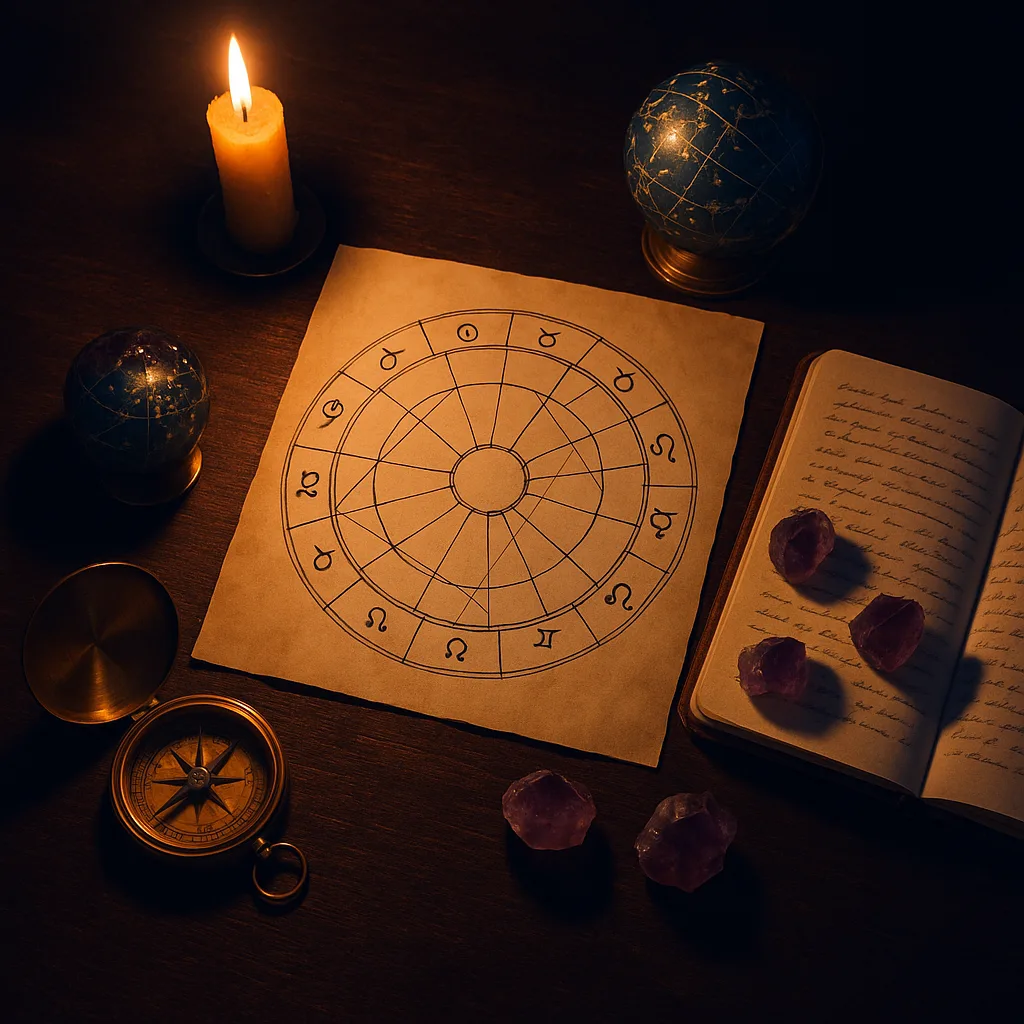
What the sky needs to know about you
Every birth chart rests on three pieces of information: your date, exact time, and place of birth. These three details allow you to calculate where each planet was in the sky at the moment you entered the world. Without the precise time, you can still determine which sign holds your Sun, Moon, and planets, but your Ascendant and houses remain out of reach. They depend on the exact moment and the horizon visible from that specific location on Earth.
If you don't know your birth time, it's worth asking your parents or checking your birth certificate before generating your chart on a website or app. It's the difference between a complete reading and a partial one. To better understand how the Sun, Moon, and Ascendant work together before diving into houses and aspects, read Sun, Moon, and Ascendant: The Trio That Reveals Who You Are.
The five-step roadmap for your first reading
Looking at a birth chart for the first time, it's easy to feel lost among symbols, circles, intersecting lines, and numbers. To stay oriented, follow an order that moves from the simplest to the most subtle.
- Step 1: Find your essential trio. Locate your Sun, Moon, and Ascendant. They form the foundation of your astrological identity. The Sun speaks to your essence, the Moon to your emotional world, and the Ascendant to how you present yourself to others.
- Step 2: Observe the sign and house of each planet. After the main trio, look at which signs hold Mercury, Venus, and Mars, and which house each occupies. The sign shows the style of expression; the house shows in which area of life that energy shows up most strongly. To understand why certain houses carry more weight in this analysis, see the article on angular, succedent, and cadent houses.
- Step 3: Note the most striking aspects. Look for prominent angles between planets, especially conjunctions, oppositions, and squares involving your Sun, Moon, and Ascendant. They show where creative tension or ease flows between different parts of you. The article on conjunction, opposition, trine, and square explains the geometric logic behind each angle.
- Step 4: Discover your Ascendant ruler. Each rising sign has a ruling planet. Locating where that planet sits in your chart helps you understand the tone it gives to your personal journey.
- Step 5: Leave the technical layers for later. Natal retrograde planets, lunar nodes, Chiron, and aspects between slower planets like Uranus, Neptune, and Pluto deserve patience. They carry deep meaning, but they make more sense once you're comfortable with the basics.
There's no rush in this process. A birth chart can be revisited for years, and each reading tends to reveal new layers as your symbolic understanding matures.
Choosing the right tools to generate and study your chart
Generating a reliable free birth chart has become much easier. Platforms like Astro.com use internationally recognized technical reference calculations, making them a solid choice for anyone wanting accuracy. Astrolink and similar sites work as lighter entry points, designed for people discovering astrology now and wanting to understand their chart without drowning in jargon.
Mobile apps have also evolved significantly in recent years, functioning almost as daily companions for self-discovery. The table below shows which type of tool works best for each beginner profile:
| Beginner profile | Recommended tool type | What it offers |
|---|---|---|
| Wants a light, direct introduction | Apps with casual language | Short daily notifications that help build the habit of observing the sky |
| Values human-written content | Platforms with author interpretations | Texts written by astrologers, whole-sign house systems, deeper monthly readings |
| Seeks a psychological approach | Relationship-focused apps | Language focused on emotional growth, with less technical jargon |
| Wants to study deeply | Technical, in-depth apps | Balance between technical depth and clarity for those planning to advance the discipline |
There's no perfect app for everyone, just the right tool for each person's moment and intention. Testing more than one option before settling on a single choice usually feels most natural.
A practical example: Using the current sky to practice reading transits
A good way to learn chart reading is to observe the present sky and compare it to your natal chart, what astrologers call a transit. In July 2026, for example, the sky offered generous material for this exercise. Mercury, which had turned retrograde in late June, resumed direct motion still that month, typically bringing relief after a period of reflection, revision, and slower communication.
During the same period, Neptune began its retrograde phase in Aries, a rare transit since the planet hadn't visited that sign for more than a century and a half. Saturn also entered retrograde in July, while Pluto continued its long retrograde cycle in Aquarius, sustaining a moment of quieter, gradual transformation. The Moon follows its familiar cycle: from new to waxing, full to waning, marking the emotional rhythm of each week. To check exact dates of lunar phases and other sky events in your city, Time and Date brings together a calendar of lunar phases, eclipses, and ephemerides organized by location.
By observing these movements and asking which house of your chart each one falls into, you begin to see how astrology connects today's sky to your personal story, not as exact prediction but as an invitation to symbolic reflection. This kind of ongoing observation is what separates a single reading from study that deepens over time, as shown in the article on planetary transits in daily life.
The most common mistakes beginners make
Some stumbles repeat themselves in first-time chart readers, and recognizing them helps avoid frustration:
- Focusing only on your sun sign: Reducing your entire chart to 'my sign is this' leaves out crucial information hidden in your Moon, Ascendant, and houses.
- Ignoring the house system used: Different software can calculate houses in different ways, sometimes creating small variations between one app and another. It's not an error, just different methodology.
- Treating tense aspects as fate: A square or opposition in your chart points to challenges to work through, not a sealed destiny.
- Jumping straight to advanced layers: Trying to understand Chiron, lunar nodes, or aspects between generational planets before mastering the basics usually confuses more than it clarifies.
After your first reading: What's next?
After recognizing your Sun, Moon, Ascendant, and main planets in signs and houses, the next step is returning to your chart periodically with fresh curiosity. Jotting down insights, comparing them with major transits, and if possible seeking a consultation with an experienced astrologer deepen this journey. For those wanting to move beyond basics, exploring how your chart reveals patterns that repeat in your life is worthwhile, the subject of the article patterns that repeat in your birth chart.
Your birth chart isn't a verdict on who you are, but a symbolic mirror inviting self-knowledge. Like any mirror, it reflects more the longer you allow yourself to look with attention.
Frequently asked questions
Do I need to know my exact birth time to read my birth chart?
For your Sun, Moon, and planets in signs, it's not required. But your Ascendant and astrological houses can only be calculated with your exact time, since they depend on the horizon visible at the moment and place of your birth.
What's the right order for looking at my birth chart for the first time?
The suggested roadmap starts with your Sun, Moon, and Ascendant, moves to the signs and houses of Mercury, Venus, and Mars, then observes the most striking aspects, locates your Ascendant ruler, and only then advances to technical layers like lunar nodes and Chiron.
Which website or app should I use to generate a free birth chart?
Astro.com is a solid choice for those seeking technically sound calculations recognized internationally. Platforms like Astrolink work as lighter entry points for people just beginning their astrology journey.
What does a retrograde planet mean in current transits?
It means that from Earth's perspective, the planet appears to move backward through the sky. In July 2026, for example, Neptune, Saturn, and Pluto were retrograde, typically read as a period of review and slower transformation in the areas each planet represents in your chart.
Are tense aspects in a birth chart always negative?
No. A square or opposition points to a place of creative tension between different parts of your personality, something that calls for attention and work, but it doesn't represent a fixed destiny or a sealed judgment.

Recomendado
Estátua Gato Bastet Egito Antigo
Inspiração Egípcia Autêntica Representa Bastet, a deusa egípcia da proteção, harmonia e energia feminina.
Universo Astral Editorial Team · Birth charts and numerology
This article was produced by the Universo Astral editorial team, with AI tools assisting research and drafting and human review before publication. If you spot anything inaccurate or outdated, let us know at our contact email.