Conjunction, Opposition, Trine, and Square: The Geometry of Your Birth Chart
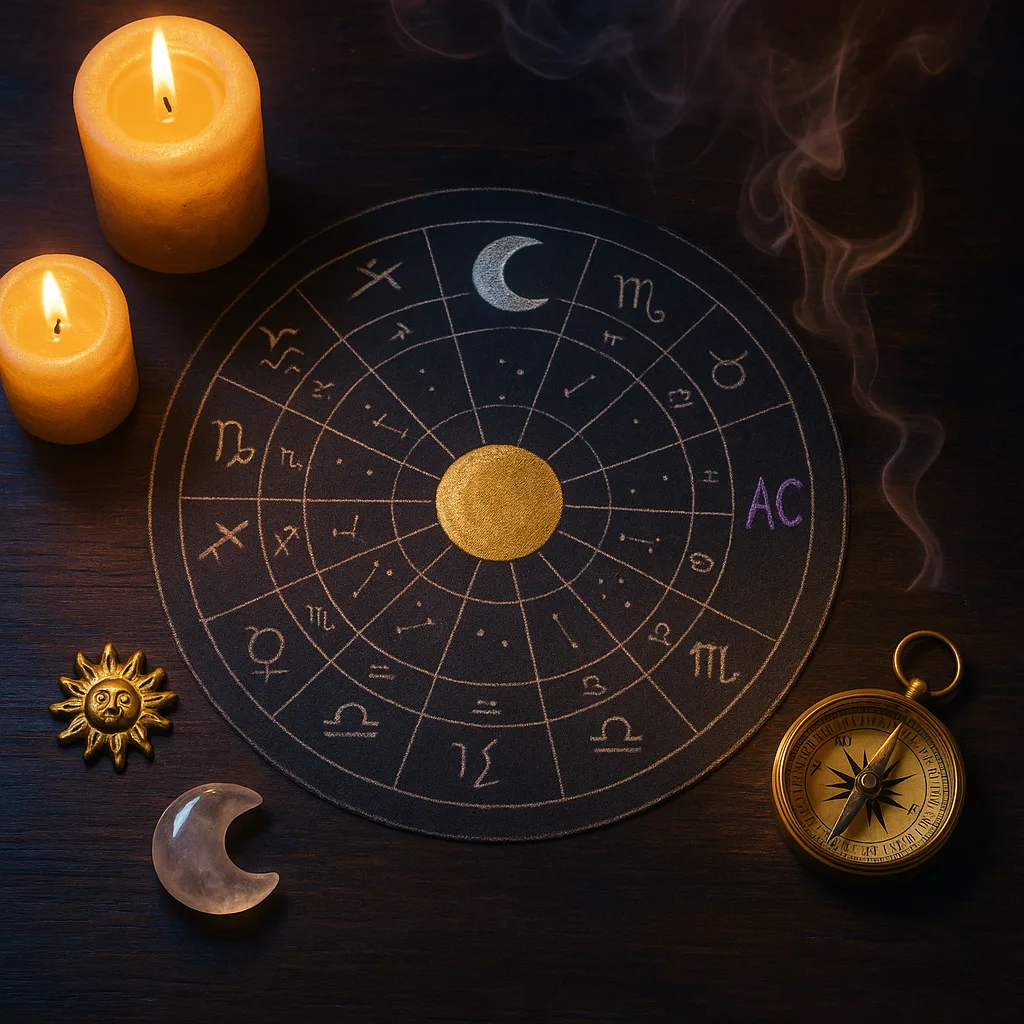
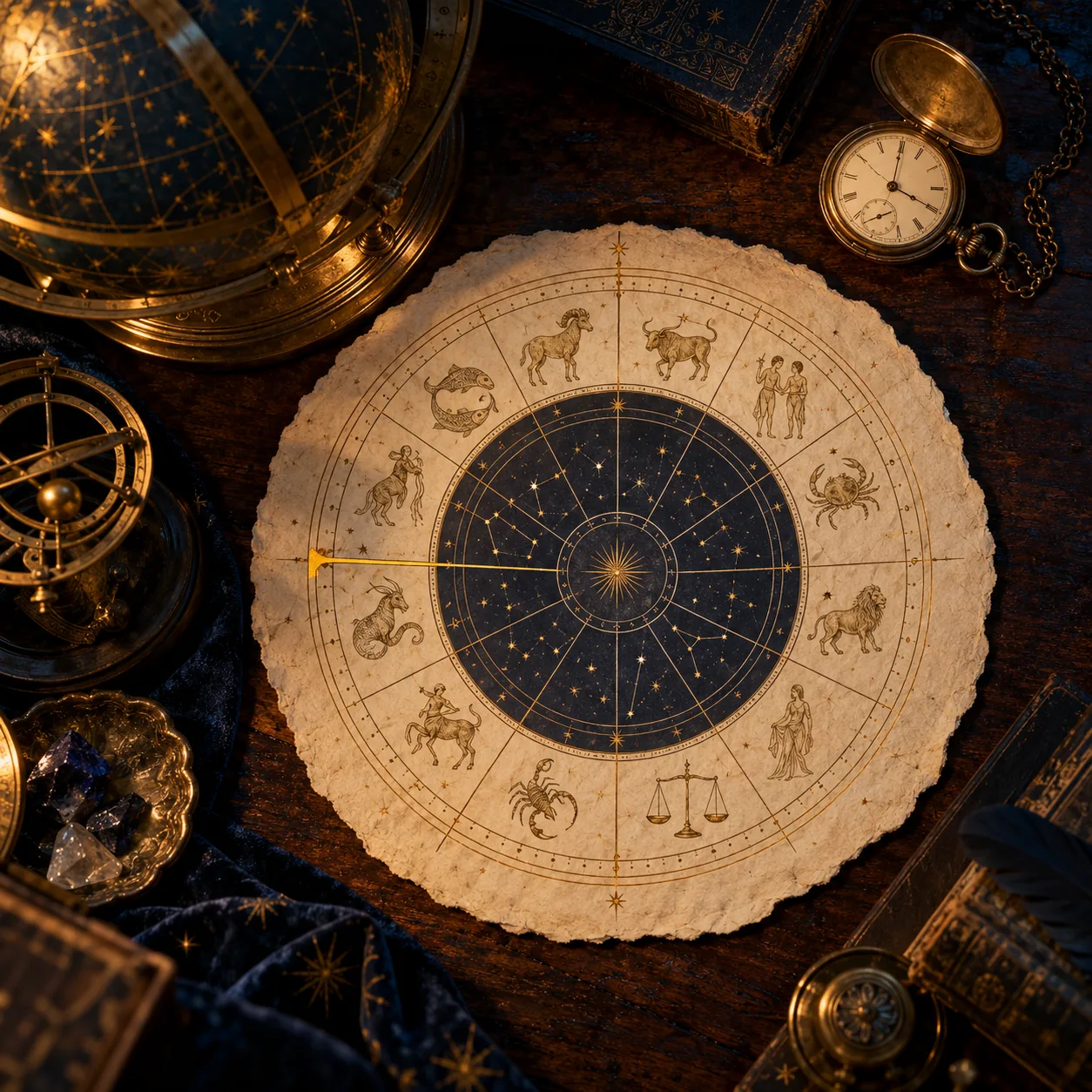
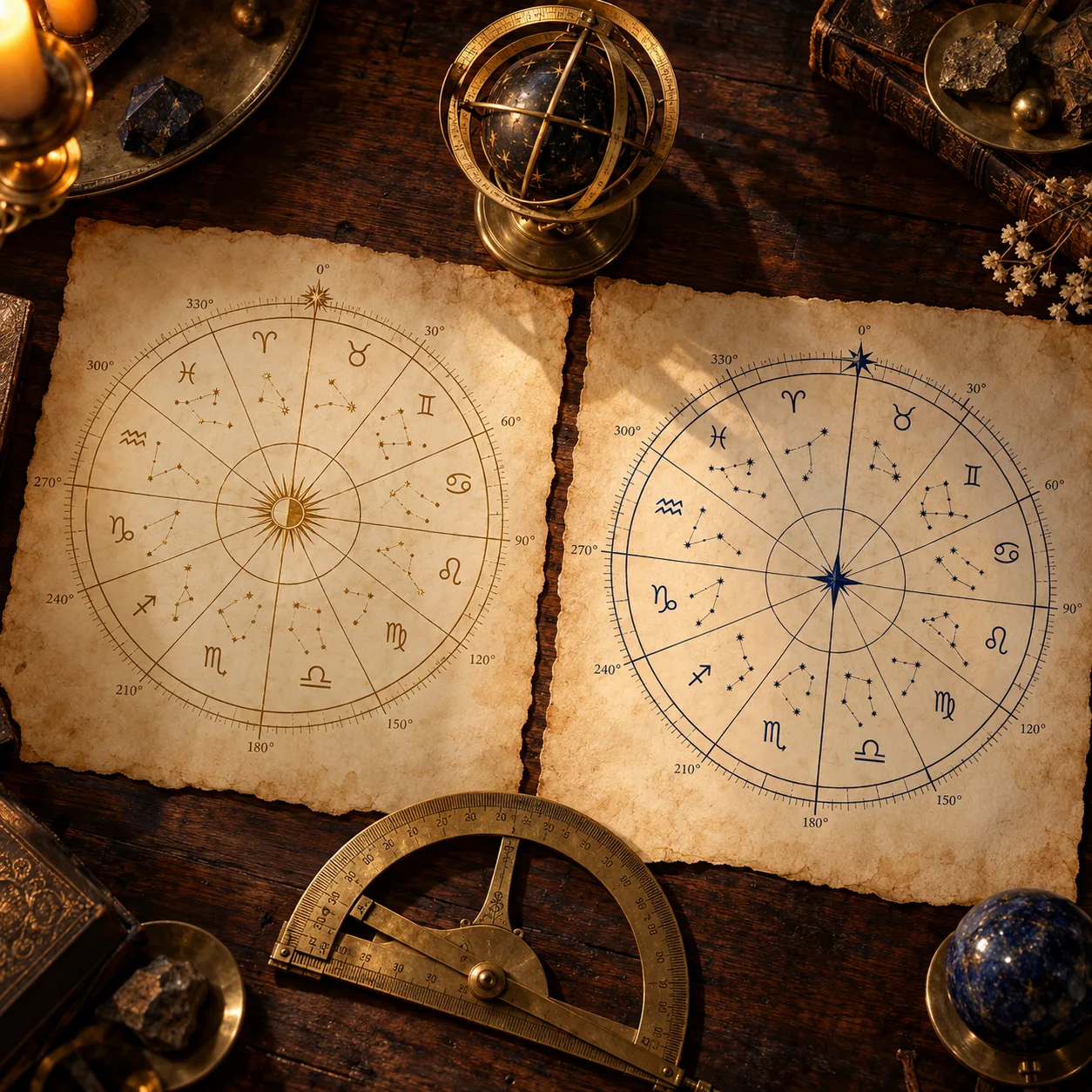
Look at your birth chart and focus on the center of the circle. Lines cross from one side to the other, connecting planets that seem distant in the drawing but are actually in constant dialogue. These lines are astrological aspects: the angles that planets form with each other at the moment of your birth. It's in this play of angles, not just in the isolated position of each planet, that your chart gains depth, contradiction, and beauty.
Several aspects are possible. Some are called minor aspects, like the semisquare or quincunx, and function almost like footnotes. But four carry the main weight of interpretation: conjunction, opposition, trine, and square. Each represents a different way two planets relate to each other: sometimes in harmony, sometimes in friction, sometimes in such a close fusion that it becomes hard to tell where one ends and the other begins. These angles are calculated from the exact distance between planets in the zodiac, and observatories and ephemeris sites like in-the-sky.org record daily when actual planets in the sky form conjunctions and other visible alignments, the same geometric principle that astrology applies to the natal chart.
Conjunction: When Two Planets Become a Single Force
A conjunction occurs when two planets are at nearly the same degree of the zodiac, 0° apart from each other. It's considered the most intense aspect of all because there's no distance between the energies: they blend and act together as a single force.
An example helps make this clear. Imagine a conjunction between Mercury, the planet of communication and reasoning, and Mars, the planet of action and impulsiveness. This person will likely communicate in a direct and energetic way, almost without a filter, and at the same time will have an agitated mental energy that never stops processing ideas. The two things walk together, inseparable.
One important note: conjunction is not synonymous with an easy aspect. Everything depends on who is meeting there. A conjunction between Venus, which speaks of attachment and affection, and Uranus, which speaks of freedom and rupture, tends to demand considerable inner work, since they pull toward opposite directions even while stuck together. A conjunction between Venus and Jupiter, on the other hand, usually flows more naturally because both speak the language of expansion and pleasure. The sign where the conjunction occurs also colors the result: the same Mercury-Mars pair would express itself more emotionally in Cancer and more critically and sharply in Virgo.
Opposition: The Mirror That Shows Both Sides of the Same Coin
When two planets are 180° apart, on opposite sides of the zodiacal circle, we have an opposition. It always occurs between signs on the same axis (Aries and Libra, Taurus and Scorpio, Gemini and Sagittarius, Cancer and Capricorn, Leo and Aquarius, Virgo and Pisces), signs that share the same line of energy but point in opposite directions.
In practice, opposition is often felt as an internal push and pull. An opposition between Sun and Moon, for example, can indicate that your identity and conscious will (Sun) don't always align with your deeper emotional needs (Moon), as if two parts of you want different things at the same time. This kind of tension between Sun and Moon also appears when you look at your chart through the basic trio of identity, something the article on Sun, Moon, and Rising Sign explores in more detail.
The good news is that this kind of tension, by opposing forces that become clearly visible to each other, tends to be easier to recognize consciously. Some astrologers argue that opposition, though uncomfortable, is simpler to integrate than a square because the conflict is exposed, almost asking to be seen, rather than hidden within a single point of the chart. When worked with well, this tension broadens your range of possibilities: you learn to alternate between two modes of being instead of getting stuck in just one.
Trine: Fluency That Looks Like a Gift But Can Become a Comfort Zone
A trine forms when two planets are 120° apart, and this only happens between signs of the same element: fire with fire, earth with earth, air with air, water with water. By sharing the same elemental language, these planets cooperate with each other almost effortlessly, making the trine the most harmonious aspect in the astrological toolkit. To better understand this logic of elements, see the article on the four elements of astrology.
Planets in trine often indicate talents that you don't even recognize as talents because they feel too natural. It's that skill exercised without effort and, for that reason, sometimes not even valued, while for someone else without that same aspect, it would require considerable practice.
But there's an important caveat. A chart with many trines can, paradoxically, create a certain settling-in. If several areas of your life seem to flow without obstacles, you might lose the drive to challenge yourself, to step out of the comfortable zone these aspects create. The trine makes things easy, but making things too easy has its own price.
Square: The Friction That Pushes You to Act
A square arises when two planets form a 90° angle between them, generally connecting signs of different elements that also have different modalities, like Aries and Cancer, or Taurus and Leo. It's considered, alongside opposition, one of the most challenging aspects in your chart, but with a difference: while opposition exposes conflict between two visible poles, a square usually creates more internal friction, harder to notice at first glance, because you don't always immediately recognize that recurring discomfort comes from the clash between two planetary energies that don't communicate easily.
That's why the square is often described as the aspect that pushes you to act. It won't let you sit still: it creates friction, generates discomfort, demands constant adjustments and decisions. People with prominent squares in their chart often report feeling like they're always struggling in a particular area of life, but it's precisely that repeated effort that, over time, builds strength, resilience, and a capacity for overcoming that more harmonious planets rarely demand. This idea of repetition connects with what the article on behavioral cycles in your birth chart discusses about patterns that keep returning to your life.
The Four Aspects Side by Side
To see the differences more directly, the table below summarizes the angle, the condition between signs, and the nature of each of the four major aspects described above.
| Aspect | Angle Between Planets | Relationship Between Signs | Predominant Nature |
|---|---|---|---|
| Conjunction | 0° | Same sign or very close degree | Fusion, intensity (depends on planets involved) |
| Opposition | 180° | Signs on the same axis | Visible tension, push and pull |
| Trine | 120° | Signs of the same element | Fluency, harmony, natural talent |
| Square | 90° | Signs of different elements and modalities | Internal friction, impulse to act |
One Same Sky, Different Readings
None of these four aspects exists in isolation in your chart. Normally one planet is connected to several others at the same time, forming a network of tensions and supports that only makes sense when observed as a whole. A generous trine can soften a difficult square; an uncomfortable opposition can find relief in a nearby conjunction. It's this whole picture, not one isolated aspect, that tells the story of how the sky's energies organize themselves within you. If you're just beginning to look at these details, you can benefit from a more structured approach, like the one presented in birth chart in practice: a 5-step guide for your first reading, which helps organize where to begin before diving deeper into aspects.
Frequently Asked Questions
What is the strongest astrological aspect?
The conjunction is usually considered the most intense aspect because the two planets sit at nearly the same degree and always act in tandem. But intensity doesn't necessarily mean harmony: the result depends on which planets are conjunct and in which sign.
Is a square always a bad aspect?
No. A square represents friction and demands constant adjustments, but that repeated effort tends to build resilience over time. It's a challenging aspect, not necessarily a negative one.
Is a trine always positive in a birth chart?
In most readings, yes, because it indicates fluency between planets of the same element. But a chart with excessive trines can create complacency, since constant ease reduces the drive to challenge yourself.
What's the difference between opposition and square?
Opposition connects planets at 180°, in signs on the same axis, and usually exposes the conflict in an obvious way between two poles. A square connects planets at 90°, in signs of different elements and modalities, creating more internal friction that's less obvious to spot.
How do I find the aspects in my birth chart?
You need to calculate your natal chart using your birth date, time, and location to see the exact degrees of each planet and the angles formed between them. If you're starting out, you can follow a structured guide like the article on how to read a birth chart for the first time to understand the logic before interpreting aspects.

Recomendado
Manual Prático da Astrologia
O universo sempre exerceu um fascínio indescritível sobre a humanidade. De todas as suas maravilhas, a astrologia se destaca como uma antiga arte que tem intrigado e inspirado gerações.
Universo Astral Editorial Team · Birth charts and numerology
This article was produced by the Universo Astral editorial team, with AI tools assisting research and drafting and human review before publication. If you spot anything inaccurate or outdated, let us know at our contact email.