Planetary Transits: Why Some Days Feel Heavy and Others Fly
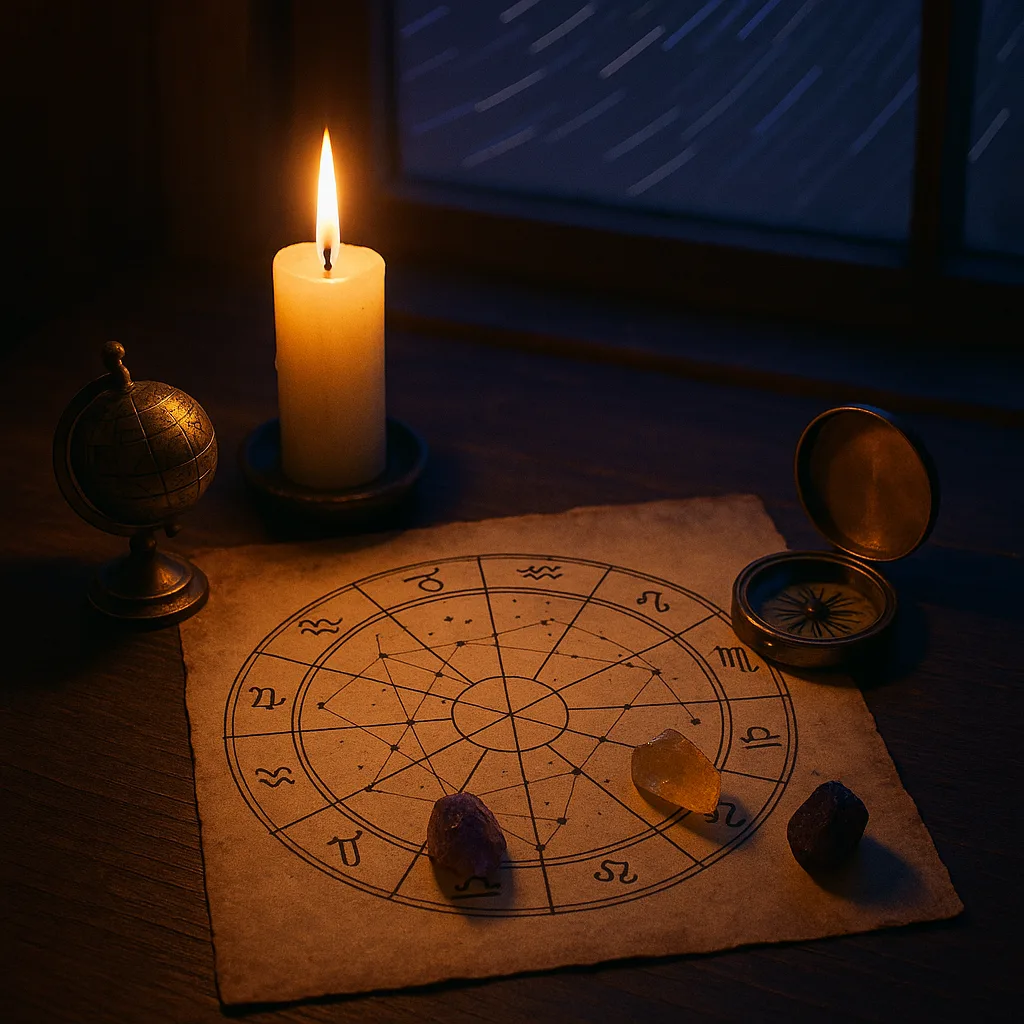
The sky never stops: what are transits
There is one moment that is entirely yours in the sky: the exact moment of your birth, recorded forever in your birth chart. It is a symbolic photograph, fixed, holding the position of each planet in that single minute. But the sky did not stop there. It kept turning and keeps turning now, as you read this text. We call this ongoing conversation between today's sky and the sky on the day you were born a transit.
In practice, it is as if the planets are always passing near your natal photograph, touching specific points within it, forming angles, moving closer or farther from the positions that belong only to you. These encounters create a kind of symbolic climate: not a sentence carved in stone, but a tendency that invites you to live something in a particular way.
This reading has shifted in tone over time. Centuries ago, transits were used almost like an oracle of concrete events (wars, harvests, the fates of kings). The astrology practiced today, influenced by figures like Dane Rudhyar and Liz Greene, looks at transits differently: less "what will happen" and more "what is moving within me now, and how can I navigate this with greater awareness".
Not everything that passes weighs heavy: flowing, challenging, or both at once
The quality of a transit depends on the angle, or aspect, that the moving planet forms with your natal chart. When this angle is a sextile or trine, the transit tends to flow: things click into place with less effort, doors seem unlocked, and you can move with the current. When the angle is a square or opposition, the invitation changes: something asks for attention, adjustment, a confrontation with a part of you that may have been asleep.
There is also the conjunction, which mixes both sensations: it can open a new cycle with the same intensity of someone feeling both excitement and vertigo.
One important nuance: challenging moments are not "punishments" from the sky. They are often the ones that push growth forward most, either voluntarily when you choose to move, or more compulsively when life chooses for you. This is why many astrologers say that a transit is not something to wait out passively. You are the protagonist of your own story, and the sky merely lights the stage.
The transit does not write the script; it shines the light on the stage where you are already performing.
Fast planets: the pulse of daily life
If you have noticed that certain days bring a lighter mood, easier conversation, or a sudden urge to act, this usually bears the signature of fast planets: Sun, Moon, Mercury, Venus, and Mars. They move quickly through the sky, and so their effects also pass quickly, typically in days or a few weeks.
This group governs the finer rhythm of life: the willingness to work, the flow (or stalling) in communication, the desire to draw close to someone, the physical energy to put a project into action. When Mercury, Venus, or Mars enters retrograde, that apparent backward motion through the sky, it is common to feel a direct impact on daily life: decisions that get stuck, relationships that need review, the feeling of paddling upstream in practical matters.
Venus speaks to how you love and how you handle money and pleasure. Mars is the fuel, the inner warrior that shows where it is worth investing energy right now. These are the planets that set the emotional tone of an ordinary Tuesday, which is why those who follow astrology day to day tend to focus on them far more than the slow planets.
Fast planet transits happen frequently. A Venus transit over a point in your birth chart might last only days, while a Mercury transit typically stretches for two or three weeks in direct motion. This explains why you feel subtle shifts in mood and energy so regularly throughout a month: these planets are passing and repassing sensitive points in your chart.
| Planet | Speed | Typical Duration | Life Areas |
|---|---|---|---|
| Sun | Fast | One month per sign | Vitality, identity, purpose |
| Moon | Very fast | 2 to 3 days per sign | Emotions, intuition, daily rhythm |
| Mercury | Fast | 2 to 3 weeks | Communication, learning, negotiation |
| Venus | Fast | 3 to 5 weeks | Affection, values, relationships, money |
| Mars | Fast | 6 to 8 weeks | Action, desire, energy, conflict |
Slow planets: the cycles that reorganize who you are
Jupiter and Saturn belong to another time scale. Jupiter, in direct motion, typically takes about ten days touching a point in your chart, but if retrograde that contact can stretch for nearly a month. It is the planet of expansion, optimism, and earned luck: its transits tend to open doors, encourage travel, study, business, and experiences that feed the soul.
Saturn moves even more slowly: on average twenty days in direct motion, possibly extending over a month when retrograde. It is known as the lord of time, not because it punishes, but because it demands structure, discipline, and maturity. Its transits are rarely comfortable, but they almost always leave something solid built after they pass.
Then there are Uranus, Neptune, and Pluto, the generational planets, so slow that it is practically impossible to move through one of their transits without also living its retrograde phase. These cycles can last years, and because of that they do not speak of your day but of entire eras of your life: a complete reinvention of identity, a dissolution of old certainties, a transformation that only makes sense when you look back, much later. The Saturn Return, which occurs around age 29, is a classic example of a cycle that marks a complete generational transition.
The neighborhood where the transit happens: the role of houses
Every transit needs an address, and that address is the astrological houses, the twelve sectors that divide your life into areas like work, relationships, health, family, and spirituality. The same planet can mean very different things depending on which house of your chart it is visiting.
Jupiter passing through the tenth house, for example, tends to favor recognition and career growth. Venus moving through the seventh house usually softens relationships, making the period more conducive to emotional closeness and partnerships. This combination of planet, aspect, and house is what gives the reading of transits its richness, and also its complexity, since the same Mars in square to the Sun can show up very differently if it is activating your financial house or your communication house.
Not all houses carry the same weight. The angular houses (1, 4, 7, and 10) are considered most powerful, followed by the succedent houses (2, 5, 8, and 11), and then the cadent houses (3, 6, 9, and 12). A transit moving through an angular house tends to have more visible impact on daily life, while a transit through the same cadent house may pass more internally, without as many immediate outer manifestations.
What to do with this information, in practice
Perhaps the most honest question is not "what will happen to me" but "what is this period inviting me to look at". Transits work less like prediction and more like a map of inner climate: knowing that the next few days tend to be more tense, you can choose to act with more care in a difficult conversation, or take advantage of a lighter phase to pursue that initiative you have been putting off.
Following fast planet transits helps you understand the ups and downs common in any week. Noticing when a slow planet is touching a sensitive point in your chart explains why certain life phases seem, in fact, more pivotal than others. Neither reading replaces your will. They merely offer a bit more awareness to choose how you want to move through time, which will pass anyway.
A practical way to start is to observe lunar transits, which shift every two or three days. During a waxing moon, energy tends to favor action and initiative. During a waning moon, focus turns toward review, closure, and inwardness. Lunar phase calendars like TimeandDate let you track the Moon's position in real time and plan activities in sync with these changes.
Steps to work consciously with your transits
- Identify your natal chart: You need to know the exact position of your planets and houses. To do this, access an online birth chart generator and enter your location, date, and exact birth time. This record creates the foundation for all subsequent transits.
- Follow fast planet transits weekly: Watch where the Moon, Mercury, Venus, and Mars are moving now. Check if they form tense aspects (square, opposition) or flowing aspects (trine, sextile) with your natal planets. This explains why some weeks feel more turbulent or smoother.
- Mark cycles of slow planets: When Jupiter or Saturn begins an important transit in your chart, mark the date on a calendar. During the months or years that follow, you will be able to recognize in hindsight how that period unfolded thematically.
- Connect the transit to the house it activates: Do not just look at the moving planet. See which house of your chart it is visiting. A retrograde Mars might shake up your second house (finances) differently than it would in the eighth house (deep transformation).
- Use the information for awareness, not passivity: If a transit suggests a period of revision, you can use that time to reorganize your life deliberately, rather than waiting for external events to force you to change.
Frequently asked questions
What is the difference between a transit and an astrological return?
A transit is the continuous movement of any planet through today's sky, touching points in your natal chart. A return, like the Saturn Return or Solar Return, is a specific event in which a planet returns exactly to the position it held at the moment of your birth. Returns are more defined landmarks, while transits are an ongoing dynamic you experience every day.
How do I know if I am living through an important transit right now?
You can check online transit generators by entering your birth date. The system will show which planets are forming significant aspects with your natal chart in this period. Alternatively, look for astrological calendars that list the month's transits. Shifts in mood, energy, or outside circumstances often coincide with important planetary activations.
Do negative transits always bring bad events?
No. A challenging transit like a Saturn square does not promise disaster, but rather a period that asks for maturity and structure. Often the most "difficult" transits are the ones that drive the greatest personal transformation when you work consciously with the energy. They function as an invitation to responsibility, not as a sentence.
How long does a transit last?
It depends on the planet. Moon transits last days. Mercury, Venus, and Mars transits last weeks to a few weeks. Jupiter and Saturn transits can last months, especially if the planet is retrograde. Uranus, Neptune, and Pluto transits last years, marking entire eras of your life.
Can I use transits to make important decisions?
Transits can inform your timing, but should not replace your judgment. If a transit suggests a period of greater clarity (like a good Mercury aspect), it may be a good time to make a decision requiring critical thinking. If it points to retrograde motion and review, launching something new might not be the best timing. Use it as an additional tool for awareness, along with your intuition and practical analysis.

Recomendado
MAPA ASTRAL E NUMEROLÓGICO PERSONALIZADO
Mapa Astral + Numerologia Um mergulho profundo na sua essência. E se tudo o que você procura… já estivesse dentro de você - esperando para ser revelado?

Recomendado
Astro Reflexo
Descubra o que os astros revelam sobre quem você é. Em menos de um minuto, calculamos seu Sol, Lua e Ascendente com precisão astronômica e uma inteligência artificial escreve um resumo personalizado só para você.

Recomendado
Mapa Astral Kármico
Você já sentiu que certos padrões se repetem em sua vida? Relacionamentos que seguem o mesmo roteiro, desafios que parecem voltar ou talentos que surgem naturalmente? Nada disso é por acaso.
Universo Astral Editorial Team · Birth charts and numerology
This article was produced by the Universo Astral editorial team, with AI tools assisting research and drafting and human review before publication. If you spot anything inaccurate or outdated, let us know at our contact email.