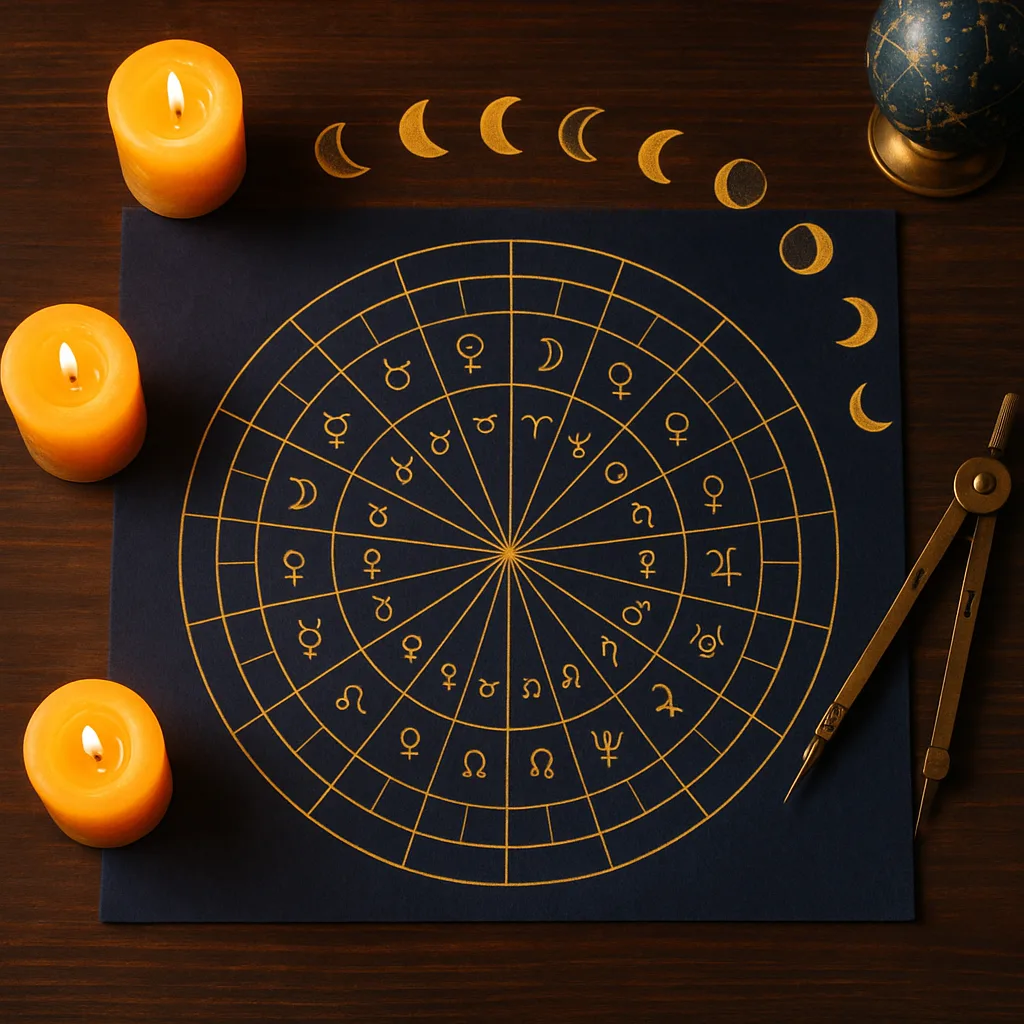
Birth Chart at Work: Using Astrology for Career Self-Understanding

Someone who changes jobs, manages a team for the first time, or starts their own business rarely thinks to consult their birth chart. Yet there is a side of astrology that avoids the cliché of generic horoscopes and hits exactly here: understanding how you work before making decisions that affect your routine, money, and professional identity.
This approach has nothing mystical about predicting whether you'll be promoted in March. It rests on something simpler: the birth chart describes behavioral patterns, and behavior repeats at work as much as anywhere else in life.
A portrait, not a script
A birth chart comes from precise calculation: your birth date, time, and place determine which sign and astrological house each planet occupied in that moment. The result is a snapshot of the sky, divided into twelve houses representing distinct areas of human experience, from self-image to finances, relationships to spirituality. For anyone wanting to understand the specific role of each of these twelve divisions, it's worth consulting the guide on the 12 astrological houses and where each area of life unfolds.
This differs entirely from the horoscope in a newspaper or app, which works only with the sun sign and can only speak in broad strokes, valid for anyone born during that stretch of the year. The individual birth chart operates at a different level of detail, accounting for the position of every planet, which houses they occupy, and the angles they form with each other. The encyclopedia Britannica notes that Western astrology, with its twelve zodiac signs, has roots in ancient Babylon and was systematized later by the Greeks, which explains why this symbolic system is far older than the newspaper horoscope we know today. Two people with the same sun sign can have radically different charts, which is why serious astrology avoids easy generalizations when it comes to career or teamwork.
The link with psychology: naming what you already feel
There is a branch of astrology called psychological astrology that draws on the archetypes described by Swiss psychologist Carl Jung. In this approach, the chart stops reading as written destiny and begins functioning as a symbolic language to decode internal patterns, including those that show up repeatedly at work: difficulty saying no to a boss, the drive to handle everything alone, resistance to changing roles despite dissatisfaction.
Its main role is to name experiences that often float loose or confused. When someone sees in their chart that they tend to repeat a certain behavioral pattern under pressure, it doesn't solve the problem by itself, but it helps see more clearly what was murky before. This type of repetition is covered in more detail in the article on how your birth chart helps identify behavioral cycles, worth reading if you notice the same pattern repeating across different jobs.
What your Sun, Moon, and Rising sign say about how you work
Without repeating what's already known about each of these three points separately, it's worth thinking about how they combine when you act professionally. The Sun shows your vital energy and core identity, what gives your career choices meaning when aligned. The Moon reveals how you handle your own emotions under pressure, including stress, deadlines, and team conflicts. Your Rising sign relates to how others perceive you at first glance, which directly shapes first impressions in interviews, meetings, and negotiations.
When these three elements create tension with each other, it's common to feel a mismatch between what you want internally, how you react under pressure, and how you're perceived externally. Recognizing this pattern helps explain why certain work situations seem to always generate the same discomfort, even across different jobs.
Houses and aspects: where energy shows up in daily life
The twelve astrological houses indicate which area of life each planetary energy tends to express most strongly. Planets concentrated in houses linked to work, resources, or communication usually signal where you naturally invest the most attention and effort, even if not consciously. Not all houses carry equal weight: the division between angular, succedent, and cadent houses explains why a planet in the tenth house, for example, typically carries more practical weight on career than the same planet in a cadent house.
Aspects are the angles planets form with each other, and they show whether that energy tends to flow easily or requires more attention and adjustment. The article on conjunction, opposition, trine, and square details this geometry. A person can have excellent leadership indicators in their chart and still face real difficulties, because tense aspects demand conscious effort to translate into practical results. This shatters the idea that having well-placed planets guarantees automatic success in any area, including work.
To organize these elements more practically, the table below summarizes what each point in your chart tends to reveal about professional behavior:
| Chart element | What it reveals in a work context | Common point of tension |
|---|---|---|
| Sun | Core identity and vital energy that gives meaning to career choices | Careers misaligned with your Sun tend to feel hollow, even if successful |
| Moon | How you handle emotions under pressure, deadlines, and team conflict | Automatic emotional reactions in moments of stress |
| Rising sign | First impression made in interviews, meetings, and negotiations | Gap between how you see yourself and how others perceive you |
| Houses (angular, succedent, cadent) | Area of life where planetary energy concentrates most strongly | Not all houses carry equal practical weight for career decisions |
| Aspects (trines, squares, etc.) | Ease or tension in the flow of a planetary energy | Tense aspects require conscious effort to produce practical results |
The limits of this tool
Astrology carries an old stigma: being confused with fortune-telling or treated as exact science, which isn't its purpose. It also doesn't replace therapy when it comes to emotional health at work, like burnout, anxiety, or deeper conflicts. What it offers is an additional symbolic layer, useful to complement other personal development practices, not to replace them.
A real risk, especially in a workplace, is using your chart to box colleagues into fixed categories: 'This person is this sign, so they're like this.' That oversimplifies a system that is naturally multilayered. No signs are bad, and no profiles are condemned to professional failure. What exists are different levels of maturity in each person, and someone immature in any sign can create friction in any team, just as someone aware of their tendencies, whatever their sign, tends to handle their own challenges better.
How to apply this without turning it into formula
The most useful reading of your chart for career decisions doesn't look for ready-made answers like 'should I take this job or not.' The value lies in spotting patterns: a productivity rhythm that may not fit rigid routines, a tendency to take on too much before learning to delegate, a specific communication difficulty that repeats in performance reviews. This productivity rhythm connects directly to the cardinal, fixed, and mutable modalities, explained in the article on the three rhythms that drive your birth chart: some people start projects easily, some sustain routines for long periods, and some need constant variation to stay engaged.
A practical way to begin this analysis, without turning your chart into a ready answer, follows a simple sequence:
- Observe your Sun, Moon, and Rising sign positions and note, without judgment, what each suggests about identity, emotional reaction, and first impression.
- Check which houses contain your planets, paying special attention to houses linked to work, resources, and communication.
- Note the strongest aspects between your planets, separating what seems to flow easily from what historically demands more conscious effort.
- Cross these observations with real situations you've lived at work, looking for patterns that repeat across different jobs or projects.
- Use these insights as background for concrete decisions, like changing fields, negotiating work conditions, or rethinking your leadership style, without expecting your chart to dictate the right answer.
Major decision moments, like moving to take a new job or closing one professional chapter to start another, are usually when this analysis makes the most sense. Not because your chart will show you the right path, but because looking at your own tendencies more clearly tends to make choices less automatic and more conscious.
Keep in mind that your chart itself doesn't change over your lifetime, but transits, the ongoing movement of planets relative to your birth positions, activate different energies at different phases. The article on planetary transits in daily life explains why the same trait can weigh more heavily one year and less the next, which helps clarify why certain periods feel more open to professional change than others.
In the end, using your birth chart in a work context is less about predicting an outside result and more about reducing autopilot in your own reactions. Someone who understands their behavioral patterns under pressure, their communication style, and what truly drives their choices tends to make career decisions more aligned with who they are, and that holds true regardless of what any prediction says about the future.
Frequently asked questions
Can your birth chart show you the right profession?
Not in the direct way it might seem to promise. Your chart shows behavioral patterns, like productivity rhythm and communication style, that help you understand your own choices better, but it doesn't point to a specific profession or guarantee success in any field.
What's the difference between your birth chart and a sun sign horoscope for career decisions?
Sun sign horoscopes work with just one point of your chart and speak in broad strokes, valid for anyone born during that period. Your full birth chart considers all planets, their houses, and the angles between them, allowing a much more specific reading of work behavior.
Is psychological astrology the same as therapy?
No. Psychological astrology uses your chart as a symbolic language to name internal patterns, inspired by Carl Jung's archetypes, but it doesn't replace therapy, especially for issues like burnout, anxiety, or deeper work-related conflicts.
Why can two people with the same sun sign behave so differently at work?
Because the sun sign is just one element among many in your chart. Your Moon position, Rising sign, houses, and aspects between planets all vary from person to person, even when your Sun is in the same sign, explaining large differences in professional behavior.

Recomendado
Curso MAPA ASTRAL
CURSO DESTRAVE SUA VIDA COM MAPA ASTRAL EM ATÉ 08 SEMANAS!
Universo Astral Editorial Team · Birth charts and numerology
This article was produced by the Universo Astral editorial team, with AI tools assisting research and drafting and human review before publication. If you spot anything inaccurate or outdated, let us know at our contact email.