Three-Card Tarot: A Step-by-Step Guide to Knowing Yourself Better
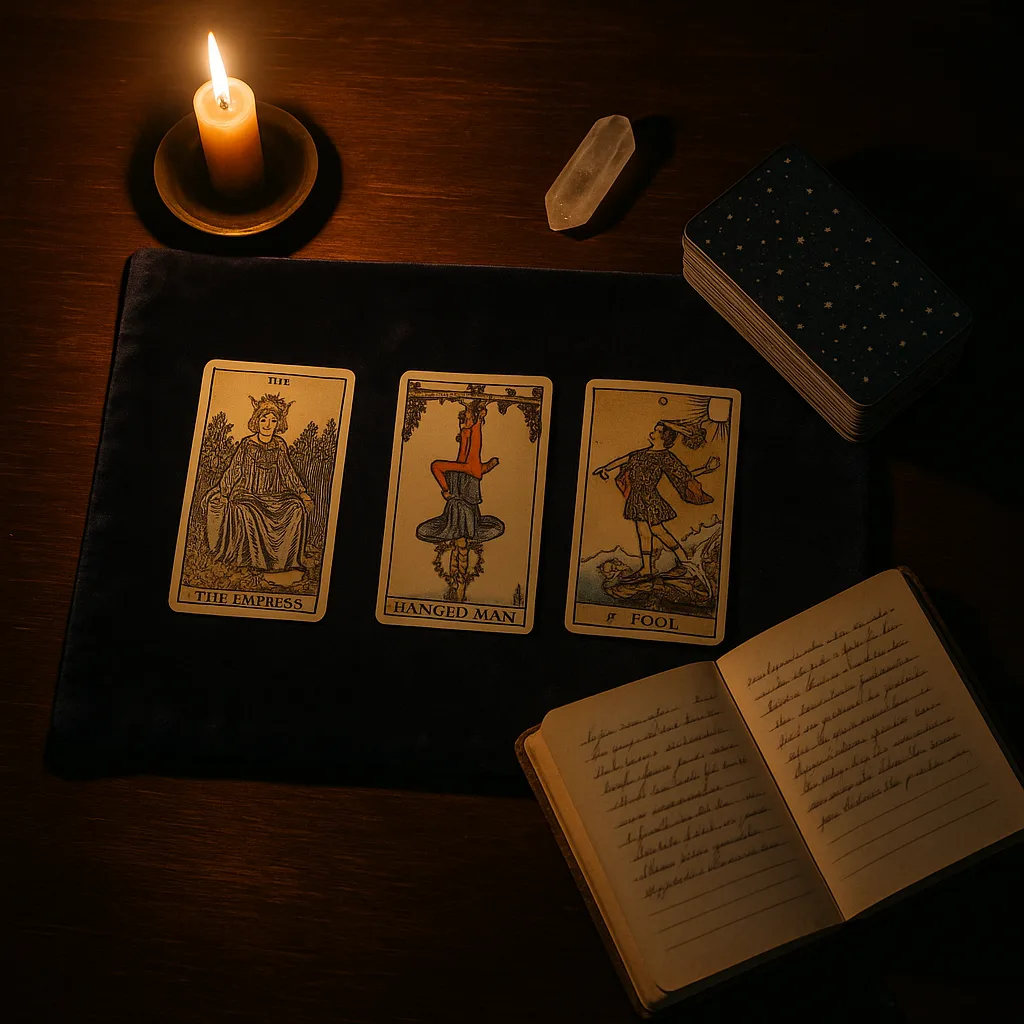
Three cards on the table, a question in your chest
Picture shuffling a tarot deck alone, by candlelight, with no question about the future, just the wish to understand why the same feeling keeps coming back. This is exactly what the three-card spread is for. It does not promise to reveal dates or certainties: it offers a pause to listen to what is already inside you, but that your busy daily life does not let you hear.
Contrary to what many people think, tarot used this way does not work like an oracle deciding anyone's fate. It works more like a shuffled mirror: the images that appear serve as a prompt for your own intuition to speak. The answer is not printed on the card, it is born from the meeting between the symbol and your own story. This symbolic logic has old roots: the National Library of France holds a digitized collection of historical tarot decks, a record of how these images circulated and changed long before any self-knowledge reading like the one proposed here.
Why exactly three cards
There is a practical reason this is the spread most used by beginners: three cards force objectivity. There is no room to get lost across twelve different positions, each card has to carry real weight within the story being told. It is just enough to avoid intimidation, and complete enough to form a line of reasoning with a beginning, middle and end.
This simplicity also explains why the spread works well for concrete self-knowledge questions: a recurring argument in a relationship, the feeling of being stuck on a career decision, an emotional pattern that resurfaces whenever you feel pressured. These are situations that call for clarity, not a sprawling map, and that is exactly what three well-read cards deliver. Anyone who wants to bring this same logic into a relationship, using the deck as a couple, can find a specific guide at three-card tarot for couples.
Before shuffling: silence matters more than technique
The first step of a self-knowledge reading does not happen with the cards in your hands, but before that. It helps to take a few deep breaths, slow down your thinking, and ask yourself honestly what is really bothering you. The reading tends to stay shallow when the question is vague: asking "what is going to happen to me" rarely brings clarity. Asking "what am I avoiding seeing in this situation with my boss" already changes the quality of the answer.
There is no required way to shuffle the deck. Some people cut it into three piles, others shuffle it like a regular deck of cards. What matters is doing it with attention, keeping the question alive in your mind while your hands work. It is this simple gesture that turns a deck into a tool for introspection, rather than just illustrated paper.
Step by step for doing your own reading
Bringing together everything described so far, the full process can be organized into six simple steps:
- Choose a quiet moment and formulate a specific question, never a generic one (prefer "what am I avoiding seeing" over "what is going to happen").
- Shuffle the deck however you prefer, keeping the question alive in your mind while your hands work.
- Cut the deck and draw three cards, laying them out from left to right in the order they came out.
- Look at all three together for a few seconds before analyzing any isolated meaning, noticing colors, figures and the overall energy of the set.
- Read each position according to the role you assigned to it (for example: subject, verb and outcome, or situation, action and result).
- Write the reading down in a notebook, with the date and the question, to compare with future readings on the same topic.
Laying out and reading the three cards
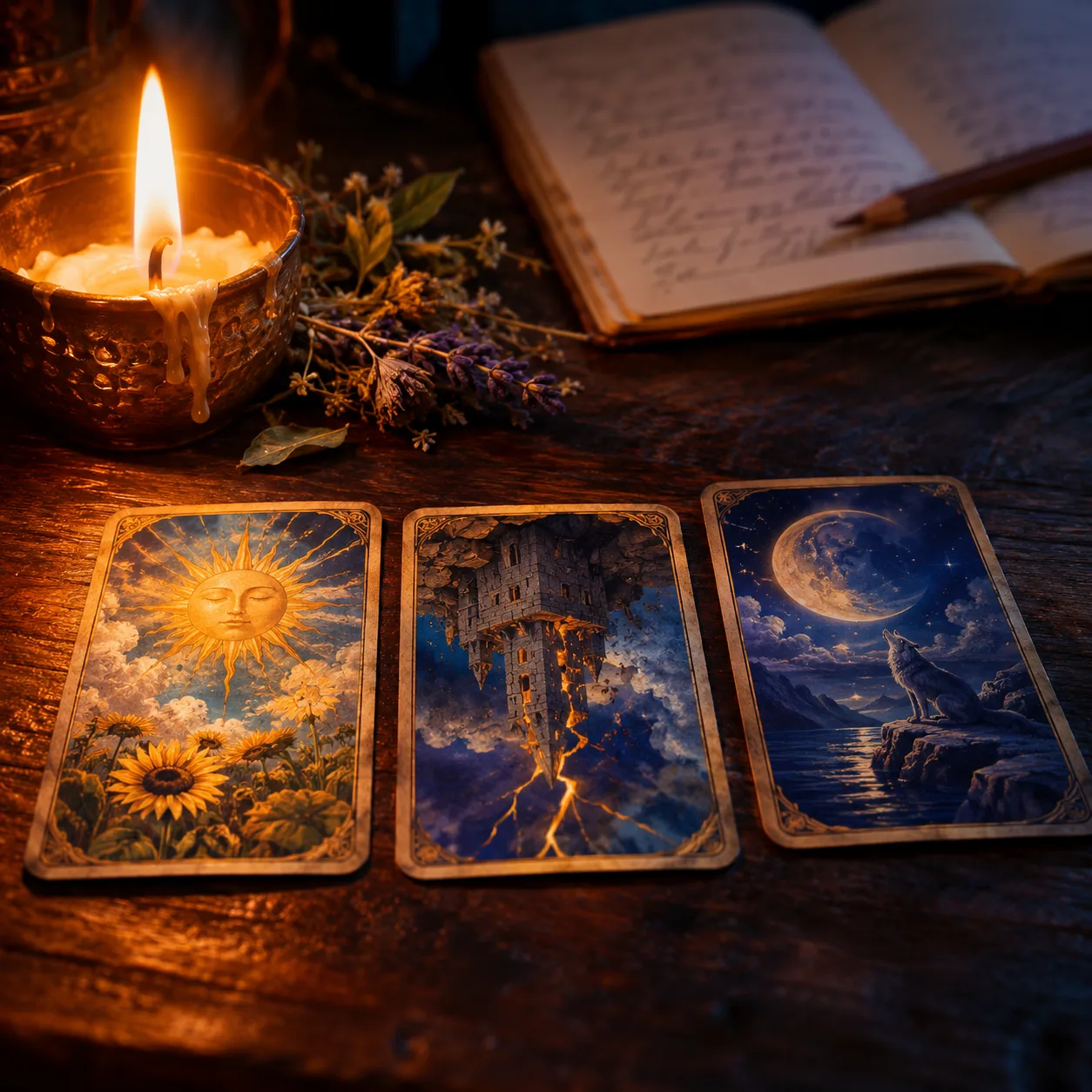
Always flip the cards in the same order, left to right, and decide beforehand what each position represents. A simple way to think about it is to see the card on the left as the subject of the sentence (who or what is at stake), the middle one as the verb (the action, what is moving right now), and the one on the right as the outcome, or the likely direction if nothing changes.
Before looking up each card's meaning in a book, look at all three together for a few seconds. Notice the colors, the figures, whether they seem to be looking at each other or drifting apart, whether the overall energy feels heavy, light, conflicted or flowing. This first impression, still without rational analysis, is often more revealing than it seems: it is intuition recognizing a pattern before you even name it.
Four ways to set up the same spread
The advantage of the three-card spread is that its structure changes depending on the question you bring. The table below summarizes the four variations described in this guide, what each position represents, and when to use each one:
| Spread | Position 1 | Position 2 | Position 3 | When to use it |
|---|---|---|---|---|
| Past, Present, Future | What brought you here | Forces at work right now | Trend if the current path continues | Understanding the origin of a recurring pattern |
| Situation, Action, Result | The real nature of the issue | A possible course of action | Where that action tends to lead | When the problem is already known and practical guidance is missing |
| Mind, Body, Spirit | Thoughts dominating your head | What the body feels or needs | What intuition is trying to communicate | Well-being questions and inner conflict |
| Shadow Spread | The fear or reaction being avoided | The repressed emotion behind it | The invitation to look without rushing | When something specific has been avoided |
Anyone who wants to dig deeper into the Mind, Body and Spirit variation can find a full guide at body, mind and spirit: the spread that exposes inner conflicts, and anyone deciding between these four formats can compare criteria at how to choose the right tarot spread for every moment.
- Past, Present, Future: the classic one. The first card shows what brought you here, the second reveals the forces at work right now, and the third points to a trend, not a sealed fate, if the current path continues.
- Situation, Action, Result: good for when you already know what the problem is and need practical direction. The first card names the real nature of the issue, the second suggests a possible course of action, and the third shows where that action tends to lead.
- Mind, Body, Spirit: a reading more focused on well-being. Each card represents a layer: the thoughts dominating your head, what your body is feeling or asking for, and what your intuition or deeper purpose is trying to communicate.
- Shadow Spread: suited for anyone who wants to face something they have been avoiding head-on, a fear, a repeated reaction, a repressed emotion. Here the three cards work as an invitation to look, without rushing, at what you usually prefer not to look at.
Reading for yourself: a few precautions that make a difference
Reading your own tarot has a common trap: the wish for the card to say exactly what you want to hear. That is why it helps to stay curious rather than anxious. If a card seems "bad", ask yourself what it is asking you to notice, not what negative thing it is predicting.
The cards do not say what will happen to you; they show, through symbols, what is already happening inside you.
It also helps to write the reading down in a notebook, with the date and the question asked. Over time, these notes form a record of how you yourself interpreted your questions at different moments, a self-knowledge resource as valuable as the reading itself.
A practice that deepens with repetition
The three-card spread does not lose its power with frequent use. On the contrary: the more you repeat the exercise, the more you recognize your own patterns in the combinations that show up. Maybe the Tower keeps appearing whenever you resist a necessary change, or the Hermit shows up during periods when your energy calls for withdrawal. These repeated encounters with the same cards, in different contexts, reveal the real value of the practice: not predicting the future, but gradually recognizing the threads that make up who you are. Anyone who does not yet have a deck, or wants to review the fundamentals of the Major Arcana before moving on to spreads, should read introduction to tarot: the Major Arcana and your first step into studying the cards.
Frequently Asked Questions
Do I need to know the meaning of every card in the deck to do this reading?
Not necessarily. The guide shows that the first impression, looking at all three cards together before any isolated meaning analysis, already brings valuable information. Over time, repeated contact with the same deck teaches you the meanings through practice.
Can I do this spread about any subject?
Yes, as long as the question is specific. The article recommends swapping vague questions like "what is going to happen to me" for concrete ones tied to a real situation, such as a behavior pattern at work or in a relationship.
How often can I repeat the same spread on the same topic?
The practice does not lose its power with repetition. On the contrary, the article explains that encountering the same cards again at different moments helps identify personal patterns, so it is worth keeping a written record with date and question to compare readings over time.
What is the difference between this spread and a reading that claims to predict the future?
The approach described here does not treat the card on the right as a sealed fate, but as a trend if nothing changes in the present. The focus is on understanding the current moment and your own patterns, not getting a guaranteed prediction.
Recomendado
Astro Reflexo
Descubra o que os astros revelam sobre quem você é. Em menos de um minuto, calculamos seu Sol, Lua e Ascendente com precisão astronômica e uma inteligência artificial escreve um resumo personalizado só para você.
Universo Astral Editorial Team · Tarot and moon transits
This article was produced by the Universo Astral editorial team, with AI tools assisting research and drafting and human review before publication. If you spot anything inaccurate or outdated, let us know at our contact email.