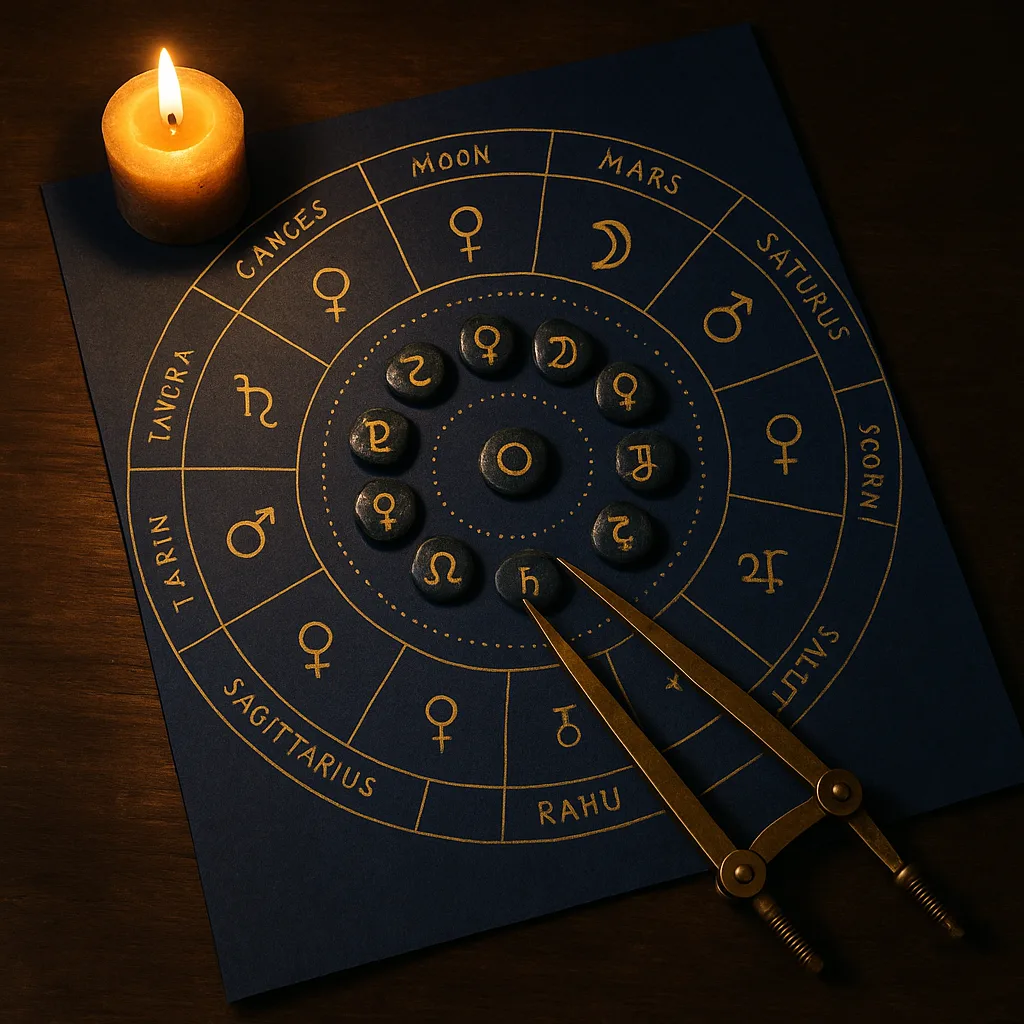
Nakshatras: The 27 Lunar Constellations Jyotish Uses (and Western Astrology Ignores)
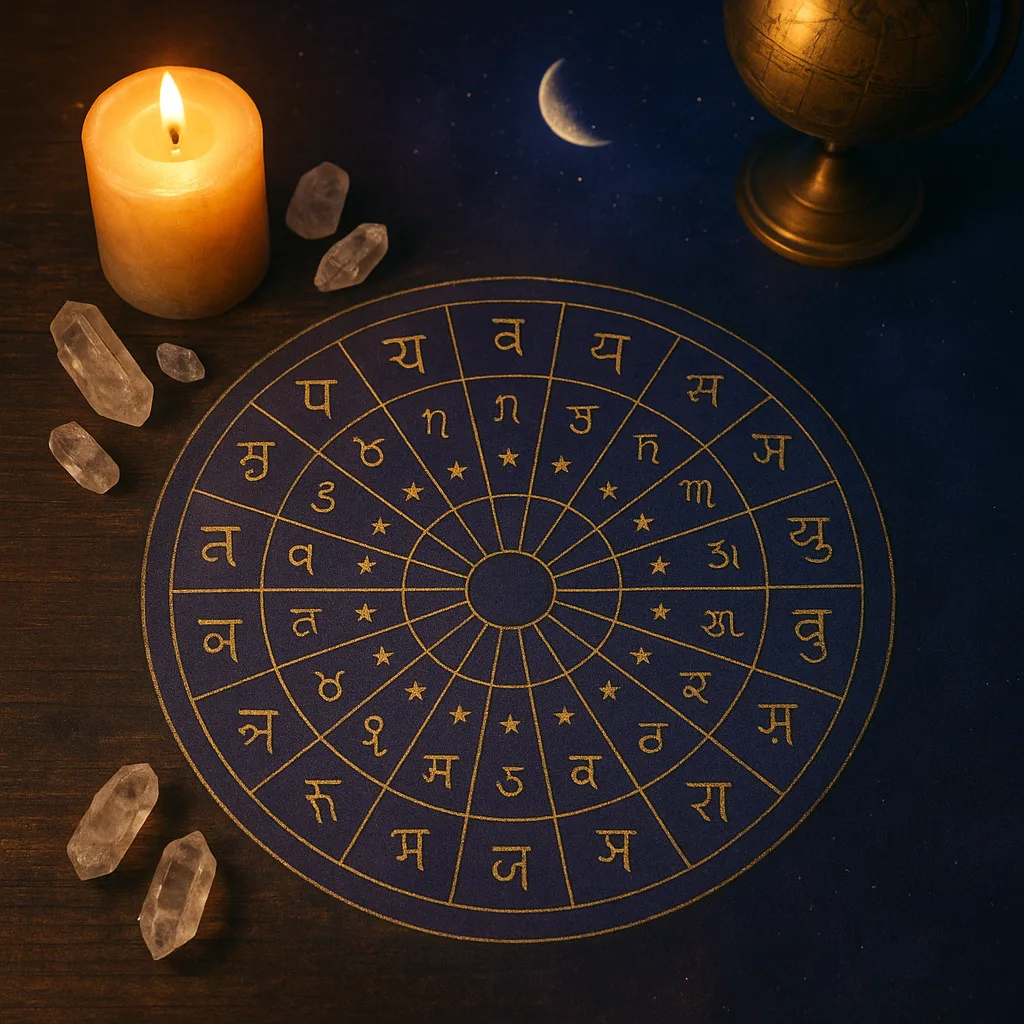
Ask a Vedic astrologer what the single most important data point in a birth chart is, and the answer probably won't be the Sun sign. It will be the Moon's nakshatra: the exact lunar constellation the Moon occupied at the moment of birth. This detail has no direct equivalent in Western astrology, and that's exactly where one of the richest, and least discussed, differences between the two systems lives.
A slice of sky Western horoscopes don't use
The zodiac, in both Jyotish and Western astrology, is divided into 12 signs of 30 degrees each. Regular readers of Universo Astral already know this well. What changes in the Vedic system is that there's a second division layered on top of the first: the full 360 degree zodiac circle is sliced into 27 equal parts of 13°20' each, called nakshatras.
Each nakshatra represents a symbolic force of nature, an archetype with its own personality, temperament and purpose. While the Western Sun sign speaks to identity, and the Moon sign speaks to emotion in fairly broad strokes, the nakshatra works like a magnifying glass: it details mental patterns, emotional leanings and even spiritual tendencies that the sign alone doesn't capture.
The 27 fragments of the sky, and what each one carries
Names like Ashwini, Bharani, Krittika, Rohini or Revati sound unfamiliar to anyone who only knows Western astrological language, but in Jyotish they're just as central as Aries or Taurus. Each of these 27 nakshatras has its own symbol, an associated deity and a ruling planet, and it's used to calculate almost everything: from the name given to a newborn in Indian tradition to the right moment for a wedding or a ceremony.
The Moon's position in the birth nakshatra is also the starting point for the Vimshottari Dasha, the 120 year system that organizes life into sequential planetary periods. That's why, in Jyotish, knowing only someone's Moon sign is incomplete information: without the nakshatra, you're missing the piece that activates the chart's entire timing calculation.
Deity, not planet: a distinction that often trips people up
There's a technical detail that even students of Vedic astrology sometimes get wrong. It's tempting to assume each nakshatra is ruled by a planet, the same way Aries is ruled by Mars. But that's not quite how it works: nakshatras are governed by deities, symbolic entities tied to Vedic mythology, each with its own function and temperament. Planets, meanwhile, keep ruling the zodiac signs, just as they always have.
This extra layer of deities is what gives nakshatras their almost devotional character, quite different from the more psychological language modern Western astrology tends to use. It's not just a constellation with astronomical influence: it's a living mythological archetype, with stories and attributes that shape the reading.
Why the Moon carries more weight in Jyotish than in pop horoscopes
In the West, newspaper and app horoscopes are almost always built on the Sun sign: the Sun's position on the day of birth. It's practical, easy to generalize, and sells well as a daily prediction format. In Jyotish, that starring role belongs to the Moon, more specifically to the combination of the Moon sign (Rashi) and the lunar nakshatra.
This isn't an accident. In the Vedic worldview, the Moon rules the mind (manas), and the mind is considered the filter through which every life experience gets processed. A traditional Vedic astrologer, upon meeting someone, tends to ask about the birth nakshatra first, not the Sun sign. It's like asking not just what season someone was born in, but the exact fold of the sky the Moon was crossing at that precise instant.
How nakshatras fit into the rest of the Vedic system
It's worth placing this piece within the bigger picture, without repeating what's already familiar: Jyotish uses the sidereal zodiac, anchored to the actual constellations (unlike the Western tropical zodiac, tied to the seasons), and operates with its own house system, the Bhava, organized from the Lagna, the ascendant. Nakshatras enter as a third layer of precision, layered on top of the sign and the house, working as a zoom function that Western astrology simply doesn't have in its standard structure.
There's no equivalent subdivision in the conventional Western repertoire applied systematically to reading personality and destiny. Some older Western systems, like decan degrees or Egyptian terms, come close in spirit (slicing the sign into smaller parts with their own meanings), but none carries the symbolic, mythological and predictive weight that nakshatras hold in Jyotish.
What changes in practice when you look at your nakshatra
For anyone who already has a chart calculated in the sidereal system, finding the birth nakshatra means adding a layer of reading that goes beyond the good old Moon sign. Two people with the Moon in Taurus, for instance, can fall into different nakshatras (Krittika, Rohini or Mrigashira, depending on the exact degree), and each of these nakshatras lends a distinct flavor to the same underlying lunar position.
It's an invitation to look at the birth sky with more granularity, understanding that in Jyotish, the Moon isn't just a sign: it's a precise address within 27 symbolic territories, each with its own story to tell.

Recomendado
MAPA ASTRAL E NUMEROLÓGICO PERSONALIZADO
Mapa Astral + Numerologia Um mergulho profundo na sua essência. E se tudo o que você procura… já estivesse dentro de você - esperando para ser revelado?

Recomendado
Mapa Astral Kármico
Você já sentiu que certos padrões se repetem em sua vida? Relacionamentos que seguem o mesmo roteiro, desafios que parecem voltar ou talentos que surgem naturalmente? Nada disso é por acaso.
Recomendado
Astro Reflexo
Descubra o que os astros revelam sobre quem você é. Em menos de um minuto, calculamos seu Sol, Lua e Ascendente com precisão astronômica e uma inteligência artificial escreve um resumo personalizado só para você.
Universo Astral Editorial Team · Birth charts and numerology
This article was produced by the Universo Astral editorial team, with AI tools assisting research and drafting and human review before publication. If you spot anything inaccurate or outdated, let us know at our contact email.