Saturn Return and the Planetary Cycles Behind Life's Big Turning Points
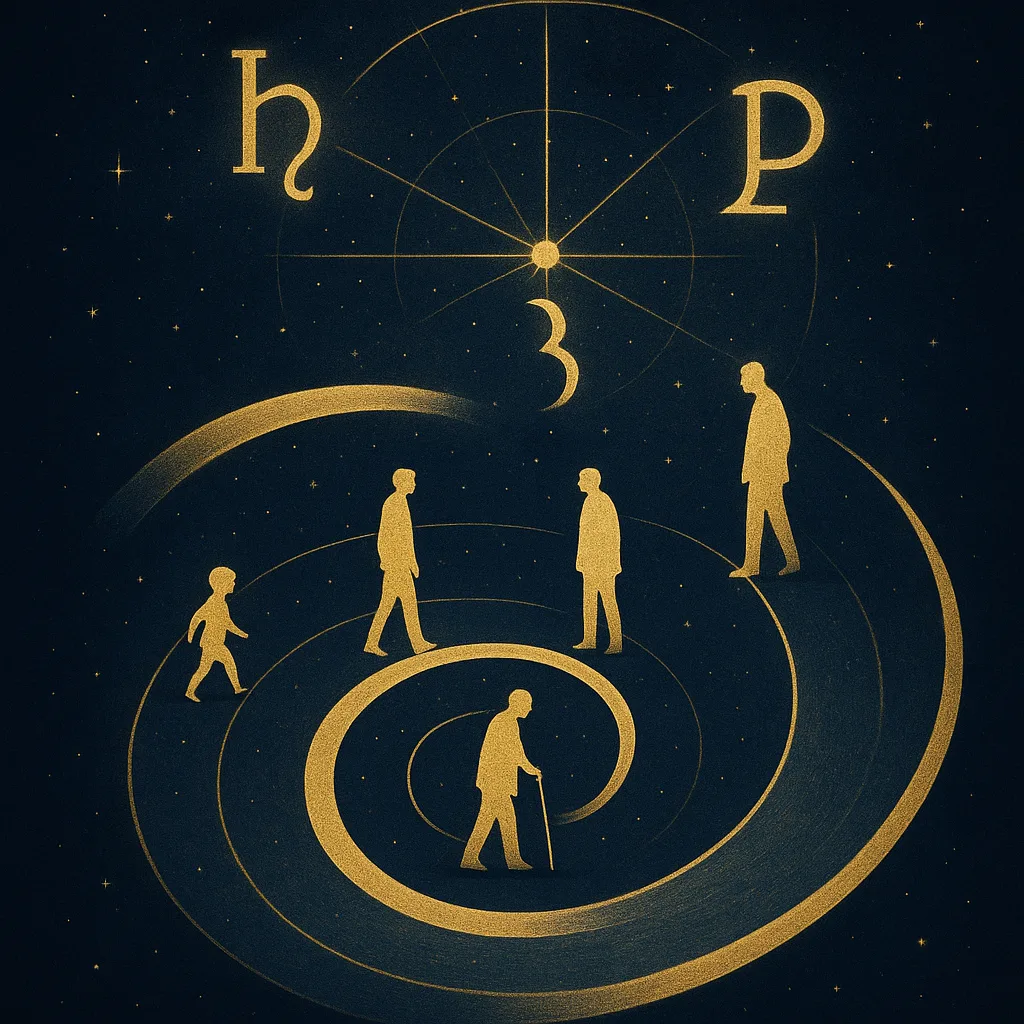
Your birth chart has an inner clock, too
Many people learn to read their birth chart, memorize the positions of the Sun, Moon, and Ascendant, get a handle on the houses, and then set the chart aside. But there's a deeper layer of reading that only makes sense over time: the great planetary cycles, slow-moving transits that circle back to touch points in your natal chart at fairly predictable moments in adult life. This isn't about the day-to-day, like the quick transits of Mercury or Venus. It's about the wide arcs of a life story, the phases when it feels like everything is changing at once.
These cycles help explain why certain ages seem to concentrate crises, major decisions, or that sense of hitting reset. Understanding this inner clock means seeing your birth chart not as a still photograph, but as a score that keeps being played out over decades.
Saturn Return: the turning point at 29
Saturn takes about 29 years to complete one orbit around the Sun and return to the exact position it held at your birth. This phenomenon, known as the Saturn Return, tends to line up with one of the most defining stretches of adult life. Between ages 27 and 30, many people go through career changes, end relationships that had stopped making sense, or feel a growing pull to take life into their own hands.
Saturn is tied to structure, responsibility, boundaries, and maturity. When it returns to your natal point, it demands an accounting: is what you've built so far solid, or was it built on a foundation that no longer holds you up? A useful tip is to check which house your natal Saturn falls in. That's where this reckoning tends to hit hardest.
The second and third returns
Fewer people know that the Saturn Return happens again: around ages 58-59, and, for those who make it that far, once more near 88-89. Each pass carries a different flavor. The second tends to bring career and legacy reflections. The third leans toward a more spiritual reassessment of one's own path.
Jupiter: the 12-year cycle that renews optimism
While Saturn calls for seriousness, Jupiter, the planet of expansion, luck, and learning, completes its cycle in roughly 12 years. Every 12 years it returns to the sign and house it occupied at your birth, opening a window of growth, opportunity, and a renewed appetite for taking chances.
- First Jupiter return (around age 12): coincides with the start of adolescence and the shaping of an identity outside the family unit.
- Second return (around age 24): often comes paired with decisions about career and independence.
- Third return (around age 36): tends to reignite projects and ambitions shelved during the rush of your 30s.
Unlike Saturn's return, Jupiter's tends to feel like a relief, a fresh injection of faith that it's possible to start over, learn something new, or finally make the leap you'd been putting off.
Uranus opposition: the midlife crisis in a new light
The so-called midlife crisis has a structural explanation in astrology. Uranus, the planet of rupture and individuality, takes 84 years to complete its orbit, which means that around ages 40-42 it arrives at the exact opposite point from where it was at your birth.
This Uranus opposition tends to trigger a deep questioning of authenticity: am I living the life I chose, or the life others expected of me? It's not unusual for this period to bring sudden changes in appearance, city, career, or relationships, not out of empty impulse, but because a more genuine part of yourself, one less shaped by expectations, is asking for room to breathe.
The lunar nodes: the 19-year cycle and recurring patterns
Another lesser-known but revealing cycle is that of the lunar nodes, mathematical points tied to eclipses that return to their natal position roughly every 19 years. Anyone past age 19, 38, or 57 tends to notice a curious pattern: emotional situations similar to those from childhood or youth resurface, as if asking to be resolved in a more mature way this time.
The great cycles don't repeat the past by accident. They offer a second chance to answer the same question differently.
How to tell which cycle you're in right now
You don't need to memorize ephemeris tables to notice these movements. A few practical markers can help you place yourself within a cycle:
- Between ages 27-30, 58-59, or 88-89: likely a Saturn Return, a phase of structure and responsibility.
- Around ages 12, 24, 36, 48, or 60: likely a Jupiter Return, a phase of expansion and new opportunities.
- Between ages 40-42: Uranus opposition, a phase of rupture and the search for authenticity.
- Around ages 19, 38, or 57: the lunar nodes cycle, old emotional patterns asking to be resolved.
Matching these ages up with the standout moments of your own life story is a revealing exercise. Many people notice, looking back, that their biggest turning points really did cluster around these windows.
A chart that walks alongside you, not one that traps you
Knowing about these major cycles isn't about predicting the exact date of a crisis. It's about giving hard phases a gentler context. If you're going through an intense turning point at 29 or 41, maybe it's not just you. It's part of a bigger, almost universal movement that astrology has observed for centuries. That doesn't take away responsibility for your own choices, but it does lighten the weight of feeling like something went wrong.
Next time a phase of life seems to be calling for reinvention, it's worth going back to your birth chart and asking what cycle is knocking on your door right now, and what it's inviting you to build, release, or finally face head-on.
Recomendado
Astro Reflexo
Descubra o que os astros revelam sobre quem você é. Em menos de um minuto, calculamos seu Sol, Lua e Ascendente com precisão astronômica e uma inteligência artificial escreve um resumo personalizado só para você.

Recomendado
Estátua Gato Bastet Egito Antigo
Inspiração Egípcia Autêntica Representa Bastet, a deusa egípcia da proteção, harmonia e energia feminina.
Universo Astral Editorial Team · Birth charts and numerology
This article was produced by the Universo Astral editorial team, with AI tools assisting research and drafting and human review before publication. If you spot anything inaccurate or outdated, let us know at our contact email.