Personal Year in Numerology: Find Your Place in the 9-Year Cycle
Your destiny number and expression number tell a fixed story, the same since birth. Your personal year works differently: it shifts every year and answers a more practical question than 'what is my purpose'. The question is: what phase of this larger cycle am I in now, and what makes sense to focus on in the next twelve months? Numerologists use this number to plan short- and medium-term decisions, not to describe personality traits.
This calculation exists alongside two smaller cycles, the personal month and personal day, which refine the reading further. To understand how all three fit together, check the numerology calendar showing personal year, month, and day, which explains how these numbers overlap in daily life.
Why numerology works with 9-year cycles
The logic behind the personal year is straightforward: just as nature has seasons, Pythagorean numerology understands life as organized in cycles that run from 1 to 9, then repeat endlessly. Each complete cycle of nine years functions like a spiral. You do not return to exactly the same place when a new cycle begins, but you revisit similar themes at a different level of maturity. A year 1 always calls for new beginnings and courage, whether it's the first cycle of adult life or the fifth one someone experiences at age 60.
Knowing which of these nine stages you're in changes how you read the same situation. Quitting a job in year 1 tends to feel like planting seeds. The same action in year 9 feels like the natural end of a chapter already running its course.
This reasoning about cycles repeating with symbolic meaning shows up in other time-counting systems, like lunar calendars and astronomical ephemerides. The site timeanddate.com compiles moon phase calendars and eclipse dates by city, useful for anyone tracking temporal cycles alongside the personal year, even though they're different systems: one is astronomical, one is symbolic.
How to calculate your personal year
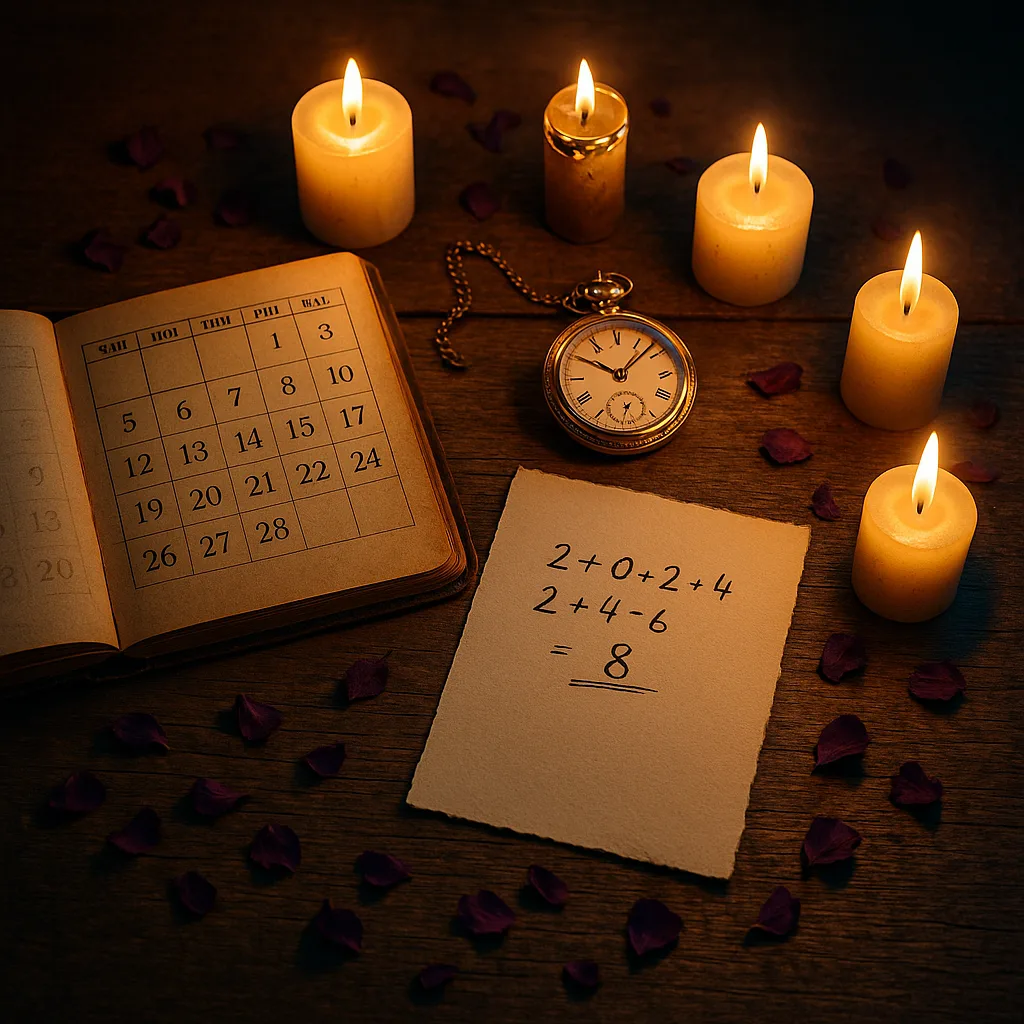
The calculation uses three pieces of information: birth day, birth month, and the current year (or whichever year you're projecting forward to). Unlike the destiny number, your birth year does not factor in here. It gets replaced by the current year, and that substitution is what makes the number change every twelve months.
Here's the step-by-step process using someone born May 14, calculating the personal year for 2025:
- Reduce the birth day: 14 reduces to 1 + 4, which equals 5.
- Reduce the birth month: May is month 5, and it's already a single digit, so it stays 5.
- Reduce the current year: 2025 reduces to 2 + 0 + 2 + 5, which equals 9.
- Add all three results: 5 + 5 + 9 = 19.
- Reduce the total to a single digit: 19 becomes 1 + 9 = 10, and 10 reduces to 1.
This person's personal year in 2025 is 1, a year of new beginnings. This same single-digit reduction method supports other Pythagorean numerology calculations, like the life path number, explained in the step-by-step guide to calculating your life path from your birth date.
One detail shifts the reading for people with birthdays later in the year: the technical personal year changes on your birthday, not January 1st. If your birthday hasn't happened yet in the year you're checking, some numerologists prefer using the previous year's number to describe the months before your next birthday. Try both calculations and see which narrative matches what you're actually experiencing.
What to prioritize in each year of the cycle
Each stage of the nine-year cycle has its own task. Using it well means moving with the current instead of pushing against it. The table below summarizes the central theme of each year and the kinds of decisions that typically make sense in it:
| Personal year | Central theme | What to prioritize |
|---|---|---|
| 1 | Beginnings | Plant new seeds: job, relationship, move to a new city |
| 2 | Cooperation | Partnerships and patience, without forcing quick results |
| 3 | Social expansion | Communication, networking, and creativity |
| 4 | Work and structure | Build solid foundations: finances, renovations, formal matters |
| 5 | Change | Travel and break routines, embrace the movement |
| 6 | Responsibility and home | Family and caring for those close to you |
| 7 | Introspection | Withdrawal, study, and internal review |
| 8 | Material harvest | Professional recognition and financial results |
| 9 | Closure | Release what has served its purpose, take stock |
This pattern of nine phases is general and does not replace reading other numbers in each person's numerology map. Someone with a master number in their chart, for example, tends to feel these phases more intensely, as described in the article on the heavier side of master numbers 11, 22, and 33.
The most common mistake: treating the personal year as fixed fate
It's tempting to think a year 9 means 'nothing will work out', but that reading weakens the tool. The personal year describes the tide, not a prohibition. It's entirely possible to start something in year 9, only the experience will likely ask for more effort because you're swimming against that stage's natural current. Similarly, a year 1 does not guarantee automatic success in any venture. It simply favors the kind of energy needed to get things moving.
Another common mistake is comparing one person's personal year to another's as if it were a compatibility ruler, thinking someone in year 6 and someone in year 2 shouldn't do anything together. This kind of flawed comparison between numerological numbers happens elsewhere too, like when calculating couple compatibility: the article on the comparison error that invents incompatibilities that don't exist shows why putting two numbers side by side without context often leads to hasty conclusions.
The personal year coexists with smaller cycles like the personal month and personal day, calculated using the same reduction logic, which fine-tune the moment even further. But before diving into those shorter time spans, knowing which of the nine years you're in now already helps you ask more useful questions about your own choices: is this a moment to plant, to wait, or to harvest what was already sown?
Frequently asked questions
Does the personal year change on my birthday or on January 1st?
Technically, the personal year changes on your birthday, not January 1st. That's why people who haven't yet had their birthday in a given year might prefer using the previous year's number to describe the months before their next birthday. The best approach is to calculate both ways and see which one resonates with what you're experiencing.
What's the difference between personal year and destiny number?
The destiny number is fixed, calculated from your complete birth date, and describes a permanent characteristic. The personal year changes every year because it swaps your birth year for the current year in the calculation, functioning as a short-term compass rather than a personality trait.
Can you start something new in a year 9?
Yes, you can, but the experience will likely require more effort since year 9 is the closure stage of the cycle, not a beginning stage. The personal year shows the dominant tide of that period, not a literal rule about what can or cannot be done.
Do I need to learn how to calculate personal month and personal day too?
It's not required, but it helps sharpen the reading. These two cycles use the same reduction logic as the personal year, just applied to shorter time spans, and they add depth to your overall understanding of the year you're in.

Recomendado
Mapa Astral Kármico
Você já sentiu que certos padrões se repetem em sua vida? Relacionamentos que seguem o mesmo roteiro, desafios que parecem voltar ou talentos que surgem naturalmente? Nada disso é por acaso.
Universo Astral Editorial Team · Birth charts and numerology
This article was produced by the Universo Astral editorial team, with AI tools assisting research and drafting and human review before publication. If you spot anything inaccurate or outdated, let us know at our contact email.