Master Numbers 11, 22, and 33: The Triangle of Illumination in Numerology
An exception that has existed for millennia of calculation
Take any birth date and add its digits until a single number between 1 and 9 remains. This logic sustains nearly all Pythagorean numerology: a system designed to fit everything into nine archetypes, a tradition tracing back to the Greek philosopher Pythagoras and sharing with astrology an ancient origin in seeking symbolic patterns in numbers and celestial positions. The Encyclopaedia Britannica contains entries on the history of astrology and the zodiac that help situate this type of symbolic system within a cultural context far older than commonly imagined. But there are three moments when the reduction rule stops applying. If 11, 22, or 33 appears during the sum, the tradition says to stop there, without reducing or simplifying that number down to a single digit. These three are called master numbers, and that is what we explain here: not each one in isolation, but the set that many numerologists read as a kind of ladder.
Why 11, 22, and 33 don't follow the rule
Of the eighteen numbers that appear in a complete numerological chart, only three refuse to become a single digit: 11, 22, and 33. The most common explanation is that they vibrate at two frequencies at once: that of the master number itself and that of the reduced number beneath it. The 11 remains 11, but carries the 2 (1+1) as a second layer of meaning. The 22 holds the 4. The 33 holds the 6.
An interpretation popularized by numerologist Hans Decoz suggests that what makes these numbers special is not merely having two repeated digits (44, 55, and 77 have those too), but the fact that these digits are precisely 1, 2, and 3. A doubled dose of individuality (1), partnership (2), or expression (3), combined with the weight of the total number, creates this intensity. Anyone wanting to understand how this origin is told differently across schools can check the controversial origins of master numbers and why not every school agrees on them.
A triangle with three stages of creation
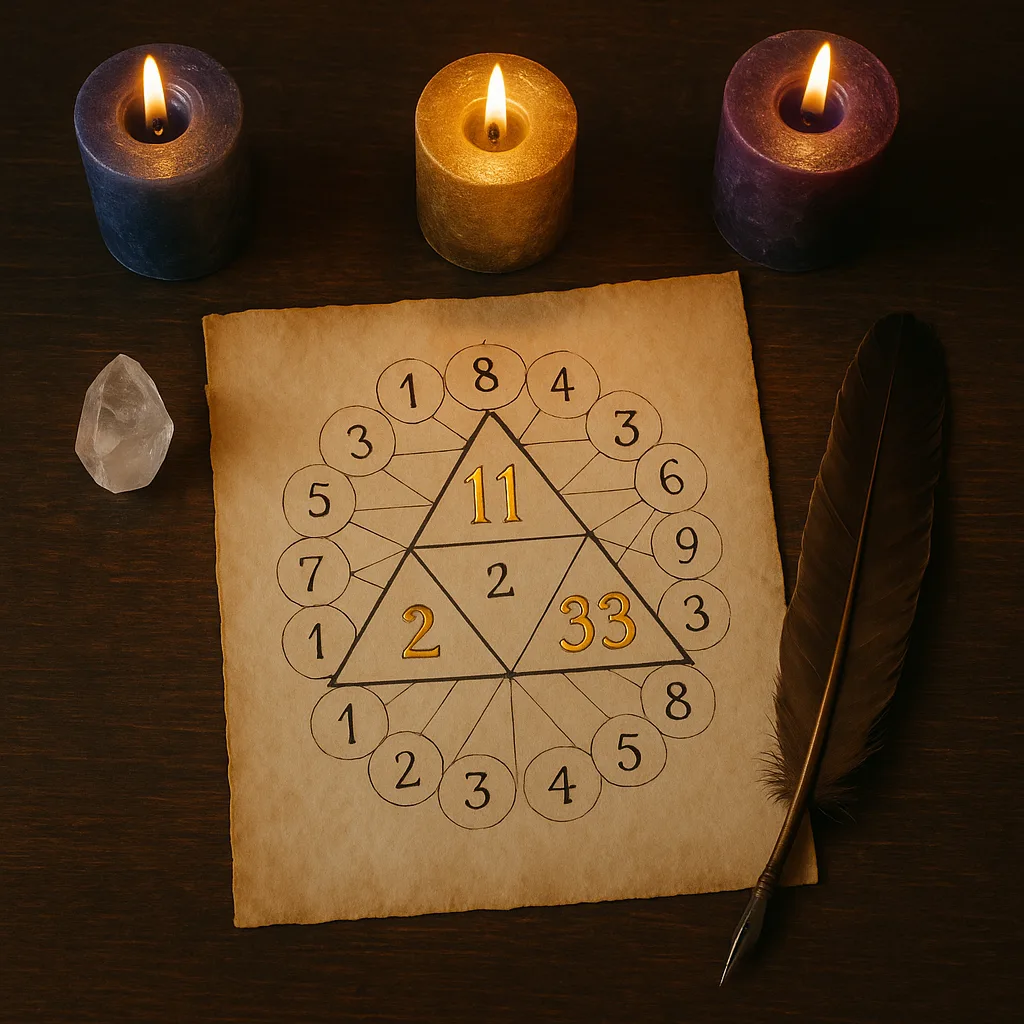
Much of the literature on the subject treats the three master numbers not as separate entities, but as stages of a single process, something like an assembly line. In this reading, 11 sees what does not yet exist. 22 takes that vision and transforms it into something concrete and structured. 33, after the work is built, delivers it to the world, teaching and caring for those who come near it. Vision, construction, and service: this progression is usually called the Triangle of Illumination, and it helps explain why the three numbers almost always appear cited together, as relatives of the same lineage.
| Master number | Root number | Role in the triangle | Predominant energy |
|---|---|---|---|
| 11 | 2 (1+1) | Vision | Intuition, inspiration, sensitivity |
| 22 | 4 (2+2) | Construction | Pragmatism, structure, large-scale projects |
| 33 | 6 (3+3) | Service | Care, teaching, collective compassion |
11: the intuition that sees before everyone else
The 11 carries the energy of 1 in double dose: individuality, initiative, the ability to forge a path alone. With a master number, this force of leadership mixes with uncommon sensitivity. People with 11 prominent in their chart are usually described as those who pick up frequencies most others don't perceive: hunches that prove right, a fine reading of their surroundings, ideas that arrive nearly complete, bypassing conventional logic. It is a number of inspiration, but also of restlessness. Absorbing so much subtle information exhausts, and part of the 11's challenge is learning to distinguish real intuition from mere anxiety.
22: the Master Builder
If the 11 dreams, the 22 builds. Hence the nickname Master Builder: it represents the ability to take a big idea and transform it into something that exists in the physical world, with structure, timeline, and results. It is no coincidence that the 22 typically appears linked to people capable of leading large-scale projects, uniting long-term vision with pragmatism to organize the details. The weight of this vibration, however, is real: holding both the spiritual side of the 2 and the practical ambition of the 4 (2+2) takes a high price, and exhaustion from trying to live up to one's own potential is a common complaint among those who identify with this number.
33: the Master Teacher and their boundless compassion
The 33 is usually described as the rarest and most intense of the three. The 6, its root number, already speaks of responsibility and care, traditionally tied to family and close circles. The 33 expands that sense of duty to an almost impersonal scale: not responsibility for one household, but for all of them. Numerologists who have encountered a genuine 33 in a central position of a chart report something similar: a person who absorbs others' suffering far beyond common sensitivity, as if feeling the weight of the world on a collective scale. It is a number linked to teachers, healers, and figures who dedicate their lives to caring for entire communities, but it is also a number that, without clear boundaries, can lead to emotional exhaustion. This heavier side of the vibration is discussed in more detail in the heavy side of master numbers, when 11, 22, or 33 weighs more than it helps.
Not every tradition agrees that 33 is a master number
It is worth noting before any enthusiasm: the idea that there are exactly three master numbers is not universal. The oldest lineages (Pythagorean, Kabbalistic, and Chaldean) recognized only two, the 11 and the 22. The 33 is a more recent addition to the system, and there are numerologists who, following the older tradition, prefer to read it by its root number, the 6, without treating it as something apart. There are still schools that go in the opposite direction and expand the list, including 44 and higher numbers. In that case, those following formal calculations tend to reduce anyway (44 becomes 4+4=8), treating that repetition as a sign worthy of attention, but not as a master number recognized by most schools. Before becoming attached to any label, it is worth understanding which numerological system is being used as reference.
How to identify a master number in your own chart
In practice, master numbers do not appear in isolation: they emerge during the calculation of any of the chart's core numbers, such as the life path, the expression, or the soul number. See the basic step-by-step for identifying a master number during a calculation:
- Write your complete birth date, separating day, month, and year.
- Add all the digits of the date, one by one, until you reach a result.
- Before reducing that result to a single digit, check whether it is 11, 22, or 33.
- If it is one of these three numbers, stop the addition there: that is the rule that preserves the master number.
- If it is not, continue adding the digits until only one number between 1 and 9 remains.
Someone born on a date whose total sum equals exactly 22, for example, carries that vibration in their life path number, even knowing that the 4 lives behind it. The complete step-by-step for this calculation, including the other numbers that may appear during the sum, is detailed in personal number in numerology: how to calculate your life path. It is also worth remembering that the life path is not the only place where these vibrations can emerge: they appear equally in the expression, soul, and destiny numbers, as shown in the article on where else 11, 22, and 33 can appear in your chart.
Having a master number in your chart is not automatic proof of a grand destiny or a guaranteed burden. It is, above all, an invitation to observe more carefully certain areas of your life where intensity tends to show up: strong intuitions, ambitions that demand structure, or a care for others that goes beyond the reasonable. Recognizing this vibration is the first step. Understanding what to do with it, over the years, is the real work of those who live with a master number.
Frequently asked questions
What is the difference between 11 and the number 2?
The 2 is the root number that sits behind the 11, the result of 1+1. The difference is one of intensity: the 2 speaks of partnership and sensitivity in a quieter tone, while the 11, being a master number, carries that same energy in double dose, along with the force of initiative from the repeated 1.
Does every person with a master number feel this intensity in practice?
Not necessarily. Many numerologists recognize that a master number indicates a potential for greater intensity in certain areas (intuition, ambition, or care for others), but how that vibration actually shows up depends also on the rest of the chart and each person's lived experience.
Why do some numerology schools not recognize 33 as a master number?
Because the oldest traditions, such as Pythagorean, Kabbalistic, and Chaldean, originally worked only with 11 and 22. The inclusion of 33 as a third master number is a more recent addition to the system, and not every numerology line adopts it, preferring instead to reduce 33 to its root number, 6.
What does it mean to have more than one master number in your chart?
It means that the doubled vibration appears in more than one of the core numbers in your numerological chart, for example in your life path and also in your expression number. This is usually read as an even greater intensification of the themes linked to vision, construction, or service, depending on which master number is present.

Recomendado
Mapa Astral Kármico
Você já sentiu que certos padrões se repetem em sua vida? Relacionamentos que seguem o mesmo roteiro, desafios que parecem voltar ou talentos que surgem naturalmente? Nada disso é por acaso.
Universo Astral Editorial Team · Birth charts and numerology
This article was produced by the Universo Astral editorial team, with AI tools assisting research and drafting and human review before publication. If you spot anything inaccurate or outdated, let us know at our contact email.