Jyotish vs. Western Astrology: Why Your Sign Changes in India
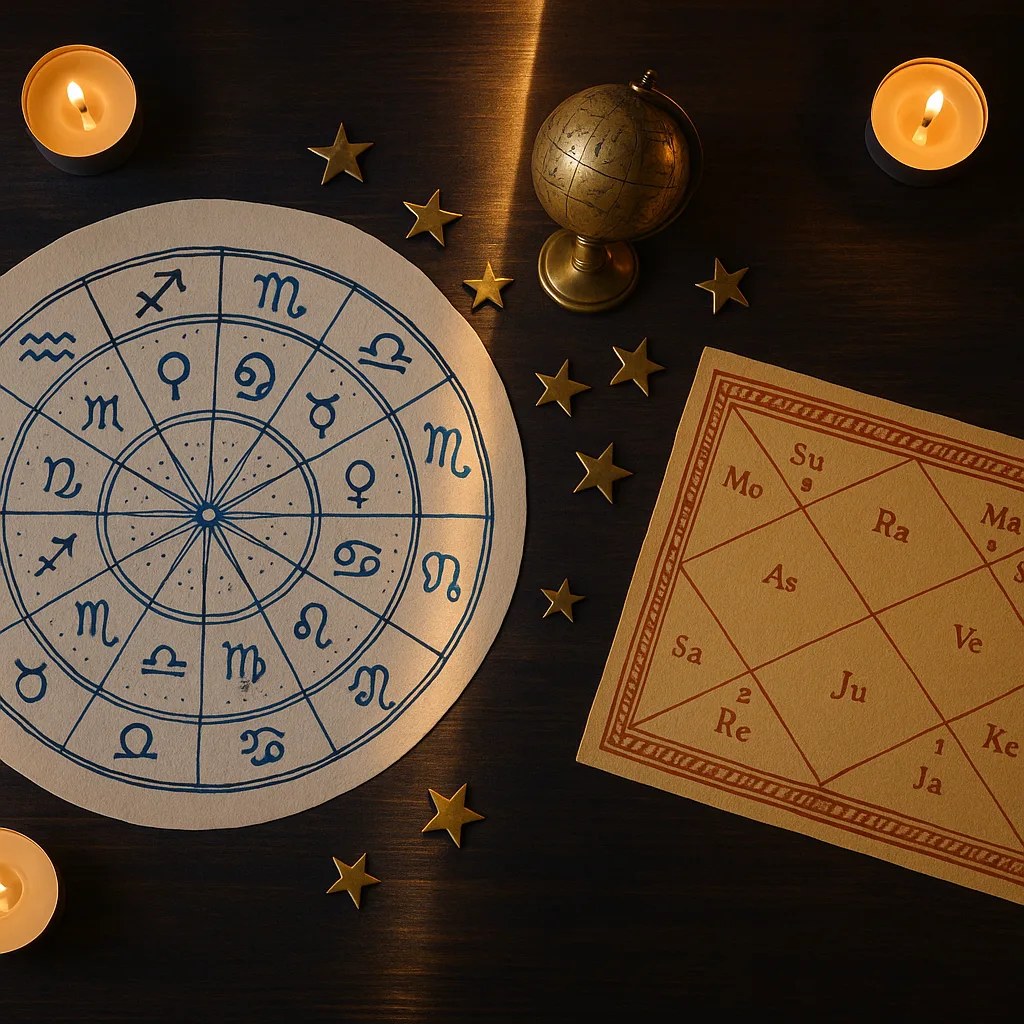
If you were born on April 5, you've probably heard you're an Aries. But show that same date to a traditional Indian astrologer and they'll tell you, without hesitation, that you're a Pisces. It's not a math error or a difference of opinion: these are two complete systems with their own logic and starting points, observing the same sky. One is Western astrology, with Greek and Mesopotamian roots. The other is Jyotish, Indian Vedic astrology, whose Sanskrit name means something like 'science of light': the idea that celestial bodies serve to illuminate the path of those who observe them.
Both traditions span thousands of years. Both arose from the human desire to understand cycles (Moon phases, eclipses, seasonal changes), and neither has the status of empirical science in Western academia. They are elaborate symbolic and cultural constructions, each with its own internal logic. The real difference lies in where each tradition marks the zero point of the zodiac and which celestial body each places at the center of its reading. For those who want to track lunar phases and eclipses concretely, calendars like timeanddate.com publish ephemerides by city, helping you visualize the same astronomical events both traditions use as their starting point, each in its own way.
Tropical vs. Sidereal Zodiac
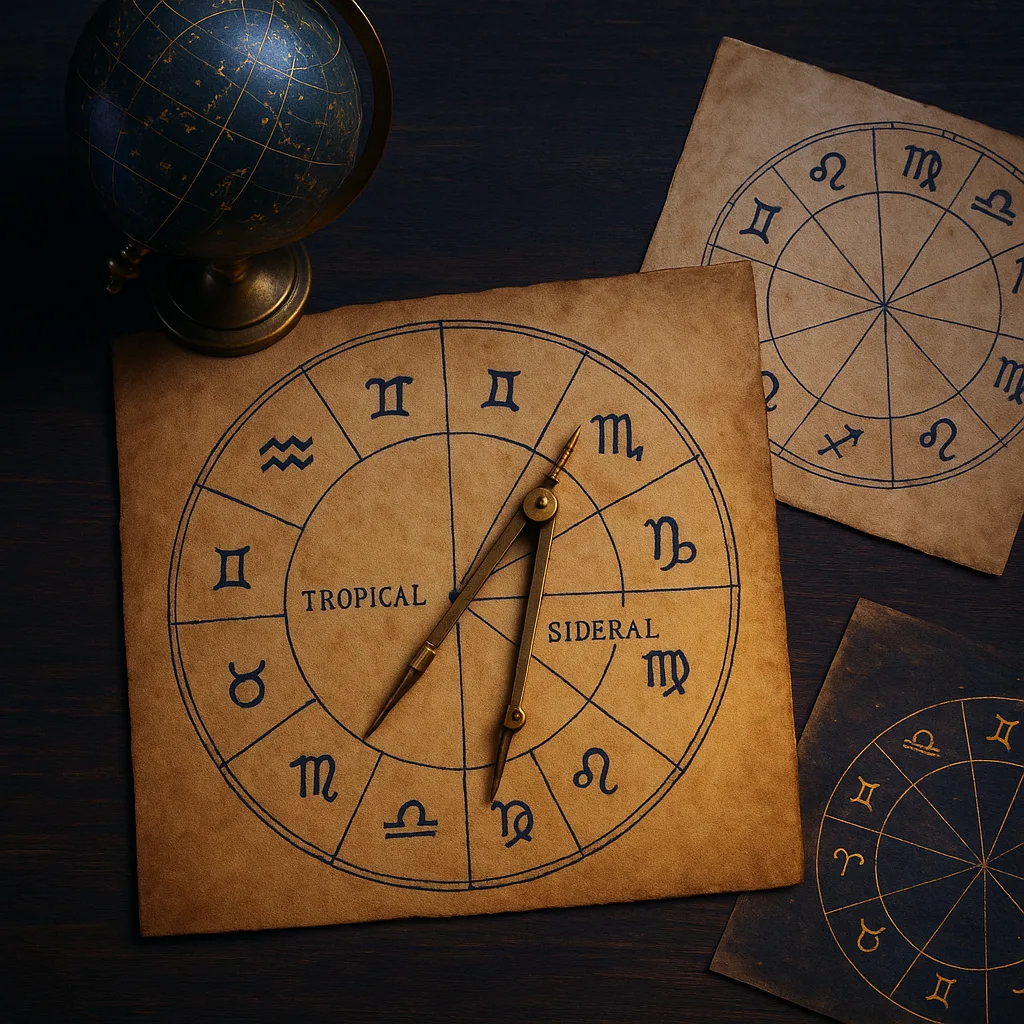
The technical basis of the difference lies in how each system defines the start of Aries. Western astrology uses the tropical zodiac, which fixes 0° of Aries at the spring equinox: the moment the Sun crosses the celestial equator toward the Northern Hemisphere. It's a zodiac tied to the seasons, not to the stars.
Jyotish uses the sidereal zodiac, which fixes 0° of Aries according to the actual position of the stars in that constellation in the sky. Here's the important detail: about two thousand years ago, the two zodiacs practically coincided. But Earth's axis oscillates slowly, a phenomenon called the precession of the equinoxes. The complete rotation takes about 26,000 years and causes the equinox point to shift back roughly 50 seconds of arc per year relative to the fixed stars. Added up over centuries, this displacement has already reached about 24 degrees between the two versions of the zodiac.
This difference, called ayanamsa in Sanskrit, explains why someone born on November 25 is a Sagittarius for the West and a Scorpio for the Vedic tradition. Neither side is wrong: the sidereal system measures actual stellar position, the tropical measures the relationship between Sun and seasons. They are different scales, made for different purposes. The article on ayanamsha in Vedic astrology details this calculation with more examples of dates that change signs between the two systems.
Even Vedic Astrologers Don't Agree on Ayanamsa
There is no consensus even within Jyotish about which ayanamsa value to use. Different schools of calculation exist: Lahiri, the standard adopted by the Indian government and the most widely used; Raman; Krishnamurti, used by a specific branch of prediction; and Fagan/Bradley, more common among Western astrologers who adopted the sidereal technique. Each approach calculates accumulated precession slightly differently, which alters planetary positions between one chart and another, sometimes enough to change a planet's sign near a cusp.
This divergence invalidates neither side: it's a legitimate technical discussion, still active among practitioners, and shows that these traditions remain living, debated and revised by those who have practiced them for generations.
The table below summarizes the points of contrast between the two systems, drawing together what has already been explained throughout the text:
| Aspect | Western Astrology | Jyotish (Vedic) |
|---|---|---|
| Type of zodiac | Tropical (based on seasons) | Sidereal (based on fixed stars) |
| Aries zero point | Spring equinox | Actual position of Aries constellation |
| Accumulated difference (ayanamsa) | , | About 24 degrees relative to tropical |
| Central body in reading | Sun (identity), with Moon and ascendant | Moon (lunar sign), nakshatra, and Lagna |
| Division of sky | 12 signs and angular aspects | 12 signs + 27 nakshatras |
| Historical origin | Ancient Greece and Mesopotamia | Vedas, attributed to the sage Parashara |
Sun or Moon: Who Really Commands the Chart?
In Brazil, when someone asks 'what's your sign?', the answer is almost always the sun sign. Contemporary Western astrology organizes its reading around three points: the Sun represents core identity, the ascendant indicates how you relate to the world, and the Moon expresses emotional life. This is usually the order in casual conversation, even though all three are considered essential in a complete analysis.
In Jyotish, the order flips. The Moon is the center of consciousness, and its sign carries more weight than the solar sign: the Indian equivalent to 'what's your sign?' would probably refer to the Moon, not the Sun. A Vedic chart focuses on three factors: the lunar sign, the nakshatra (the exact lunar mansion in which the Moon was at birth), and the Mahadasha, a sequence of great planetary cycles that succeed each other during a lifetime, each governed by a different planet. The detailed workings of these cycles are described in the article on Vimshottari Dasha, the 120-year planetary calendar used by Vedic astrology.
The starting point of analysis also changes. A Vedic astrologer typically begins with the Lagna, the ascendant calculated at the exact moment of birth, because it organizes the entire chart and defines the distribution of planets in the houses. Modern Western astrology, meanwhile, usually starts with the Sun-Moon-ascendant combination, presenting these three points as the entry point for those beginning to know themselves through the sky.
Nakshatras: The 27 Lunar Stations the West Doesn't Use
One of the most distinctive elements of Jyotish, with no widespread equivalent in current Western astrology, is the nakshatras: 27 mansions or lunar constellations that divide the sidereal sky into sections smaller than the traditional twelve signs. Each nakshatra has its own divinity, symbolism, characteristics, and specific influence over the planet passing through it.
While Western astrology relies mainly on the twelve signs and angular relationships between planets (conjunctions, oppositions, trines, squares), Jyotish adds this extra layer of lunar refinement. It's a finer division of the sky, twelve regions versus 27 micro-regions, which gives Vedic analysis a temporal and psychological precision that the modern Western tradition generally doesn't seek in the same way. Those who want to dive deeper into this topic can find more details in the article on nakshatras, Rahu, and Ketu in Vedic astrology.
Roots Lost in History
The origins of the two traditions are also different. Western astrology developed in Ancient Greece and Mesopotamia, organized by Greek thinkers who transformed Babylonian knowledge into the system we know today. Jyotish has roots in the Vedas, the oldest sacred texts of Indian culture, and is traditionally attributed to the sage Parashara, who according to tradition lived about five thousand years ago. There are records of Vedic astrology being used to track planetary cycles, lunar phases, and eclipses, and to determine auspicious dates for ceremonies, dating back at least 1,200 years before the common era.
These are two different civilizations trying to answer the same ancient question (what does the sky reveal about life on Earth), each building its own symbolic repertoire over the centuries. Those interested in the comparative origins of different peoples who read the sky can check the article on the origin of astrology and the peoples who first read the sky.
Two Lenses, Neither More Correct Than the Other
There's no point in calling one system the 'true' one. The tropical zodiac speaks more directly to psychological self and personal development within this lifetime, which is why it feels so natural when someone defines their personality by their sun sign. The sidereal, tied to fixed stars, tends to reveal karmic patterns and a sense of purpose that spans longer cycles, as the Vedic Mahadashas themselves indicate.
Comparing Jyotish and Western astrology is not about determining who is right, but about recognizing that there are at least two valid languages for interpreting the same sky.
Those interested in both systems need not choose one definitively. Many people consult the tropical chart to understand everyday psychology and also turn to the sidereal chart, with its nakshatra and Lagna, to grasp broader rhythms of their own journey. Tropical and sidereal are two different angles for observing the same celestial vault, and each has something genuine to offer to those seeking meaning by looking up.
Frequently Asked Questions
Why does my sign change when calculated by Vedic astrology?
Because Jyotish uses the sidereal zodiac, based on the actual position of the stars, while Western astrology uses the tropical zodiac, based on the seasons. Over the centuries, the precession of the equinoxes has caused these two starting points to drift about 24 degrees apart, which typically shifts the sun sign by an entire house.
Which astrological system is correct, Vedic or Western?
Neither is wrong. They are two different lenses on the same sky: tropical measures the relationship between the Sun and the seasons, sidereal measures actual stellar position. Each was built with its own aims and logic over millennia.
What is ayanamsa in Vedic astrology?
It is the name given to the angular difference between the tropical and sidereal zodiacs, currently around 24 degrees. There are several schools of calculating this value, such as Lahiri, Raman, Krishnamurti, and Fagan/Bradley, and each can generate slightly different planetary positions.
Why does Jyotish place so much importance on the lunar sign?
Because in the Vedic tradition, the Moon represents the center of consciousness and mind, while in Western astrology that central role typically belongs to the Sun. That's why a Vedic chart looks first at the lunar sign, the nakshatra, and the Lagna, rather than starting from the solar sign.
What are nakshatras and why doesn't Western astrology use them?
Nakshatras are 27 lunar mansions that divide the sidereal zodiac into fractions smaller than the twelve signs, each with its own symbolism and divinity. Western astrology never developed a widespread equivalent system, preferring to work with the twelve signs and angular aspects between planets.

Recomendado
Manual Prático da Astrologia
O universo sempre exerceu um fascínio indescritível sobre a humanidade. De todas as suas maravilhas, a astrologia se destaca como uma antiga arte que tem intrigado e inspirado gerações.
Universo Astral Editorial Team · Zodiac signs and fun facts
This article was produced by the Universo Astral editorial team, with AI tools assisting research and drafting and human review before publication. If you spot anything inaccurate or outdated, let us know at our contact email.