Fire, Earth, Air, and Water: The Logic Behind Astrology's Elements
A system older than the planets
Before astrology calculated transits, aspects, or houses, it organized the sky in a simpler way: dividing the twelve signs into four groups of matter. The idea didn't originate within astrology. It came from Greek natural philosophy, especially Empedocles, and was later discussed by Plato and Aristotle as an attempt to explain what physical matter is made of. The Stoics applied this framework to the human body and soul, and centuries later Ptolemy, in the Tetrabiblos, brought this logic into astrology as we know it today. Fire, Earth, Air, and Water are the oldest foundation of the zodiac, long before any discussion of retrograde Mercury or astrological houses.
Chinese astrology and Feng Shui work with similar logic, but they use five elements: Wood, Fire, Earth, Metal, and Water. This shows that the need to organize the world into essential blocks crosses different civilizations, each with its own symbolic mathematics. It's worth noting that the twelve signs of the Western zodiac don't correspond to officially recognized astronomical constellations: the International Astronomical Union catalogs 88 constellations with formally defined boundaries and names, a sky reference system different from the four-element symbolic division used by astrology.
The order in the zodiac is not random
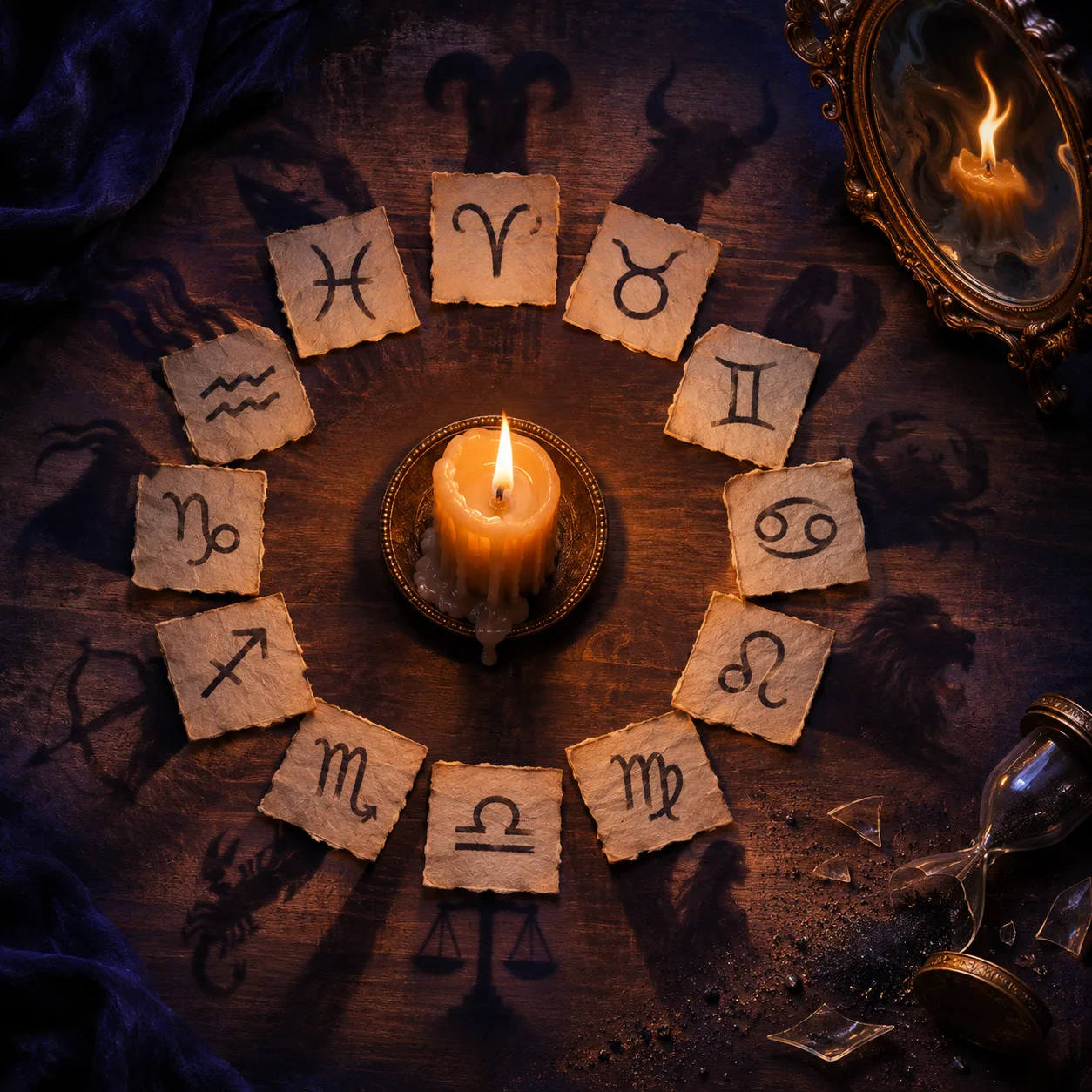
Looking at the zodiacal wheel from beginning to end, the elements repeat in a fixed sequence: Fire, Earth, Air, Water, and Fire again, restarting the cycle in Aries. This sequence tells a small story about how anything is born and transforms. Fire (Aries) represents the spark, the initial impulse. Earth (Taurus) comes right after to give form and body to that impulse, materializing what was once only will. Air (Gemini) spreads that form into the world of ideas and exchange. And Water (Cancer) closes the initial trio by dissolving everything into feeling, absorbing the experience before the cycle begins again with new Fire in Leo. This complete journey, from initial impulse to emotional dissolution, is discussed in more detail in From Spirit to Dissolution: the secret journey of the four elements through the zodiac.
This pattern repeats three times around the zodiac. That's why the elements are also called, in classical language, triplicities: each brings together three signs positioned exactly one hundred twenty degrees apart, forming a triangle on the wheel.
Yin and yang: the polarity that few mention
One point that often gets left out of more basic explanations: the elements don't form just four loose groups, but two families of energy. Fire and Air are considered active or yang elements, energies that move outward, that initiate contact with the world and react before thinking twice. Earth and Water are receptive or yin: they absorb, process internally, and only then respond.
This polarity explains things that a simple list of characteristics doesn't solve. An Aries (Fire) and an Aquarius (Air) may seem opposite at first glance, one intense and impulsive, the other distant and mental, but both share the same outward orientation, the same discomfort with passivity. Similarly, a Cancer (Water) and a Virgo (Earth) often understand each other in silence, without needing to perform anything, because both process life from the inside out before acting. This combination of Earth and Water, by the way, appears frequently among pairs of signs considered most stable, as shown in the article about Taurus and Cancer, Capricorn and Scorpio, Virgo and Pisces: the most enduring sign pairs in astrology.
Why trines are the most peaceful aspect in the sky
When three signs share the same element, like Aries, Leo, and Sagittarius in Fire, the exact one hundred twenty degree distance between them forms what astrology calls a trine, considered the most harmonious aspect of all. It's no coincidence that people with sun, moon, or rising sign in this trio often recognize each other quickly: they speak, in essence, the same emotional language, even with very different personalities among themselves.
That's why it's said that elements reveal what a sign is made of, while modalities (cardinal, fixed, and mutable) reveal how it acts in the world. Aries and Sagittarius are both Fire, but one is cardinal (initiates) and the other is mutable (adapts). Understanding this combination of two layers is what gives real nuance to a chart reading, instead of reducing everything to generalizations. The reason Aries, Leo, and Sagittarius have such distinct personalities despite the same element is detailed in Fire, Earth, Air, and Water: why signs of the same element have such different personalities, and the modality layer is explained in Cardinal, Fixed, or Mutable: the compatibility layer most people overlook between two signs.
What each element carries and where it stumbles
Fire (Aries, Leo, Sagittarius) is the element of passion and initiative: it acts first, evaluates later, and has a rare ability to genuinely feel enthusiastic about being alive. In excess, that same urgency becomes chronic impatience and difficulty waiting for any slower process.
Earth (Taurus, Virgo, Capricorn) brings its feet to the ground, patience, and self-discipline. It's the element that knows how to build something lasting, supported by the five senses and the material world. The shadow side appears as excessive attachment to security: little openness to the new, rigid conservatism, difficulty letting go of control.
Air (Gemini, Libra, Aquarius) governs intellect, communication, and the exchange of ideas. It's the element that needs to circulate, converse, connect dots. In excess, it generates real emotional distance, a tendency to intellectualize everything to avoid truly feeling.
Water (Cancer, Scorpio, Pisces) rules the emotional world in all its breadth: joy, boredom, ecstasy, melancholy, everything belongs to this territory. The challenge of Water is never to feel less, but to learn to regulate what it feels without letting emotion completely dominate the response. To feel fully and still act with intention.
The table below summarizes these characteristics along with the polarity of each group:
| Element | Signs | Polarity | Strength | Challenge |
|---|---|---|---|---|
| Fire | Aries, Leo, Sagittarius | Active (yang) | Passion and initiative | Impatience |
| Earth | Taurus, Virgo, Capricorn | Receptive (yin) | Patience and discipline | Attachment to control |
| Air | Gemini, Libra, Aquarius | Active (yang) | Intellect and communication | Emotional distance |
| Water | Cancer, Scorpio, Pisces | Receptive (yin) | Emotional depth | Difficulty regulating feeling |
The connection between these four elements and the four classical temperaments of ancient medicine, choleric, sanguine, phlegmatic, and melancholic, has its direct origin in this same Greek tradition, as shown in the article about the four temperaments hidden in astrological elements.
How to look at this in your own chart
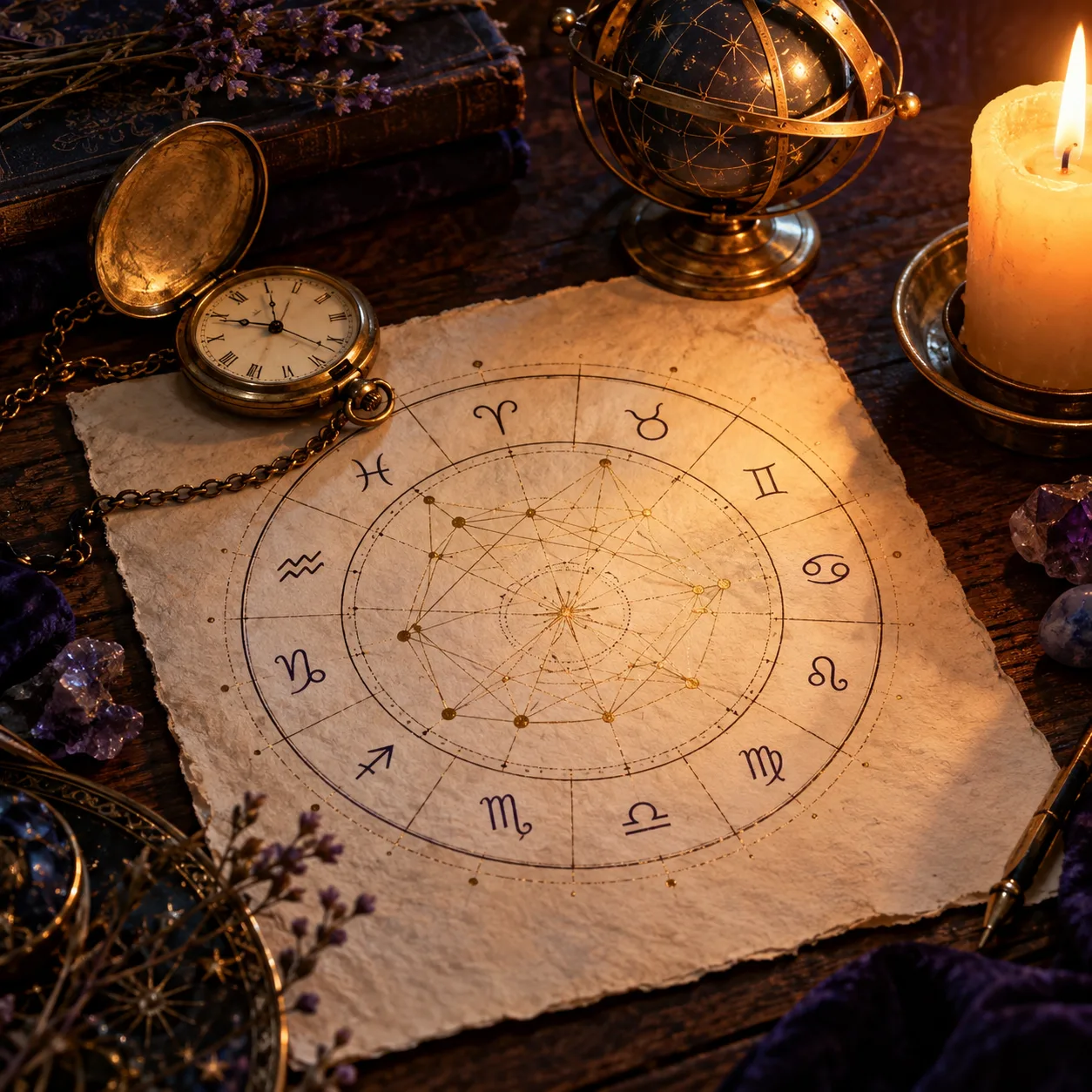
No person can be reduced to a single element, not even to the element of their own sun sign. What matters is observing how the planets in the complete chart, including Moon and Ascendant, are distributed among the four groups. When an element appears repeatedly, it usually points to a natural strength, an almost automatic talent. When an element is barely present or absent, it doesn't signal a flaw: it simply indicates an area that probably requires more conscious effort and learning, rather than coming ready-made.
To do this reading in practice, a simple path is to follow these steps:
- List all planets in your birth chart (Sun, Moon, Mercury, Venus, Mars, Jupiter, Saturn and, if the complete chart is available, Uranus, Neptune, and Pluto), along with the Ascendant.
- Note the element of the sign each is positioned in: Fire, Earth, Air, or Water.
- Count how many planets fall in each element. An element with three or more planets usually indicates a dominant strength in temperament.
- Notice if any element appears zero or only once. That's the weakest element in your chart, not a flaw, but territory that asks for more conscious practice.
- Cross the result with polarity: lots of Fire and Air without Earth or Water, for example, tends to indicate someone more turned outward than inward.
Looking at the chart through this elemental lens, crossing active with receptive, Fire with Water, Earth with Air, usually reveals behavior patterns more real than any isolated reading of the sun sign, because it shows not just who the person is, but how the different parts of them talk, or fight, with each other. Anyone who wants to dig deeper into how to fill the gap of a missing element can check The element missing from your birth chart: how to discover and compensate for what you don't have.
Frequently asked questions
What is the origin of the four elements in astrology?
The four elements come from Greek natural philosophy, especially Empedocles, with later discussions by Plato and Aristotle about what matter is made of. The Stoics applied this idea to the body and soul, and Ptolemy, in the Tetrabiblos, incorporated this framework into astrology as it is practiced today.
What is the difference between element and modality of a sign?
The element (Fire, Earth, Air, or Water) shows what a sign is made of, its essential energy. The modality (cardinal, fixed, or mutable) shows how that energy expresses itself in the world, whether it initiates, sustains, or adapts. Aries and Sagittarius share the Fire element, but have different modalities, which explains real differences in behavior between them.
What does it mean for an element to be absent from a birth chart?
When no important planet falls in signs of one element, it indicates that that area, whether action (Fire), structure (Earth), communication (Air), or emotion (Water), doesn't come as an automatic talent and tends to ask for more conscious effort to develop over a lifetime.
Why do signs of the same element usually match well together?
Signs of the same element form a trine between them, with exactly one hundred twenty degrees of distance on the zodiacal wheel, considered the most harmonious aspect in astrology. This makes them share a kind of common emotional language, even though they have different personalities because of their modality.
Recomendado
Astro Reflexo
Descubra o que os astros revelam sobre quem você é. Em menos de um minuto, calculamos seu Sol, Lua e Ascendente com precisão astronômica e uma inteligência artificial escreve um resumo personalizado só para você.
Universo Astral Editorial Team · Zodiac signs and fun facts
This article was produced by the Universo Astral editorial team, with AI tools assisting research and drafting and human review before publication. If you spot anything inaccurate or outdated, let us know at our contact email.