Your Birth Chart as a Mirror: Using Astrology for Self-Discovery
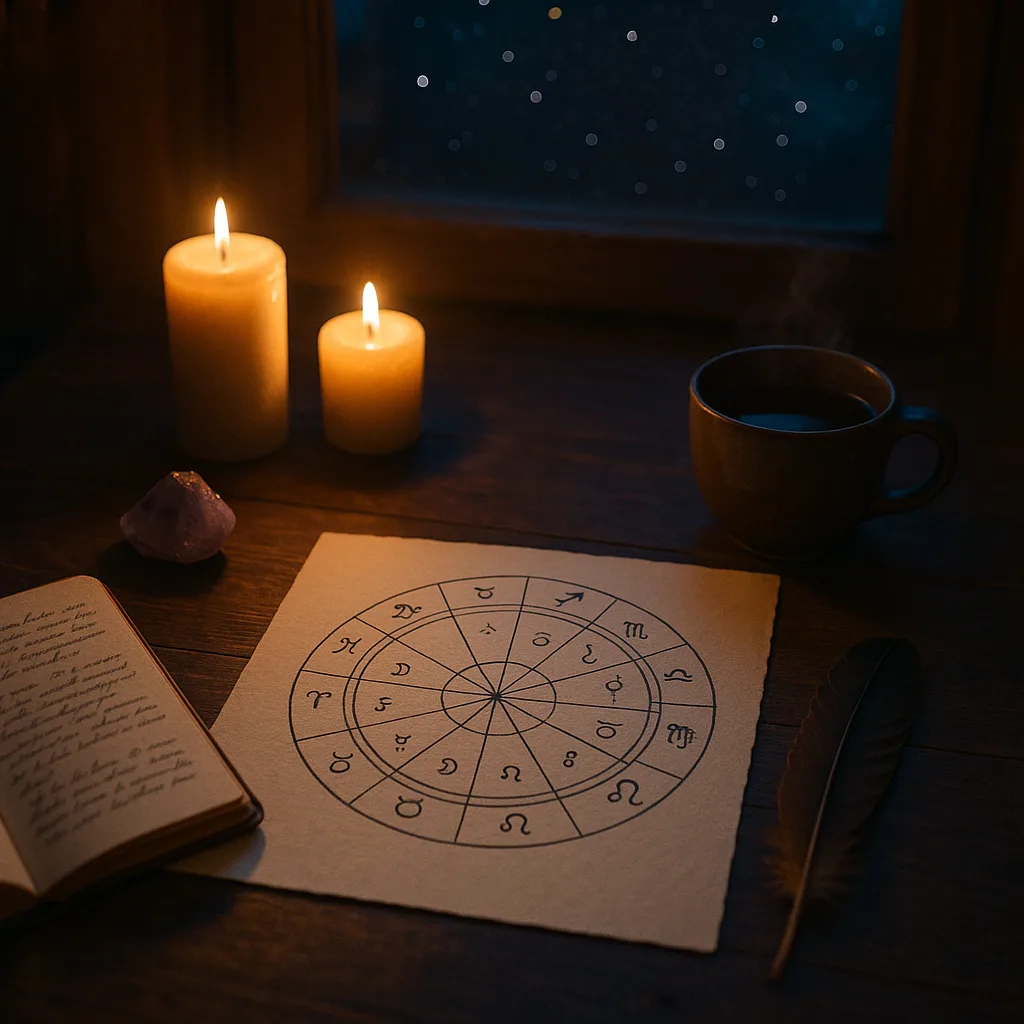
The Sky as a Mirror, Not an Oracle
Many people turn to astrology looking for a direct answer: Will I get married? Will I become wealthy? Is today the day my luck changes? That impulse makes sense. We live surrounded by uncertainty, and the sky, with its promise of order and meaning, seems like a reasonable place to look. But anyone who spends real time with astrology eventually realizes its value doesn't come from prediction. It comes from revealing what's already there. A birth chart works less like a crystal ball and more like a well-placed mirror, reflecting patterns, tendencies, and issues that may have existed all along, just unnamed.
This shift, from oracle to mirror, is what turns astrology into a genuine tool for self-knowledge. The question isn't what will happen, but how you tend to react to what happens: what your emotional patterns are, where your drive to act comes from, where you tend to hide. It's an invitation to listen inward, not a reading of some sealed fate.
From Fortune-Telling to Symbolic Psychology
Astrology emerged thousands of years ago, tied to observation of the sky and attempts to understand the fate of peoples and kingdoms. Over the course of the 20th century, though, it underwent a significant shift. Writers such as Liz Greene, Stephen Arroyo, and Robert Hand helped build a more psychological approach to the birth chart, connecting astrological symbols to concepts like the shadow, archetypes, and individuation. Under this approach, the chart stops being a fixed script of events and becomes a symbolic map of potential: emotional tendencies, ways of coping with challenges, patterns that repeat until they're understood.
Astrology is not a science and it doesn't replace the work of a mental health professional. What it offers is complementary: a symbolic language that can name diffuse feelings and give shape to things a person already senses but can't yet explain. People often describe the moment they first read their chart as an “oh, that's what this is” moment, not because astrology invented something new, but because it gave form to something already being lived internally.
The Chart Doesn't Change, But You Do: The Role of Transits
One of the most useful aspects of studying your birth chart is understanding that it's fixed. The exact position of the planets at the moment of your birth never changes. Life, though, keeps moving, and that's where transits come in: the ongoing dialogue between the sky right now and the sky at your birth, which activates different areas of your chart over the years.
2026, for instance, is a particularly good year for astrological introspection. Saturn continues its steady march through Aries, a sign tied to courage, action, and building one's own identity, drawing attention to how each person takes on responsibility and builds their life projects. When a planet like Saturn goes retrograde, astrology tends to read this as an invitation to look inward. It's not the time to push everything forward at any cost, but rather to revisit structures, correct course, and strengthen foundations before moving on.
Neptune, retrograde from July to December, also in Aries, tends to be read as a call to filter dreams and ideals through reality: courage to act without illusions. Pluto retrograde, active between May and October, often symbolizes processes of symbolic death and rebirth, a call to release patterns of control, fear, or attachment to something that has already lost its meaning. Worth remembering: technically, no planet actually moves backward. It's an optical effect caused by the difference in speed between Earth and the planet being observed. Symbolically, though, astrology uses this illusion to describe moments when that planet's energy turns inward, calling for pause and reflection rather than impulsive forward motion.
Reading transits isn't about memorizing dates. It's about noticing that the sky, at certain times, seems to whisper “now is the time to look within,” and it's up to each of us to decide what to do with that invitation.
Turning Your Chart Into a Practice, Not a One-Time Reading
A common mistake among people new to astrology is treating the birth chart as something you read once and file away. Its greatest potential for self-knowledge emerges when it becomes an ongoing practice, a reference point you return to at different stages of life, always with new questions. Here are a few simple ways to do that:
- Revisit your chart during turning points. Job changes, breakups, moving to a new city: these are good moments to see which houses and planets are being activated by that period's transits.
- Track patterns, not predictions. Instead of asking what's going to happen, ask what emotional pattern keeps repeating whenever this theme shows up in your life.
- Use the Moon to understand your reactions. Your Moon placement speaks to how you process emotions and relate to comfort and security, a good starting point for self-reflection on hard days.
- Look at your Ascendant as a social mask. It shows how you present yourself to the world, which can reveal gaps between who you are inside and how others perceive you.
- Keep a small astrological journal. Writing down how you felt during a New Moon, a retrograde, or your solar return helps you notice your own emotional cycles over time, without relying on outside interpretations.
This kind of practice brings astrology closer to a therapeutic journal. It's not about finding one absolute truth, but about creating a regular space for listening, where the symbols of the sky serve as a starting point for deeper questions about yourself.
The Limits and the Value of This Tool
Astrology doesn't replace psychological counseling, medical care, or any other form of professional mental health support. It carries no obligation to diagnose or heal. Its value lies in offering a symbolic language that helps organize feelings, name phases of life, and reflect on choices. Used with that understanding, it becomes a gentle ally: a recurring invitation to pause, listen, and ask what this moment is trying to show you.
That may be the real value a birth chart offers to those who study it with care: not certainty about the future, but symbolic company for moving through the present with more awareness. Every transit, every planetary return, every New or Full Moon is another chance to return to your own symbols and ask, with curiosity, who you're becoming.

Recomendado
MAPA ASTRAL E NUMEROLÓGICO PERSONALIZADO
Mapa Astral + Numerologia Um mergulho profundo na sua essência. E se tudo o que você procura… já estivesse dentro de você - esperando para ser revelado?

Recomendado
Mapa Astral Kármico
Você já sentiu que certos padrões se repetem em sua vida? Relacionamentos que seguem o mesmo roteiro, desafios que parecem voltar ou talentos que surgem naturalmente? Nada disso é por acaso.
Recomendado
Astro Reflexo
Descubra o que os astros revelam sobre quem você é. Em menos de um minuto, calculamos seu Sol, Lua e Ascendente com precisão astronômica e uma inteligência artificial escreve um resumo personalizado só para você.
Universo Astral Editorial Team · Birth charts and numerology
This article was produced by the Universo Astral editorial team, with AI tools assisting research and drafting and human review before publication. If you spot anything inaccurate or outdated, let us know at our contact email.