Birth Chart at Work: Using Astrological Self-Knowledge for Career Decisions
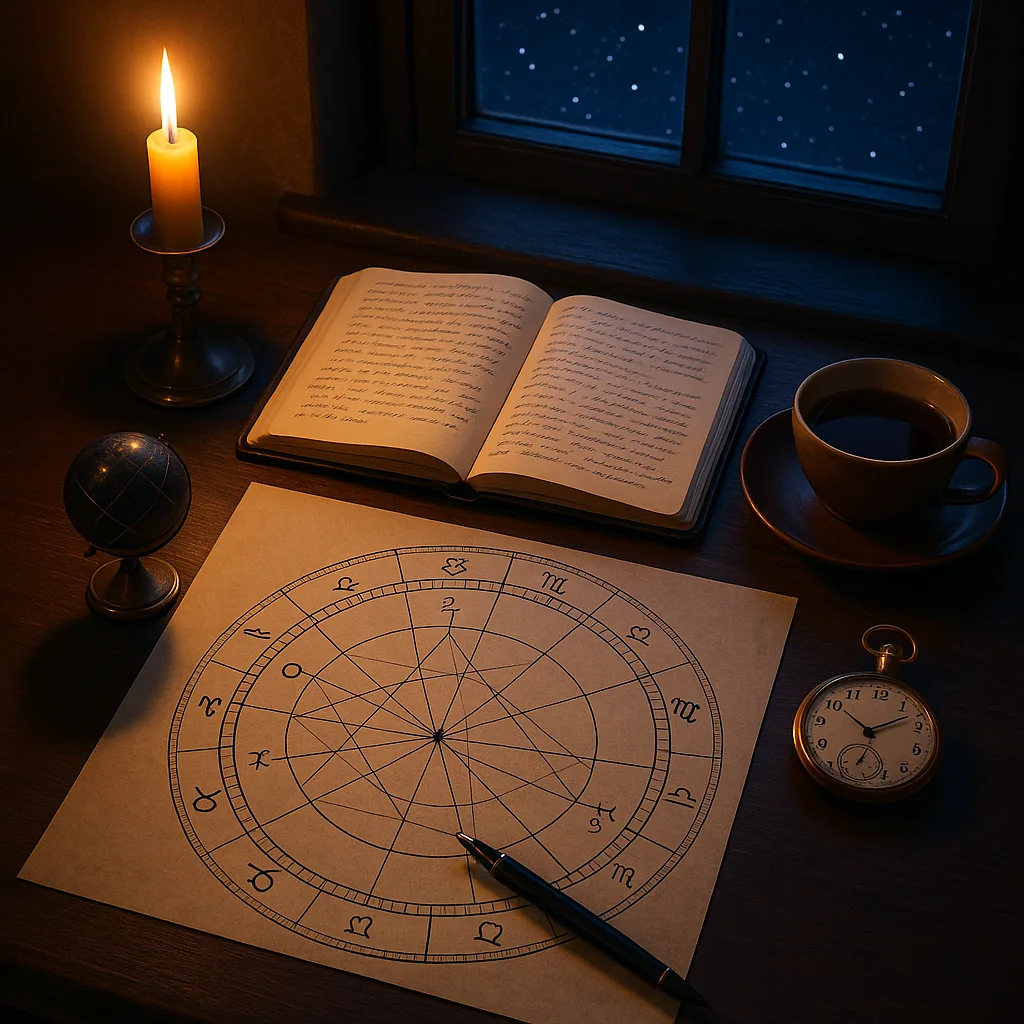
Someone who changes jobs, takes on a team for the first time, or decides to start a business rarely thinks about checking their own birth chart first. But there is a use of astrology that skips the generic horoscope cliché and aims exactly at that: understanding how you function before making decisions that affect your routine, your money and your professional identity.
This use has nothing mystical about it in the sense of predicting whether you will get a promotion in March. It starts from a simpler idea: the birth chart describes behavioral tendencies, and behavior repeats itself at work just as much as in any other area of life.
A portrait, not a fixed script
A birth chart comes from a precise calculation: your date, time and place of birth determine the sign and astrological house each planet occupied at that exact moment. The result is a kind of snapshot of the sky, divided into twelve houses that represent distinct areas of human experience, from self-image to finances, from relationships to spirituality.
This is quite different from the horoscope you find in a newspaper or app, which only works with your sun sign and can therefore only speak in broad terms, valid for anyone born in that period of the year. An individual chart goes into a whole other level of detail, because it takes into account the position of every planet, the houses they fall into, and the aspects they form with one another. Two people with the same sun sign can have radically different charts, which is why a serious reading avoids easy generalizations when the topic is career or teamwork.
The bridge with psychology: naming what you already feel
There is a branch of astrology known as psychological astrology, which draws on the archetypes described by Swiss psychologist Carl Jung. In this approach, the chart is no longer read as a fixed destiny but works as a symbolic language for decoding internal patterns, including the ones that show up repeatedly at work: trouble saying no to a boss, the impulse to take everything on alone, resistance to changing roles even when unhappy.
Its main role is putting a name to experiences that often feel scattered or confusing. When someone looks at their own chart and notices a tendency to repeat a certain behavior pattern under pressure, that alone does not solve the problem, but it helps bring clarity to something that was previously vague.
What Sun, Moon and Rising Sign say about how you work
Rather than repeating what is already known about each of these three points in isolation, it is worth thinking about how they combine when it comes to acting professionally. The Sun points to core identity and vital energy, the thing that gives meaning to career choices when it is aligned. The Moon shows how someone handles their own emotions under pressure, including stress, deadlines and team conflicts. The Rising Sign has to do with how others perceive that person right away, which directly shapes first impressions in interviews, meetings and negotiations.
When these three elements pull in different directions, it is common to feel a kind of mismatch between what you want internally, how you react under pressure, and how you come across externally. Recognizing this pattern helps explain why certain work situations always seem to produce the same kind of discomfort, even in different jobs.
Houses and aspects: where the energy shows up day to day
The twelve astrological houses indicate which area of life each planetary energy tends to express itself most strongly. Planets clustered in houses tied to work, resources or communication tend to signal where a person naturally puts more attention and effort, even if not always consciously.
Aspects, the angles formed between planets, show whether that energy tends to flow easily or needs more attention and adjustment. Someone can have great leadership indicators in their chart and still face real difficulties, because tenser aspects require conscious effort to translate into practical results. This pushes back on the idea that well-placed planets guarantee automatic success in any area, including work.
The limits of this tool
Astrology carries an old stigma of being mistaken for fortune-telling or treated as an exact science, which is not what it claims to be. It also does not replace therapy when the issue is emotional health related to work, such as burnout, anxiety or deeper conflicts. What it offers is an extra symbolic layer, useful as a complement to other personal development practices, not a substitute for them.
A real risk, especially in a professional setting, is using the chart to put coworkers into fixed boxes: “so-and-so is that sign, that is why they act that way.” That oversimplifies a system that is, by nature, full of layers. There are no bad signs and no profiles doomed to professional failure. What exists are different levels of maturity in each person, and someone immature, whatever their sign, can create friction on any team, just as someone who is aware of their own tendencies, whatever their sign, tends to handle their own challenges better.
How to apply this without turning it into a formula
The most useful way to read a chart for career decisions is not to look for ready-made answers like “should I accept this offer or not.” The value lies in spotting patterns: a productive rhythm that might not suit rigid routines, a tendency to take on too much responsibility before learning to delegate, a specific communication issue that keeps showing up in performance reviews.
Major turning points, like moving to a new city for a job or closing one professional chapter to start another, tend to be the moments when this kind of analysis makes the most sense. Not because the chart will point to the right path, but because looking at your own tendencies more clearly tends to make choices feel less automatic and more deliberate.
It is worth remembering that the chart itself does not change over a lifetime, but transits, the ongoing movement of the planets relative to your original birth positions, keep activating different energies at different stages. That is why the same trait can weigh more heavily in one year and less in another, which explains why certain periods feel more suited to career changes than others.
In the end, using the birth chart in a work context is less about predicting an external outcome and more about switching off autopilot in your own reactions. Someone who understands their behavior patterns under pressure, their communication style, and what actually drives their choices tends to make career decisions that feel more aligned with who they are, regardless of what any prediction says about the future.

Recomendado
MAPA ASTRAL E NUMEROLÓGICO PERSONALIZADO
Mapa Astral + Numerologia Um mergulho profundo na sua essência. E se tudo o que você procura… já estivesse dentro de você - esperando para ser revelado?

Recomendado
Astro Reflexo
Descubra o que os astros revelam sobre quem você é. Em menos de um minuto, calculamos seu Sol, Lua e Ascendente com precisão astronômica e uma inteligência artificial escreve um resumo personalizado só para você.

Recomendado
Curso MAPA ASTRAL
CURSO DESTRAVE SUA VIDA COM MAPA ASTRAL EM ATÉ 08 SEMANAS!
Universo Astral Editorial Team · Birth charts and numerology
This article was produced by the Universo Astral editorial team, with AI tools assisting research and drafting and human review before publication. If you spot anything inaccurate or outdated, let us know at our contact email.