Which Tarot Court Card Matches Your Zodiac Sign?
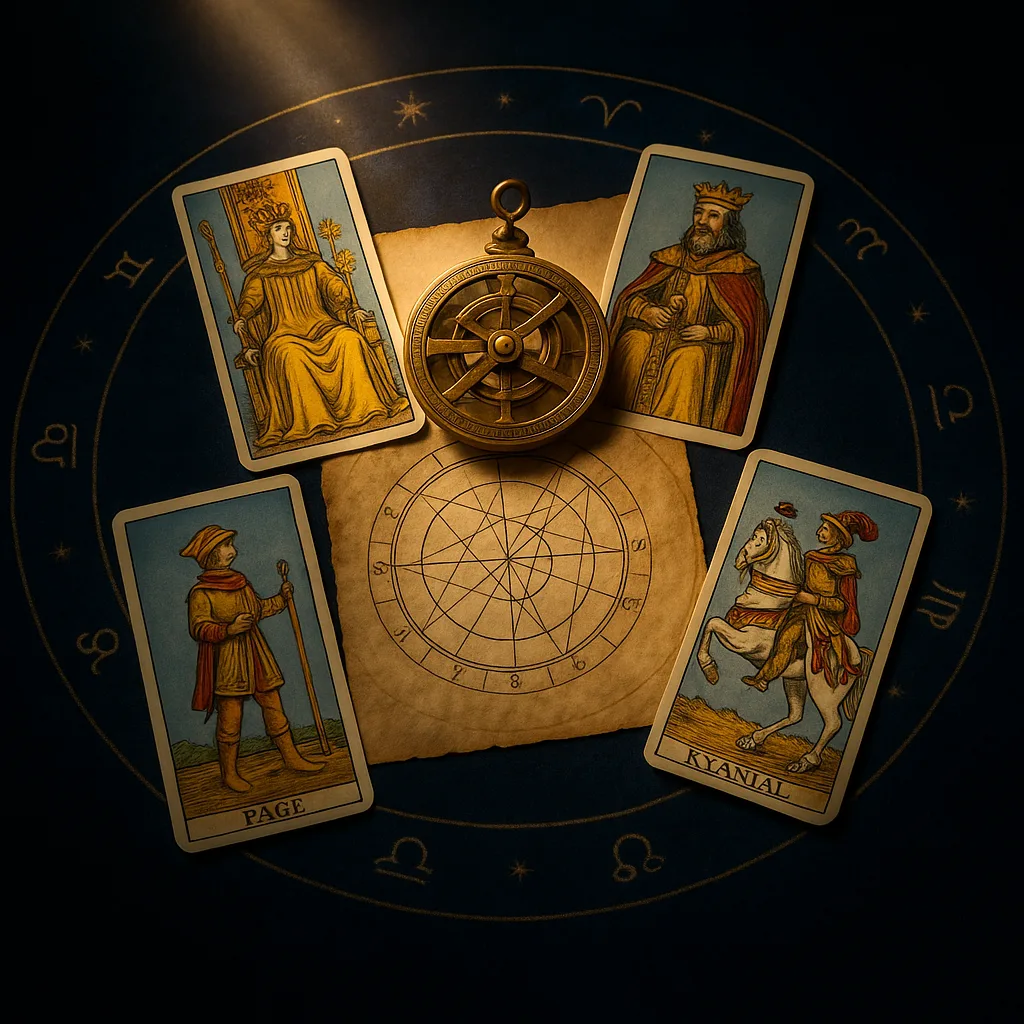
Two symbolic languages, one alphabet
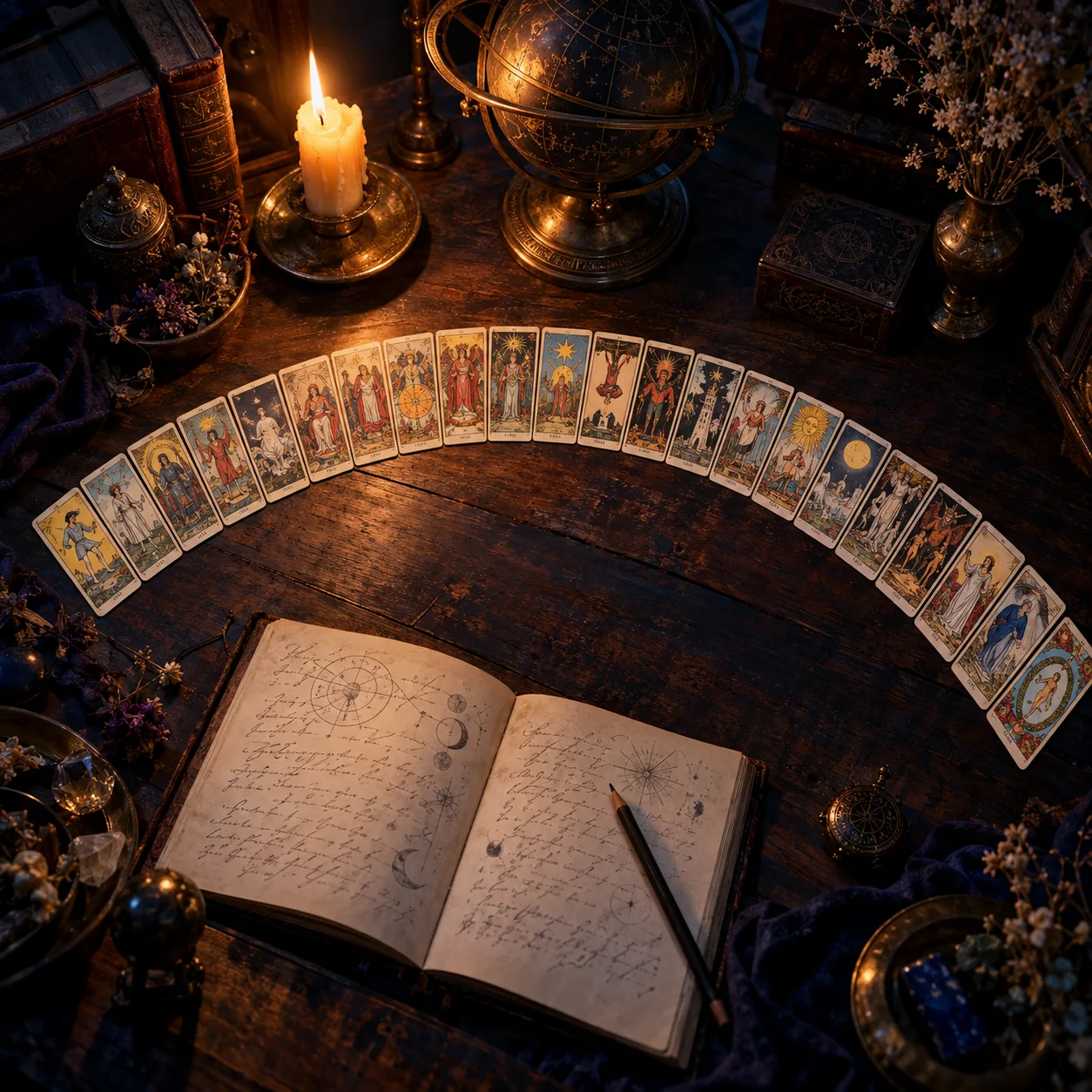
Anyone who has studied tarot for a while notices that the deck constantly converses with astrology. The Major Arcana have planets and signs associated with each card, and the four suits of the Minor Arcana correspond directly to the four elements that also organize the zodiac: Wands is fire, Cups is water, Swords is air, and Pentacles is earth. Fewer people know that this connection goes beyond the suit itself. In the hermetic tradition that shaped modern tarot, each of the sixteen court cards was also assigned a specific sign. This opens a practical question: which court card is your sign?
This matters to anyone already reading their own birth chart and wanting to use that knowledge as a shortcut for remembering and feeling the court cards, rather than memorizing them in isolation. It is also useful for readers working with others: knowing your client's sign, or that of someone important in their life, makes it easier to recognize which court figure might be portraying that person in a spread. Before diving into the correspondences, it helps to understand what each court position (Page, Knight, Queen, and King) already means on its own, as explained in the article on what each tarot court position represents.
The correspondences, suit by suit
Following the attribution established by the Hermetic Order of the Golden Dawn, the same esoteric school that directly influenced Arthur Edward Waite, each court card carries a predominant sign within its element. The table below brings together the twelve combinations, organized by suit and element:
| Card | Suit (element) | Sign | Central trait |
|---|---|---|---|
| Queen of Wands | Wands (fire) | Aries | Initiative and the drive to start everything now |
| King of Wands | Wands (fire) | Leo | Magnetic leadership and pleasure in being recognized |
| Knight of Wands | Wands (fire) | Sagittarius | Hunger for broad horizons and aversion to routine |
| Queen of Cups | Cups (water) | Cancer | Nurturing warmth and instinct to protect loved ones |
| King of Cups | Cups (water) | Scorpio | Contained intensity and absolute loyalty |
| Knight of Cups | Cups (water) | Pisces | Romanticism and artistic sensitivity |
| Queen of Swords | Swords (air) | Libra | Sense of justice and diplomacy |
| King of Swords | Swords (air) | Aquarius | Rationality and intellectual independence |
| Knight of Swords | Swords (air) | Gemini | Quick thinking and curiosity |
| Queen of Pentacles | Pentacles (earth) | Taurus | Steadiness and skill at managing the concrete |
| King of Pentacles | Pentacles (earth) | Capricorn | Discipline and long-term ambition |
| Knight of Pentacles | Pentacles (earth) | Virgo | Method and attention to detail |
The four Pages fall outside this list. In hermetic tradition, they do not represent a fixed sign but the purest, still-undifferentiated energy of the suit itself. For this reason they are usually read as messengers or children of the suit, not as a mature zodiacal personality. The division of the zodiac into twelve signs, each associated with a constellation, follows an ancient astronomical and cultural convention. The International Astronomical Union is the body responsible today for the official naming of constellations, including those of the zodiac that astrology uses as its symbolic foundation, even though the two fields follow distinct logics.
Recognizing real people through their sign
In reading practice, this correspondence functions as a detector of personalities. Imagine a client who draws the Queen of Swords in a question about a new relationship. Knowing that this card resonates with Libra energy, you can directly ask whether there is a Libran, or someone with strong Libra transits at the moment, involved in this story. Similarly, the Knight of Wands that keeps appearing in someone's spreads might be describing the restless Sagittarian who just entered their life, or asking that person to access their own dormant Sagittarian qualities.
This dual reading, external person or internal trait, already appears in more structural texts about court cards, but the astrological angle adds an extra layer of precision. Instead of asking only which phase of maturity this is, you begin asking which zodiacal temperament is being called for now. This brings the reading closer to the language that anyone studying astrology already knows. When this figure appears in a relationship question, it is worth cross-checking with what the article on court cards and who stands beside you in love explains about these figures representing other people.
A quick test for your own chart
To apply this to yourself, the simplest path follows these steps:
- Identify the three central points of your chart: your Sun sign, Moon sign, and Rising sign.
- Check in the table above which court cards correspond to each of these three signs.
- Observe in your own spreads over time whether these specific cards appear more frequently than others.
- When one of them appears, ask whether it is describing a trait of yours or an external person who carries that sign.
It is common to discover that these cards appear with unusual frequency in your own personal spreads, not by mystical coincidence, but because they describe traits you already carry and recognize quickly when you see them illustrated in a card.
A person with Sun in Taurus and Moon in Scorpio, for example, tends to identify strongly with both the Queen of Pentacles and the King of Cups: the first for her search for sensory stability, the second for the emotional intensity she knows how to contain well.
This is a complementary layer of interpretation, not a rigid rule that replaces the context of the spread. A court card still requires attention to its suit, position in the layout, and neighboring cards. The astrological correspondence is an additional lens, useful especially for those who already think naturally in terms of signs and want to learn tarot with less effort and more familiarity.
Why it is worth memorizing these combinations
Studying tarot through astrology has a practical advantage: instead of memorizing sixteen loose meanings, you begin associating each card with a sign you probably already know by heart, the way a Leo acts, the stubbornness of a Taurus, the restlessness of a Gemini. This transforms the tarot court, which often intimidates beginners by seeming abstract, into a map of personalities that is more tangible, anchored in something most tarot readers already understand intuitively: the zodiac itself.
This logic of suit and element also extends to other reading contexts. For those wanting to understand how suits behave outside the court, it is worth seeing how Pentacles, Wands, Cups, and Swords show up in work and finances, a different angle on these same four elemental energies.
Frequently asked questions
Does every zodiac sign have a corresponding court card?
Yes, the twelve signs are distributed among the twelve Knight, Queen, and King cards. The four Pages are left out of this fixed assignment because they represent the raw energy of the element, not a specific sign.
Why don't the Pages have a zodiac sign associated with them?
In the hermetic tradition used as reference in this article, the Page symbolizes the purest and most undifferentiated phase of the suit's element, a kind of potential still in formation. For this reason, Pages are treated as messengers or apprentices, not as a mature zodiacal personality like the other court cards.
How do I know if a court card represents me or another person?
There is no fixed rule: the context of the question and the surrounding cards help decide. If the spread addresses a relationship or situation involving others, the card usually points to another person with that sign. If the question is about self-knowledge, it tends to describe a trait of yours.
Is this correspondence between cards and signs the only one used in tarot?
No. The assignment presented here follows the Hermetic Order of the Golden Dawn system, which influenced Arthur Edward Waite and is the most widespread in modern decks, but other tarot lineages use different astrological correspondences for the court cards.

Recomendado
Astrologia, Simbolismo e Mapa das Personalidades
A astrologia acompanha a humanidade desde as primeiras grandes civilizações. A ideia de que a vida biológica na Terra pode ser influenciada pelos astros gerou e gera grande fascínio no homem.
Universo Astral Editorial Team · Tarot and moon transits
This article was produced by the Universo Astral editorial team, with AI tools assisting research and drafting and human review before publication. If you spot anything inaccurate or outdated, let us know at our contact email.