Waxing Moon vs. Full Moon: The Best Time to Manifest Your Goals
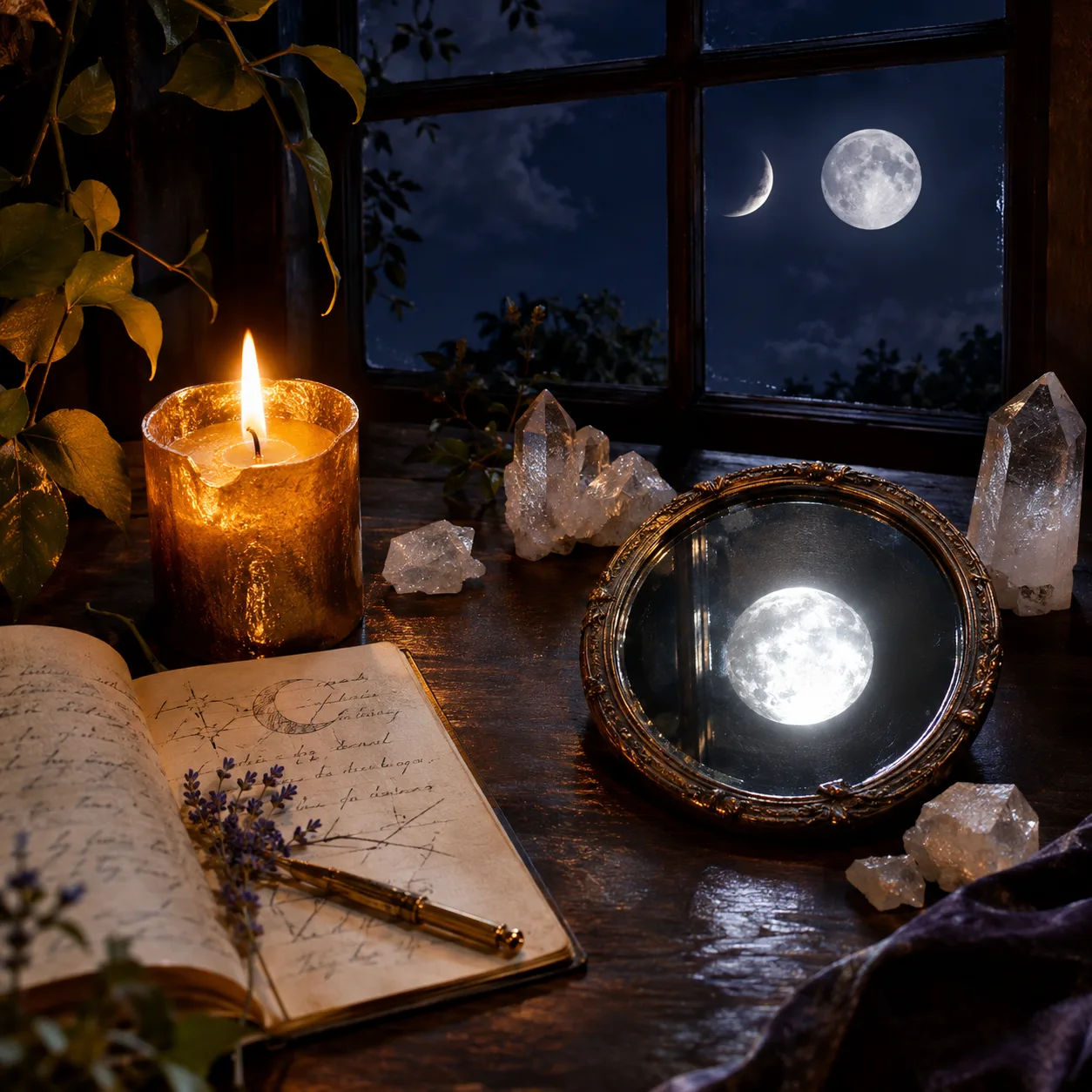
Every lunar cycle moves through two phases of growing light before reaching its peak: waxing and full. People who practice manifestation rituals often ask which of the two is better for making a request, and the short answer is that they are not meant for the same kind of request. The waxing moon is process, the full moon is culmination. Understanding this difference helps avoid the most common mistake beginners make when working with lunar cycles: treating both phases as if they were interchangeable.
This article separates astronomical fact from contemporary symbolic tradition, since the two tend to blend together on this topic. It ends with a practical step-by-step guide to help you decide, in your own routine, whether your goal calls for action (waxing) or harvest (full).
What technically sets the two phases apart
The Moon moves through eight phases in a complete cycle: new, waxing crescent, first quarter, waxing gibbous, full, waning gibbous, last quarter and waning crescent. The new moon happens when it sits between Earth and the Sun, with no illuminated face visible from here; the full moon is the opposite, with the lunar disk on the side facing away from the Sun relative to Earth, fully lit, according to the definition from the Encyclopaedia Britannica.
One point that causes confusion: the waxing phase is not a single moment, it is a process lasting roughly 14.75 days, half of the full synodic month (the cycle from one new moon to the next averages 29.53 days, according to NASA/GSFC's ephemeris site). The full moon, on the other hand, is technically an exact instant: the precise moment when illumination stops increasing and begins to decrease. In practice, people tend to celebrate the whole night as if it were the full moon, but the actual astronomical peak lasts only a few minutes.
This changes how we think about manifestation: asking for something during the waxing phase means committing to a two-week process. Asking during the full moon marks a turning point, a specific moment of clarity or closure.
The symbolic logic behind each phase
No scientific study proves the effectiveness of lunar manifestation rituals, and that needs to be clear from the start. What does exist is a symbolic tradition, consolidated mainly through wellness practices and 20th and 21st century neopaganism, that reads the growth and fullness of moonlight as metaphors for different stages of a personal project.
In this reading, the waxing phase represents building energy, determination and action. It is the time to take the first concrete steps toward a goal, to put visible effort into the world. Some practitioners link this phase to the sign of Aries and the planet Jupiter, precisely because of its emphasis on initiative and expansion. Near the end of the waxing phase, in what is called the waxing gibbous (when the Moon is more than half lit but not yet full), tradition points to fine-tuning: time to refine what has already been planted, correct course and prepare for the peak.
The full moon, in turn, is read as a moment to receive rather than to ask. The core idea is that manifesting at the full moon is less about forming a new wish and more about harvesting what has already been in motion since the previous new moon. It is also the phase most associated with emotional clarity: with everything illuminated, it becomes easier to see what isn't working, which is why it also pairs well with release and review rituals.
This division (waxing for action, full for harvest or release) has a curious historical root: traditional farmers' almanacs used the new and waxing phases as the fertile window for planting, and the full and waning phases as a drier period tied to harvest and rest for the land. The modern manifestation metaphor is essentially a reinterpretation of this old agricultural cycle applied to personal goals.
Comparing the two phases side by side
| Criteria | Waxing Moon | Full Moon |
|---|---|---|
| Position and illumination | Between a quarter and three-quarters of the disk lit, increasing | Disk fully illuminated, Moon opposite the Sun relative to Earth |
| Duration | About 14.75 days (half of the 29.53-day synodic cycle) | Exact astronomical instant, popularly celebrated as a whole night |
| Symbolic association | Growth, building energy, action, determination | Emotional peak, clarity, moment to receive results |
| Suggested practical use | Start projects, take first steps, commit to a plan | Consolidate what's already underway, review, celebrate or release |
| Traditional archetype (neopaganism) | The Maiden: beginnings, youth, optimism | The Mother: fulfillment, stability, fullness |
Step by step: choosing the right phase for your goal
Instead of trying to force any wish into any phase, it helps to think about what stage your goal is actually at. A worked example makes this easier to picture.
- Identify the stage of your goal. Ask yourself: is this a new idea that hasn't left the drawing board, or something you've already been working on for weeks and just needs a final push? Example: you want to start a small business but haven't even picked a name yet.
- If it's a beginning, choose the waxing phase. In this example, the waxing phase is the time to write the plan, pick the name, take the first bureaucratic step. Symbolic tradition recommends using this period for concrete actions, not just vague wishes.
- If it's consolidation, choose the full moon. Suppose that two weeks later, the business already has its registration and first sales. The following full moon is the symbolic moment to acknowledge what worked, adjust what didn't and, if appropriate, celebrate the first visible result.
- Mark the actual dates on your calendar. In January 2026, for example, the new moon falls on January 18 and the full moon on January 3 (still closing out December's cycle); in February, the new moon falls on the 17th and the full moon on the 1st. These times can vary by minutes between calculators depending on the reference time zone, so it's worth checking the exact date for your local time zone with an ephemeris source before planning a ritual.
- Repeat the cycle. Each new lunation restarts the process: what was harvested at the full moon can become a seed for the next waxing phase.
The 2026 lunar calendar, according to timeanddate.com, shows for instance that May of that year has two full moons (May 1 and May 31, a blue moon), which naturally creates two consolidation points within the same month, something that rarely happens.
Where this fits into the rest of the lunar cycle
Waxing and full are just two stops in an eight-phase cycle. For anyone who wants the full picture, including the new moon that precedes the waxing phase and the waning phases that follow the full moon, it's worth reading the article on the meaning of each main lunar phase. And for anyone who has ever felt that some full moon nights feel more intense than others, the article on your natal lunation explains why your personal relationship with the lunar cycle might differ from someone else's, depending on the phase the Moon was in when you were born.
It's worth repeating: none of this replaces real planning, concrete effort, or well-informed decisions about money, health or relationships. This practice works as a symbolic calendar of intention, not a guarantee of results.
Frequently Asked Questions
Waxing or full moon for manifesting?
It depends on what you're manifesting. The waxing phase is better suited for starting something new and taking action toward a goal, while the full moon is more associated with harvesting or reviewing something that's already been in motion since the previous new moon.
Which moon phase is best for making wishes?
Symbolic tradition recommends the new moon and the waxing phase that follows for forming and acting on a new wish. The full moon tends to be used more for acknowledging results than for making new requests.
Can I do a manifestation ritual on the full moon?
Yes, but the focus is usually different: instead of asking for something new, the full moon pairs better with reviewing what's already been planted, celebrating achievements and releasing what no longer serves you.
What should I write during the waxing moon to manifest?
Practitioners usually write specific intentions and concrete actions tied to their goal, since this phase is associated with building energy and determination rather than vague wishes.
What's the difference in meaning between the waxing moon and the full moon?
The waxing moon symbolizes process, growth and action over about two weeks. The full moon is a single peak moment, linked to clarity, culmination and the feeling of receiving something that was already on its way.

Recomendado
Incensário Cascata Refluxo Cerâmica
Efeito cascata hipnotizante A fumaça desce como uma cachoeira, criando um visual relaxante perfeito para momentos de calma e foco
Vanessa Teixeira · Tarot and moon transits · Universo Astral Editorial Team
This article was produced by the Universo Astral editorial team, with AI tools for research and drafting, and went through automated checks of structure, links and sources before going live. If you spot anything inaccurate or outdated, let us know at our contact email.