Tarot Court Cards: Pages, Knights, Queens and Kings
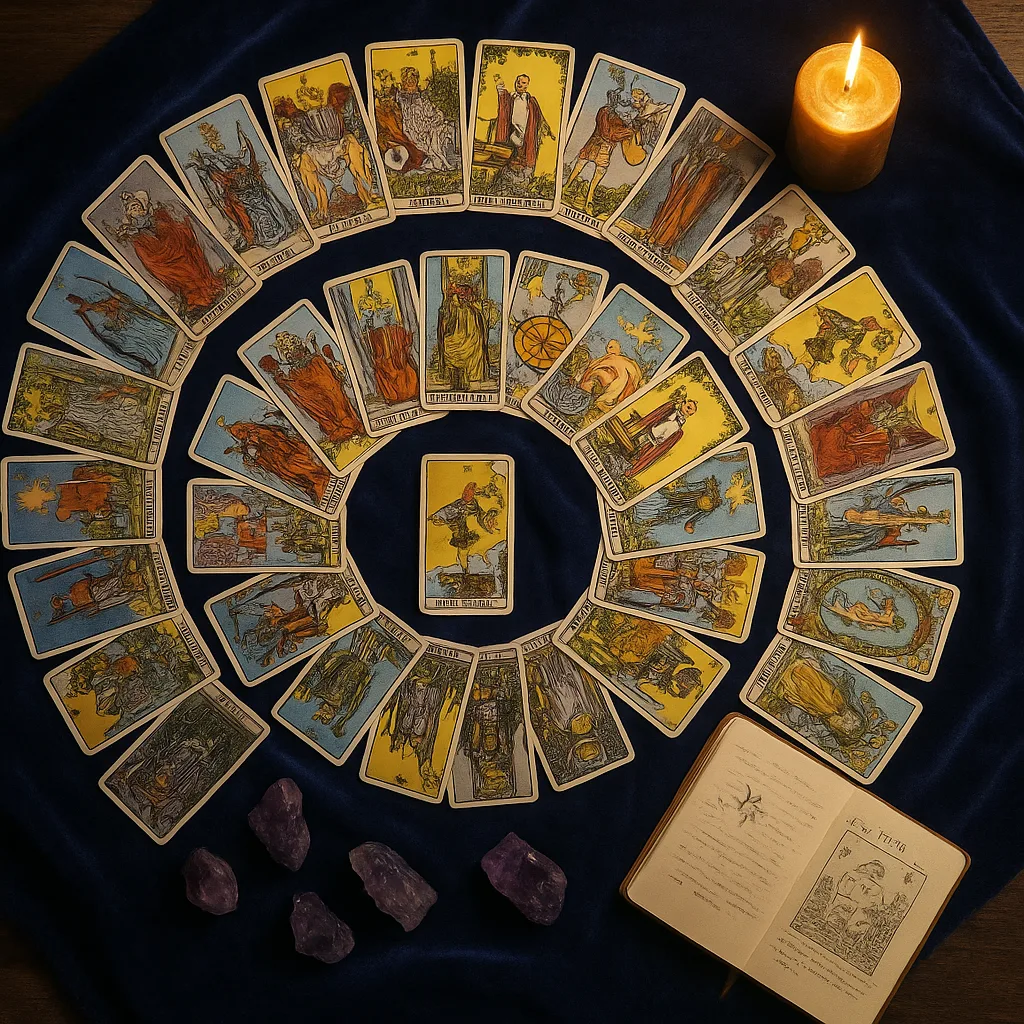
Take any tarot deck and set aside the sixteen cards with human faces: four Pages, four Knights, four Queens and four Kings. Anyone studying tarot on their own often gets stuck right here. After the Major Arcana, it's the court cards where confusion hits hardest, because they don't speak of events or abstract energies, but of people. And people are difficult to sum up in a handbook sentence.
The link between the Major Arcana and the numbers
The court cards are part of the 56 Minor Arcana, divided into four suits (Cups, Swords, Wands and Pentacles), with fourteen cards each: ten numbered cards and four court figures. The function of these figures within the deck is curious: they work as a bridge, an intermediate territory between the broader symbolic language of the Major Arcana and the concrete, sequential language of numbers. Because of this, many tarot readers consider that the energetic weight of a Page, Knight, Queen or King approaches that of an Ace or a 10: they are cards that carry full power, a complete cycle of possibilities within that suit.
It's worth noting that this group of cards usually receives less attention in books and courses than it deserves. It's common to find shallow, almost decorative interpretations, like Queen of Cups is the gentle woman or King of Swords is the authoritarian man, reductions that ignore the historical and symbolic richness of these figures. For those who want to understand how each suit behaves outside the context of the court, it's also worthwhile to see how each tarot suit shows up in daily life.
A family within each suit
An efficient way to mentally organize the sixteen court cards is to imagine them as a family gathered around the same element. In each suit, the Page is the child: curious, still discovering the territory, playing with a possibility without definite commitment. The Knight is the teenager: already moving in a direction, already in motion, taking risks and testing limits to prove something to himself. The Queen is the mother: no longer needs to run, because she sustains, holds and cultivates what she conquered with patience. And the King is the father: the one who has vision of the whole, makes decisions and answers for the consequences, because his mastery over that element is already consolidated.
This progression can also be read as a timeline within a reading. When a Page appears, it usually refers to a recent desire, an idea still in formation, an expectation that hasn't yet taken shape, and the suit indicates the tone of that initial phase. The Knight already represents a more elaborate project, something the person is actively involved in, seeking to advance even without guarantees. The Queen speaks of possession and permanence: what has already been conquered and now needs to be maintained, defended, nurtured. The King, finally, is the stage of full realization: the idea became structure, and there is real power to act upon it.
The table below summarizes this logic of role and stage, crossing what has already been described with the moment in a reading to which each card usually refers:
| Card | Family role | Stage | When it typically appears in a reading |
|---|---|---|---|
| Page | Child | Discovery | Recent desire, idea still in formation |
| Knight | Teenager | Movement | Project in progress, risk taken on |
| Queen | Mother | Permanence | What has already been achieved and needs to be maintained |
| King | Father | Realization | Consolidated structure, real power of action |
Element and role: the dual key to reading
The second layer of meaning for each court card comes from the suit, that is, the element it represents: Cups is water, Swords is air, Wands is fire and Pentacles is earth. By crossing that element with the family role (child, teenager, mother or father), you arrive at very specific personalities.
- Page of Pentacles is the child of earth: learns about the world through the body, through practice, through the concrete, with curiosity turned toward study and manual work.
- Knight of Wands is fire in motion: enthusiasm, impulsivity, willingness to act before thinking twice.
- Queen of Swords is the mother of air: cares through words, through mental clarity, through reason. May indicate a teacher, writer or someone who guides through intellect.
- King of Cups is the father of water: thinks and organizes from emotions, with mature empathy. Profile of a counselor, therapist or figure that welcomes without drowning in their own feeling.
By repeating this exercise for the remaining twelve combinations, it's possible to build a fairly precise map of personalities, whether to identify traits in yourself or to recognize real people who appear in a reading. A complementary guide on what each court position represents beyond the zodiac sign helps deepen this cross-reading.
From knave to page: a historical reversal
There's a curious detail hidden in the name of these cards. In the Waite-Smith tarot, the reference for most modern decks, the old knave was renamed as page. Today, the word page suggests someone subordinate, almost a servant. But in the time of medieval chivalry, being a page was prestigious: a young person of noble birth, sent to serve the lady of a knight precisely to learn, through daily contact, the values and weapons of that craft. Only after growing up and being prepared did the page become a squire, and then a knight.
This origin explains why the Page of tarot should never be read as something minor: it represents active learning, the beginning of a trajectory still to unfold. The Golden Dawn order, at the end of the nineteenth century, attempted to rename the figures as princess, prince, queen and king on horseback, in an attempt to hierarchically reorganize their meaning. Waite absorbed much of the Golden Dawn's influence when creating his deck, but chose to keep the traditional names (Page, Knight, Queen and King), and it was this nomenclature that became popular. The French National Library maintains a digitized collection of historical tarot decks, including examples prior to the Waite-Smith tarot, which allows comparison of how court figures were named and illustrated before the standardization we know today. Curiously, in common playing card decks, not tarot, the old knave became jack in English simply to avoid confusion between the initial letters of king and knave when printed on cards, a purely practical change, with no symbolic weight.
When the court card is you, and when it's someone else
One of the most frequent questions from those beginning to study these cards is: does this figure represent a real person in my life or a part of me? The answer depends on the context of the spread. In many readings, the Knight of Swords that appears in a position of conflict may indeed be someone in the person's surroundings, a rushed colleague, an impulsive ex-partner. But most of the time, especially in spreads for self-knowledge, these cards describe a behavior or stance that the querent themselves is exercising at that moment, even if unconsciously. This interpretation exercise becomes clearer when applied in a concrete spread, like the one described in three-card tarot for better self-knowledge.
Be wary of rigid readings like this card is always a woman or this card is always an older man. It's precisely here that many experienced tarot readers recommend caution: the court figures carry an archetypal role (child, young person, mother, father), not a fixed identity of gender or age. A King of Pentacles can perfectly describe a middle-aged woman who is extremely pragmatic and resourceful; a Queen of Wands can represent a charismatic and magnetic man who leads through enthusiasm.
A contemporary movement worth noting
In recent years, a movement of reassessing gender readings in the court cards has grown among tarot readers and tarot authors. Historically, Queens were automatically associated with femininity, and Kings and Knights with masculinity, a direct reflection of the patriarchal social structures of the time when the decks were created, not necessarily a universal symbolic truth. Many contemporary tarot readers today prefer to interpret these figures in a more neutral way, focusing on the role (mature energy, moving energy, caring energy, decision-making energy) rather than tying each card to a specific body.
This shift in perspective does not erase tradition. It returns to the court cards something that was always there, hidden under layers of custom: the idea that each of these sixteen figures is, above all, a stage of maturity within an element, available for anyone to recognize in themselves, regardless of who they are outside the deck.
Frequently asked questions
What is the difference between Page and Knight in tarot?
The Page represents the child of the suit: an idea, desire or recent learning, still without definite commitment. The Knight is already the teenager in motion, someone actively involved in a project and willing to take risks to advance in it.
Do court cards always represent specific men or women?
Not necessarily. The figures carry an archetypal role (child, young person, mother, father), not a fixed identity of gender or age. A King can describe a pragmatic and resourceful woman, just as a Queen can represent a charismatic man who leads through enthusiasm.
Why did the knave from the common deck become a page in tarot?
In the Waite-Smith tarot, the term page was chosen to reclaim the medieval sense of the word: a young noble who served a knight's lady to learn, in practice, the values of that craft, before becoming a squire and then a knight.
How do you know if the court card represents you or another person?
It depends on the context of the spread. In some readings the figure may indicate someone in the querent's surroundings, but in most cases, especially in spreads for self-knowledge, it describes a behavior that the querent themselves is exercising at that moment.
Is there a logic to organizing the 16 court cards in memory?
Yes: imagining them as a family (child, teenager, mother, father) within each of the four elements (water, air, fire, earth) helps you cross role and suit and arrive at a specific personality for each of the sixteen cards.

Recomendado
Lewtemi Espelho de tarô acrílico tarô
Lewtemi Espelho de tarô acrílico tarô cartão decoração de parede mística presentes de bruxa para mulheres espaço sagrado cartomante espiritualidade astrologia bruxa magos arte decoração
Universo Astral Editorial Team · Tarot and moon transits
This article was produced by the Universo Astral editorial team, with AI tools assisting research and drafting and human review before publication. If you spot anything inaccurate or outdated, let us know at our contact email.