Master Numbers 11, 22, and 33: The Real Weight Behind the Vibration
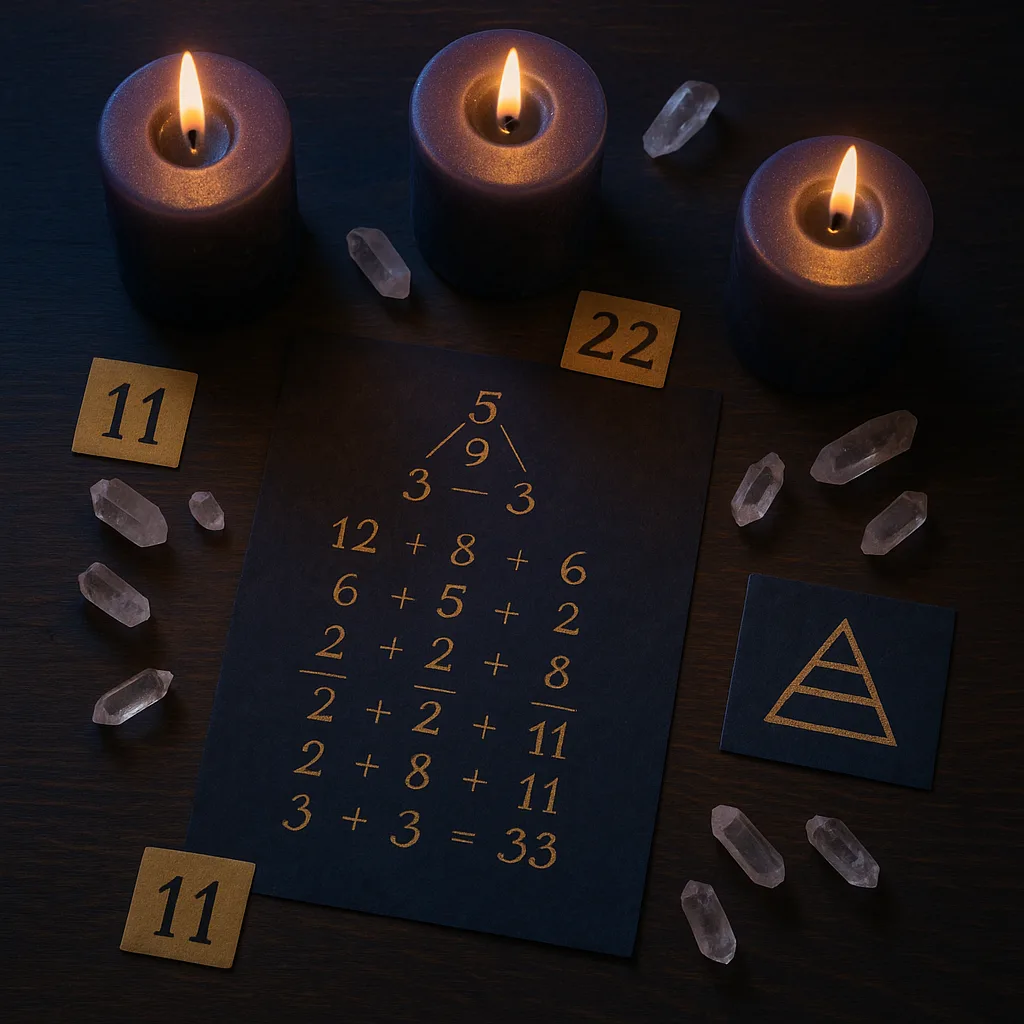
Someone adds up their birth date, arrives at 22, and discovers that numerology tells them to stop there: the number doesn't reduce to 4, it stays exactly as it is, carrying twice the force of 2 plus the value of the sum itself. This exception is what sets the so-called master numbers (11, 22, and 33) apart from all other digits in a numerological chart, and it's worth examining what that difference really means.
The rule that refuses to bend
Almost everything in numerology moves toward simplicity: you add the numbers of a date or name until a single digit remains, from 1 to 9. This reduction process creates the life path number, the expression number, and other pillars of the chart. Yet three results refuse to be simplified: 11, 22, and 33. When they appear before the final reduction, they stay intact.
The most accepted explanation for this exception doesn't rest solely on the repetition of two digits, since 44 and 55 also repeat but aren't part of the traditional master group. What makes 11, 22, and 33 special is the combination of repetition and value: 11 is 1 doubled, 22 is 2 doubled, 33 is 3 doubled. This doubling amplifies the leadership qualities of 1, the partnership of 2, and the expression of 3, creating something that vibrates at two frequencies at once, both the master number and its reduced form. A person with 11 in their chart carries both the intensity of 11 and the sensitivity of 2 (the result of 1+1). This duality is the root of the tension many numerologists point to as typical for those with a master number in their chart. This origin is, in fact, debated among different numerological schools, as shown in the discussion about the controversial origins of master numbers.
Three rungs of the same ladder
One way to understand all three numbers together is to see them as stages of a single creative process, an idea known as the Triangle of Illumination. The 11 sees first: it's the spark, the vision, the intuition that arrives before any concrete plan. The 22 builds: it takes that hazy vision and transforms it into structure, into something tangible. The 33 teaches: it takes what was seen and built and delivers it to the world, in the form of care, guidance, or service.
This sequence (vision, construction, delivery) works almost like a metaphor for mind, matter, and spirit moving together. You don't need all three numbers in your chart to feel this logic: even in isolation, each one carries a fragment of that larger journey. Beyond the life path, these three numbers can also appear in other positions on the chart, as explained in the article about where 11, 22, and 33 can show up elsewhere in your numerological chart.
11: the antenna switched on too high
The 11 is often called the psychic master, and that's not mere figure of speech. People ruled by it tend to catch what's between the lines before they even hear the full sentence, an intuition that works almost like a social and emotional radar. Add to that the natural charisma of the number and you get a form of leadership that's far from conventional: it leads through inspiration, not through force.
The problem is that an antenna this sensitive picks up too much signal. It's not uncommon for the 11 to feel emotionally overwhelmed, absorbing the mood of those around them as if it were their own, or developing anxiety that arises precisely from the difficulty of switching off that sharp perception. The vibration of 2 hiding behind the 11 calls for diplomacy and partnership, and that's where balance lives: turning intuition into a bridge, not into a solitary burden.
22: the dream that insists on becoming brick
If the 11 sees, the 22 builds, hence the nickname master builder. Here the intuition of the 11 meets the practicality of 4 (the result of 2+2), forming someone capable of giving concrete shape to ideas that would remain only on paper in other hands. It's common to associate this number with profiles that unite creativity and execution: architects, political organizers, engineers, community project coordinators, always someone who can turn vision into real foundation.
This power to build comes with a weight to match. The sense of responsibility felt by those carrying the 22 can be crushing, and there are consistent reports of emotional instability tied to this number: sudden shifts in mood or attitude that sweep those nearby along. The challenge of the 22, more than raising something large, is sustaining your own internal structure while building the external one.
33: teaching before you're ready
The 33 is the rarest of the three, and there's a practical reason for it: since no month has 33 days, this number never appears as a birthday, which already naturally limits its frequency in charts. Perhaps because of this, it carries such elevated symbolism: it's called the master teacher, linked to unconditional love and almost overflowing compassion.
People with 33 tend to feel an almost involuntary calling to care for, guide, and teach others, often before they feel ready to do so. There's a natural inclination toward spirituality, service, and the idea that their own presence should somehow make the other person better. The built-in risk in this gift is self-neglect: so much energy directed toward lifting those around you can leave little space for your own care. It's worth noting that not every numerological school treats 33 as a master number in the same way. Some schools only recognize it when it appears clearly in specific calculations, which makes its reading more delicate and less standardized than that of 11 and 22.
The price of a double dose
One point that often gets left out of the more enthusiastic descriptions of master numbers is the wear they impose. Having a master number in your chart isn't gaining a seal of special destiny without cost: it's carrying, at the same time, two layers of demand, the intensity of the master number and the practical requirement of the reduced number living behind it. It's not uncommon for numerologists to describe these people as someone in constant tension between the grand ideals they feel internally and the difficulty of expressing them in ordinary daily life. This heavier side is explored in detail in the article about when 11, 22, or 33 weighs more than it helps.
This explains why so many readings about 11, 22, and 33 talk of anxiety, overload, and instability alongside intuition, construction, and compassion. A master number doesn't promise an easier life. It promises a life with higher potential for meaning, which in practice usually comes with proportional challenges.
The table below summarizes what has been described about each of the three master numbers, bringing together the nickname, doubled vibration, central quality, and typical challenge noted by numerological readings:
| Master number | Nickname | Reduced number behind it | Central quality | Typical challenge |
|---|---|---|---|---|
| 11 | Psychic master | 2 (1+1) | Intuition and charisma | Emotional overload and anxiety |
| 22 | Master builder | 4 (2+2) | Ability to transform vision into concrete structure | Weight of responsibility and mood instability |
| 33 | Master teacher | 6 (3+3) | Compassion and calling to teach or care | Neglecting your own care |
Not every system agrees
Before you take 11, 22, and 33 as closed truth, it's important to know that numerology is not a single block of rules. Some more advanced schools, particularly those connected to Kabbalistic and Tantric numerology, also recognize 44, 55, 66, 77, and even 99 as numbers of elevated potential, treating them as later stages of symbolic evolution. The more widespread tradition, however, continues to limit master numbers to three: 11, 22, and 33.
This disagreement doesn't invalidate any of the readings. It simply reminds you of something true for all numerology: the numbers tell a story, but the system you choose to read them with is part of that story too. The very idea of assigning symbolic meaning to numbers and cycles has ancient roots that intertwine with the history of astrology: the Britannica encyclopedia includes entries on how different ancient cultures developed symbolic systems to organize time, the sky, and destiny, a useful backdrop for understanding why modern numerology also splits into divergent traditions. Before you hold on to a result, it's worth understanding which tradition stands behind the calculation you've made.
Frequently asked questions
Why don't 11, 22, and 33 reduce like other numbers?
Because the numerological tradition recognizes in them a combination of repetition and value that amplifies the qualities of the corresponding reduced number (2, 4, and 6). Other repeated numbers, like 44 and 55, don't receive the same treatment in the more widespread tradition, which shows the exception isn't just about repeating digits.
Does everyone have a master number in their chart?
No. Master numbers only appear when the sum of a date or name results in exactly 11, 22, or 33 before the final reduction. As the article shows, 33 is especially rare because no month has 33 days, which already limits how often it shows up as a birth day number.
Is having a master number always positive?
According to the readings discussed in the text, not necessarily. Alongside the intuition of 11, the constructive capacity of 22, and the compassion of 33 come real challenges: anxiety, overwhelm from responsibility, and self-neglect. The master number amplifies both potential and demand at the same time.
What's the difference between 11, 22, and 33 in practice?
The 11 is linked to vision and intuition (psychic master), the 22 to the ability to turn ideas into concrete structure (master builder), and the 33 to the calling to care for and teach (master teacher). Together, they form the sequence known as the Triangle of Illumination, moving from vision to construction to delivery.
Do all schools of numerology recognize only these three master numbers?
No. The most widespread tradition limits master numbers to 11, 22, and 33, but some schools tied to Kabbalistic and Tantric numerology also treat 44, 55, 66, 77, and 99 as numbers of elevated potential, understood as later stages of symbolic evolution.

Recomendado
Mapa Astral Kármico
Você já sentiu que certos padrões se repetem em sua vida? Relacionamentos que seguem o mesmo roteiro, desafios que parecem voltar ou talentos que surgem naturalmente? Nada disso é por acaso.
Universo Astral Editorial Team · Birth charts and numerology
This article was produced by the Universo Astral editorial team, with AI tools assisting research and drafting and human review before publication. If you spot anything inaccurate or outdated, let us know at our contact email.