I Ching: The Ancient Chinese Oracle and Your First Reading
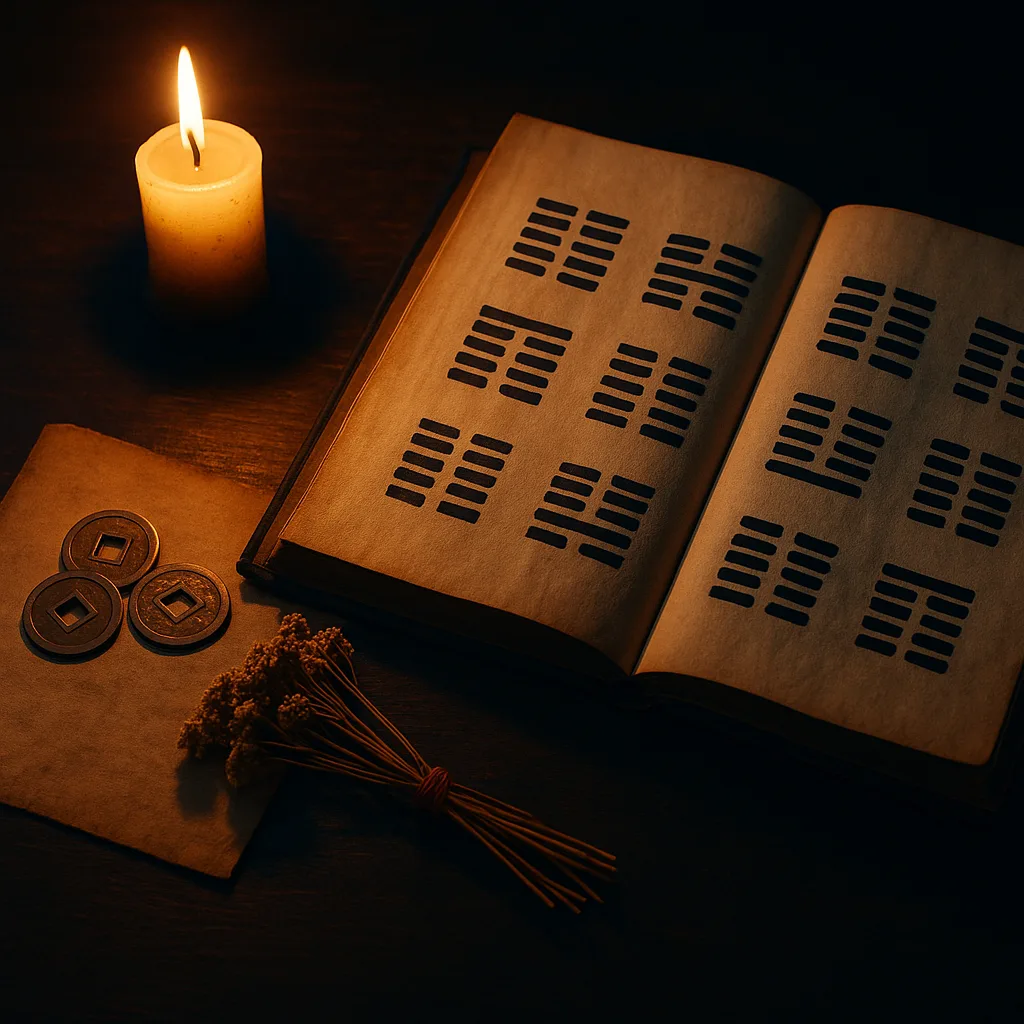
A text spanning nearly three thousand years
The I Ching's origins trace back roughly three thousand years before Christ, when Chinese tradition credits the legendary Emperor Fu Hsi with creating the eight trigrams, the foundational blocks of the entire system. Stories vary by region and era, but they tell of Fu Hsi receiving this knowledge in an almost supernatural manner: symbols seen on a turtle's shell, visions attributed to celestial beings, or versions that lean more symbolic. It's not history in the academic sense, but it functions as a founding myth. The World History Encyclopedia gathers records on ancient Chinese dynasties and helps place this kind of oral tradition within pre-imperial China's timeline.
The decisive shift came much later, during the Shang dynasty between 1766 and 1122 BCE. In that period, King Wen, then a political prisoner, is said to have used his time in confinement to reorganize the eight trigrams into combinations of six lines, the hexagrams. He gave a name to each of the 64 possible results and wrote what we now call the Judgment, a summary of each figure's meaning. His son would later overthrow the Shang and establish the Chou dynasty. It was the Duke of Chou, uncle of the new ruler, who completed the work by writing explanatory texts for each of the six lines across all hexagrams.
Centuries later, Confucius studied the material and produced a set of philosophical commentaries known as the Ten Wings: among them the Tuan Chuan, devoted to the judgments, the Hsiang Chuan, focused on symbolic images, and the Ta Chuan (or Great Treatise), which discusses the cosmological foundations of the system. It was King Wen again, around 1143 BCE, who fixed the order of the 64 hexagrams as it eventually reached modern Western translators like Richard Wilhelm and Alfred Huang. The terms 'trigram' and 'hexagram,' now natural to anyone studying the subject, are not originally Chinese: they were coined by British sinologist James Legge in his translation published by Oxford in 1882.
The name I Ching is usually translated as The Book of Changes, and that translation already reveals the work's spirit: the central theme is not predicting a fixed destiny, but describing how the forces of change move, the interplay between yin and yang, between states that transform into one another without stopping. It is one of the oldest wisdom texts still in use today, having circulated orally through generations before taking written form, a path that resembles other ancient symbolic systems, as shown in the article about the origins of astrology and the peoples who first read the sky.
How hexagrams are built
The complete I Ching system contains 64 hexagrams, each made up of six horizontal lines stacked on top of each other. Each line can be yang, shown as a solid stroke, or yin, shown as a broken stroke in the middle. Traditional reading starts from the bottom up: the line at the base is the first, and the one at the top is the sixth. This order has symbolic meaning, since the hexagram 'grows' from bottom to top, from the beginning of the question to its final unfolding, just as a situation develops over time.
Each hexagram is born from the combination of two trigrams, three-line figures stacked one on top of the other. There are eight possible trigrams, known as Ba Gua, and each corresponds to a force of nature. The table below summarizes the eight trigrams and the elements they represent:
| Trigram | Force of nature | Common position in hexagram |
|---|---|---|
| Heaven | Creative force, upward movement | Can occupy lower or upper trigram |
| Earth | Receptivity, stability | Can occupy lower or upper trigram |
| Water | Danger, depth, flow | Can occupy lower or upper trigram |
| Fire | Clarity, light, visibility | Can occupy lower or upper trigram |
| Wind | Gradual penetration, gentleness | Can occupy lower or upper trigram |
| Lake | Joy, exchange, openness | Can occupy lower or upper trigram |
| Thunder | Sudden movement, awakening | Can occupy lower or upper trigram |
| Mountain | Stillness, limitation, rest | Can occupy lower or upper trigram |
This set of symbols extended beyond divination: it appears in Feng Shui, and some countries incorporated it into their national identity. Vietnam features the Fire trigram on its flag, and South Korea displays four trigrams (Heaven, Water, Earth, and Fire) around the Taegeuk symbol.
A symbolic reading common among contemporary practitioners suggests that the lower trigram of a hexagram speaks to the inner world of whoever consults (feelings, disposition, present state), while the upper trigram represents the external scenario, the situation or challenge faced at the moment of the question. It's not a rule set by classical texts, but it helps those beginning to organize their reading. More advanced practitioners also turn to the nuclear hexagram, formed from the central lines of the original hexagram, an extra layer of meaning hidden within the main figure. Worth knowing, but it can wait until after your first readings. Those already studying other ancient symbol systems, like the Nordic runic alphabet and its historical origins, will recognize a similar logic: layers of meaning that reveal themselves with practice over time, not in the first reading.
Methods of consultation: from yarrow stalks to coins
The oldest way to consult the I Ching is also the most labor-intensive: the yarrow stalk ritual, described in the book's own Great Appendix. The traditional procedure used 50 dried stalks of this plant, considered sacred for its supposed divination properties, one of which was set aside at the start, representing the original unity from which all things spring. The remaining 49 stalks were divided randomly into two piles, and a precise sequence of counting and separation followed, repeated eighteen times until a single line value for the hexagram was obtained. A complete ritual, with all six lines, could take twenty to forty minutes, performed in near-meditative silence. Historically, mastering this technique was the work of court diviners, Taoist monks, and Confucian scholars, people who dedicated their lives to studying the text. In regions where yarrow wasn't found, bamboo stalks took its place, showing that the ritual's essence lay in the gesture and intention, not in the specific material.
There's also a simpler variation using sixteen markers or beads that reproduces the logic of the stalks more quickly and quietly, useful for those wanting to keep something of the original ritual without the time it demands.
But it was a more direct method that brought the I Ching into popular use in the West and remains today the entry point for most practitioners: the three-coin reading.
How to consult the I Ching with three coins
Before tossing any coins, it's worth taking a moment of silence to formulate your question clearly: the I Ching responds better to open, honest questions than to closed yes-or-no ones. Something like 'what do I need to understand about this situation' typically brings richer answers than 'should I or shouldn't I do this.'
- Gather three identical coins and assign a value to heads and tails (traditionally one side is worth 3 and the other 2, but what matters is keeping the same rule from start to finish).
- Toss all three coins together and add up the values. The result will always be 6, 7, 8, or 9.
- Note the line type that corresponds: even numbers (6 and 8) form yin lines, and odd numbers (7 and 9) form yang lines. The values 6 and 9 are 'changing lines,' moments of greater intensity that show where the situation is moving.
- Repeat the toss six times, always recording results from bottom to top, until you've formed all six lines of the hexagram.
- Identify the resulting hexagram using a chart or reference book, and read the Judgment and images tied to that figure. If there are changing lines, also observe the hexagram that emerges from their transformation.
It's a process that typically takes just a few minutes, which explains its popularity: it keeps the oracle's logic alive, chance guided by intention, without requiring the technical training of yarrow stalk methods. Those who enjoy quick, hands-on divination practices may notice similarities with other casting methods, like the step-by-step process described in your first rune reading: methods, spreads, and best practices, which also moves from a simple gesture to a broader symbolic interpretation.
A reading that asks for time, not speed
The I Ching was never meant as a system of ready-made answers. Its texts are intentionally cryptic, almost poetic, meant to be read slowly. It's common to reread the same hexagram days after a consultation and find a layer of meaning that went unnoticed on first reading. Perhaps that explains why the Book of Changes continues to be consulted after so many centuries: it doesn't deliver certainties, but invites deeper thought about the moment when the question was asked.
Frequently asked questions
What's the difference between a trigram and a hexagram?
A trigram is made of three lines, yin or yang, and there are eight possible combinations, called Ba Gua. A hexagram is formed by joining two trigrams, one below and one above, making six lines total, with 64 possible combinations in the complete I Ching system.
Do I need specific coins to consult the I Ching?
No. Any set of three identical coins works, as long as you assign a fixed value to heads and tails (traditionally 3 and 2) and stick with that rule throughout, so the results of 6, 7, 8, and 9 make sense.
What do changing lines mean?
Changing lines are those that add up to 6 or 9 when you toss the coins. They mark a point of greater intensity in the reading and point to where the situation is transforming, creating a second hexagram from the shift in those specific lines.
Is the three-coin method as reliable as the yarrow stalk method?
Both follow the same symbolic logic of blending chance and intention to reach a hexagram, but the stalk ritual, described in the book's own Great Appendix, is longer and more detailed, while the coin method is what popularized the practice in the West for being quicker.
Can any question be asked of the I Ching?
The system tends to respond better to open questions seeking understanding of a situation than to closed yes-or-no questions. Framing your question clearly before tossing the coins usually brings a more useful reading.
Universo Astral Editorial Team · Zodiac signs and fun facts
This article was produced by the Universo Astral editorial team, with AI tools assisting research and drafting and human review before publication. If you spot anything inaccurate or outdated, let us know at our contact email.