Where Do Astrology Myths Come From? The Real Story Behind the 13th Sign, Mercury Retrograde, and the Full Moon
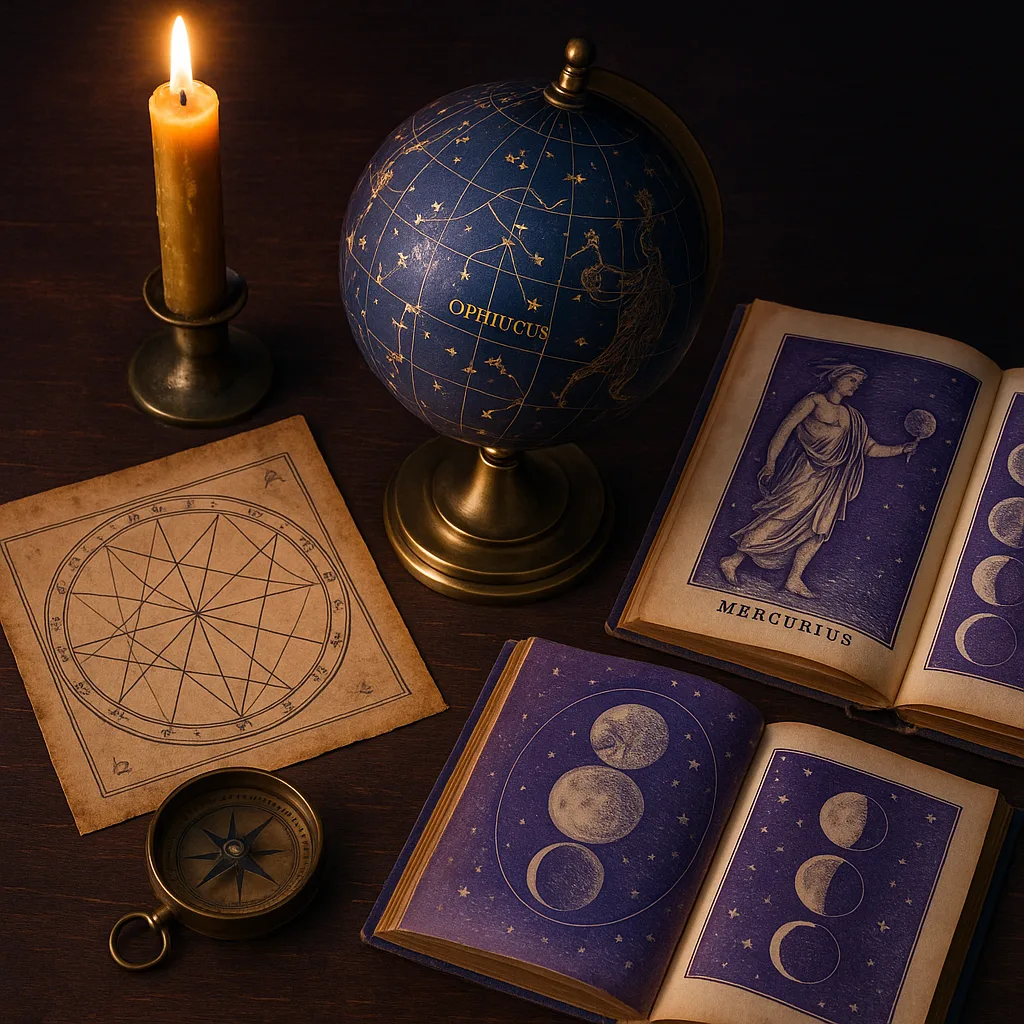
The myths the sky never asked to carry
Any symbolic system as rich as astrology accumulates, over time, a collection of stories that spread more through repetition than accuracy. This isn't about proving something right or wrong. It's about understanding how certain ideas form, gain traction, and become assumptions that almost no one questions. Instead of simply debunking these ideas, this article traces the origins of three of the zodiac's most repeated myths and looks at why they keep resurfacing, cycle after cycle.
The 13th sign no space agency ever announced
Every so often, a story resurfaces online claiming there's a forgotten sign, Ophiuchus, and that some major scientific institution decided to add it to the zodiac. The story has a conspiracy-theory appeal, but its real origin is more down to earth, and much older, than any official announcement.
Ophiuchus is a real constellation, one of thirteen the Sun appears to pass through along its path across the sky. The ancient Babylonians, who first organized this solar path into a symbolic system, knew it existed. Choosing twelve divisions instead of thirteen wasn't an oversight. It was a practical decision, meant to match the zodiac to the twelve lunar cycles of a year. Twelve signs of thirty degrees each made a clean, workable system. Ophiuchus didn't fit that design and was left out by choice, not by accident.
The idea of reviving it as an extra sign didn't come from astronomy. It came from astrology itself. In 1970, author Steven Schmidt proposed in a book that there were actually fourteen signs, including both Ophiuchus and Cetus. In 1995, a British astrologer revived the theory in a book arguing for thirteen signs. The rumor gained more traction in 2011, when statements from an astronomer were repeated out of context by the media, creating the impression that the zodiac had received an official scientific update.
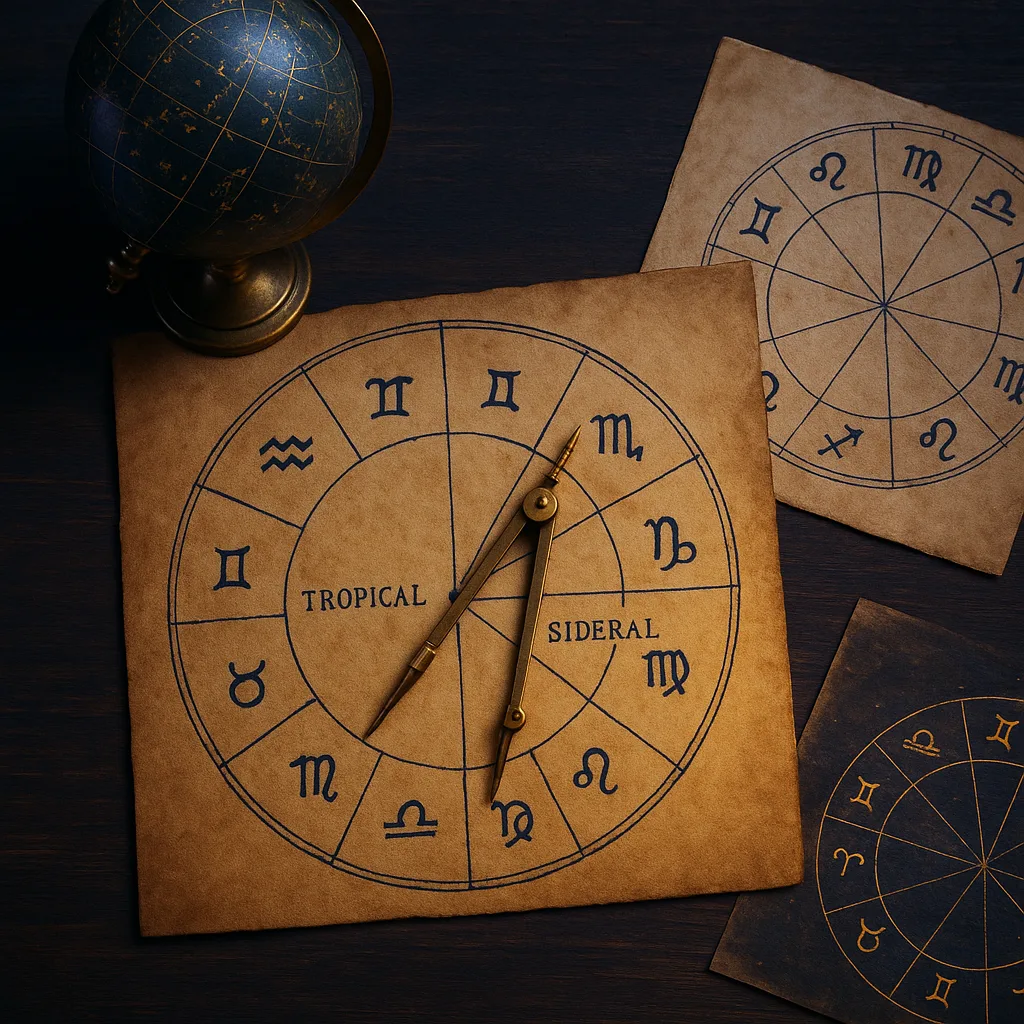
The confusion comes from mixing up two different systems. Astronomy observes real constellations, which have irregular sizes and imprecise boundaries. Astrology works with a symbolic system of twelve fixed-size signs, established by convention thousands of years ago. They are two different maps of the same sky, and one doesn't invalidate the other. They just aren't speaking the same language.
Mercury never actually moves backward, but it sure looks like it
Few astrological phenomena cause as much stir as Mercury retrograde. Every time a new retrograde season begins, warnings start circulating: don't sign contracts, don't send that important message, wait it out. The question is whether planets actually move backward.
The answer is no. No planet in the solar system ever reverses its orbit. What happens is an optical effect: when a planet moves more slowly than Earth at a certain point in its path, that difference in speed creates the illusion, from where we stand, that it's moving backward across the sky. It's similar to watching a slower car from a moving train: for a moment it looks like it's going backward, when it's really just moving slower than you are.
Mercury draws so much attention because, with the shortest orbit and closest position to the Sun, it goes through this effect three to four times a year, each period lasting about three weeks. Other planets go retrograde too: Venus, Mars, Jupiter, and the rest all have their own cycles, usually spaced further apart and lasting longer the farther they are from the Sun. Mercury just gets talked about the most because it happens so often on the calendar.
The link to communication comes from mythology. Mercury was the messenger of the gods, the planet associated with words, contracts, and travel. The wariness around this movement isn't a modern invention: records show that as far back as the mid-18th century, British farming almanacs tracked this phenomenon to decide planting times, blending practical astronomical observation with a symbolic reading of timing.
There's no evidence that the apparent motion of planets directly affects human affairs. What does exist is a symbolic tradition within astrology that reads these periods as invitations to review and reflect, not necessarily as omens of disaster. A less fatalistic view has become common among contemporary astrologers: Mercury retrograde as a pause to reread what was said and revisit what was agreed upon, not a verdict that everything is doomed to go wrong.
The full moon and the myth science never confirmed
If there's one celestial phenomenon that carries almost mythological weight in popular culture, it's the full moon. The belief that it makes people more restless, sleepless, or even aggressive is old enough to have given rise to the word lunatic, used for centuries to describe behavior seen as out of the ordinary.
When researchers examined this connection rigorously, the so-called lunar effect didn't hold up. Multiple large-scale reviews of studies found no consistent statistical link between moon phases and human behavior. One example comes from a study conducted in Canada, which followed nearly six thousand children and found no meaningful impact of the lunar phase on behavior or sleep quality, with one small exception: a roughly five-minute reduction in sleep time during the full moon, equal to about 1% of the night. That's hardly enough to support the idea of turbulent nights caused by the moon.
The belief persists generation after generation for a reason tied to a well-known cognitive bias: people tend to notice and remember, more vividly, the moments that confirm what they already expected. If someone believes the full moon brings restless nights, they will notice and remember exactly the nights when that happened, while forgetting the many calm full moons that passed without incident.
There's also a subtler point: even without any proven physical mechanism, the cultural expectation that the full moon heightens emotions can genuinely influence the mood of people who believe in it. It isn't the moon pulling at the tides of human behavior. It's the psychological effect of belief itself, real, even if not gravitational.
Why we keep believing, even when we know the truth
The more useful part of this isn't proving the myths wrong, but understanding why they make sense to people in the first place. Stories like the 13th sign, Mercury seeming to move backward, and the moon seeming to stir emotions share a narrative quality: they give a name to vague feelings, explain hard days, and create a shared script for the unexplainable.
Astrology, at its most useful, never claimed to be an exact science. It works in a different territory, that of symbolic language and metaphor that helps organize human experience. The problem isn't using the sky as a mirror for self-knowledge. It's turning poorly told rumors into absolute truths, whether dressed up as science or as astrology.
Knowing where a myth comes from doesn't strip the sky of its meaning. It restores something more valuable: the curiosity of looking at the stars to understand, not just to fear.
Next time someone brings up a secret sign, a villainous planet, or a maddening moon, the more useful response isn't just correcting the facts. It's asking, with the same curiosity ancient sky-watchers had, where the story came from and what it reveals about the human search for meaning in what we can't control.

Recomendado
Manual Prático da Astrologia
O universo sempre exerceu um fascínio indescritível sobre a humanidade. De todas as suas maravilhas, a astrologia se destaca como uma antiga arte que tem intrigado e inspirado gerações.

Recomendado
Astrologia, Simbolismo e Mapa das Personalidades
A astrologia acompanha a humanidade desde as primeiras grandes civilizações. A ideia de que a vida biológica na Terra pode ser influenciada pelos astros gerou e gera grande fascínio no homem.

Recomendado
Curso MAPA ASTRAL
CURSO DESTRAVE SUA VIDA COM MAPA ASTRAL EM ATÉ 08 SEMANAS!
Universo Astral Editorial Team · Zodiac signs and fun facts
This article was produced by the Universo Astral editorial team, with AI tools assisting research and drafting and human review before publication. If you spot anything inaccurate or outdated, let us know at our contact email.